
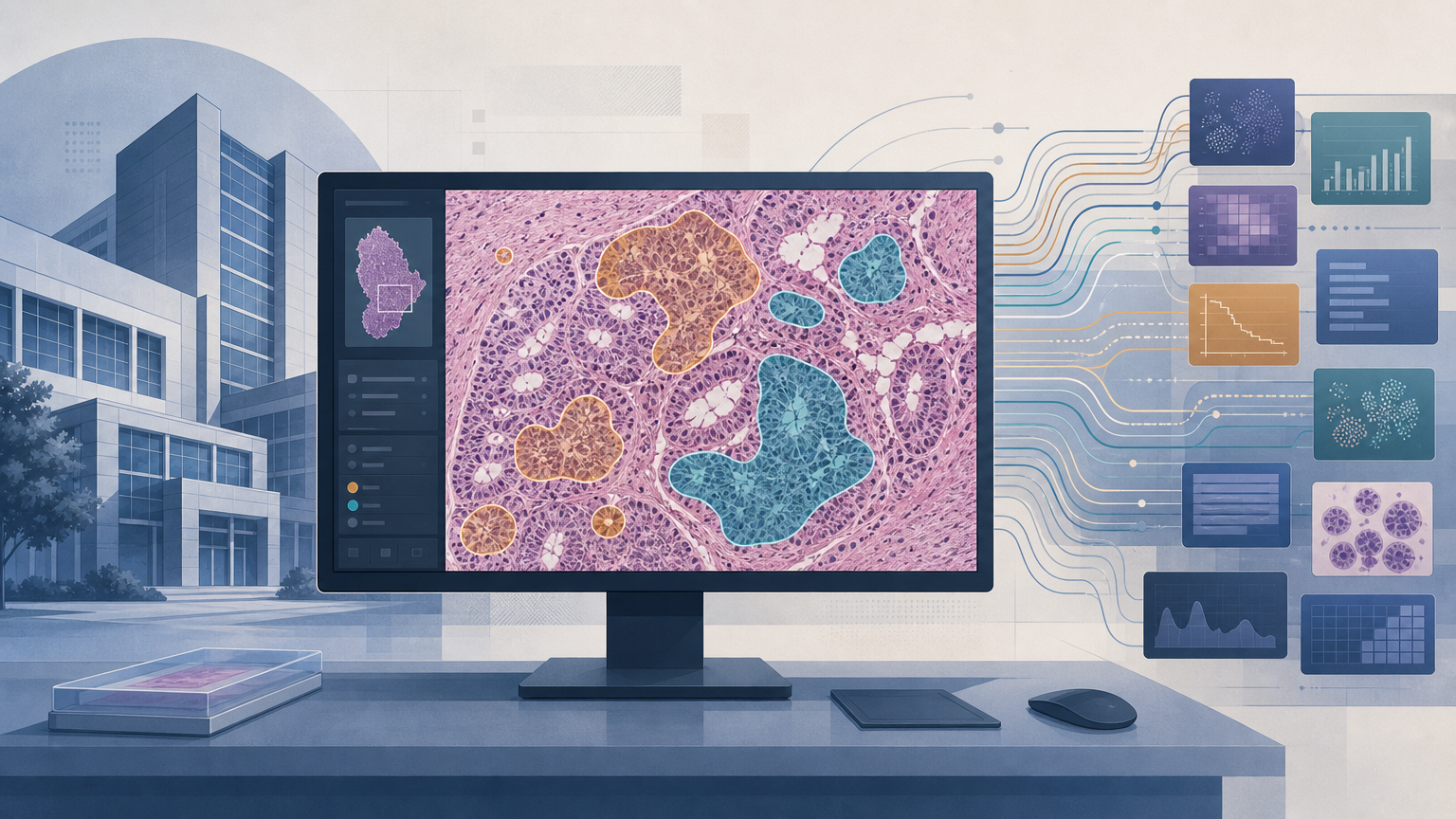
 Paige Computational Pathology Platform (Prostate, Breast, GI, PanCancer Suites; Virchow / PRISM foundation models)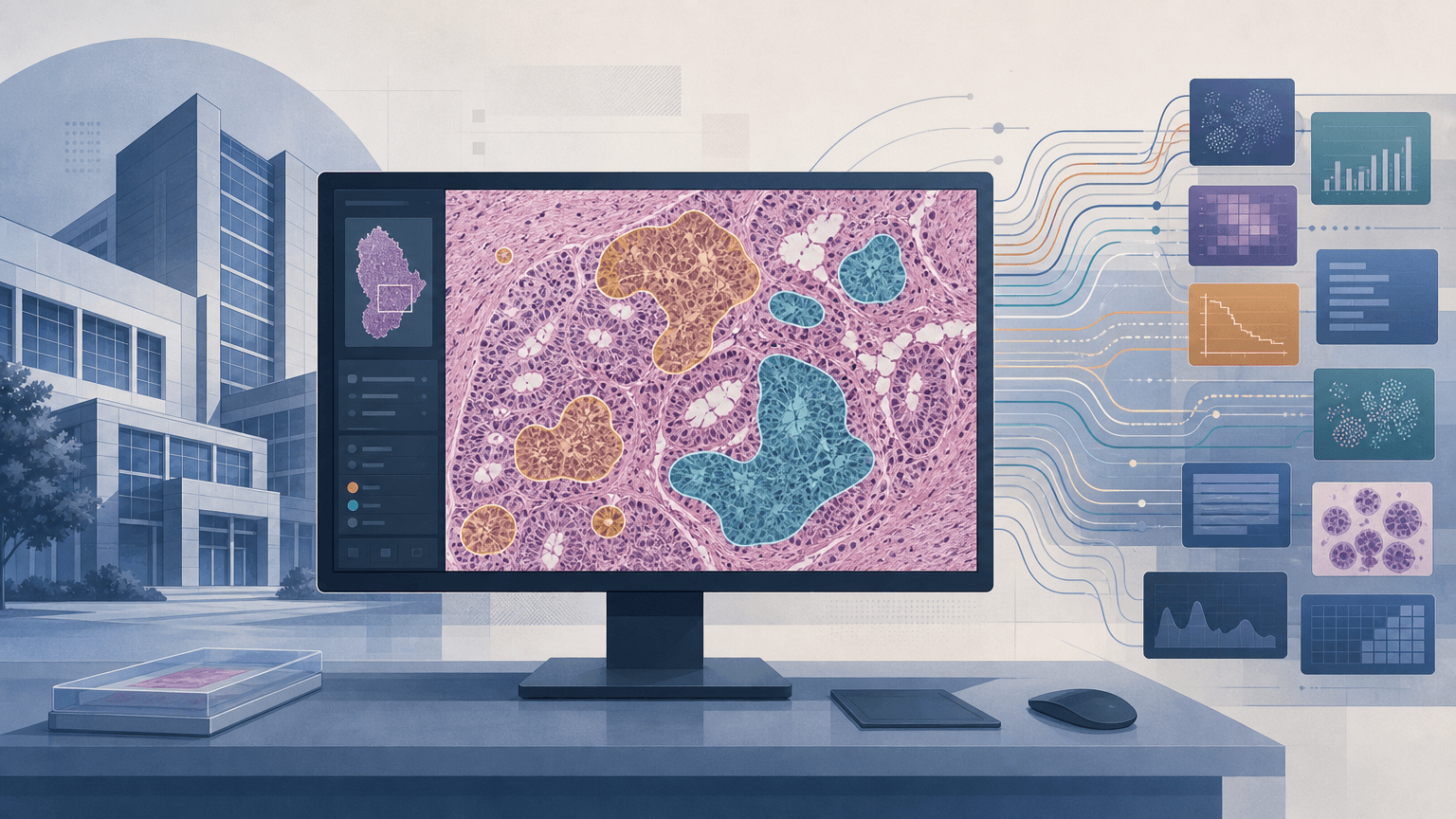
Company Snapshot
Paige AI is a computational pathology company that develops AI-powered diagnostic tools and foundation models for cancer detection, biomarker analysis, and pathology workflow integration. The company spun out of Memorial Sloan Kettering Cancer Center (MSK) in 2017, publicly launched and announced its first funding in February 2018, and operated as an independent entity until August 2025, when it was acquired by Tempus AI in an $81.25 million deal. Paige now operates as a subsidiary of Tempus, with its products and foundation models continuing under the Paige brand.
| Field | Detail |
|---|---|
| Legal Name | Paige.AI, Inc. |
| Headquarters | New York, NY |
| Spinout Year | 2017 (incorporation); February 2018 (public launch and Series A) |
| Primary Domain | Computational pathology — cancer detection, grading, biomarker prediction |
| Current Status | Subsidiary of Tempus AI (acquired August 2025) |
| FDA-Authorized Products | 1 (Paige Prostate Detect, De Novo DEN200080, authorized September 21, 2021) |
| Foundation Models | Virchow, Virchow2, Virchow2G, Virchow2G-Mini, PRISM, PRISM2 |
| Disclosed Funding (verified floor) | More than $220 million raised by 2021 |
Origins and the MSK Exclusive License
Paige was conceived inside MSK around 2015 by two co-founders with complementary institutional standing. Dr. Thomas Fuchs, director of MSK's computational pathology laboratory and widely described as the "father of computational pathology," brought a background that included algorithm development for NASA's Mars Rover program. Dr. David Klimstra, then chair of MSK's pathology department, brought decades of clinical and diagnostic expertise. Both retained their MSK roles while building the company.
In February 2018, Paige emerged from stealth with a $25 million Series A led by Jim Breyer of Breyer Capital and an exclusive license to MSK's archive of 25 million pathology slides along with MSK's computational pathology intellectual property. MSK received approximately 9% equity in the company as part of the license arrangement rather than as a cash investor. Klimstra, Fuchs, and Norman Selby — an MSK board executive committee member who became Paige's chairman — each received equity stakes.
The arrangement drew sustained scrutiny. A ProPublica investigation and a subsequent Congressional inquiry raised several overlapping concerns: whether MSK had complied with federal and state nonprofit law given that the institution did not seek an independent valuation of the tissue archive and did not put the proposal out for competitive bidding; whether the exclusive licensing of decades of pathology expertise to a for-profit startup was appropriate without consent or credit to the pathologists whose diagnostic work had built the archive; and whether patient data privacy protections were adequate.
"They did not seek an independent valuation of the tissue archive, nor did they put the proposal out for competitive bidding."
MSK pathologists formally objected to the deal, arguing that the exclusive commercialization of their accumulated expertise — built over more than 60 years — without their participation or recognition was fundamentally unfair. Richard Beattie, MSK's honorary board chairman, acknowledged the institution's position directly: "We were desperate... This is more risky than most transactions, and we couldn't find investors." Klimstra subsequently announced he would divest his ownership stake in the company.
Platform Architecture
Paige structures its platform into three functional layers that serve different buyer segments and use cases.
- Diagnostic & Biomarker AI Applications: Tissue-based AI tools for clinical pathology workflows, covering cancer detection, grading, quantification, perineural invasion assessment, and molecular biomarker prediction. These are the products with FDA and CE regulatory authorization. Compatible with any slide scanner and laboratory information system (LIS), with cloud storage compliant with HIPAA and GDPR.
- AI Technology & Services: Foundation model licensing to pharmaceutical companies and AI developers for drug discovery, clinical trial support, and downstream model development. This layer monetizes Paige's foundation model portfolio (Virchow, PRISM) outside the clinical diagnostics channel.
- Paige Alba Co-Pilot: A multimodal agentic co-pilot integrating the diagnostic AI and foundation model layers. Currently in beta; not commercially available. Described in more detail in the Paige Alba section below.
Diagnostic AI Product Suite
Paige's clinical product portfolio spans four organ-system suites. Regulatory status and scanner compatibility differ materially across suites and individual products.
| Suite | Products | FDA Status | CE/UKCA Status | Scanner Compatibility |
|---|---|---|---|---|
| Paige Prostate Suite | Detect, Grade & Quantify, Perineural Invasion, Biomarker Panel | De Novo authorized (DEN200080, September 21, 2021) — Prostate Detect only | CE-IVD and UKCA marks | Philips UltraScan (FDA); Leica Aperio AT2 and Philips UltraScan (CE/UKCA) |
| Paige Breast Suite | Detect, Lymph Node, and additional modules | Breakthrough Device Designation for Lymph Node (October 2023); no FDA clearance confirmed as of Q2 2026 | CE-IVD and UKCA marks | Leica Aperio AT2 and GT450 |
| Paige GI Suite | Detection and classification across full GI tract | No FDA clearance confirmed as of Q2 2026 | Not confirmed in available sources | Not specified in available sources |
| Paige PanCancer Suite | Multi-tissue rare cancer detection and classification | No FDA clearance confirmed as of Q2 2026 | Not confirmed in available sources | Not specified in available sources |
Paige Prostate Suite
Paige Prostate Detect received FDA De Novo authorization on September 21, 2021 (submission number DEN200080), making it the first AI device authorized in computational pathology. The authorization established the QPN product code, which has since served as the predicate device for subsequent 510(k) clearances in the specialty. The FDA-authorized version is specifically cleared for use with the Philips UltraScan scanner.
The CE-IVD and UKCA marks extend compatibility to the Leica Aperio AT2 scanner in addition to the Philips UltraScan. Pricing as documented in the CADTH Horizon Scan starts at a minimum of £1 per case plus a one-time LIS integration fee of approximately £15,000.
Paige Breast Suite
The Breast Suite carries CE-IVD and UKCA marks with compatibility for the Leica Aperio AT2 and GT450 scanners. The Paige Lymph Node product within this suite received FDA Breakthrough Device Designation in October 2023 — a designation that expedites FDA review and reflects the agency's assessment that the device addresses an unmet need, but does not constitute market authorization. No FDA clearance or authorization for any Breast Suite product has been confirmed in available public sources as of Q2 2026.
Paige GI Suite and Paige PanCancer Suite
The GI Suite is described as Paige's newest product portfolio, built on the company's latest foundation model technology and covering detection and classification across the full gastrointestinal tract. The PanCancer Suite is described as trained on the Virchow foundation model and cumulatively trained on more than 1.5 million slides, targeting subtle cancer complexities across multiple tissue types including rare cancers. Neither suite has confirmed FDA authorization in available public sources as of Q2 2026.
Foundation Model Stack
Paige has developed and published a chronological series of foundation models that underpin both its clinical products and its AI Technology & Services licensing business. The progression moves from tile-level feature extraction toward slide-level multimodal inference.
Virchow (2024)
Published in Nature Medicine in July 2024, Virchow is a 632-million-parameter Vision Transformer (ViT-H) architecture trained on 1,488,550 hematoxylin and eosin (H&E) whole-slide images (WSIs) from approximately 119,629 MSK patients. Training used DINOv2 self-supervised learning, with no labeled annotations required during pretraining.
| Model | Pan-Cancer AUC | Prostate AUC | Breast AUC |
|---|---|---|---|
| Virchow (pan-cancer model) | 0.950 | 0.980 | 0.985 |
| Paige Prostate Detect (specialist) | — | 0.995 | — |
| Paige Breast (specialist) | — | — | 0.992 |
| UNI (baseline) | 0.940 | — | — |
| Phikon (baseline) | 0.932 | — | — |
| CTransPath (baseline) | 0.907 | — | — |
Virchow2 and Virchow2G
Virchow2 and Virchow2G are second-generation tile-level foundation models building on the original Virchow architecture. Virchow2G-Mini is a smaller-parameter variant in the same family. These models underpin the Paige GI Suite and PanCancer Suite and are available for licensing through the AI Technology & Services layer. Detailed peer-reviewed benchmark publications for Virchow2 and Virchow2G are not represented in the confirmed sources available for this profile.
PRISM and PRISM2 (2025)
PRISM2, released in July 2025, represents a substantive architectural shift from the Virchow family. Where Virchow produces tile-level embeddings, PRISM2 operates at the slide level — processing entire WSIs with their paired clinical pathology reports as training signal. The model was trained on more than 2.3 million H&E WSIs, each paired with its corresponding clinical report, and was developed in collaboration with Microsoft Research.
PRISM2 includes a version integrated with Microsoft Phi-3, enabling LLM-compatible multimodal deployment. This allows the model to receive natural language queries and return clinician-aligned narrative outputs — a capability the tile-level Virchow models do not support natively. According to Paige's press release, PRISM2 outperforms its predecessor and other slide-level models across diagnostic and biomarker prediction tasks, with strong zero-shot performance on tumor detection and clinician-aligned report generation.
Paige Alba Co-Pilot
Paige Alba is described as a multimodal co-pilot that integrates PRISM2 for agentic pathology workflows. Intended capabilities include AI-assisted case triage, structured case review, and multimodal decision support accessible via voice and text interaction. The system is designed to surface relevant diagnostic AI outputs and foundation model inferences within the pathologist's review workflow rather than requiring separate tool access.
Clinical Evidence Summary
Published clinical evidence for Paige's products is concentrated in the Prostate Suite, which has the most extensive documented study record as the only FDA-authorized product. Evidence for other suites is limited in publicly available sources.
Paige Prostate: What the Evidence Shows
The CADTH Horizon Scan (2024) identified five retrospective studies evaluating Paige Prostate's diagnostic performance. As a standalone tool, sensitivity ranged from 96% to 99.2% and specificity from 93% to 98% at the WSI level. Assisted review — pathologists reviewing cases with AI support — increased sensitivity by 2.9 to 16 percentage points compared to unassisted review. In one study, pathologists using AI requested significantly fewer immunohistochemistry stains and second opinions.
| Metric | Range Across Studies | Study Design | External Validation |
|---|---|---|---|
| Sensitivity (standalone AI) | 96% – 99.2% | Retrospective WSI-level | No prospective multicenter RCT |
| Specificity (standalone AI) | 93% – 98% | Retrospective WSI-level | No prospective multicenter RCT |
| Sensitivity gain (AI-assisted) | +2.9% to +16% | Retrospective assisted review | Limited |
| Training data demographics | 82.2% white patients (FDA report) | Single-center training data | Not representative of all populations |
Key Partnerships
- Microsoft Research: Collaboration on foundation model development, including PRISM2 and the Phi-3 integration enabling LLM-compatible multimodal deployment. Paige's cloud infrastructure runs on Microsoft Azure; Tempus assumed Paige's Azure cloud commitment as part of the acquisition.
- Philips: Scanner compatibility partnership enabling Paige Prostate Detect's FDA-authorized deployment with the Philips UltraScan. The Philips UltraScan is the only scanner for which the FDA authorization applies.
- Quest Diagnostics: Confirmed strategic partnership. Specific scope of clinical deployment or integration details are not fully described in available public sources.
- Breast International Group (BIG): Confirmed partnership for breast cancer AI research and clinical application. Specific trial or deployment scope not detailed in confirmed sources.
Funding History and Business Model
Paige raised $25 million in a Series A announced in February 2018, led by Jim Breyer of Breyer Capital. The company subsequently raised additional rounds through Series C. The confirmed verified floor from MedTech Dive reporting is that Paige had raised "more than $220 million" by 2021. A figure of $241 million circulates in industry commentary attributed to LinkedIn analysis, but this has not been verified against SEC filings or primary press release sources and should be treated as unconfirmed.
| Round | Date | Amount | Lead Investor | Source |
|---|---|---|---|---|
| Series A | February 2018 | $25 million | Breyer Capital (Jim Breyer) | TechCrunch (confirmed) |
| Series B / C | 2019–2021 | Not individually confirmed in available sources | Not confirmed | — |
| Total raised (verified floor) | Through 2021 | More than $220 million | — | MedTech Dive (confirmed) |
| Total raised (unverified) | — | ~$241 million | — | LinkedIn commentary (unverified against filings) |
The business model for clinical products uses subscription pricing. As documented in the CADTH Horizon Scan, pricing for Paige Prostate starts at a minimum of £1 per case with a one-time LIS integration fee of approximately £15,000. Pricing for other suites is not confirmed in available public sources. The AI Technology & Services layer generates revenue through foundation model licensing to pharmaceutical and developer partners.
August 2025 Tempus Acquisition
Tempus AI acquired Paige in August 2025 for $81.25 million. The deal was paid predominantly in Tempus stock, with Tempus also assuming Paige's remaining Microsoft Azure cloud commitment. The acquisition price represents less than 40% of Paige's publicly disclosed funding total.
From Tempus's perspective, the acquisition brought three primary assets: nearly 7 million digitized pathology slides and associated data from 45 countries spanning diverse genders, races, ethnicities, and geographic regions; clinical data licensed from MSK; and Paige's foundation model capabilities in computational pathology. Tempus CEO Eric Lefkofsky stated the acquisition "substantially accelerates" Tempus's effort to build the largest oncology foundation model.
Following the acquisition, Tempus launched Paige Predict as the first integrated biomarker prediction product from the combined entity. Paige CEO Razik Yousfi characterized the combination as enabling Paige to "bring our innovations to a broader patient population."
Industry Context: What Paige's Valuation Outcome Signals
The gap between Paige's disclosed funding and its acquisition price is a documented data point with implications for how procurement teams and investors assess the standalone commercial viability of regulated computational pathology AI.
Paige raised more than $220 million across multiple rounds, secured the first FDA authorization in computational pathology, published peer-reviewed foundation model research in Nature Medicine, and built a product portfolio spanning four organ-system suites. It was acquired for $81.25 million — less than 40% of disclosed prior funding, paid predominantly in acquirer stock rather than cash.
This outcome does not indicate product failure. It indicates that the commercial pathway for a standalone company building regulated AI diagnostic tools in pathology — with the associated cost of FDA authorization, clinical evidence generation, LIS integration, and scanner partnership development — proved difficult to sustain at a scale that would return capital to investors at or above the funding total.
More broadly, Paige's arc illustrates a pattern visible across the computational pathology sector: the technical capability to build high-performing AI diagnostic tools has outpaced the commercial infrastructure — reimbursement pathways, scanner ecosystem standardization, LIS integration standards, and clinical workflow adoption — needed to sustain independent companies at scale. Acquisition by larger oncology data platforms may be the dominant exit pathway for the foreseeable future.
Comments
Join the discussion with an anonymous comment.