
The Correction Decision: When Detected Drift Requires Action
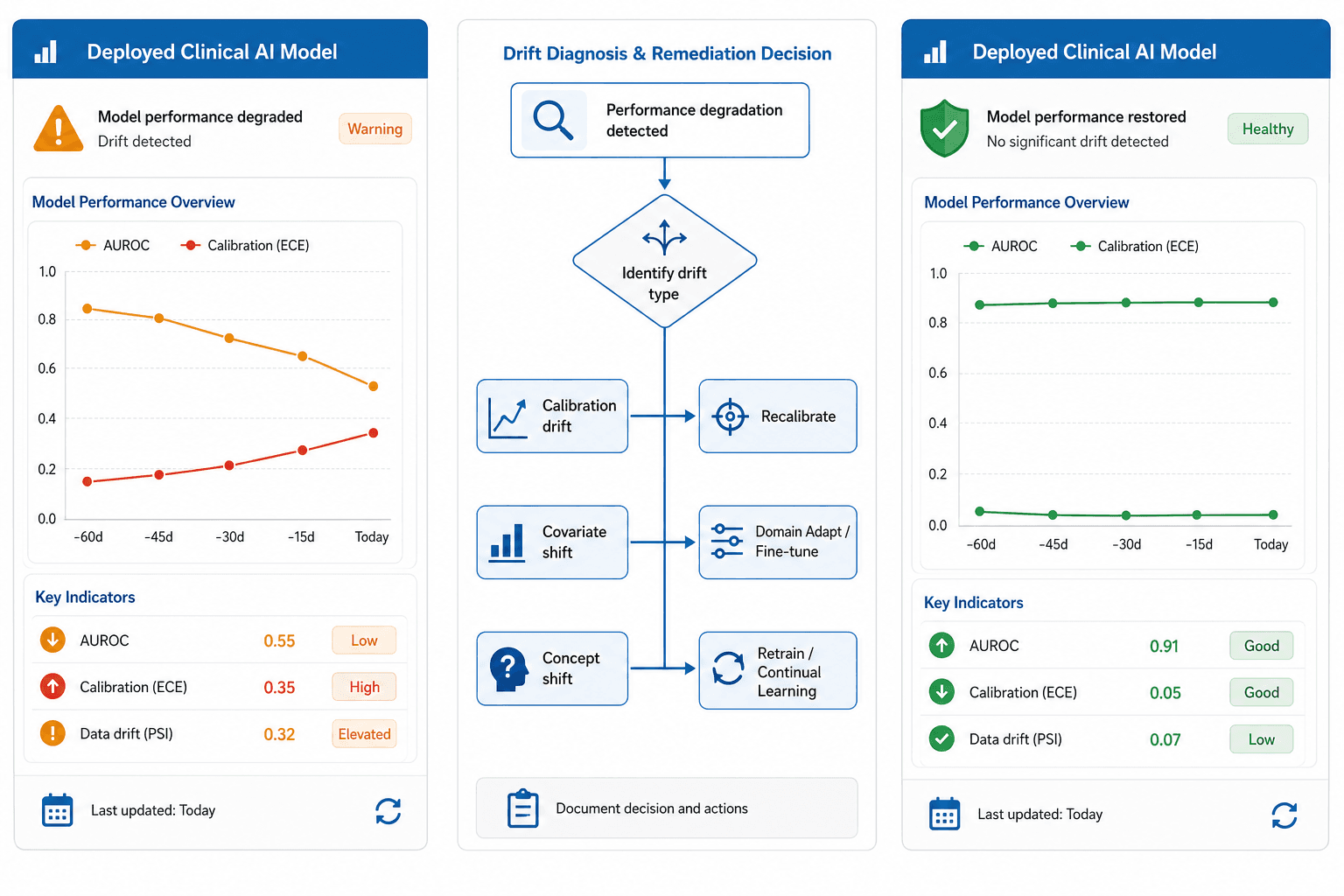
Detecting drift and deciding to correct it are two separate thresholds. A monitoring alert is not an automatic mandate to retrain. The appropriate response depends on which performance dimension has degraded and by how much.
The most clinically consequential distinction is between discriminative performance and calibration. Discriminative performance — measured by AUROC — reflects whether a model correctly ranks high-risk patients above low-risk ones. Calibration reflects whether the model's predicted probabilities correspond to observed outcome rates. These two dimensions can degrade independently, and the correction strategy differs substantially depending on which has failed.
Evidence from AKI prediction models tracked over nine years shows that AUROC can remain stable while calibration degrades significantly. In that scenario, a model continues to rank patients correctly but assigns systematically wrong risk probabilities — a patient it labels as 30% risk may actually be at 55% risk. This degrades clinical utility without triggering standard performance alarms based on discrimination alone. The correction required is recalibration, not retraining. See the clinical AI model evaluation metrics reference for the technical distinction between AUROC and calibration metrics.
When both discrimination and calibration have degraded, or when the underlying relationship between input features and outcomes has shifted — concept drift — the correction threshold is higher and may require fine-tuning, full retraining, or a continual learning update. Watchful monitoring without correction is appropriate when drift signals are within pre-specified control limits and the performance degradation has not crossed the clinical impact threshold established in the institutional monitoring program.
Taxonomy of Correction Strategies
Five correction strategies apply to different drift types in deployed clinical AI. Each carries distinct data requirements, operational costs, and patient safety implications. Selecting the wrong strategy for the observed drift type is as problematic as ignoring drift entirely.
| Strategy | Drift Type Addressed | Label Requirement | Operational Cost | Primary Clinical Risk |
|---|---|---|---|---|
| Recalibration | Calibration drift (stable AUROC) | Low — some approaches label-free | Low | Overcorrection if calibration shift is transient |
| Fine-tuning / Transfer Learning | Covariate shift (cross-site, demographic) | Moderate — small labeled target sample | Moderate | Overfitting to small target dataset |
| Full Retraining | Concept drift, major distributional shift | High — fully labeled recent + historical data | High | False positive rate increase if historical data excluded |
| Continual Learning | Ongoing temporal shift | Low to moderate — adapts incrementally | Low to moderate | Catastrophic forgetting of rare conditions or subpopulations |
| Domain Adaptation | Covariate shift without target labels | None required from target environment | Moderate | Distributional alignment failure if domains are too dissimilar |
Recalibration: Correcting Probability Misalignment Without Retraining
Recalibration is the preferred first-line correction when a model's discriminative performance remains intact but its predicted probabilities no longer reflect observed outcome rates. Rather than modifying the underlying model structure, recalibration adjusts the model's outputs to re-align probability estimates with the current patient population.
Three update approaches are used in practice:
- Simple coefficient updating adjusts the intercept and slope of the model's output transformation. This is computationally lightweight and can be applied with relatively small post-deployment samples. It corrects for systematic over- or under-prediction introduced by prevalence shifts.
- Meta-model updating combines the existing model's output with a secondary model trained on recent deployment data. This approach accommodates more complex calibration shifts while preserving the primary model's validated discriminative structure.
- Dynamic updating applies continual refinement as new data arrive, updating calibration parameters on a rolling basis. Evidence from cardiac surgery models shows that adaptive calibration updates improve reliability in clinical settings under this approach.
A practical advantage of recalibration over retraining is that some approaches can detect and correct calibration shift without requiring outcome labels from the deployment environment. Label-free calibration shift correction uses cohort-level feature distributions to identify when the model's output distribution has diverged from the training population's pattern, enabling correction even when downstream clinical outcomes are not yet available.
The Label Availability Problem in Clinical Drift Correction
Correcting drift in clinical AI is considerably harder than in most other ML domains because the ground-truth labels needed to evaluate and retrain models are often delayed, expensive to obtain, or structurally unavailable at the time the correction decision must be made.
For clinical prediction tasks — mortality, AKI, sepsis, readmission — the outcome of interest may not be recorded for days, weeks, or months after the model generates its prediction. A model flagging sepsis risk at admission will not have confirmed sepsis diagnoses available immediately for monitoring or retraining purposes. This temporal gap between inference and label availability creates two compounding problems: performance-based drift monitoring triggers arrive late, and label-dependent retraining pipelines are bottlenecked by the labeling delay.
The practical workarounds that have emerged address this constraint directly:
- Output distribution monitoring tracks changes in the model's predicted probability distribution across patient cohorts without requiring outcomes. A shift in the distribution of scores — for example, systematic upward drift in mean predicted risk — can signal calibration drift before outcomes are confirmed.
- Cohort-level calibration shift detection identifies divergence between the model's output distribution and expected population-level outcome rates using historical base rates, without waiting for individual patient outcomes.
- Domain adaptation without target labels applies unsupervised techniques to minimize the distributional distance between source and target feature representations, enabling covariate shift correction with no outcome labels from the deployment environment.
Full Retraining: When It Is Required and What It Risks
Full retraining is appropriate when concept drift has altered the underlying relationship between input features and clinical outcomes — when P(Y|X) has changed, not just the input distribution. It is also indicated when major distributional shifts have rendered existing calibration and fine-tuning adjustments insufficient to restore clinical reliability.
A study examining 1.83 million patient discharge records found that ML clinical models remain effective for over a year but show gradual decline that eventually necessitates strategic retraining. This supports a scheduled retraining cadence anchored to observed performance trends rather than reactive emergency retraining triggered by acute failures.
A critical and underappreciated risk in full retraining is the decision of what data to train on. Retraining on only recent data — the most intuitive approach — can increase false positive rates even when aggregate AUROC appears to recover. The mechanism is that recent data overrepresents current patient mix and may undersample rare conditions or historically important demographic patterns. Full historical data retraining, with recency weighting where appropriate, has been shown to be more robust.
The resource demands of full retraining are substantial. A systematic review of 32 studies on drift correction strategies found that frequent model retraining is computationally burdensome, particularly in large-scale datasets or high-dimensional models, making routine retraining impractical in low-resource or time-constrained clinical environments. The same review found no single correction method that generalizes across use cases, reinforcing the case for strategy selection matched to drift type.
Continual Learning and the Catastrophic Forgetting Risk
Continual learning (CL) enables a deployed model to adapt incrementally to new data over time without requiring full retraining cycles. For clinical AI under temporal drift, this approach offers a practical middle path: the model updates its parameters in response to incoming data, preserving prior knowledge while accommodating new distributional patterns.
A study applying drift-triggered continual learning to 143,049 adult inpatients across seven Toronto hospitals, covering January 2010 to August 2020, demonstrated that CL significantly improved model performance during the COVID-19 pandemic period, with a delta AUROC of 0.44 (SD 0.02; P=.007). The drift was detected using a black box shift estimator with Maximum Mean Discrepancy testing, which triggered the CL update pipeline automatically.
The significant limitation of continual learning is catastrophic forgetting: as the model adapts to current data patterns, it can lose previously validated performance on conditions or subpopulations that are underrepresented in recent training windows. Rare diagnoses, demographically distinct patient groups, and low-frequency clinical scenarios are particularly vulnerable. The model may perform well on current common cases while silently failing on edge cases it previously handled reliably.
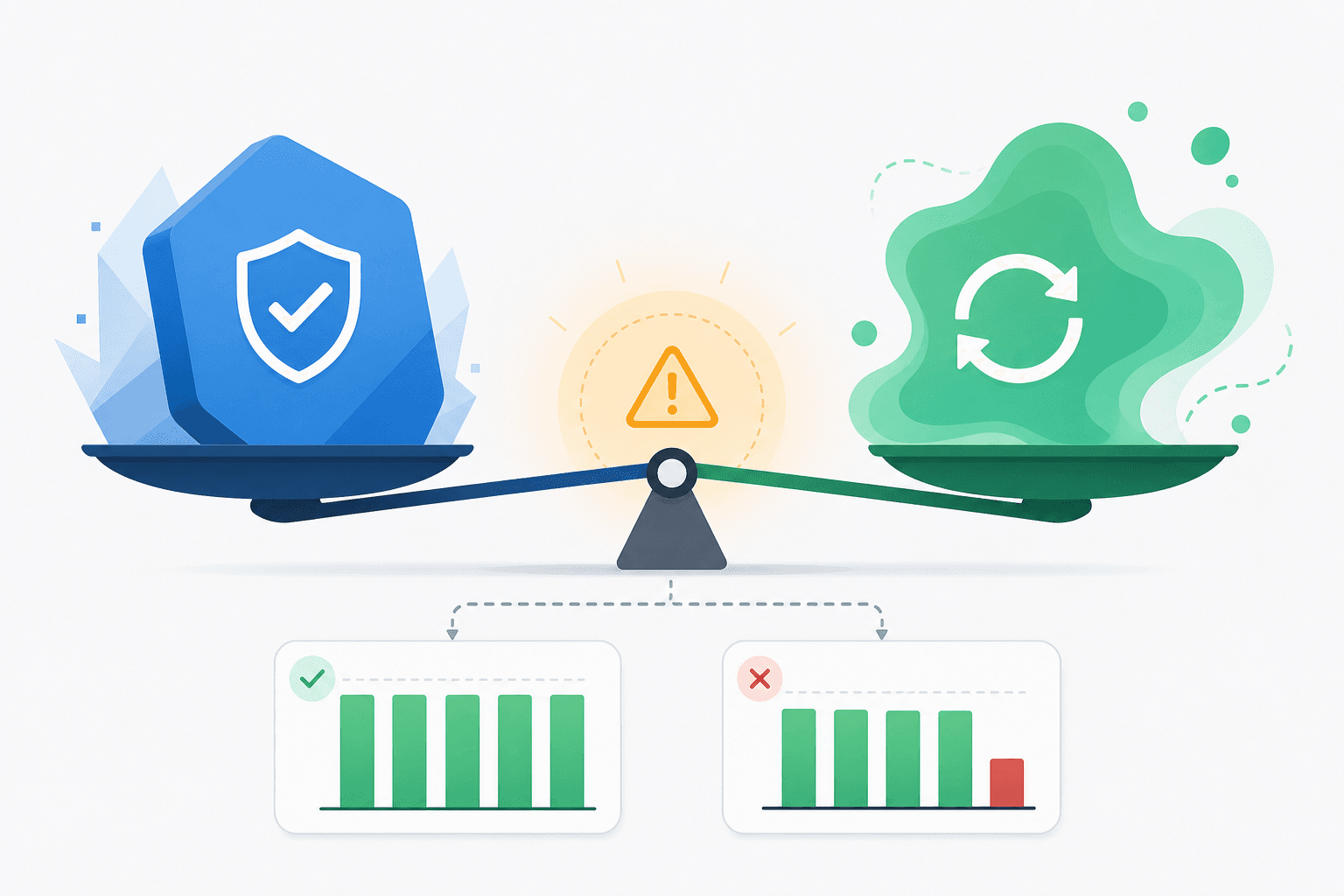
This is the stability-plasticity dilemma: a model must be plastic enough to adapt to legitimate distribution shifts but stable enough to retain validated performance on historical patterns. In clinical AI, this dilemma has direct equity implications. Models updated too aggressively via automatic pipelines can eliminate previously reliable performance on underrepresented subpopulations without triggering standard performance alarms — because aggregate metrics may remain stable while subgroup performance collapses. This connects directly to algorithmic bias risks in healthcare AI: a CL-updated model that appears healthy on aggregate AUROC may be systematically worse for specific demographic groups or diagnostic categories.
Adaptive Update Frameworks: Matching Correction Intensity to Drift Severity
A practical governance framework for correction strategy selection is the bootstrap-based adaptive approach: the correction type is chosen based on the measured severity of degradation rather than a fixed policy applied uniformly to all drift events.
The core finding from comparing five evaluated correction strategies for clinical prediction models is that simple recalibration performs as well as more complex methods in most real-world drift scenarios. Full retraining is necessary only when degradation is major — specifically, when the input-outcome relationship has shifted in ways that calibration adjustment and fine-tuning cannot address.
| Degradation Severity | Performance Pattern | Recommended Correction |
|---|---|---|
| Minor — calibration shift only | AUROC stable; calibration slope or intercept drifted; Brier score elevated | Recalibration (coefficient or meta-model update) |
| Moderate — covariate shift | AUROC declining; input feature distributions shifted; calibration degraded | Fine-tuning or domain adaptation; recalibration as adjunct |
| Major — concept drift or structural shift | AUROC substantially degraded; prior probability shifted; P(Y|X) changed | Full retraining with historical + recent data; full re-validation |
| Sustained temporal drift | Gradual, multi-month decline across metrics | Drift-triggered continual learning with subgroup monitoring; scheduled retraining review |
This framework is a decision structure, not a deterministic algorithm. The boundaries between severity tiers require institutional judgment, informed by clinical context, the specific model's application, and the patient safety consequences of the task. An escalation protocol for translating monitoring signals into these correction decisions is covered in the institutional monitoring program design entry.
FDA Regulatory Governance of Model Corrections
The regulatory implications of each correction strategy depend on whether the modification falls within the scope of the device's original authorization or constitutes a change that requires additional FDA review.
Under the FDA's Total Product Lifecycle (TPLC) approach, manufacturers are expected to monitor real-world device performance continuously and maintain systems for detecting safety and effectiveness changes post-market. For AI/ML-based Software as a Medical Device (SaMD), the regulatory question is whether a given correction — recalibration, fine-tuning, or full retraining — constitutes a device modification that requires a new premarket submission or an update that can be implemented under existing authorization.
The Predetermined Change Control Plan (PCCP) mechanism allows manufacturers to pre-specify planned algorithm modifications, including drift-correction procedures, at the time of initial clearance. When a subsequent correction falls within the PCCP's pre-specified parameters, it can be implemented without a new 510(k) submission. See the PCCP reference entry for the procedural and definitional content on PCCP structure and submission requirements.
A structural limitation in the current regulatory framework is that the FDA's MAUDE adverse event reporting database is not suited to capturing calibration drift and covariate shift as reportable events. These phenomena do not fit the traditional "device malfunction" construct that MAUDE is built around. Analysis of the regulatory framework for AI/ML medical devices has identified this gap explicitly: AI systems trained on one population but deployed in a shifting population, with neither training data updates nor deployment condition changes captured in MAUDE, represent a patient safety monitoring blind spot.
The FDA's 2025 Request for Information on measuring and evaluating real-world AI-enabled medical device performance signals evolving expectations in this area. The RFI asks specifically about triggers for additional performance assessments, how organizations define and respond to degradation, and what methods have been most effective in incorporating clinical outcomes and user feedback into model updates. This reflects regulatory movement toward formalizing post-market drift monitoring obligations that the existing MAUDE framework does not capture.
Vendor vs. Institutional Responsibility for Drift Correction
One of the most practically consequential — and least addressed — dimensions of drift correction is the question of who is responsible for it. In most health system AI deployments, the AI software is licensed from a vendor who trained and validated the model. The health system operates the model in its clinical environment. When drift occurs, the contractual boundary between these parties often does not clearly assign responsibility for detecting, reporting, or correcting it.
The consequence is a governance gap. Data shows that only 16% of health systems have a systemwide governance policy specifically addressing AI usage and model updates. Where policies do exist, they frequently focus on initial procurement and deployment rather than ongoing correction obligations. Vendors may monitor aggregate performance metrics but have no visibility into site-specific drift caused by local patient population changes. Health systems may notice performance degradation but lack the contractual leverage or technical capacity to compel vendor-side correction.
The correction strategy taxonomy described in this entry is a practical tool for resolving this ambiguity. Health systems that understand the distinction between recalibration, fine-tuning, and full retraining can negotiate contracts that specify which party is responsible for each correction type, under what triggering conditions, within what timeline, and with what validation and reporting obligations. Without this vocabulary, procurement contracts default to vague "model maintenance" language that leaves the correction governance gap open.
For the organizational structure, escalation pathways, and governance committee design that operationalizes correction decisions, see the institutional monitoring program for clinical AI model drift. The correction strategies in this entry define what to do; that entry defines how to organize the institution to do it.
Comments
Join the discussion with an anonymous comment.