
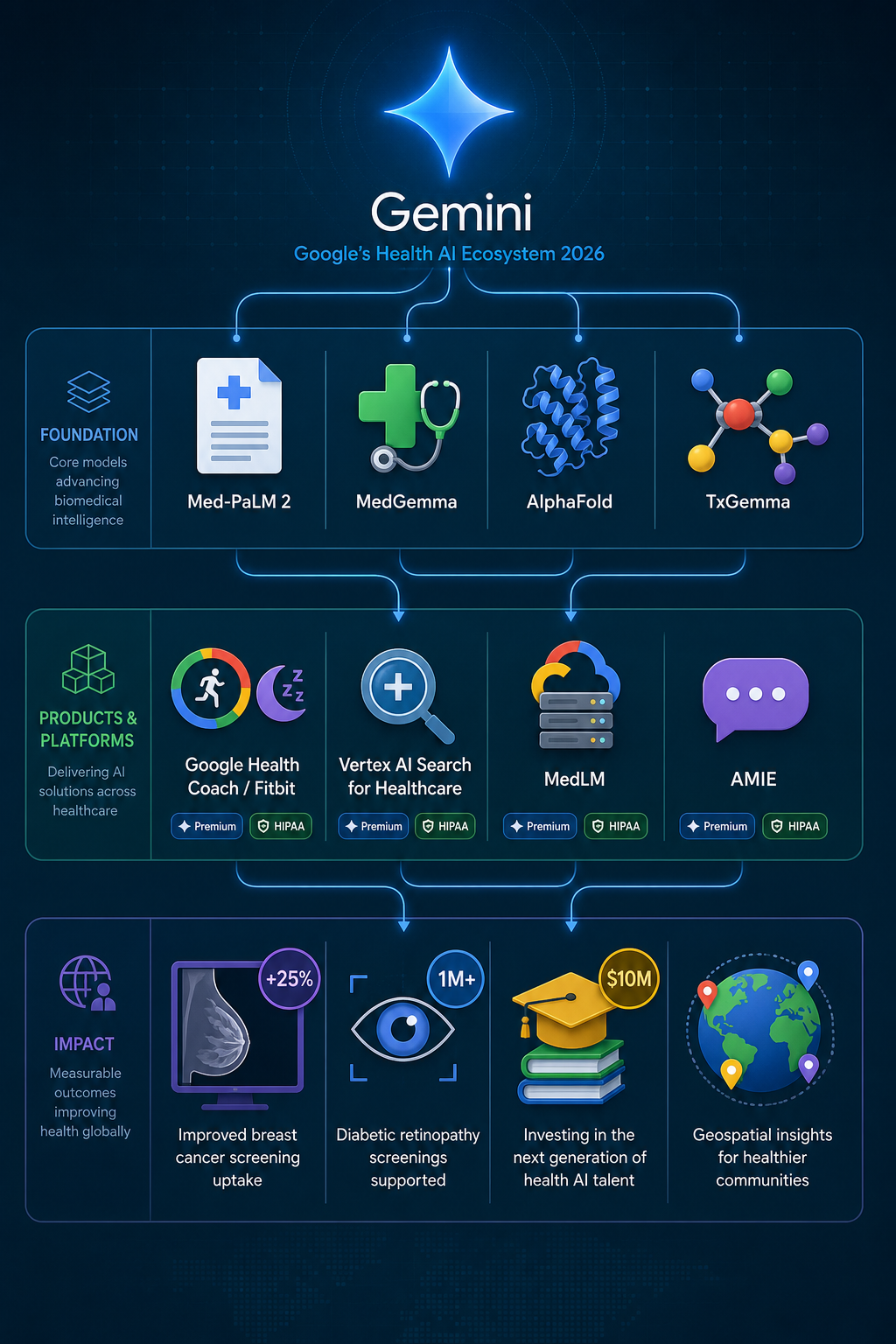
Introduction: Google's Health AI Ambitions in 2026
No technology company has assembled a health AI portfolio as broad as Google's. While competitors like Microsoft and OpenAI focus primarily on enterprise clinical tools or consumer chatbots, Google operates across four distinct tiers simultaneously: foundational AI models trained on medical data, consumer-facing wellness products, enterprise cloud solutions for healthcare organizations, and an open-source ecosystem for developers and researchers. This breadth creates both strategic advantages and organizational complexity.
The portfolio spans from Med-PaLM 2, which scored 86.5% on USMLE-style questions and was preferred by physicians over human answers on eight of nine clinical axes (Nature Medicine, 2025), to the Google Health Coach, a Gemini-powered wellness application launched globally on May 19, 2026, at $9.99 per month. It includes clinical research published in Nature Cancer (March 2026) showing AI detection of 25% more interval breast cancers, and open-weight models like MedGemma being deployed by AIIMS New Delhi for outpatient triage. This profile examines each tier in detail, assesses the supporting evidence, and evaluates Google's competitive position in the 2026 healthcare AI landscape.
Foundational AI Models: Gemini, Med-PaLM 2, and MedGemma
Google's health AI capabilities rest on a stack of foundation models, each designed for different deployment contexts. The Gemini architecture provides the multimodal backbone, capable of reasoning across medical images, text, sensor data, and full patient health histories. On top of this, Google has developed specialized medical models that set benchmarks for clinical language understanding and open-weight medical AI.
Med-PaLM 2: Clinical Language Benchmark
Published in Nature Medicine in 2025, Med-PaLM 2 achieved 86.5% accuracy on the MedQA dataset of USMLE-style questions, improving upon the original Med-PaLM by more than 19 percentage points. In pairwise ranking evaluations on 1,066 consumer medical questions, physicians preferred Med-PaLM 2 answers over physician-written answers on eight of nine clinical axes — including accuracy, safety, and alignment with medical consensus. Med-PaLM 2 answers were judged to better reflect medical consensus 72.9% of the time. On adversarial datasets designed to test robustness, Med-PaLM 2 answers carried a low risk of harm for 90.6% of responses, compared to 79.4% for the earlier model.
In a pilot study on real-world bedside consultation questions from clinical settings, specialists preferred Med-PaLM 2 answers over generalist physician answers 65% of the time. These results position Med-PaLM 2 as one of the most rigorously evaluated medical language models in the peer-reviewed literature, though it remains a research system — not a cleared medical device.
MedGemma and TxGemma: Open-Weight Medical Models
Google released MedGemma as a collection of open-weight models for medical text and image comprehension, built on the Gemma 3 architecture. Available variants include MedGemma 1.5 (4B multimodal) and MedGemma 1 (4B multimodal, 27B text-only, and 27B multimodal). These models support medical image interpretation across CT, MRI, whole-slide histopathology, and longitudinal imaging, as well as medical document understanding and clinical reasoning. TxGemma, a companion model, is designed specifically for therapeutic development tasks.
The open-weight approach allows healthcare organizations to fine-tune models for local populations and workflows using techniques like LoRA and reinforcement learning, and to orchestrate them with external tools such as FHIR APIs or Gemini 2.5 Pro. This flexibility has driven early global adoption, which is covered in the open ecosystem section below.
| Model | Type | Key Capability | Evidence / Benchmark |
|---|---|---|---|
| Med-PaLM 2 | Closed research model | Medical Q&A, clinical reasoning | 86.5% MedQA; preferred over physicians on 8/9 axes (Nature Medicine 2025) |
| MedGemma 1.5 4B | Open-weight multimodal | 3D imaging, histopathology, EHR extraction | Community benchmarks; deployed at AIIMS, Singapore MOH |
| MedGemma 1 27B | Open-weight multimodal | High-resolution imaging, complex reasoning | Community benchmarks; Kaggle challenge (850+ submissions) |
| TxGemma | Open-weight text | Therapeutic development, drug discovery | Research stage; no published clinical benchmarks |
Consumer Health AI: Google Health Coach and Fitbit Integration
Google's most visible health AI product for consumers is the Google Health Coach, launched on May 19, 2026, as part of the Google Health Premium subscription at $9.99 per month or $99 per year. Built on Gemini models, the coach provides personalized guidance across fitness, sleep, and nutrition — moving beyond the passive tracking that characterized earlier wearable platforms.
Core Features
- Tailored weekly workout plans generated from user activity data and goals
- Sleep consistency tracking with personalized recommendations
- Continuous glucose monitor (CGM) connectivity via Health Connect, starting April 2026
- Medical record integration for U.S. users, enabling secure linking of clinical data
- Nutrition logging through voice, images, and document uploads
- Cycle tracking and dynamic workout guidance
- Health record summarization using Gemini's text comprehension capabilities
The coach is available first for Fitbit and Pixel Watch users, with support for other devices — including the Apple Watch — promised later in 2026. This cross-platform strategy reflects Google's recognition that it lags behind Apple, Samsung, Xiaomi, and Huawei in global wearable market share, according to IDC data cited in press reporting.
Safety and Evaluation: The SHARP Framework
Google developed the SHARP evaluation framework — assessing Safety, Helpfulness, Accuracy, Relevance, and Personalization — specifically for the Health Coach. The product was developed with input from a Consumer Health Advisory Panel and Google's in-house clinical scientists. Google AI Pro and Ultra subscribers receive Google Health Premium at no additional cost.
The Personal Health Agent Research
The Health Coach builds on research from Google's Personal Health Agent (PHA) study, which used a multi-agent architecture with three specialist sub-agents: a Data Science agent acting as a personal data analyst, a Domain Expert agent grounded in the NCBI database for verifiable medical knowledge, and a Health Coach agent using motivational interviewing techniques for behavioral change. The study involved approximately 1,200 users who shared Fitbit wearable data, health questionnaires, and blood test results. Evaluation included 10 benchmark tasks, more than 7,000 annotations, and over 1,100 hours of effort from health experts and end-users.
Results showed the Data Science agent scored 75.6% on analysis planning tasks versus 53.7% for the base model. Clinicians rated the Domain Expert agent's summaries as significantly more clinically relevant than baseline outputs. The integrated multi-agent PHA outperformed both single-agent and non-orchestrated multi-agent baselines in the majority of cases, according to both end-user and expert rankings.
Clinical and Enterprise Products: Vertex AI and MedLM
For healthcare organizations, Google Cloud offers a suite of AI products designed for clinical and administrative workflows. These are distinct from the consumer-facing Health Coach and from the research-stage clinical AI systems — they are enterprise products with HIPAA compliance and contractual support for regulated use.
Vertex AI Search for Healthcare
Vertex AI Search for Healthcare is a medically tuned search product for clinical records, using Gemini generative AI to help clinicians find information across structured and unstructured patient data. It is designed to address the common problem of information fragmentation in EHR systems, where relevant clinical data may be scattered across notes, lab results, imaging reports, and medication lists. The product is available through Google Cloud's healthcare and life sciences portfolio.
MedLM and Medical Imaging Suite
The MedLM family of foundation models is available broadly via Vertex AI, allowing healthcare organizations to build and deploy custom clinical AI applications. MedLM for Chest X-ray, announced at HIMSS24, supports classification for operational, screening, and diagnostic use cases. The Medical Imaging Suite provides tools for radiology AI development and deployment, including capabilities for 2D X-ray and 3D brain CT scan analysis.
Claims Acceleration Suite
Google's Claims Acceleration Suite applies AI to revenue cycle management, targeting the administrative burden of prior authorization, claims processing, and coding. This product competes directly with specialized healthcare AI companies in the administrative automation space, leveraging Gemini's natural language capabilities to process unstructured clinical documentation.
- Vertex AI Search for Healthcare — Gemini-powered clinical information retrieval across structured and unstructured data
- MedLM on Vertex AI — Foundation model access for custom clinical AI development
- Medical Imaging Suite — Radiology AI tools for screening, diagnostic, and operational use cases
- Claims Acceleration Suite — AI for prior authorization, claims processing, and clinical coding
Research and Clinical Evidence: Breast Cancer, Diabetic Retinopathy, and AMIE
Google's strongest clinical evidence comes from three research streams: breast cancer screening AI, diabetic retinopathy detection, and the AMIE conversational diagnostic agent. All three remain in research or pilot stages — none are FDA-cleared medical devices — but they represent the most clinically validated AI systems in Google's portfolio.
Breast Cancer Detection AI
Published in Nature Cancer in March 2026, Google's breast cancer AI research with Imperial College London and the UK's NHS produced two significant findings. The first study reviewed mammograms of 125,000 women and found that the AI identified 25% of interval cancers — cancers that appear between routine screenings — that had been previously missed. The second study, involving more than 50,000 women, demonstrated that the AI could reduce radiologist screening workloads by an estimated 40% when used as a second reader.
An observational feasibility study across 12 NHS screening sites processed over 9,000 cases in real-time, revealing that AI requires careful calibration to each hospital's workflow, equipment, and patient populations. The research also documented a critical tension in human-AI collaboration: arbitration panel specialists occasionally overruled AI-detected cancers, raising questions about how to optimize the human-AI review process in real-world screening programs.
Diabetic Retinopathy Screening
Google's diabetic retinopathy screening model has provided over 1 million screenings across India, Thailand, and Australia, delivering diagnoses in as little as 2 minutes. This is one of the most extensively deployed AI screening programs globally, though it operates through clinical partnerships rather than as a direct-to-consumer or FDA-cleared product in all markets.
AMIE: Articulate Medical Intelligence Explorer
AMIE is Google's conversational diagnostic agent, designed for diagnostic reasoning in clinical settings. It is being tested in clinical research with Beth Israel Deaconess Medical Center (BIDMC). Early evaluations used simulated clinical examinations, and the system has shown promise in structured diagnostic conversations. AMIE remains firmly in the research stage with no regulatory submission or clinical deployment timeline announced.
| Research Area | Key Finding | Study Population | Stage |
|---|---|---|---|
| Breast cancer detection | 25% more interval cancers detected; 40% workload reduction | 125,000 women (detection); 50,000+ women (workload) | Research / pilot (Nature Cancer 2026) |
| Diabetic retinopathy | 1M+ screenings; diagnosis in ~2 minutes | India, Thailand, Australia populations | Deployed via clinical partnerships |
| AMIE diagnostic agent | Promising simulated exam performance | BIDMC clinical research | Research only |
| TB / lung cancer screening | 3M free AI-powered screenings over 10 years | India (Apollo Radiology partnership) | Announced partnership |
Open Ecosystem: Health AI Developer Foundations and Global Adoption
Google's open-source strategy for health AI is organized under the Health AI Developer Foundations initiative, which provides open-weight models, development tools, and reference implementations. This approach differs from competitors like OpenAI and Microsoft, which primarily offer closed, API-accessed models for healthcare use.
MedGemma Global Adoption
MedGemma's open-weight availability has enabled direct adoption by healthcare institutions. At AIIMS New Delhi, researchers are using MedGemma for outpatient triage and dermatology screening. Singapore's Ministry of Health is fine-tuning the model for primary care applications. The Kaggle MedGemma Impact Challenge attracted over 850 submissions from developers worldwide, indicating strong community interest in building applications on top of Google's medical models.
Open Health Stack and Public Health Tools
The Open Health Stack provides open-source building blocks for mobile health applications using interoperable data standards. It has been deployed in Kenya through IntelliSOFT's Mama's Hub maternal health app. Google Earth AI has been applied to public health, providing super-resolution MMR vaccination coverage estimates at the ZIP-code level, used by Mount Sinai and Boston Children's Hospital/Harvard researchers.
Clinician Education Investment
Google announced a $10 million investment via Google.org to reimagine clinician education in the AI era, partnering with the Council of Medical Specialty Societies and the American Academy of Nursing. This investment addresses a critical barrier to AI adoption in healthcare: most clinicians have received no formal training in evaluating or using AI tools in clinical practice.
- MedGemma open-weight models adopted by AIIMS New Delhi for outpatient triage and dermatology
- Singapore MOH fine-tuning MedGemma for primary care applications
- Kaggle MedGemma Impact Challenge: 850+ developer submissions
- Open Health Stack deployed in Kenya for maternal health (Mama's Hub app)
- Google Earth AI providing vaccination coverage estimates for public health research
- $10M Google.org investment in clinician AI education with CMSS and American Academy of Nursing
Regulatory and Safety Posture
Google's approach to AI safety and regulation in healthcare is shaped by its AI Principles, which prohibit the deployment of AI systems in areas that could cause harm without appropriate safeguards. For health-specific applications, Google has developed additional governance mechanisms.
The SHARP evaluation framework (Safety, Helpfulness, Accuracy, Relevance, Personalization) was developed specifically for the Health Coach product. The Consumer Health Advisory Panel provided external input during development. Google's in-house clinical scientists review health AI products before launch. However, these are internal governance processes, not external regulatory standards.
A critical distinction for healthcare professionals evaluating Google's offerings: the vast majority of Google's clinical AI systems — including Med-PaLM 2, AMIE, the breast cancer detection AI, and the diabetic retinopathy screening model — are not FDA-cleared medical devices. They operate as research tools, clinical decision support software (which may have different regulatory requirements depending on jurisdiction), or non-regulated wellness products. The enterprise products on Google Cloud (Vertex AI Search for Healthcare, MedLM) are platform tools that customers can use to build their own applications, but Google does not market them as pre-validated clinical solutions.
Competitive Positioning: Google vs. Apple, OpenAI, Microsoft, and Samsung
Google's competitive position in health AI is defined by its unique breadth, but also by specific vulnerabilities against more focused competitors. The table below summarizes the competitive landscape across key dimensions.
| Competitor | Core Strength | Google's Relative Position | Key Gap for Google |
|---|---|---|---|
| Apple | Wearable market share, consumer trust, privacy positioning | Lags in wearable market share (IDC data); Health Coach supports Apple Watch later in 2026 | Hardware ecosystem lock-in; Apple's health features are free with device purchase |
| OpenAI | Consumer AI brand recognition, ChatGPT health usage (230M weekly health questions) | Broader clinical research portfolio; stronger enterprise cloud offering | OpenAI has stronger consumer brand for general health Q&A; no wearable hardware |
| Microsoft | Enterprise healthcare cloud (Azure, Nuance DAX Copilot, Copilot Health launched March 2026) | Comparable enterprise cloud; stronger foundation model research | Microsoft has deeper EHR integrations via Nuance; earlier enterprise healthcare market entry |
| Samsung | Global wearable market share leader (IDC) | Superior AI research depth; open ecosystem strategy | Samsung's scale in wearables and smartphones provides larger consumer data pipeline |
A West Health-Gallup survey from April 2026 found that one in four U.S. adults now use AI for healthcare research or advice, indicating a rapidly growing market. Google's strategy of making Health Coach available across device platforms — including Apple Watch — reflects an attempt to overcome its hardware disadvantage through interoperability. However, the company faces an uphill battle against Apple's deeply integrated health features on iPhone and Apple Watch, which are provided at no additional cost to device owners.
In the enterprise segment, Microsoft's launch of Copilot Health in March 2026 and its existing Nuance DAX Copilot for ambient clinical documentation give it a strong position with health systems. Google's advantage lies in the breadth of its foundation model research and the open-weight MedGemma strategy, which appeals to organizations that want to customize models rather than use black-box APIs.
Caveats and Limitations
A balanced assessment of Google's health AI portfolio requires acknowledging several important limitations.
Regulatory Status
The most significant caveat is regulatory. Google's most clinically impressive AI systems — the breast cancer detection AI, AMIE, Med-PaLM 2 — remain in research or pilot stages. None have FDA clearance as medical devices. Healthcare organizations evaluating these systems for clinical deployment must navigate regulatory pathways themselves or wait for Google to pursue formal clearance. This contrasts with dozens of FDA-cleared AI devices from companies like Aidoc, Viz.ai, and Zebra Medical Vision that have established regulatory precedents.
Organizational Complexity
Google's health AI efforts are distributed across multiple organizational units — Google Research, Google DeepMind, Google Cloud, Fitbit, and the Google Health division — each with different priorities, timelines, and go-to-market strategies. This fragmentation can create confusion for potential partners and customers trying to understand which team owns which product and how they integrate.
Evidence Variability Across Tiers
The evidence base varies dramatically across Google's product tiers. The foundation models have strong peer-reviewed evidence (Nature Medicine 2025 for Med-PaLM 2). The clinical research has promising results (Nature Cancer 2026 for breast cancer AI). The consumer Health Coach has internal evaluation frameworks but no published peer-reviewed validation. The enterprise cloud products have platform-level documentation but limited independent clinical validation. Healthcare professionals should evaluate each product tier on its own evidentiary merits rather than assuming consistent quality across the portfolio.
Wearable Market Position
Google lags behind Apple, Samsung, Xiaomi, and Huawei in global wearable market share, according to IDC data. This limits the consumer data pipeline that feeds the Health Coach's personalization capabilities. The decision to support Apple Watch later in 2026 is a strategic acknowledgment of this weakness, but it also means Google's health AI depends on a competitor's hardware platform for a significant portion of its potential user base.
Conclusion: Assessing Google's Health AI Trajectory
Google occupies a unique position in the 2026 healthcare AI landscape. It is the only company with a portfolio spanning all four tiers: foundation models with peer-reviewed clinical benchmarks, consumer wellness products with millions of potential users, enterprise cloud solutions for healthcare organizations, and open-source tools adopted by health systems globally. This breadth is unmatched by Apple, OpenAI, Microsoft, or any single healthcare AI company.
The strategic advantages are clear. Gemini's multimodal architecture provides a unified technical foundation that competitors must assemble from multiple models. The open-weight MedGemma strategy creates a path to global adoption that closed-model competitors cannot replicate. The $10 million clinician education investment addresses a real barrier to AI adoption that most competitors ignore.
The challenges are equally significant. The lack of FDA clearance for clinical AI systems limits deployment in regulated healthcare settings. Organizational fragmentation across Google Research, DeepMind, Cloud, and Fitbit creates coordination costs and market confusion. The wearable market share deficit constrains the consumer data advantage that powers personalization. And the evidence base, while strong in specific research areas, remains uneven across the portfolio.
For healthcare professionals and health IT decision-makers, the practical assessment is this: Google's health AI portfolio offers exceptional breadth and research depth, but each product tier requires separate evaluation of regulatory status, clinical evidence, and deployment readiness. The foundation models and open-source tools are immediately useful for research and development. The enterprise cloud products are viable platforms for building custom solutions. The consumer Health Coach is a compelling wellness product with appropriate safety guardrails. But the clinical AI systems that generate the most impressive research results remain in the pipeline, not in the clinic.