
An impressive AUC for an ACL prediction model is a starting point, not an answer. For clinicians evaluating AI in sports-medicine knee-injury risk prediction, the current appraisal frame is fairly stark: no FDA-cleared ACL-specific prediction or graft-failure risk tool was identified in the reviewed materials; the peer-reviewed evidence base remains sparse; reported performance ranges from AUC 0.63 to 0.85, with one small-cohort study reporting 96% accuracy; external validation is essentially absent except for one Norwegian registry model; and clinical readiness is low.
That does not mean the models are uninteresting. Some are technically strong enough to deserve follow-up. The problem is narrower and more important: most headline figures come from the same environment in which the model was built. A sports-medicine clinic cannot treat that as proof that the score will travel to a different team, age group, sex distribution, surgical pathway, rehabilitation program, or recreational athlete population.
What the Reported Numbers Actually Cover
The published results do not support a single claim such as “AI predicts ACL tears.” They describe different targets, cohorts, input data, and validation designs. First-time ACL injury screening is not the same task as predicting graft failure after reconstruction. A homogeneous cohort of female basketball players is not the same clinical problem as a mixed orthopaedic practice seeing adolescents, adults, competitive athletes, and recreational patients.
| Study or model | Prediction target | Reported performance | Immediate appraisal point |
|---|---|---|---|
| Jauhiainen et al. | First-time ACL injury prediction in 791 female athletes | SVM AUC 0.63 | A modest result that better reflects the difficulty of predicting rare future injury in a broader athletic population |
| Taborri et al. | ACL injury risk classification in female basketball players | Reported accuracy 96% | High headline accuracy, but from a small homogeneous cohort |
| Benjaminse et al. | ACL injury risk screening | Fine Gaussian SVM AUC 0.85 | Promising discrimination, still requiring validation outside the development setting |
| Alaiti et al. | ACL reconstruction graft-failure prediction | CatBoost AUC 0.85 in 680 patients | A recent graft-failure model with knee hyperextension as the most consistent predictor across ML models |
| Martin et al. | ACL revision prediction using Norwegian registry data | External validation AUC approximately 0.71–0.74 | Lower than the best internal figures, but more credible because it was tested in an independent trial cohort |
The strongest recent graft-failure signal comes from Alaiti et al., who reported a CatBoost AUC of 0.85 in a 680-patient cohort and found knee hyperextension to be the single most consistent predictor across the machine-learning models they tested.[1] That is a clinically plausible and useful lead. It is not yet a clinical rule. The finding comes from one recent cohort and needs independent replication before it should affect return-to-play counseling, surgical planning, or surveillance intensity.
The broader reinjury literature is even more cautious when viewed as a map rather than as isolated model papers. Ahmed et al.’s 2026 scoping review examined 10 AI-based reinjury prediction models after ACL reconstruction and found that external validation was uncommon, while calibration and clinical-utility reporting were inconsistent across studies.[2] Molavi et al.’s 2026 systematic review of first-time ACL injury prediction identified only 7 studies, underscoring how small the evidence base remains for an area now receiving much larger claims.[3]
Why External Validation Changes the Meaning of an AUC
AUC measures discrimination: whether, across pairs of patients, the model tends to rank the higher-risk patient above the lower-risk patient. It does not tell the clinician whether a predicted 18% risk is actually close to 18%, whether the model improves decisions, or whether it remains stable when used in a different population. A model can separate cases reasonably well and still be poorly calibrated for the clinic sitting in front of it.
This is why the Norwegian registry model matters. Martin et al.’s revision prediction model is the key comparator not because it has the highest number, but because it is the rare example with published external validation. In an independent trial cohort, it retained only moderate discrimination, with AUC approximately 0.71–0.74.[2] That result is not a failure. It is the kind of shrinkage clinicians should expect when a model leaves the derivation environment.
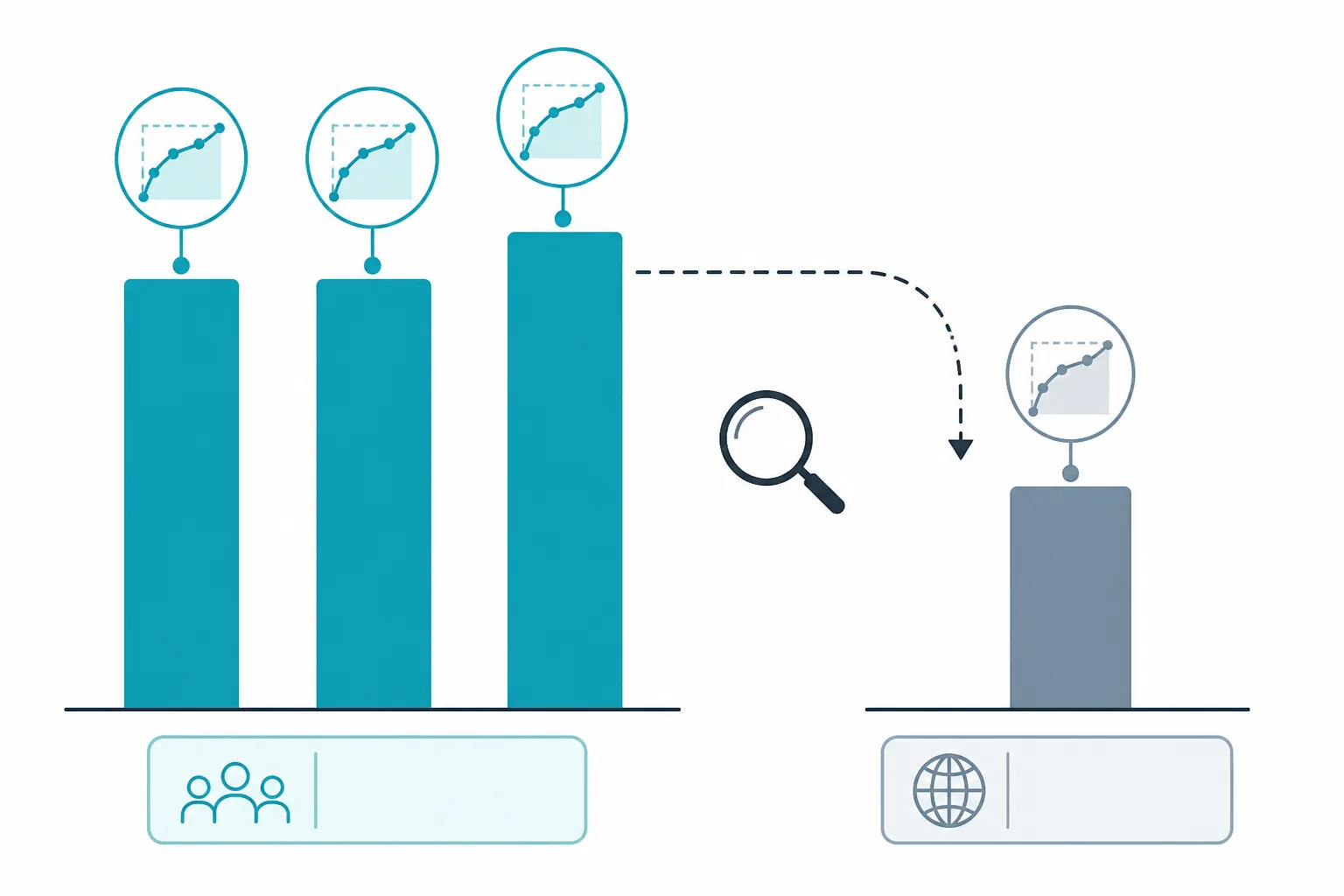
A high internal AUC answers a limited question: did the model find a pattern in the dataset available to the investigators? External validation asks the question a clinician actually needs answered: does the pattern survive when patient selection, measurement habits, surgical practice, rehabilitation exposure, and outcome capture change? For ACL prediction, that second question has barely been tested.
This distinction is where procurement conversations often go wrong. A vendor or internal innovation team may present “96% accuracy” as if it means 96 out of 100 future clinical decisions will be correct. In a small homogeneous cohort, accuracy can be shaped by class balance, case definitions, threshold choice, and the similarity between training and testing data. Without external validation and calibration, the number cannot be translated into a defensible athlete-level risk conversation.
The Missing Populations Are Not a Minor Footnote
ACL prediction is not an abstract classification challenge. The consequences land on athletes deciding whether to return to pivoting sport, parents trying to understand reinjury risk, surgeons explaining graft choices, coaches managing pressure, and clinicians documenting why a recommendation was made. If the dataset does not resemble those people, the model’s risk estimate becomes harder to defend.
The reviewed evidence repeatedly leaves important groups underrepresented, excluded, or poorly described: female athletes, youth athletes under 18, and non-elite or recreational patients. That is not just a fairness problem in the abstract. It limits applicability to the exact populations many sports-medicine clinicians see every week.
A model developed around elite or narrowly selected athletes may learn signals that reflect access to standardized testing, consistent rehabilitation exposure, specialized surgical follow-up, or better outcome capture. A recreational athlete recovering outside a professional support system may have a different monitoring pattern altogether. The model may still output a clean probability. The issue is whether that probability has earned trust for that person.
The same concern applies to sex and age. A model that underrepresents female athletes cannot be assumed to handle female-specific distributions of exposure, biomechanics, sport participation, or recovery context. A model that excludes or sparsely samples youth athletes cannot be treated as ready for adolescent return-to-sport decisions. These are not exotic edge cases; they are central to ACL practice.
Internal Bias Scores Do Not Solve Applicability
Risk-of-bias tools such as PROBAST-AI are useful because they force reviewers to ask whether a model was developed and assessed in a methodologically coherent way. But a development study can look acceptable on internal bias criteria and still be a poor fit for clinical deployment. That mismatch is visible in the ACL evidence: some models may be competently built, yet their applicability remains high concern because none has been prospectively tested in a real screening or deployment program.
Prospective testing matters because clinical use changes the environment. Athletes may alter behavior after receiving a risk label. Clinicians may intensify rehabilitation, delay return to sport, or request more testing. Missing data patterns change. A score that performed well retrospectively may become less stable when it starts influencing the pathway it is supposed to predict.
Calibration and utility are the other missing pieces. Calibration asks whether predicted probabilities match observed outcomes. Clinical utility asks whether using the model improves decisions compared with current practice. Ahmed et al. found inconsistent reporting of both calibration and clinical-utility information across the 10 reinjury prediction models they reviewed.[2] For a clinician, that means the evidence often stops before the most practical questions begin.
How to Read a Claim Before Bringing It Into Clinic
The first question is not whether the model uses machine learning. It is whether the model has been tested in a population resembling the one where it will be used. A busy sports-medicine service does not need another retrospective score that looks good on paper but cannot be explained to a patient, audited by governance, or compared with usual clinical assessment.
- Ask whether the reported figure is internal validation, cross-validation, temporal validation, or true external validation in an independent population.
- Separate discrimination from calibration; an AUC does not tell you whether the absolute risk estimate is accurate.
- Check whether female athletes, adolescents, and recreational patients were included in sufficient numbers for the intended use.
- Look for prospective testing in a real screening, rehabilitation, or return-to-sport workflow.
- Require a clinical-utility analysis before treating the model as a decision aid rather than a research output.
- Keep regulatory status separate from performance claims; no FDA-cleared ACL-specific AI prediction tool was identified in the reviewed materials.
A constrained research deployment could still be reasonable if it is transparent: predefined protocol, independent audit, representative recruitment targets, calibration monitoring, and no automatic return-to-play decision based on the model. That is very different from buying or recommending an ACL risk tool as though the published AUC has already proven clinical value.
Clinical Readiness Scorecard
| Domain | Current appraisal |
|---|---|
| Evidence volume | Sparse; Molavi et al. identified 7 first-time ACL injury prediction studies, and Ahmed et al. reviewed 10 AI-based reinjury prediction models.[2][3] |
| Reported discrimination | Variable; published AUC figures range from 0.63 to 0.85, alongside high internal performance claims including 96% accuracy in a small homogeneous cohort. |
| External validation | Very limited; the Norwegian registry model is the main externally validated example, retaining only moderate AUC approximately 0.71–0.74.[2] |
| Calibration and utility | Insufficient; reporting is inconsistent across reinjury prediction models.[2] |
| Population applicability | High concern; female athletes, youth athletes, and non-elite or recreational patients are underrepresented, excluded, or poorly described. |
| Regulatory status | No FDA-cleared ACL-specific prediction or graft-failure risk tool identified in the reviewed materials. |
| Clinical recommendation | No recommendation for routine clinical deployment; use should remain limited to evaluation, audit, or research contexts. |
Current ACL AI prediction and graft-failure models are research-stage tools, not clinically ready decision aids. The best-looking numbers mostly come from settings too narrow to support deployment. Until external validation, calibration, prospective testing, and representative athlete cohorts are available, these models should not be used to make or justify athlete-level clinical decisions.