
The headline claim for AI agents in healthcare revenue is easy to understand: automate enough of prior authorization, coding support, denial prevention, underpayment detection, and follow-up, and the revenue cycle starts to approach a touchless operating model. McKinsey has put one of the strongest versions of that claim into circulation, estimating that agentic AI could reduce cost to collect by 30% to 60%.[1] In the published evidence base, reported ROI figures of 210% to 480% also appear across more than half of the studies in the most comprehensive 2025 synthesis.[2]
Those two numbers should not be read the same way. The 30% to 60% figure is a modeled projection, not an empirical result from a deployed hospital system. The 210% to 480% ROI range is reported in studies, but it comes from a thin and uneven evidence base with short follow-up, inconsistent denominators, and no randomized controlled trials.[1][2] That does not make AI agents irrelevant to revenue-cycle work. It does mean a hospital should not let a modeled cost-to-collect number migrate into a business case as if it were a generalizable operating benchmark.

First sort the claim by evidence type
In procurement conversations, “recovered revenue” often hides more than it reveals. It may mean reduced denials, accelerated account creation, missed-charge capture, payer contract compliance recovery, coder productivity, or lower labor cost per account. These are related, but they are not interchangeable. A denial reduction that improves cash timing is not the same as net-new revenue. Faster coder training is not the same as durable cost-to-collect reduction. A payer contract recovery project can surface dollars already owed, but that does not prove the same agent will improve first-pass acceptance across service lines.
| Claim type | What it can support | What it cannot support |
|---|---|---|
| Modeled projection | A plausible upside scenario for business-case scoping | A deployed result or benchmark expectation |
| Single-site operational report | A concrete example of workflow potential in one setting | Generalizable ROI across hospitals |
| Observational study | Directional evidence when baseline and outcome definitions are clear | Causal proof without concurrent controls |
| Experimental study | Stronger evidence than a retrospective or case design | Broad generalizability if small, short, or not externally validated |
| Systematic review | A map of the evidence landscape and its weaknesses | Stronger conclusions than the underlying studies allow |
That sorting matters because AI agents are being sold into painful operational problems. Denials create rework. Missed charges leave money unbilled. Payer contract leakage requires labor-intensive reconciliation. Slow account creation delays downstream activity. If an agent can remove manual queues or catch a leakage pattern earlier, the operational case for a controlled pilot may be strong even before the evidence is definitive. The mistake is treating that pilot rationale as proof of enterprise-level ROI.
What counts as an AI agent in this setting
For revenue-cycle purposes, the useful distinction is not whether a tool has fashionable AI branding. An AI agent is more than a dashboard that flags a risk score and more than a static rules engine that routes a claim based on fixed logic. The agentic promise is that software can observe a work queue, interpret context, take or recommend the next action, and keep moving a task across systems with limited human intervention.
That distinction raises the evidence standard. A model that predicts denial risk can be evaluated on discrimination and calibration. An agent that changes work queues, writes appeal language, creates accounts, checks contract compliance, or touches claim status has to be evaluated on operational outcomes: first-pass acceptance, denial rate, net collection, rework volume, staff time, payer response, error handling, integration burden, and whether gains persist after the implementation team leaves.
The strongest synthesis is still thin
The central evidence source is a 2025 systematic review by Iloanusi and Nweke, available as an Advance/Sage preprint. It covers 24 studies and more than 2.3 million encounters, making it the most comprehensive synthesis identified for AI agents and revenue-cycle performance. Its preprint status matters: the findings are useful for mapping the field, but they should be treated as preliminary rather than settled peer-reviewed evidence.[2]
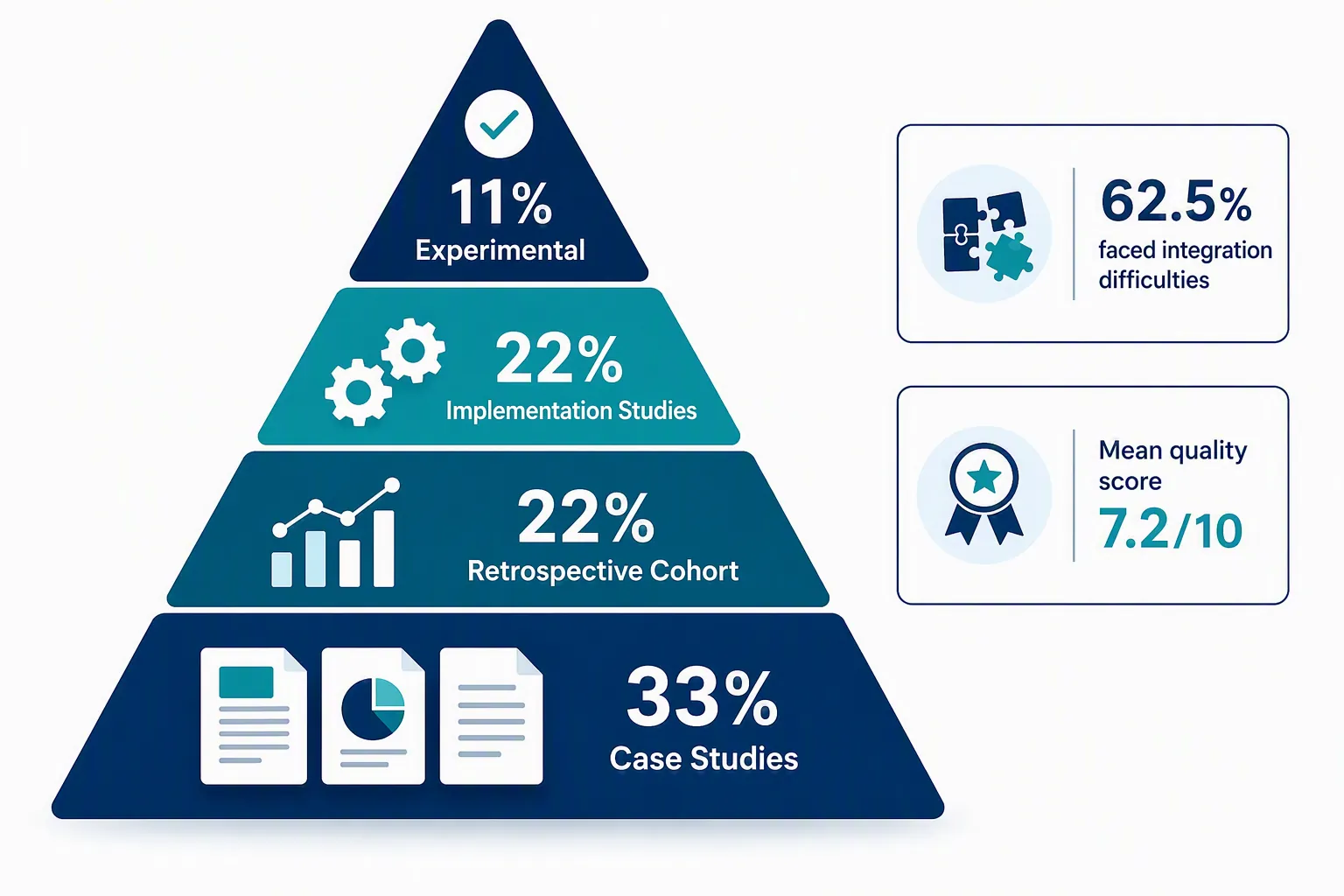
The design mix explains why the review reads positively but cannot carry broad ROI claims. Of the included studies, 33.3% were case studies, 22.2% were retrospective cohort studies, 22.2% were implementation studies, and only 11.1% used experimental designs. No randomized controlled trials were identified. Only 37% reported power analyses. The mean JBI quality score was 7.2 out of 10, and only 33% of studies scored 8 or higher.[2]
The sample-size distribution creates another ceiling on confidence. Only 4 of the 24 studies had sample sizes above 50,000 encounters. Another 44.4% fell between 10,000 and 50,000 encounters, while 33.3% had fewer than 10,000 encounters.[2] For a hospital with varied payer mix, multiple EHR instances, outsourced functions, specialty-specific coding patterns, and different denial drivers by site of care, those denominators are not trivial.
The reported direction is still favorable. In studies that reported first-pass acceptance improvement, 75% showed gains of at least 15%.[2] That is a meaningful signal, especially because first-pass acceptance connects directly to rework and cash timing. But the signal sits inside short 6- to 18-month follow-up windows and uneven outcome definitions.[2] It is a prompt for disciplined testing, not a permission slip to assume the same improvement will travel unchanged across payer contracts, departments, and legacy workflows.
Integration difficulty is not an implementation footnote
The review reports that 62.5% of studies faced integration difficulties with legacy systems.[2] That finding deserves to sit next to the ROI figures, not after them. Revenue-cycle agents do not operate in a clean software diagram. They encounter EHR configuration, clearinghouse workflows, payer portals, contract-management tools, identity and access controls, coding edits, local workarounds, and exception queues that may have been stable only because experienced staff knew when to ignore the official path.
Implementation burden also changes the denominator in an ROI claim. If the ROI calculation includes recovered dollars but excludes interface build, staff validation, payer-specific tuning, governance review, retraining after edits change, and time spent managing exceptions, the number may describe a product effect without describing the hospital’s actual economics. The more agentic the tool, the more this matters, because the system is no longer just informing staff; it is changing the sequence of work.
This is where an adjacent question becomes practical: which revenue-cycle AI functions are mature enough for production use, and which still need controlled pilots? A separate production-readiness appraisal can help frame that distinction by function rather than by vendor category: Which Revenue Cycle AI Functions Are Production-Ready in 2026.
The hospital examples explain demand, not proof
The most concrete hospital examples come through HFMA’s discussion of AI and revenue leakage. Texas Children’s Hospital reportedly evaluated 30,000 claims over 18 months and saw a 30% denial reduction along with 50% faster coder training. Saint Luke’s reported a 10% productivity gain. Montgomery Health reported 92% faster account creation. A California academic medical center reportedly recovered $12 million in missed charges over 6 months. A Midwest system with $3 billion in revenue reportedly reduced denials by about $40 million. A Texas integrated delivery network reportedly recovered more than $25 million through payer contract compliance work.[3]
These examples are exactly why buyers pay attention. They are tied to recognizable pain points, and the numbers are large enough to matter to a finance committee. They are also single-site, uncontrolled reports shared anecdotally through HFMA, not independently verified peer-reviewed studies.[3] A hospital can use them to form hypotheses: denial prevention may be worth a pilot; missed-charge detection may pay back quickly in a specific service line; account creation may be a reasonable automation target. It should not use them as benchmark expectations.
The Texas Children’s example is a useful illustration of the difference. A 30% denial reduction over an 18-month study period on 30,000 claims is operationally interesting.[3] But without a concurrent control, standardized case-mix adjustment, payer-specific breakdown, implementation-cost accounting, and follow-up after the initial deployment period, it cannot tell another hospital what denial reduction to expect. It can tell that hospital what to measure before signing a broader contract.
The denominator problem behind ROI
ROI in revenue-cycle AI has three recurring denominator problems. The first is scope: some calculations measure one work queue, while procurement decks can imply enterprise impact. The second is time: the published literature lacks long-term follow-up beyond 12 to 24 months, while integration drag and workflow decay may appear after initial tuning. The third is cost: implementation labor and ongoing governance can be treated as background effort rather than as part of the investment.
The systematic review’s reported ROI range of 210% to 480% is therefore best read as evidence that strong returns are possible in selected settings, not that they are probable across hospitals.[2] The field lacks standardized outcome definitions, which makes cross-study comparison unreliable and prevents a clean meta-analysis. Publication bias is also likely: failed deployments, abandoned integrations, and tools that merely shifted work from coders to analysts are less likely to appear in the literature.
A defensible ROI case should specify the payer, workflow, baseline period, claim population, staffing assumption, implementation cost, and follow-up window. It should separate recovered historical leakage from recurring run-rate improvement. It should also distinguish a reduction in manual touches from a reduction in total cost to collect. Those are not academic niceties; they determine whether the revenue-cycle director can defend the result after the pilot team leaves.
Adoption signals are not effectiveness evidence
Market analyses show that healthcare organizations are paying attention. Oliver Wyman’s 2026 revenue-cycle AI survey included more than 200 decision-makers and 90 end users, and it describes growing adoption and expectations around AI impact in revenue-cycle work.[4] Menlo Ventures’ 2025 report describes AI spending and adoption patterns across healthcare from a venture-capital perspective.[5]
Those sources are useful for understanding market motion, not for proving effectiveness. Oliver Wyman’s survey is vendor-sponsored and not peer-reviewed.[4] Menlo Ventures’ report reflects a VC firm’s methodology and market vantage point.[5] Both can help a CFO or governance committee understand why competitors may be piloting these tools. Neither should substitute for baseline-controlled measurement inside the hospital’s own revenue cycle.
Regulatory confidence should not be borrowed from clinical AI
Within the materials reviewed for this appraisal, no FDA-cleared AI agents for revenue-cycle management were identified. That is not surprising: most revenue-cycle AI tools are marketed as non-device SaaS rather than clinical devices. But it changes the governance posture. A hospital should not let the general language of healthcare AI imply that these tools have passed through the same clearance pathways that apply to some clinical AI products.
For revenue-cycle agents, accountability has to come from contracting, auditability, access controls, model-change notification, exception handling, payer-specific monitoring, and local performance measurement. The relevant failure modes are not only model accuracy problems. They include silent work shifting, denial-category miscoding, inappropriate appeal generation, contract-rule drift, staff overreliance, and automation that accelerates the wrong step.
What a controlled pilot should require
The evidence supports piloting in targeted revenue-cycle functions where baseline pain is measurable and the workflow can tolerate close monitoring. Denial prevention, missed-charge detection, underpayment identification, coder support, and account creation are reasonable candidates when the hospital can define the queue, the payer mix, the human review point, and the financial endpoint before go-live.
- Set a baseline period before deployment, including denial rate, first-pass acceptance, manual touches, turnaround time, staff hours, net collection, and rework volume.
- Use a concurrent comparison where feasible, such as a similar payer, service line, facility, or work queue that does not receive the agent during the same period.
- Track implementation cost explicitly, including interface work, analyst time, coder validation, IT security review, training, exception management, and ongoing tuning.
- Define revenue outcomes narrowly: recovered historical leakage, avoided denials, faster cash, lower labor cost, and sustained run-rate improvement should not be collapsed into one number.
- Require payer- and workflow-specific reporting, because aggregate improvement can hide deterioration in a high-friction payer or a complex specialty.
- Continue follow-up beyond the initial deployment window when possible, since short-term lift may fade as payer rules, staff behavior, and system configuration change.
The decision standard should be practical: not “prove generalizable ROI before touching the workflow,” and not “accept the vendor’s modeled ROI because the use case is painful.” A useful pilot asks whether the agent improves a defined revenue-cycle function in this hospital, against this baseline, with these integration costs, under this governance model. That is a lower bar than universal proof, but a much higher bar than a slide showing 30% to 60% cost-to-collect reduction.
For denial-specific evaluation, the same discipline applies at a narrower level: Preventing denials with AI in RCM examines the denial-management subset without treating every revenue-cycle automation result as interchangeable.
The procurement-ready judgment
The evidence for AI agents in healthcare revenue is directionally positive. The operational targets are real, the hospital examples are plausible, and the systematic review shows encouraging signals for first-pass acceptance and reported ROI.[2][3] The weakness is not that the use cases are imaginary. The weakness is that the evidence base is dominated by case studies and observational designs, with small-to-medium sample sizes, short follow-up, limited power-analysis reporting, no randomized controlled trials, inconsistent outcome definitions, and substantial integration difficulty.[2]
A hospital can justify controlled pilots for specific workflows with clear baselines, concurrent comparison where possible, explicit integration-cost tracking, and payer-specific endpoints. The current published evidence does not support treating 30% to 60% cost-to-collect reduction or 210% to 480% ROI as generalizable expectations.
References
- Agentic AI: The race to a touchless revenue cycle, McKinsey.
- Artificial Intelligence Agents in Healthcare Revenue Cycle Management: A Systematic Review, Advance/Sage, 2025.
- Why AI is such a promising tool for eliminating a hospital’s revenue leakage, HFMA.
- AI impact on revenue cycle healthcare, Oliver Wyman, May 2026.
- 2025: The State of AI in Healthcare, Menlo Ventures, 2025.