
The evidence behind the claim that AI-designed proteins will make antivenom cheaper separates into three different questions. The first is biological: AI-designed miniproteins can bind and neutralize selected venom toxins in preclinical models. That claim is supported, with important limits. The second is manufacturing: recombinant or alternative-scaffold antivenoms may be cheaper to produce than plasma-derived products under some assumptions. That claim is plausible, but extrapolated. The third is pricing: those lower production costs will translate into lower U.S. patient or payer costs. That claim is not demonstrated by the current evidence.

That distinction matters because the strongest science in this area is not a pricing study. Vázquez Torres and colleagues showed that de novo proteins designed with RFdiffusion could bind three-finger toxins with nanomolar affinities, remain highly thermally stable in selected designs, and protect mice from otherwise lethal toxin challenge in rescue experiments. The paper reports crystallographic agreement of 0.42–1.32 Å RMSD, binding affinities from 0.9–271 nM, melting temperatures from 61°C to greater than 95°C, and 80–100% murine survival in the reported rescue models.[1] Those are not trivial preclinical signals.
They are also not a U.S. price-reduction result. The Nature paper does not contain a cost model, a pricing analysis, human efficacy data, human safety data, immunogenicity data, or dosing evidence for clinical use. Its own discussion explicitly tempers the implication, stating that traditional antivenoms will likely remain a therapeutic cornerstone in snakebite treatment for the immediate future.[1] That is the right level of caution for a platform that has produced elegant animal data but has not yet become a licensed antivenom product.
What the miniprotein evidence actually shows
The Nature study is compelling because it does not stop at a computational design figure. The investigators designed small proteins against lethal snake venom toxins, measured binding, solved structures, assessed stability, and tested protection in mice. For a field crowded with attractive in silico claims, that sequence matters. Binding without structure can mislead. Structure without neutralization can remain a beautiful dead end. Neutralization without stability can collapse when the product leaves the controlled conditions of a laboratory.
The reported thermal stability is especially relevant for antivenom access. Some designs retained greater than 95% thermal stability, and the reported melting temperature range reached beyond 95°C.[1] If such properties survived formulation, scale-up, storage, and clinical development, they could matter in settings where cold-chain requirements and product wastage are not administrative inconveniences but access barriers.
The murine survival data are also more meaningful than a binding-only claim. In the reported rescue models, survival ranged from 80% to 100% against the tested three-finger toxins.[1] That is the part that should catch the attention of anyone who has watched promising protein-engineering work fail at the first biological contact point.
But the target and model are narrow. These designs were tested against selected elapid three-finger toxins, not against the broad mixture of medically relevant venoms encountered across regions and species. The U.S. cost problem most commonly discussed in hospital settings is heavily tied to crotaline, or pit viper, envenomation. A molecule that performs well against selected elapid toxins may be a step toward a new design strategy; it is not evidence that the economics of U.S. pit viper treatment have changed.
| Question | What the evidence supports | What remains unproven |
|---|---|---|
| Did AI-designed miniproteins work preclinically? | Yes, for selected toxins in binding, stability, structural, and murine rescue experiments. | Human safety, efficacy, dosing, pharmacokinetics, immunogenicity, and broad venom coverage. |
| Could similar scaffolds reduce manufacturing cost? | Possibly, based on broader recombinant-antivenom cost modeling. | A published cost model for the specific RFdiffusion-designed miniproteins. |
| Would this lower U.S. patient or payer prices? | Not shown. | A mechanism showing that lower production cost flows through hospital markup, legal, regulatory, contracting, and billing layers. |
The manufacturing-cost argument is plausible, but it is not the pricing argument
There is a reasonable reason people reach for the word cheaper when discussing recombinant antivenoms. Jenkins and Laustsen modeled the cost of manufacturing recombinant snakebite antivenoms and estimated monovalent treatments at $20–225 and polyvalent treatments at $48–1,354, compared with current plasma-derived antivenoms at $13–1,120 in their analysis.[2] Small engineered scaffolds in the approximate size range of the Nature miniproteins could, in principle, benefit from production approaches different from horse- or sheep-derived plasma products.
That modeling is the best evidence that the production-cost claim is not imaginary. It also needs to stay in its lane. Jenkins and Laustsen did not model the specific RFdiffusion-designed proteins from the Nature study. Their estimates are for broader recombinant-antivenom manufacturing scenarios, and the model assumes 500 kg/year antibody production.[2] Unit economics at very small U.S. orphan-disease volumes would not be expected to behave the same way.
This is where a purchasing claim often outruns the evidence. A lower cost of goods can matter greatly when manufacturing cost is a large part of the access barrier. It can matter less, or almost not at all, when the final charge is built mostly after the product leaves the manufacturing process. The same molecule can be economically meaningful in one system and economically muted in another.
In the U.S. model, manufacturing is the smallest slice
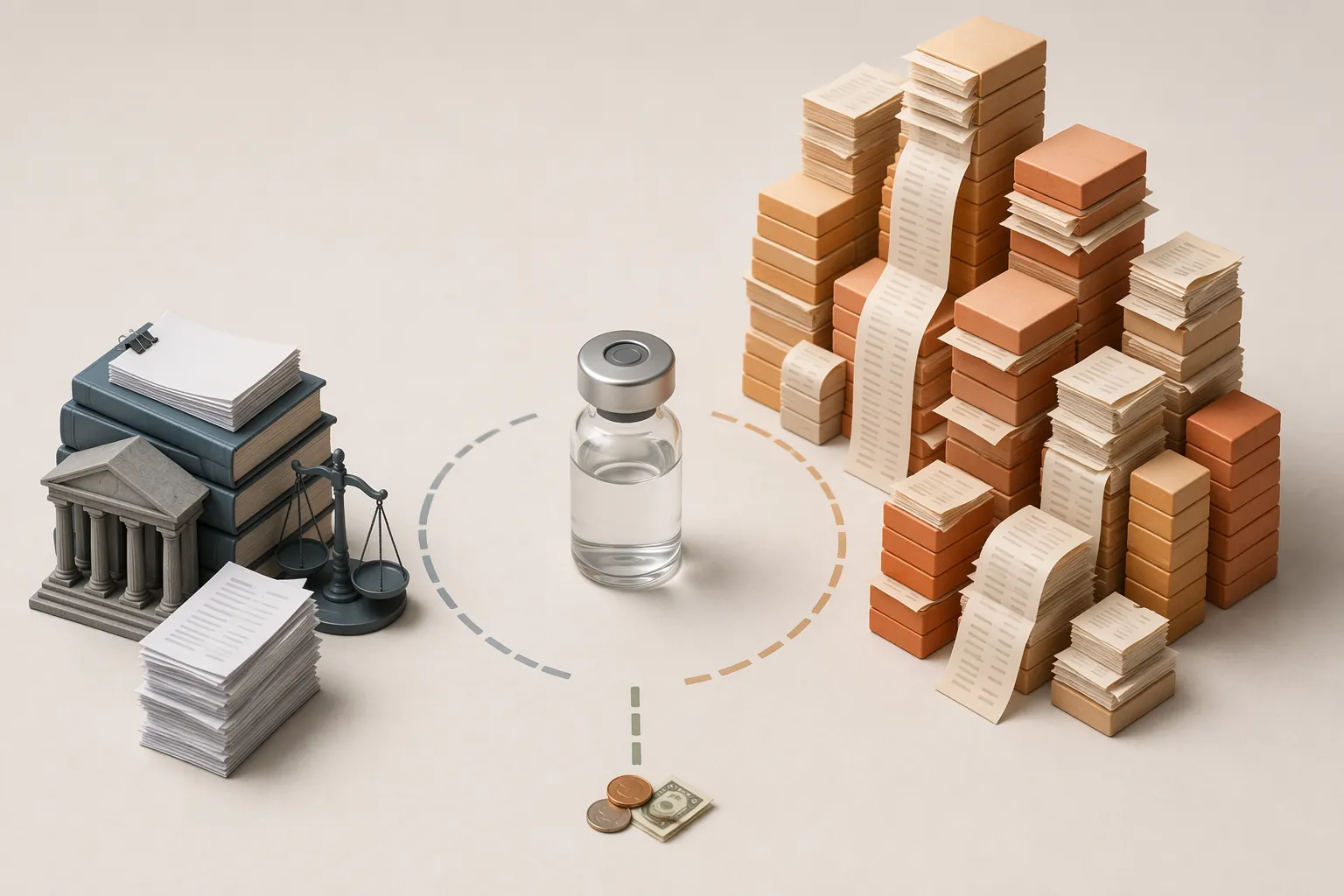
Boyer and colleagues published the pricing decomposition that should be kept next to any U.S. claim about cheaper antivenom. In their model of a $14,000-per-vial antivenom charge, manufacturing accounted for $9 per vial, or about 0.1% of the patient charge. Hospital markups accounted for $10,250 per vial, or 70.1%. Legal and regulatory overhead accounted for $4,100 per vial, or 27.7%. Clinical trials accounted for $300 per vial, or 2.1%, and R&D for $1 per vial, less than 0.01%.[3]
The exact percentages should not be treated as a universal law. The Boyer paper was published in 2015 and modeled a hypothetical arachnid antivenom rather than a current snake antivenom. Contracting, product mix, hospital billing, and regulatory costs may have shifted since then. But the direction of the finding is hard to ignore: in that U.S. model, manufacturing cost was not the lever driving the final charge.[3]
A simple hypothetical illustrates the problem without pretending to model a real contract. If a manufacturer cut production cost dramatically but the largest downstream charges remained unchanged, the patient-facing or payer-facing bill could barely move. The procurement committee would still have to ask who captures the savings, where the price is reset, and whether the billing structure changes. A lower bioreactor cost does not answer those questions.
That is why the phrase AI-designed proteins will make antivenom cheaper needs a location attached to it. Cheaper to manufacture is a production claim. Cheaper for a rural clinic to stock is an access claim. Cheaper for a U.S. patient after emergency department care, hospital billing, insurer adjudication, and cost sharing is a different claim entirely.
Actual treatment episodes confirm that antivenom dominates the bill
The North American Snakebite Registry cost-minimization study gives the discussion a clinical footing. Herzel and colleagues found an average total treatment cost of $31,343 per patient. In the Fab group, antivenom represented 75% of total cost, with total cost reported at $33,347, compared with $19,747 in the F(ab')2 group. Using average sale prices, the estimate rose to $52,572.[4]
This does not reveal the internal mechanics of each vial’s price. It does show why hospitals, payers, and patients care so much about antivenom pricing in the first place. The drug is not a rounding error inside the encounter. It is the dominant cost driver in the treatment episode studied.[4]
The source mismatch matters here. Herzel’s study concerns North American snakebite care, especially the real treatment setting that U.S. hospitals face. The RFdiffusion miniprotein study concerns selected elapid toxins. Boyer’s pricing decomposition models an antivenom charge structure, but not the exact same clinical scenario as current U.S. pit viper treatment. Taken together, the sources support caution, not a clean arithmetic bridge from a mouse rescue experiment to a lower emergency department bill.
Where the claim is strongest

The most defensible version of the optimistic claim is not centered on the U.S. hospital bill. It is centered on settings where production cost, supply reliability, cold-chain burden, and batch consistency more directly determine whether antivenom is available at all. In those settings, a stable, manufacturable recombinant product could be important if it covers the relevant toxins, can be produced at scale, and proves safe and effective in humans.
That is still a chain of conditions. The current miniprotein evidence supports the beginning of the chain: rationally designed proteins can neutralize selected lethal toxins in preclinical experiments. The recombinant manufacturing literature supports the possibility that some alternative scaffolds could be produced at favorable costs under specified assumptions. Neither source proves that a licensed AI-designed antivenom will be affordable in every market.
The U.S. case is less forgiving. If the drug enters a pricing system where manufacturing cost is a tiny fraction of the final charge, reducing that cost may be scientifically impressive and fiscally insufficient. The claim would need evidence about launch price, contracting, hospital acquisition cost, markup behavior, payer reimbursement, patient cost exposure, and competition. The published RFdiffusion data do not supply that evidence.
What value-analysis teams should ask before accepting a pricing claim
The useful response is not to dismiss the science. It is to force the claim into the right evidence category. A biologic can be novel, effective in animals, easier to manufacture, and still fail to reduce the bill that reaches a U.S. patient or payer.
- For efficacy: Which venom species and toxins were tested, and are they the ones driving the local clinical need?
- For readiness: Are there human safety, immunogenicity, pharmacokinetic, dosing, and clinical outcome data?
- For manufacturing: Is there a cost model for the actual product, at the expected production volume, using the intended manufacturing process?
- For pricing: Does the analysis distinguish cost of goods from wholesale acquisition cost, hospital acquisition cost, billed charge, payer allowed amount, and patient liability?
- For U.S. impact: Which party is expected to pass through the savings, and what evidence shows that it will?
Those questions are not academic obstacles. They identify who bears the consequence of a vague claim. If the inventor says production may be cheaper, the hospital still has to decide what it pays. The payer still has to decide what it reimburses. The patient may still see a charge built from layers that have little relationship to the manufacturing process.
The evidence-supported verdict
AI-designed antivenom proteins have earned attention as a scientific advance. The Vázquez Torres study shows precise design, strong binding, high stability in selected constructs, and protection in mouse models against selected toxins.[1] The recombinant-antivenom cost literature gives a credible reason to investigate whether small engineered scaffolds could improve manufacturing economics.[2]
The pricing claim is weaker. In the most detailed U.S. antivenom pricing decomposition available, manufacturing cost represented about 0.1% of a modeled $14,000 vial charge, while hospital markups and legal or regulatory overhead made up the overwhelming majority.[3] Actual U.S. snakebite treatment data show antivenom as the dominant cost driver in care episodes, but they do not show that lower manufacturing cost alone would lower the final bill.[4]
AI-designed antivenoms may matter most where manufacturing cost, stability, and supply directly constrain access. In the U.S., current evidence supports a genuine preclinical advance and a possible production-cost advantage, not a demonstrated pricing remedy.
References
- De novo designed proteins neutralize lethal snake venom toxins. Nature, 2025.
- Cost of Manufacturing for Recombinant Snakebite Antivenoms. Frontiers in Bioengineering and Biotechnology, 2020.
- On 1000-Fold Pharmaceutical Price Markups and Why Drugs Cost More in the United States than in Mexico. American Journal of Medicine, 2015.
- The Cost of Antivenom: A Cost Minimization Study using the North American Snakebite Registry. PubMed, 2025.