
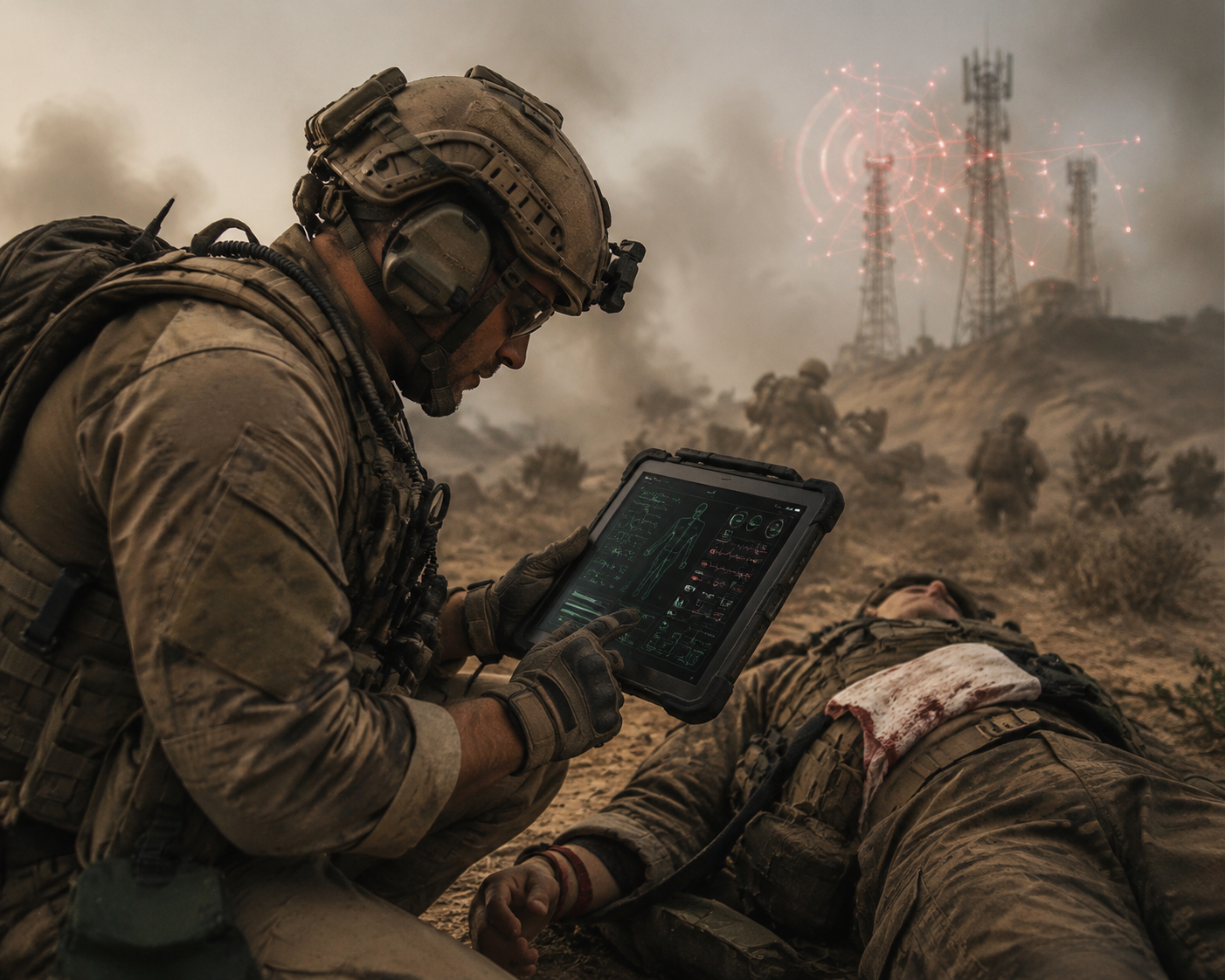
At the point of injury, the task is not abstract classification. It is deciding, fast, who is likely to exsanguinate, who can wait, and who needs evacuation before the window closes. In military casualty assessment, whether the patient is a service member or a civilian caught in the same blast, the job is the same: make a clinically defensible call from partial data, under stress, with a communications picture that may be failing while the assessment is still underway.
What the strongest systems show
ERTRIAGE has the clearest claim set in this space. The company says its system was trained on more than 75,000 combat trauma encounters and reached 96.2% injury severity score prediction accuracy, with a 93.8% correlation with emergency department disposition decisions. It also reports triage completion time falling from 8.3 minutes to 2.7 minutes, medic exposure time dropping from 45 minutes to 18 minutes, and helicopter evacuation efficiency improving by 41%, but those figures come from the vendor's own materials rather than independent validation. [1]
| System | What is reported | Why it matters |
|---|---|---|
| ERTRIAGE | 96.2% ISS prediction accuracy; 93.8% correlation with ED disposition; triage time and exposure reductions [1] | Strongest published signal, but still vendor-published. |
| APPRAISE | Vital-sign-based hemorrhage risk stratification at point of injury; synthetic data used to supplement a small training set [2] | Shows researchers trying to work around sparse prehospital data. |
| TRACIR | Autonomous trauma care system trained on more than 7,000 prehospital records [3] | Broadens the field, but still rests on a small dataset. |
Read together, these are not interchangeable products. They are different attempts to answer the same operational question with different inputs and different levels of maturity: a cleaner commercial claim in ERTRIAGE, a smaller vital-sign model in APPRAISE, and a prehospital system in TRACIR. None of them escapes the basic problem that combat casualty assessment is sparse-data medicine. [2][3]
Why the evidence still bends
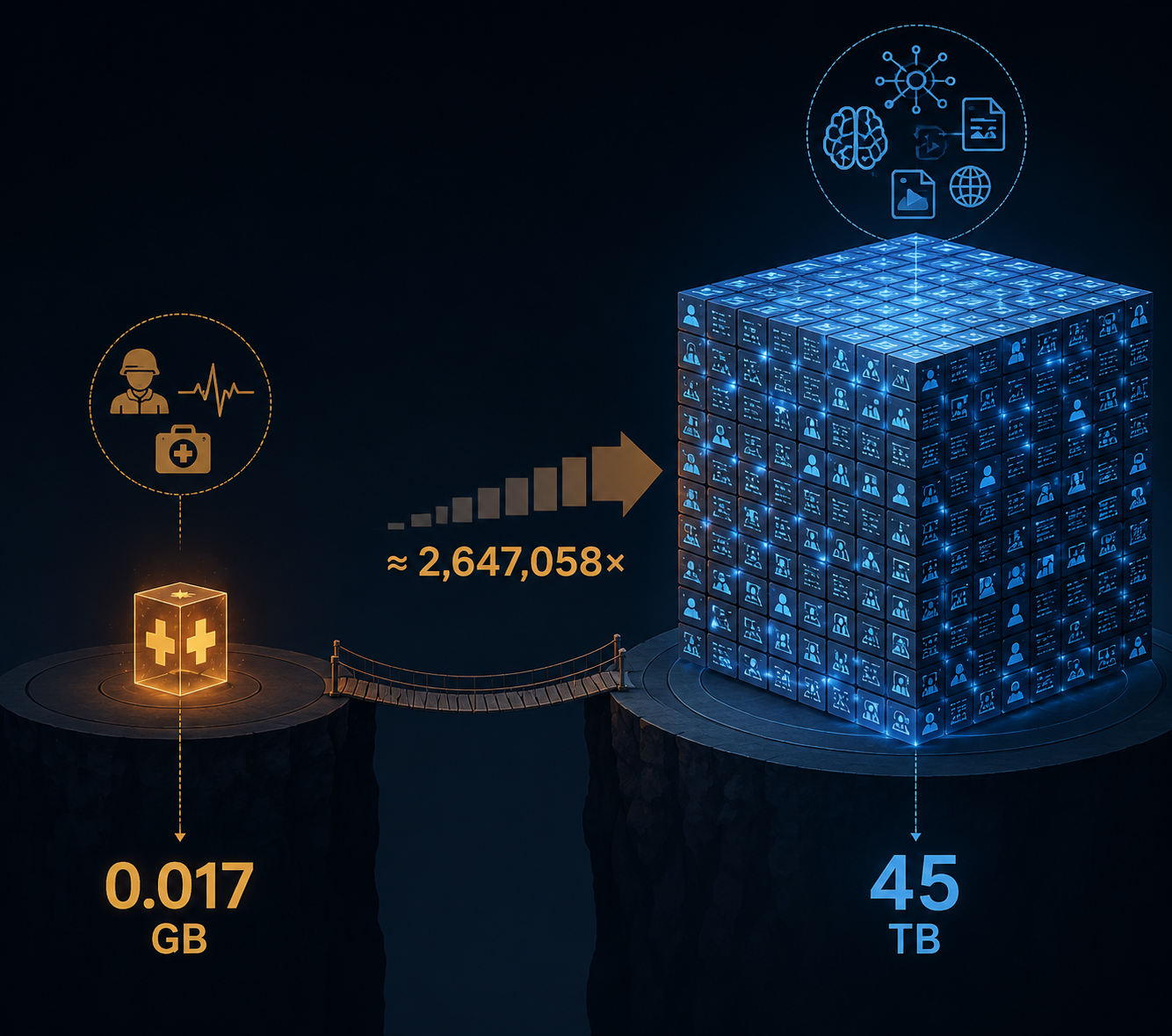
The data problem is not a footnote. One recent review notes that the DoD Trauma Registry contains only about 0.017 GB of structured data across more than 140,000 records, roughly 2.6 million times less than the 45 TB training corpus used for ChatGPT-3. That gap explains why researchers reach for synthetic augmentation and why performance claims built on curated datasets still leave open the question that matters most: what happens when the model sees ugly cases, missing values, and sensor noise in the field? [3]
That is also why DDIL matters more than demo-day accuracy. In a disconnected combat workflow, the model has to survive intermittent connectivity, delayed handoffs, incomplete documentation, and a physiologic picture that changes while the casualty is still being moved. A 2026 narrative review in the Journal of Trauma and Acute Care Surgery frames the near-term use case as human-machine teaming, with wearable sensors and early warning in the shortest horizon, multimodal predictive decision support in the middle, and digital twins much farther out. [4]
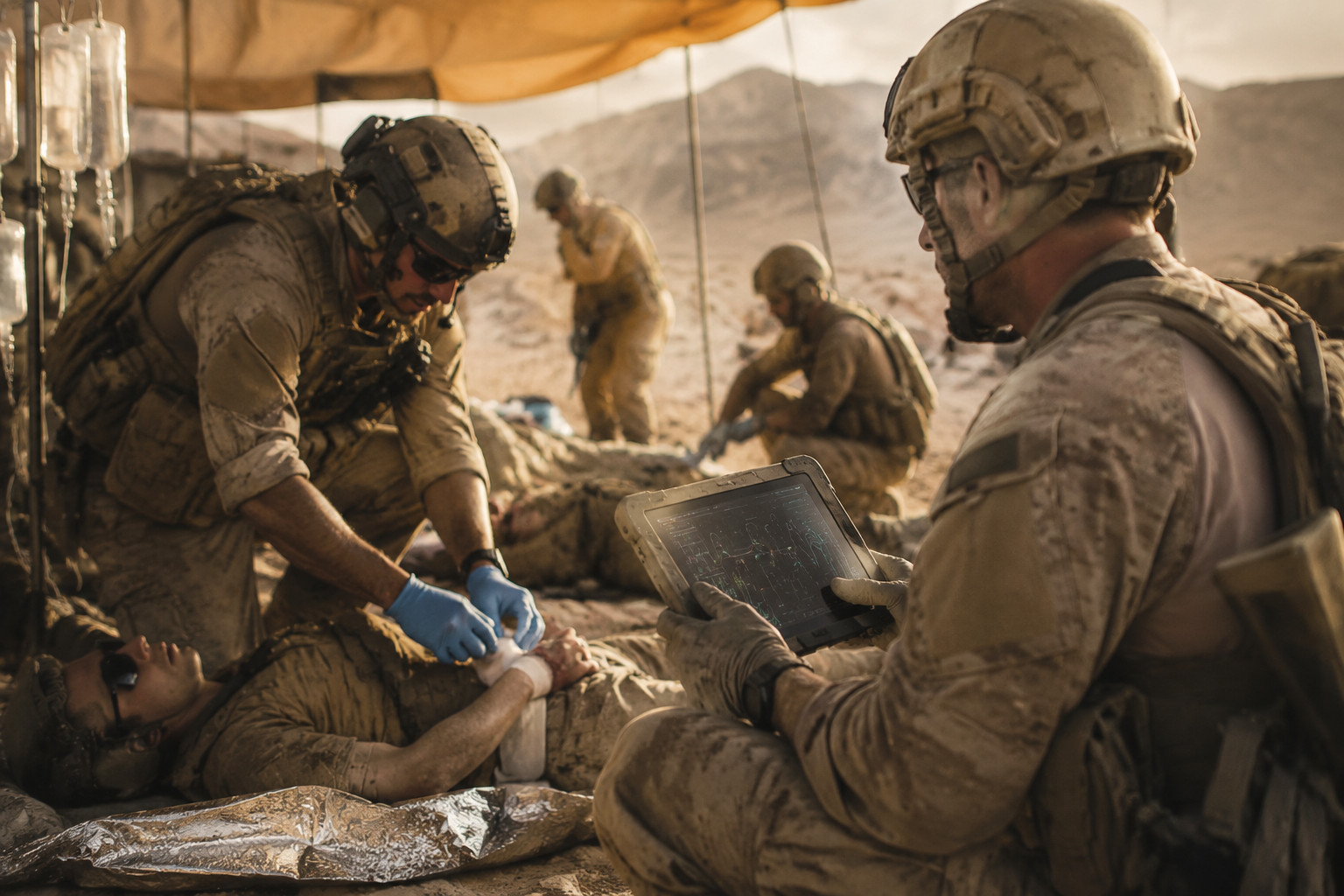
Regulatory movement is real, but it is not the same as operational proof. Defense reporting in 2026 described the first Army AI/software-as-a-medical-device clearance for battlefield hemorrhage triage, which is an important foothold for clinical adoption but still not evidence that a system can be trusted under fire when communications fail and the case mix is hostile to clean model assumptions. [5]
The practical conclusion is narrower than the marketing claims and more useful to the bedside team: AI can plausibly shorten triage, reduce exposure, and make casualty sorting more consistent, but the evidence still supports supported decision-making, not replacement. For now, human-machine teaming is the defensible model, because the gap is not whether these systems can help in a controlled setting; it is whether they remain trustworthy when the network breaks, the patients are messy, and the next decision cannot wait for a second try.
References
- Military & Humanitarian — ERTRIAGE
- AI decision support system aims to improve battlefield triage — GovCIO Media
- AI in Operational Medicine — PMC
- Human-machine teaming in battlefield casualty care — PubMed
- Military medical triage systems modern combat DIU — DefenseScoop, 2026-02-25