The short answer is narrower than the phrase “AI data center power stability risks” often implies. Documented AI data center power instability exists at the grid level. Large load drops, rapid AI training-load swings, and measurable power-quality distortions have been reported by reliability organizations and grid researchers. What has not been shown in the published clinical literature is the next link in the chain: a measured increase in clinical-AI downtime, latency outliers, unsafe outputs, or diagnostic-performance degradation caused by those power events.
That distinction matters in procurement. A health system should not accept a vendor’s vague assurance that “the cloud is resilient” as a substitute for dependency mapping. It also should not turn grid-level events into a quantified patient-safety claim without evidence that the clinical tool actually failed, slowed, or degraded under those conditions. The responsible position is uncomfortable but usable: data center power dependency is an unquantified planning gap, not yet an established clinical-AI reliability risk.
What the grid evidence actually establishes
The strongest evidence begins outside health care. The North American Electric Reliability Corporation’s 2026 State of Reliability overview describes data-center load-drop events of 1,800 MW in February 2025 and 1,300 MW in June 2025. NERC warns that as individual campuses approach gigawatt scale, customer-initiated load reductions can move from ordinary contingency planning into system-level reliability concern.[1]
Those are not abstract energy-demand projections. They are reliability events involving sudden removal of large electrical load. In a hospital review meeting, that is the part worth separating from generic commentary about AI’s electricity use. The relevant operational question is not whether AI consumes a lot of power over a year. It is whether a large compute campus can change its electrical behavior quickly enough, and at sufficient magnitude, to affect grid stability assumptions.
A Texas A&M comprehensive review helps explain why AI workloads deserve separate treatment from conventional data-center demand. The review separates AI data center grid impacts into long-term planning, short-term operation and market effects, and real-time dynamics and stability. It also reports that AI training loads can fluctuate by hundreds of MW within sub-second intervals.[2] That timescale is the clinical-informatics clue: it is too fast to fit comfortably into the procurement language of annual uptime averages and too mechanical to dismiss as ordinary cloud growth.
| Evidence link | What is supported | What is not supported |
|---|---|---|
| Grid events | Large data-center load drops have been documented by reliability bodies. | They do not, by themselves, show a clinical-AI failure. |
| Load behavior | AI training loads can fluctuate by hundreds of MW in sub-second intervals. | The evidence does not identify which clinical AI services were exposed. |
| Power-quality propagation | Residential sensor data show distortion patterns near large data-center clusters. | The analysis does not isolate every possible harmonic source. |
| Health-system dependency | Vendor, API, and SaaS failure modes are underplanned in many health-system processes. | The proxy evidence does not attribute incidents to data center power instability. |
The 2024 Virginia “Data Center Alley” event gives the issue a concrete precedent. Reported accounts identify a drop of about 1,500 MW from more than 60 data centers after protective disconnection. The practical significance is not that every such event threatens a hospital AI tool. It is that hyperscale digital infrastructure can behave as a large, fast-moving grid actor rather than a passive background utility customer.[1]
Power-quality evidence widens the concern, with limits
The Bloomberg and Whisker Labs sensor analysis, reported by Data Center Dynamics, adds a different kind of signal. Across roughly 1 million residential sensors, more than 75% of highly distorted power-quality readings occurred within 50 miles of large data center clusters, and more than 50% of the worst readings occurred within 20 miles.[3] That finding matters because it points to propagation beyond the data-center fence line rather than only to internal facility engineering.
It should not be over-read. Harmonic distortion near data-center clusters is not the same thing as a measured outage in a clinical AI service. The analysis also has confounding risks: solar inverters, EV chargers, and industrial equipment can contribute to harmonic patterns. The reported association survived controls for those factors, but the evidence remains proximity and power-quality evidence, not a clinical incident study.[3]
IEEE Spectrum’s reporting on volatile AI power use and grid oscillation findings is useful as an accessible technical overview, particularly around harmonics and UPS-related oscillation concerns.[4] It is less important as a clinical source. For hospital AI governance, the value is in sharpening the dependency question: if a vendor’s clinical tool relies on external inference endpoints, third-party APIs, or SaaS orchestration, which part of that path is exposed to power-quality events, and who has evidence that the exposure is controlled?
The missing link is still clinical measurement
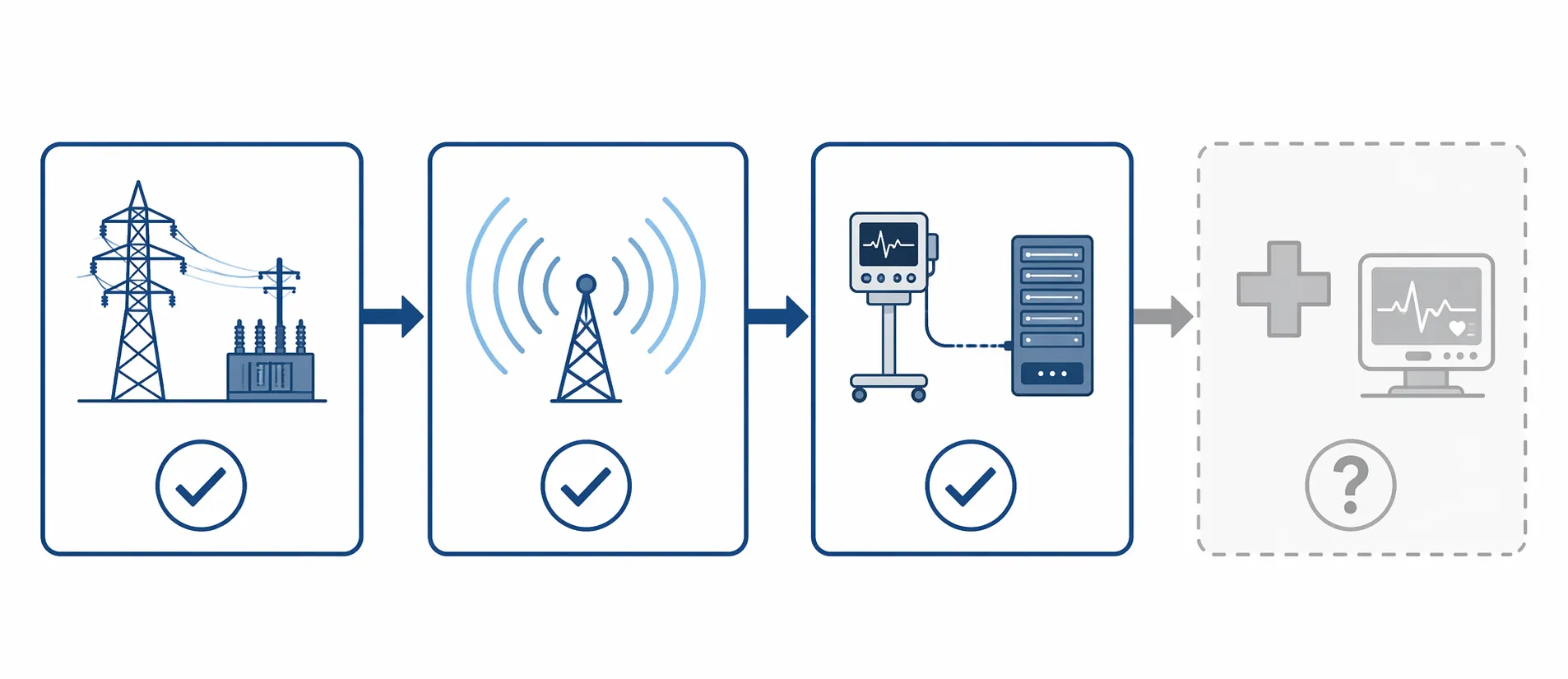
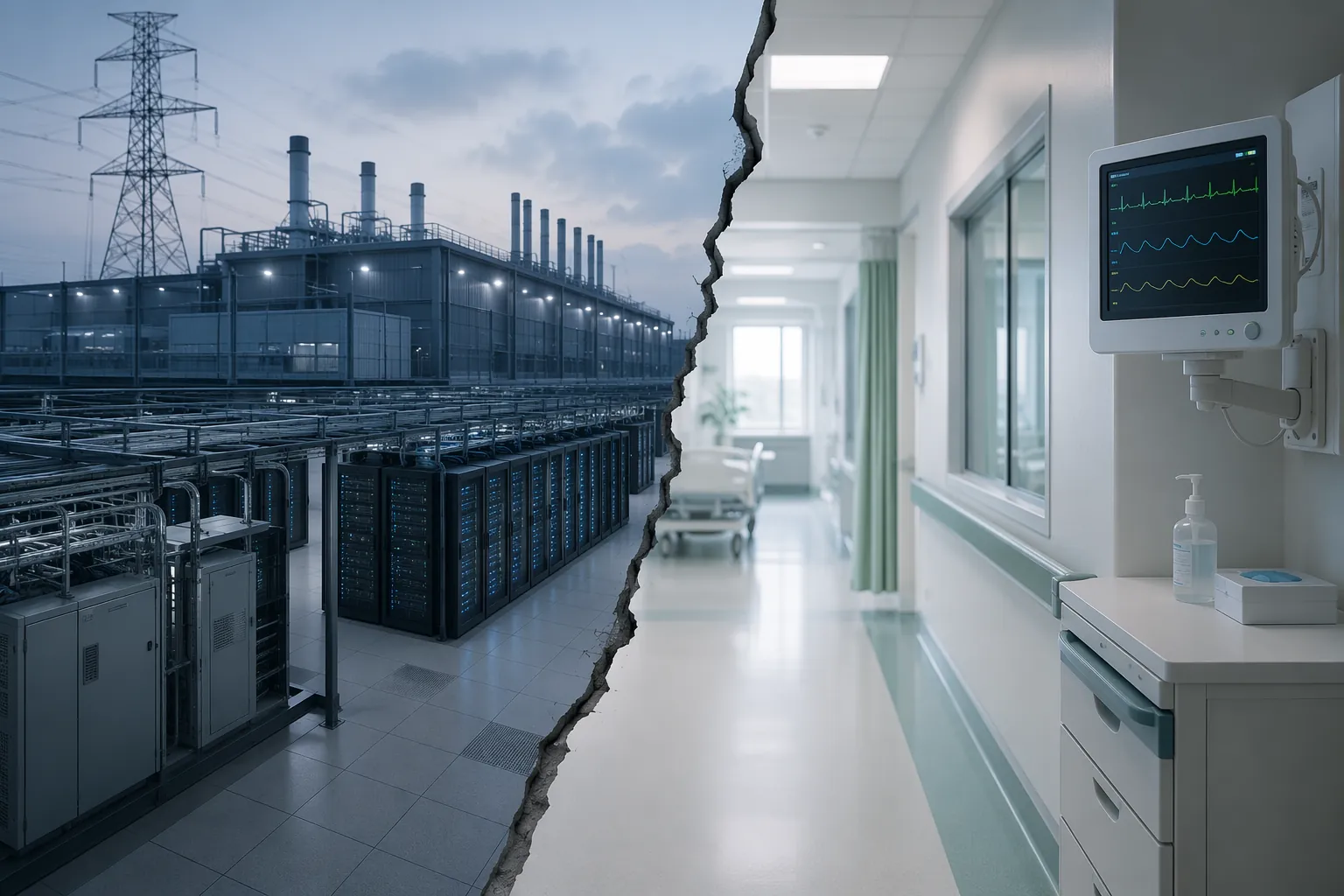
A complete evidence chain would need four links: a documented grid or power-quality event; a plausible propagation mechanism into the AI service stack; a named clinical-AI dependency exposed to that pathway; and a measured clinical effect such as downtime, latency, unavailable recommendations, delayed reads, changed output quality, or degraded diagnostic performance. The first two links are increasingly documented. The third is often discoverable during vendor review. The fourth is the gap.
No source in the available research set reports a peer-reviewed measurement of clinical-AI tool failure rates, latency outliers, or diagnostic accuracy degradation attributable to AI data center power instability. That absence does not prove safety. It means the risk has not been clinically quantified. A procurement committee should be careful with any claim that converts NERC load drops or harmonic readings into a numerical clinical-AI failure probability.
This is where ordinary uptime language can mislead. A vendor may have excellent internal redundancy and still leave a health system without a clear answer about inference routing, API dependencies, model-hosting geography, queue behavior under regional degradation, or fallback workflows when an upstream service is unavailable. Conversely, the existence of grid instability does not mean the vendor’s clinical application failed. The review burden is to locate the handoff, not to assume the outcome.
Health systems already have the governance gap
Censinet’s July 2026 analysis is useful precisely because it is not proof of data-center power causality. It reports that 74% of U.S. hospitals describe shared accountability for predictive AI, while 66% have a dedicated AI committee. It also reports that AI safety incidents in health care rose 56.4%, from 149 to 233, between 2023 and 2024, and identifies API failures, SaaS outages, and vendor disruptions as a distinct failure mode for which many health systems lack planned fallback workflows.[5]
That is proxy evidence, not causal evidence. It shows that health systems are already dependent on external AI service chains they do not always operationalize in downtime planning. It does not show that a data center load drop caused a missed alert, a delayed triage result, or an incorrect model output. Its procurement value is different: it identifies where the clinical organization is exposed if any upstream infrastructure failure occurs, including but not limited to power-related instability.
E&E News and POLITICO’s reporting on NERC Large Loads Task Force work adds another cautionary layer, including an ERCOT frequency-excursion analysis in which a loss above 2,600 MW could drive frequency to 60.4 Hz.[6] That kind of scenario belongs in grid-reliability planning. In a hospital AI review, it should prompt questions about service continuity and regional dependencies, not a direct assertion that clinical AI will become unsafe at a specific grid threshold.
What procurement can responsibly ask
The practical response is not to reject cloud-hosted clinical AI because grid evidence exists. It is to stop treating upstream infrastructure as outside the clinical review boundary. If a model, rules engine, orchestration layer, or user-facing application depends on external compute, the health system needs enough information to decide whether a transient upstream disruption becomes a clinical workflow interruption.
- Ask vendors to identify all externally hosted components required for normal clinical use, including inference endpoints, APIs, model-monitoring services, authentication, queueing, and notification layers.
- Require service-level language that distinguishes full outage, degraded latency, stale output, partial regional failover, and silent fallback to a lower-capability mode.
- Ask whether uptime claims are measured at the application layer visible to clinicians or only at the infrastructure layer controlled by the vendor or cloud provider.
- Require documentation of regional redundancy, failover testing frequency, recovery-time assumptions, and whether failover has been tested under abrupt load or dependency loss.
- Map the clinical fallback: who notices degradation, who pauses the tool, what manual workflow replaces it, and how delayed or missing AI output is communicated to clinicians.
The most important contract question is often not “Do you have redundancy?” but “What exactly happens to this clinical workflow when your upstream dependency is degraded?” A radiology triage aid, a sepsis prediction alert, an ambient documentation system, and a prior-authorization assistant do not carry the same clinical consequence when unavailable. The same infrastructure event may be tolerable for one workflow and unacceptable for another.
A defensible evidence verdict
The evidence supports a real grid-level phenomenon: large AI data center load drops, rapid AI workload fluctuations, and power-quality distortion patterns near large data-center clusters. The evidence also supports a health-system governance problem: many organizations have not fully planned for vendor, API, and SaaS failure modes in AI-enabled workflows.
The evidence does not yet support the stronger claim that AI data center power instability is a measured, material cause of clinical-AI tool failure. No cited source closes the chain from grid event to exposed clinical-AI dependency to observed clinical degradation. Until that link is measured, risk language should stay disciplined.
| Claim | Evidence status | Procurement posture |
|---|---|---|
| AI data center loads can create grid-relevant instability. | Supported at the infrastructure level. | Ask vendors to document hosting, failover, and dependency controls. |
| Power-quality effects can propagate beyond a facility boundary. | Supported by sensor analysis with confounding limitations. | Do not convert proximity findings into clinical risk scores. |
| Clinical-AI tools have failed because of data center power instability. | Not directly demonstrated in the available evidence. | Do not label as an established clinical-AI reliability risk. |
| Upstream infrastructure dependency is underplanned in AI governance. | Supported as a planning-gap concern. | Include it in vendor review, uptime assumptions, and downtime workflows. |
For now, health systems should treat AI data center power stability risks as a dependency question that belongs in AI governance and procurement documentation. They should not treat it as a proven clinical-harm mechanism. The right file to open is not a disaster scenario. It is the vendor architecture diagram, the downtime procedure, the API dependency list, and the service-level clause that says who is responsible when the upstream system is not simply “down,” but degraded.
References
- 2026 State of Reliability Overview, North American Electric Reliability Corporation, nerc.com/globalassets/programs/rapa/pa/nerc_sor_2026_overview.pdf
- Comprehensive Review, Texas A&M, arxiv.org/html/2509.07218v4
- AI data centers causing distortions in US power grid - Bloomberg, Data Center Dynamics, datacenterdynamics.com/en/news/ai-data-centers-causing-distortions-in-us-power-grid-bloomberg/
- AI's Volatile Power Use Quietly Tests Grid Limits, IEEE Spectrum, spectrum.ieee.org/data-centers-grid-instability
- What Health Systems Haven't Yet Planned for in AI System Failure, Censinet, July 2026, censinet.com/perspectives/health-systems-ai-system-failure-planning-gap
- AI power demand creates high likelihood, high impact grid risks, E&E News / POLITICO, eenews.net/articles/ai-power-demand-creates-high-likelihood-high-impact-grid-risks/