
The Equity Gap That Makes This Deployment Context Different
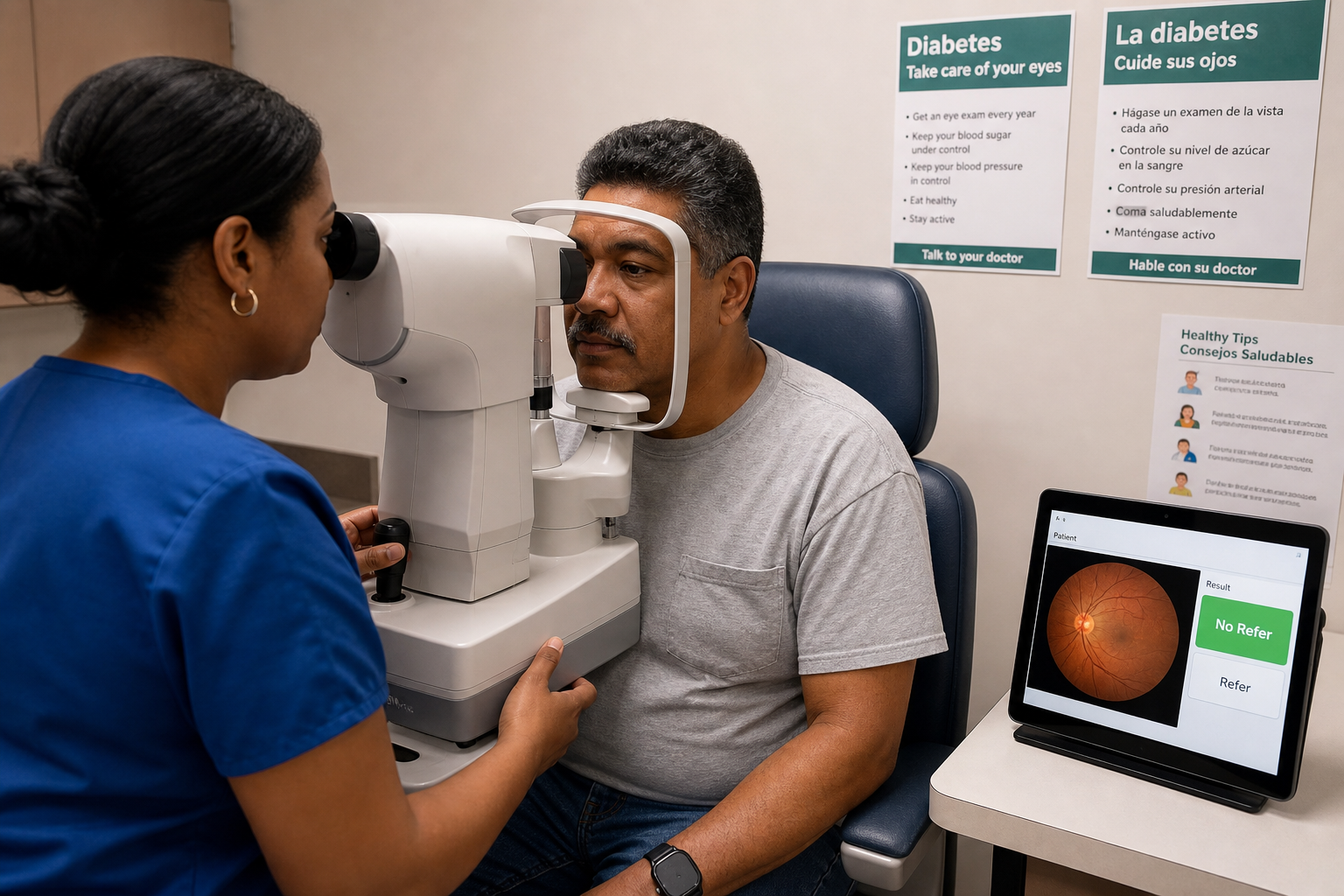
Fewer than half of people with diabetes in the United States receive annual diabetic retinopathy (DR) screening — despite it being a guideline-recommended standard of care. The screening gap is not evenly distributed. Black and Hispanic patients face higher rates of DR prevalence and, simultaneously, lower rates of annual eye exams. Diabetic retinopathy remains a leading cause of preventable blindness in working-age adults in the US, and it is disproportionately concentrated in the populations least likely to be screened on schedule.
Community health centers and Federally Qualified Health Centers (FQHCs) serve the populations at the center of this gap — people without private insurance, rural residents, recent immigrants, and communities of color with high rates of type 2 diabetes. These are the settings where autonomous AI DR screening carries its greatest potential equity impact. They are also the settings where deployment is structurally the hardest.
That tension — equity mandate meeting implementation gap — is what this article is about. It does not repeat the tool-level overview, regulatory history, or pivotal trial statistics covered in the AI diabetic retinopathy screening landscape article. Instead, it focuses on what that article does not: what real-world implementation evidence shows in safety-net settings, where deployment fails and why, and what early adopters have learned about making these tools work for the patients who need them most.
Why CHC and FQHC Deployment Is Structurally Different
Most of what has been published about AI DR screening implementation comes from academic health systems. Johns Hopkins Medicine, Stanford, Temple University — the early evidence base is concentrated at institutions with dedicated IT teams, ophthalmology departments on campus, and the organizational bandwidth to run implementation projects. That experience does not transfer directly to safety-net settings.
A 2025 synthesis in Ophthalmology Science that reviewed US health system adoption found that both LumineticsCore and EyeArt have more than five academic health system adopters. FQHC adoption, by contrast, was concentrated at only a handful of sites — most prominently Cahaba Medical Care and Tarzana Treatment Centers. The gap reflects four structural differences that any CHC or FQHC considering deployment needs to account for.
- Limited IT and informatics capacity. Most CHCs do not have in-house AI integration staff or clinical informatics teams. EHR integration — which is necessary for ordering, billing, and referral scheduling — requires vendor coordination and internal workflow redesign that academic centers can absorb but safety-net clinics often cannot without dedicated project support.
- Fewer ophthalmology referral options. In many communities served by FQHCs — especially rural and peri-urban areas — ophthalmology access is limited. A positive AI screen that cannot be followed by a timely specialist appointment does not prevent vision loss. The referral pathway is the critical constraint, and CHCs have less leverage over it than academic health systems with on-site ophthalmology.
- Tighter operating margins with a higher proportion of Medicaid and uninsured patients. The ~$40 Medicare reimbursement rate for CPT 92229 may not cover camera, maintenance, and subscription costs at low-volume sites. CHCs cannot subsidize deployment through specialty revenue in the way academic centers can.
- Higher disease burden per patient. CHC patients with diabetes often have longer duration of disease, higher rates of hypertension and chronic kidney disease, and more comorbidities than patients at academic medical center primary care sites. This raises the clinical stakes and affects both gradability rates and the volume of follow-up care generated by positive screens.
What the Real-World Equity and Adherence Evidence Shows
The strongest real-world evidence for AI DR screening in underserved populations comes from a propensity-score-weighted retrospective analysis of more than 17,000 patients with diabetes across Johns Hopkins Medicine primary care sites.
Published in npj Digital Medicine in 2024, the Liu et al. study compared diabetic eye disease (DED) testing adherence at sites that switched to AI-assisted screening versus those that did not, from 2019 to 2021. AI-switched sites saw a 7.6 percentage point greater increase in testing adherence than non-AI sites (p<0.001). The equity signal was more pronounced: Black and African American patients at AI-switched sites experienced a 12.2 percentage point increase in adherence, compared with a 0.6 percentage point decrease at non-AI sites over the same period. The adherence gap between Asian Americans and Black patients shrank from 15.6% in 2019 to 3.5% in 2021 at AI-switched sites.
A follow-on Hopkins study by Leong et al., published in npj Digital Medicine in March 2026, examined downstream specialist access in a cohort of 3,745 patients referred from Hopkins primary care. AI-assisted screening was associated with a statistically significant increase in presentation to eye care specialists specifically among African American patients (OR=1.15, 95% CI: 1.02–1.29, p=0.022) after inverse-probability-weighted regression. The AI group was more likely to have hypertension and chronic kidney disease — a higher-risk profile overall.
The ACCESS RCT (Wolf et al., Nature Communications 2024) offers RCT-level evidence in a distinct population: 164 racially and ethnically diverse youth with diabetes (35% Black, 6% Hispanic, 47% Medicaid-insured). The autonomous AI intervention achieved 100% diabetic eye exam completion versus 22% in the standard-of-care control arm. Among participants who screened positive, 64% completed follow-through with an eye care provider, compared with 22% in the control group. The authors note that follow-through rates after teleophthalmology screening with referable DR are as low as 5–30% in other studies — making the point-of-care, immediate-result model a meaningful differentiator.
Early-adopter CHC operators provide a ground-level view of what these results look like in practice. Based on interviews with San Ysidro Health, Urban Health Plan, and Howard Brown Health, the Commonwealth Fund reported in March 2026 that approximately 60% of patients tested negative, 20% positive, and 15–20% inconclusive in real-world CHC deployments. That distribution matters for triage value: in a high-prevalence CHC population, one in five patients is identified as needing specialist follow-up in a single primary care visit.
| Study | Design | Population | Key Finding | Caveat |
|---|---|---|---|---|
| Liu et al. (npj Digital Medicine, 2024) | Retrospective propensity-score analysis | >17,000 patients, Johns Hopkins Medicine | +7.6 pp adherence vs. non-AI sites; Black/AA patients +12.2 pp vs. –0.6 pp | Observational; causality not established |
| Leong et al. (npj Digital Medicine, 2026) | Retrospective observational | 3,745 patients, Hopkins primary care referrals | AI screening associated with increased eye specialist presentation by AA patients (OR=1.15, p=0.022) | Exploratory; hypothesis-generating only |
| Wolf et al. / ACCESS RCT (Nature Communications, 2024) | Pre-registered RCT | 164 diverse youth with diabetes, 47% Medicaid | 100% diabetic eye exam completion vs. 22% standard care; 64% vs. 22% follow-through after positive screen | Youth population; may not generalize to adult CHC settings |
| Commonwealth Fund CHC interviews (2026) | Qualitative / interview-based | San Ysidro Health, Urban Health Plan, Howard Brown Health | ~60% negative, 20% positive, 15–20% inconclusive in practice | Not peer-reviewed; qualitative data only |
Algorithm Performance Is Not Uniform: What Head-to-Head Evidence Shows
A common assumption in deployment discussions is that any FDA-cleared AI DR screening system will perform comparably to any other. The evidence does not support that assumption.
An independent evaluation of eight CE-marked automated retinal image analysis systems on 201,438 consecutive screening encounters from the North East London Diabetic Eye Screening Programme found false-positive rates ranging from 4.3% to 61.4% across vendors on the same dataset. Screen-positive rates ranged from 23% to 74%. Applied to the 2.2 million people screened annually in England, the best-performing system would remove approximately 1.7 million encounters from the human grading queue; the worst would remove only 572,000.
False-positive rate variation matters acutely in CHC and FQHC settings for a reason that does not apply in the same way to academic health systems: ophthalmology referral capacity is scarce. A system generating false positives at 60% of encounters will exhaust a community's limited ophthalmology appointments with patients who do not have referable disease — delaying care for those who do.
There is an additional evidence gap that matters for system selection. AEYE-DS, the third FDA-cleared autonomous screening tool, has no published peer-reviewed real-world implementation studies as of June 2026. This does not mean the system does not perform — it means that the evidence base for real-world CHC or FQHC deployment is thinner than for LumineticsCore or EyeArt. Procurement decisions should account for this asymmetry.
| Evaluation Dimension | Range Observed (North East London DESP) | Why It Matters for CHCs |
|---|---|---|
| False-positive rate (no observable DR) | 4.3% – 61.4% | High false-positive rates consume scarce ophthalmology referral slots with patients who do not have referable disease |
| Screen-positive rate (all encounters) | 23% – 74% | Wide variation on same dataset indicates substantially different thresholds, not just different populations |
| Workload reduction potential | 26% – 77% of encounters removed from human review | Directly affects staffing model and operational cost justification at low-volume CHC sites |
The Post-Screening Referral Bottleneck: The Primary Failure Point
The AI delivers a result in minutes. The ophthalmology appointment can take months. That gap is not a marginal implementation problem — it is the primary failure mode for autonomous AI DR screening in safety-net settings.
An implementation study at a community health center in rural Punjab, India (JMIR Medical Informatics, 2025) found that of 64 patients referred following a positive AI screen, only 14% attended a recommended ophthalmologist follow-up. Identified barriers included harvesting season, lack of family support, financial dependence, and time constraints. The study concluded that low referral adherence underscores the need for effective, coordinated referral pathways before introducing new screening models.
US data confirms the same structural problem. The Ophthalmology Science (2025) synthesis found that Temple University's experience illustrates the difference a dedicated patient care navigator makes: after hiring one, scheduling completion improved from 30% to 57%, follow-up completion improved from 26% to 35%, and time-to-scheduling dropped from 46 days to 8 days. No change to the AI algorithm. No change to the camera protocol. The navigator was the intervention.
The ACCESS RCT result reinforces the same point from a different angle: 64% follow-through after a positive screen in the point-of-care AI arm, versus 22% in standard care. The difference was not algorithmic — it was structural. Point-of-care diagnosis with immediate results, communicated during the visit, produced meaningfully better downstream follow-through.
The technology 'doesn't solve the persistent challenge of needing better access to ophthalmologists to do follow-up care.'
That practitioner assessment, from a CHC leader interviewed by the Commonwealth Fund, is the clearest summary of where deployment investment should be directed: the screening step is solved. The referral pathway is not.
EHR integration that enables same-visit ophthalmology appointment scheduling is the other critical enabler. If a primary care staff member can schedule the eye appointment in the same workflow that generates the AI result, follow-through rates improve substantially. If scheduling requires a separate call, a portal message, or a paper referral, a meaningful proportion of patients will not complete it.
The DRES-POCAI Trial: What It Is Testing and What to Watch
The most methodologically rigorous evidence currently in progress for the FQHC deployment question is the Diabetic Retinopathy Screening Point-of-Care Artificial Intelligence (DRES-POCAI) trial, conducted at San Ysidro Health in San Diego County.
San Ysidro Health is an FQHC serving over 121,000 San Diego County residents from medically underserved minority communities with high rates of diabetes. Its DR screening rate at baseline was approximately 54% — well below the national standard but representative of the real-world FQHC context where AI intervention has the most to offer.
The DRES-POCAI trial (NCT06721351) is a multicomponent RCT testing AI-powered DR screening with full EHR integration within the primary care setting. The trial is designed to evaluate whether the intervention improves quality performance measures, facilitates clinical decision-making, accelerates timely identification of DR, and improves linkage to guideline-concordant care. The trial protocol was published in JAMA Network Open in 2025.
What makes DRES-POCAI the most important near-term evidence to watch is its combination of features no prior study has assembled: an FQHC setting, full EHR integration, a randomized design, and a population with documented screening gaps and high disease burden. If results confirm the effectiveness signals from the Hopkins observational data and the ACCESS RCT, they will provide the most direct implementation evidence base to date for safety-net AI deployment.
Implementation Requirements in Resource-Constrained Settings
The implementation friction points at CHCs and FQHCs are predictable — and documented. The following synthesizes findings from the Ophthalmology Science (2025) systematic review of US adopters, Commonwealth Fund CHC operator interviews (2026), and published real-world performance studies. For a broader look at AI decision support deployment in primary care settings, see AI Clinical Decision Support in Primary Care: Evidence, Applications, and Deployment Realities.
| Implementation Factor | What CHC Operators Report | Mitigation Approach |
|---|---|---|
| Camera setup and IT integration | Vendors claim one day of training; real proficiency takes weeks of iterative practice with the device and workflow | Plan for a 4–8 week ramp period with peer mentoring; do not count on full-volume productivity from week one |
| EHR integration | Critical for ordering, billing documentation, and same-visit referral scheduling; incomplete integration is a primary adoption failure point | Require EHR integration with your specific system as a procurement condition; verify with existing customer sites using your EHR |
| Non-mydriatic image gradability | 49%–75% gradability in real-world CHC deployments; older patients with cataracts are disproportionately ungradable — the same patients with the highest DR risk | Protocol for ungradable images must be established before go-live; these patients cannot simply be rescheduled without a follow-up plan |
| Patient care navigator staffing | Without a dedicated navigator, scheduling completion rates fall to 30% or below; navigator reduces time-to-scheduling from 46 to 8 days (Temple University data) | Budget for navigator role from deployment start; this is not a nice-to-have in high-volume or high-risk populations |
| Incidental non-DR findings | AI detects DR and diabetic macular edema only; 23.5% of patients in a real-world Belgian study had non-DR findings (optic disc pathology, suspected AMD, retinal vascular anomalies) that the AI did not flag | Establish a clinical protocol for fundus images reviewed by a clinician where non-DR pathology is suspected; do not rely on AI to catch all pathology |
| Stakeholder alignment | Top-down health system commitment and ophthalmology–primary care co-ownership were identified as the most consistent success factor across early adopters | Engage ophthalmology leadership in program design before procurement; primary care–only deployment without ophthalmology partnership creates downstream referral failures |
Reimbursement Sustainability at Safety-Net Organizations
The financial sustainability of autonomous AI DR screening at low-volume CHC sites is a genuine open question, not a solved problem.
CPT 92229 (point-of-care automated analysis of retinal images) had a 2023 Medicare base reimbursement rate of $40.28. Camera acquisition, ongoing subscription or per-use software fees, and staff time for image capture may not be recoverable at this rate in a site seeing relatively few diabetic patients per day. Writers should verify the current fee schedule rate at time of publication using the CMS Physician Fee Schedule search tool, as rates are updated annually.
A database analysis covering roughly 40% of US CMS claims found only 15,097 CPT 92229 claims from 2021 to 2023, concentrated in metropolitan ZIP codes with academic medical centers. Three cities — Philadelphia, Dayton, and New Orleans — accounted for the most claims. This geographic concentration is consistent with the broader adoption pattern: safety-net sites have the most to gain clinically but are least represented in current billing data.
For CHCs and FQHCs, reimbursement sustainability typically requires a multi-source strategy rather than reliance on 92229 alone. Potential supplemental pathways include:
- Value-based care incentives tied to HEDIS DRE (Dilated Eye Exam) measure performance, where improved screening rates generate quality bonus payments.
- Quality improvement grants from state Medicaid agencies, private foundations, or the Health Resources and Services Administration (HRSA), which funds FQHCs through Section 330.
- Section 330 grant flexibility for health IT investments that directly support quality improvement metrics required for HRSA reporting.
- Bundled care revenue from downstream ophthalmology visits generated by increased screening — relevant in integrated health systems with affiliated specialty care.
What Implementation Success Looks Like: Lessons from Early Adopters
Across the documented early adopters — Cahaba Medical Care, Tarzana Treatment Centers, San Ysidro Health, Urban Health Plan, Howard Brown Health, Temple University, and Johns Hopkins Medicine primary care sites — consistent patterns emerge that cut across vendor choice and geography.
- Top-down organizational commitment. Every successful deployment identified in the Ophthalmology Science synthesis had health system leadership driving the initiative, not a single champion in primary care. Without executive-level backing, EHR integration and billing setup stall.
- Ophthalmology–primary care co-ownership. The deployment works best when ophthalmology and primary care leadership jointly own the program — not just primary care using a tool that generates referrals ophthalmology was not consulted on. Co-ownership means referral pathway problems get solved, not ignored.
- EHR integration before go-live. Sites that launched without full EHR integration for ordering, billing, and referral scheduling consistently reported lower follow-through rates. This is not a nice-to-have — it is a prerequisite.
- Dedicated patient care navigator. The Temple University data is the clearest illustration, but the pattern appears across multiple adopters: a staff member specifically responsible for scheduling and tracking follow-up substantially changes the trajectory of referral completion.
- Realistic staff training expectations. Vendors may claim one day of training. CHC operators report that true proficiency — image quality, patient positioning, troubleshooting — develops over weeks. Staffing plans should reflect this.
'We should be using every single tool we have to meet the needs of our populations. Why not use the best of the best so that we can have equity?'
That framing, from San Ysidro Health's VP of Population Health, captures the equity mandate that makes this technology worth the implementation work. The tools are not perfect, and the referral infrastructure remains a limiting constraint. But for a CHC serving a population where one in five diabetic patients will screen positive and most would otherwise go unscreened, the case for implementation is not primarily economic — it is clinical.
Known Limitations of the Current Evidence and Technology
A calibrated deployment decision requires understanding what autonomous AI DR screening cannot do, not just what it can. The limitations are both technological and evidentiary.
- Algorithm scope is narrow. FDA-cleared autonomous AI DR screening systems detect diabetic retinopathy and diabetic macular edema. They do not detect glaucoma, retinal detachment, choroidal melanoma, age-related macular degeneration, or other pathology that may be visible on the same fundus photograph. In one real-world Belgian cohort, 23.5% of patients had non-DR ocular findings — including optic disc pathology, suspected AMD, and retinal vascular anomalies — none of which the AI flagged. Deployment protocols must address what happens to these images.
- Ungradable images disproportionately exclude the highest-risk patients. Non-mydriatic gradability ranges from 49% to 75% in real-world CHC deployments. Older patients with cataracts — those with the longest diabetes duration and highest DR risk — are excluded at the highest rates. Published validation performance figures typically exclude ungradable images, meaning headline sensitivity and specificity statistics do not apply to this subgroup.
- The AI digital divide is an active structural barrier. Safety-net providers serve the populations with the highest DR burden and the lowest screening rates, but have the least organizational AI capacity. This is not a problem that awareness alone solves. It requires investment in IT infrastructure, staff training, and sustained organizational support that most CHCs currently lack.
- The evidence base has significant gaps. The two Hopkins studies are retrospective and from a single academic health system. AEYE-DS has no published peer-reviewed real-world implementation studies. Head-to-head performance benchmarks come from CE-marked systems in a UK NHS context, not FDA-cleared US tools. The DRES-POCAI RCT at an FQHC has not yet published full outcomes. Readers evaluating these tools should apply the same interpretive standards to this evidence that they would apply to any observational AI performance literature — as covered more broadly in Artificial Intelligence in Medical Diagnosis: What the Clinical Evidence Actually Shows.
- The referral infrastructure dependency is non-negotiable. As the North East London DESP evaluation noted, 'screening without a functioning referral pathway risks identifying sight-threatening disease that cannot be treated within recommended timelines.' Deploying AI screening without addressing referral access does not improve patient outcomes — it generates documented disease that cannot be treated on time.