
Foodborne outbreaks rarely begin with a clean signal. The first useful clue may be a restaurant review, a search burst, a lab result, or a shipment score that only looks obvious after someone has already spent hours chasing it. AI matters here only if it shortens the interval between contamination and first useful action.
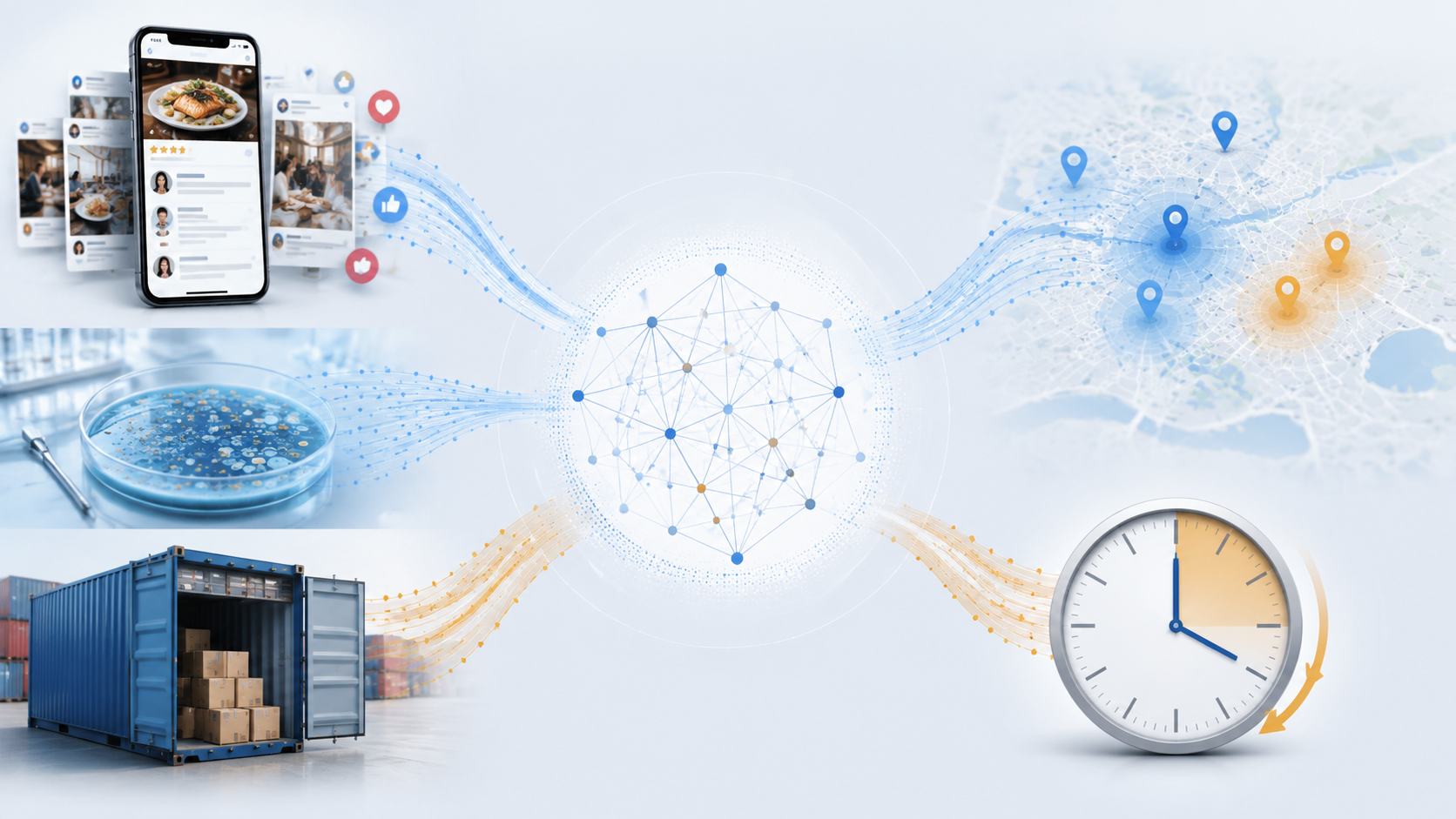
Syndromic surveillance is the clearest field signal
FINDER is still the most convincing real-world evidence that AI can change outbreak investigation before the lab catches up. In deployments in Las Vegas from May to August 2016 and Chicago from November 2016 to March 2017, restaurants identified by the system were found unsafe 52.3% of the time, versus 24.7% under baseline targeting, a 3.1x improvement. That is not a benchmark score on polished text; it is a shift in where inspectors were sent and how often they found a real problem. The obvious limitation is just as important: the published field result is old, and no large-scale replication has yet been published since. [1]
The UKHSA pilot in 2025 widened the same idea to large-language-model classification of gastrointestinal illness mentions in 3,000 annotated Yelp reviews. It showed feasibility, but the unresolved parts are the ones that matter to an outbreak team: getting real-time access to the data, tying symptoms back to ingredients, and handling spelling, slang, and other text noise. That is the difference between a model that can score a dataset and one that can help decide where to send a phone call tonight. [2]
Rapid pathogen detection moves the clock, but only inside narrow boundaries
The Oregon State model is the kind of result that invites optimism and caution at the same time. In testing, it detected live E. coli, Listeria, and B. subtilis in chicken, spinach, and Cotija cheese within 3 hours, and it reported 0% false positives when trained on both bacteria and food debris. That is a meaningful gain if the question is how quickly to separate a suspect lot from the rest of the line. But the claim travels only as far as the experiment does: three bacterial strains, three food matrices, and no proof yet that the model will hold up once ingredients, process conditions, and contamination patterns stop looking like the lab. [3]
The same caution applies to the UConn electronic-nose work summarized in a 2026 npj Science of Food review. A 12-sensor array with machine-learning classifiers identified 8 bacterial species in dairy and meat in under 2 hours with 98% accuracy, but it was still a controlled laboratory setting. That matters because food-safety datasets tend to overrepresent safe environments, which makes anomaly detection harder than the headline numbers suggest. When class imbalance is severe, a strong accuracy figure can hide the fact that the model has mainly learned the easy case. [4]
Import screening is useful, but it solves a different problem
FDA's AI work shows how far prioritization can go without becoming outbreak detection. Elsa, launched in June 2025 and now in a 4.0 iteration with the HALO data platform, consolidates more than 40 data sources and is used agency-wide for scientific review, inspection targeting, and post-market surveillance. That can push reviewers toward higher-yield work, but it is still a targeting layer, not a complete detection system. [5]
The same logic applies to FDA's import-risk screening models, which use shipment history, product characteristics, and country-risk indicators to estimate violation probability. That kind of score can help decide which containers get attention first, but it does not tell investigators whether a patient cluster is already forming, and it does not replace the lab work needed to confirm what is actually in the food. It is prevention-oriented triage, not end-to-end outbreak control. [6]
What connects, and what does not
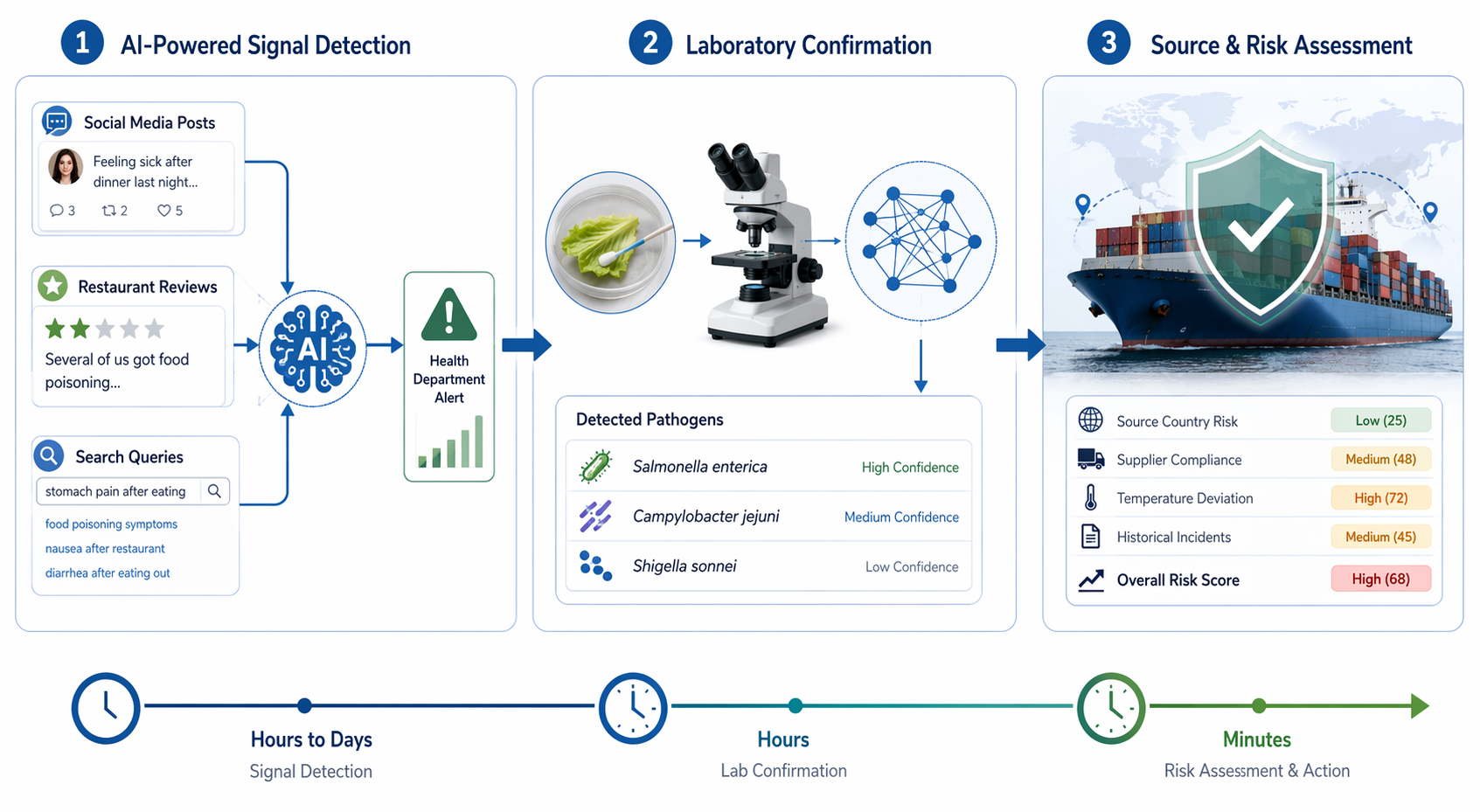
Taken together, these systems are narrowing the time to action at different points in the pipeline. FINDER shows that field-based syndromic surveillance can outperform baseline targeting; UKHSA's pilot shows unstructured text can be made usable, with caveats; lab models can accelerate confirmation inside constrained matrices; and FDA's tooling shows AI can already prioritize reviews and shipments. What is still missing is the end-to-end deployment that connects those gains through the whole chain, under real operational friction, with replication beyond the original pilots and test beds. The honest conclusion is narrower than the hype, but more useful: AI is already shaving time off outbreak detection and investigation at several stages, yet the evidence is still uneven and the system is not integrated. [1][2][3][4][5][6]
References
- Machine-learned epidemiology: real-time detection of foodborne illness at scale (FINDER) — npj Digital Medicine (Nature), 2018
- AI could help detect and investigate foodborne illness outbreaks — GOV.UK, March 2025
- New AI model improves accuracy of food contamination detection — Oregon State University, 2026
- npj Science of Food systematic review on AI-enabled food contamination detection, covering literature through April 2024, 2026
- FDA Launches Agency-Wide AI Tool to Optimize Performance for the American People — FDA.gov, June 2025
- FDA import food shipment violation-risk modeling coverage — FDA press releases and ProFood World, 2025-2026