
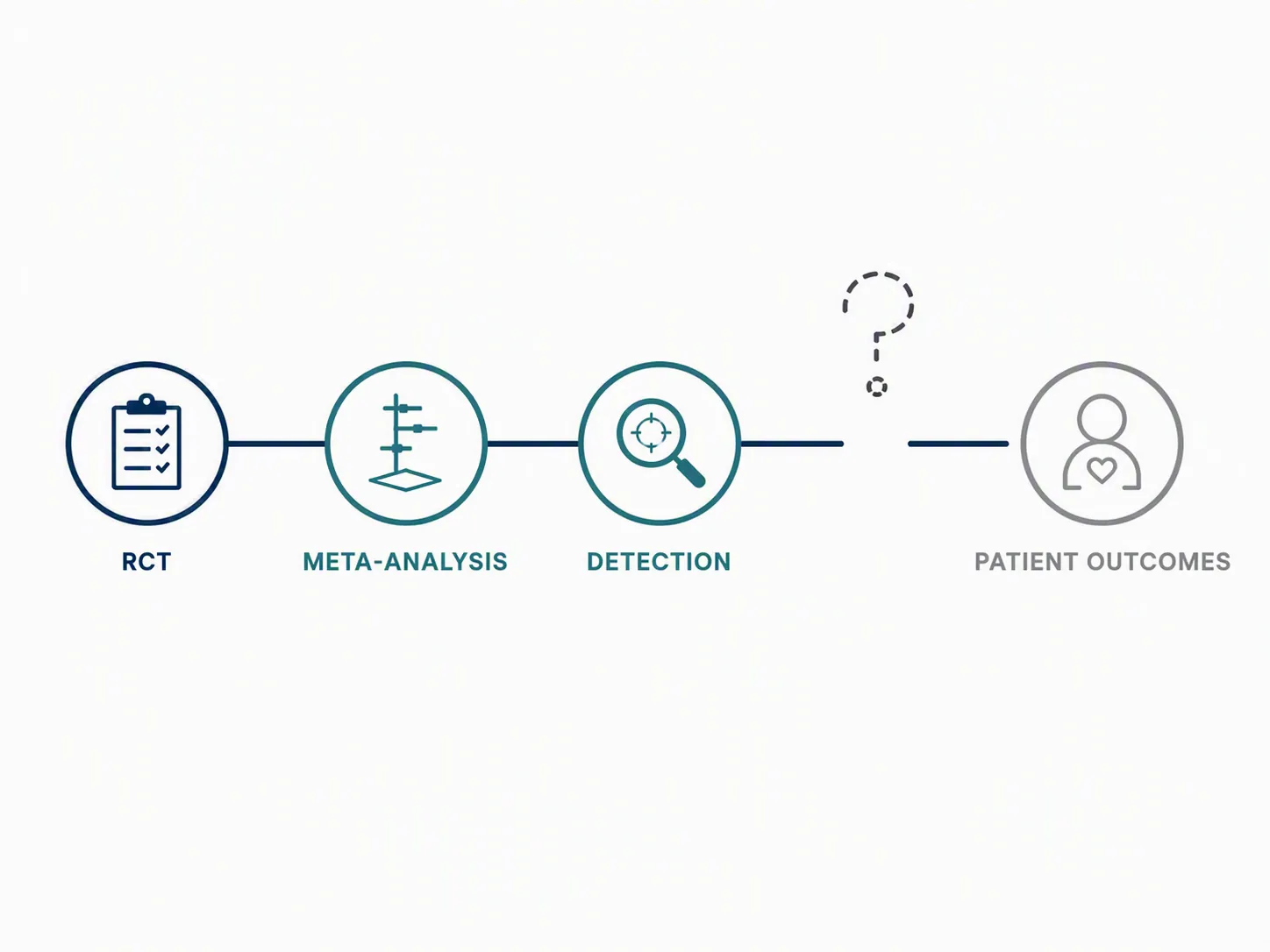
The practical question is not whether computer-aided detection, or CADe, can make colonoscopists find more adenomas. Across randomized trials, it can. The more difficult purchasing question is whether that detection gain is large enough, durable enough, and clinically meaningful enough to justify routine deployment when no trial has shown fewer colorectal cancers or deaths.
A fair evidence verdict starts with both halves of the record: CADe has an unusually large randomized evidence base for a clinical AI tool, and the adenoma-detection signal is real; the patient-outcome claim remains unproven. That distinction matters because the costs of the decision do not stop at the software contract. Extra adenomas change surveillance intervals, pathology volume, nursing time, scheduling pressure, and the quality metrics that remain after implementation support has left.
| Appraisal domain | What the evidence supports | What it does not establish |
|---|---|---|
| Study design | Multiple randomized trial syntheses support improved adenoma detection: Makar et al. included 28 RCTs with 23,861 participants, and the corrected Annals review included 43 RCTs with 34,896 cases. [1][2] | Randomization on detection outcomes is not the same as randomized evidence for reduced colorectal cancer incidence or mortality. |
| Key metric | ADR rises by about a fifth in relative terms in major meta-analyses: Makar reported ADR RR 1.20, and the corrected Annals review reported 44.8% vs 37.4% with RR 1.22. [1][2] | ADR is a surrogate. It is linked to quality, but a CADe-driven ADR increase has not itself been tested through to cancer or death reduction. |
| Miss-rate evidence | The adenoma miss-rate signal is strong in trial settings: Makar reported miss-rate RR 0.45. [1] | Miss-rate reduction under tandem trial conditions does not automatically quantify long-term patient benefit or operational value. |
| External/prospective evidence status | The strongest evidence is prospective and randomized for detection endpoints. | The evidence base is narrower for downstream outcomes, long-term surveillance burden, and real-world durability after local workflow changes. |
| Regulatory status | GI Genius received FDA de novo clearance on April 12, 2021; clearance status belongs in a regulatory tracker and should be separated from the clinical evidence verdict. | A clearance decision is not proof that a system prevents colorectal cancer, reduces mortality, or pays for itself. |
| Risk of bias and certainty | Lou et al. found certainty ranging from very low to moderate and detected publication bias for ADR. [3] | A large RCT base reduces some uncertainty, but it does not erase endpoint limitations or publication-bias concerns. |
| Use boundary | This is an evidence appraisal for governance and value analysis. | It is not medical advice for an individual patient and should not replace local clinical judgment, credentialing, or quality review. |
The adenoma-detection signal is real
Makar et al. is a useful starting point because it does not make the reader choose between enthusiasm and skepticism. In 28 randomized controlled trials with 23,861 participants, CADe was associated with higher adenoma detection, with ADR RR 1.20 and a 95% CI of 1.14 to 1.27. The same review found adenoma miss rate RR 0.45, with a 95% CI of 0.37 to 0.54. The ADR gain also persisted in studies limited to expert endoscopists, with RR 1.19. [1]
Those are not trivial findings. A tool that makes an already trained clinician notice lesions that are easy to overlook is doing something clinically relevant at the point of care. The tandem miss-rate result is especially hard to ignore because it tests the problem CADe is designed to solve: lesions present in the colon that the first pass fails to identify.
The corrected Annals of Internal Medicine review gives a similar but not identical estimate, which should be kept separate rather than blended into a generic sales number. In 43 RCTs with 34,896 cases, CADe was associated with ADR of 44.8% versus 37.4%, RR 1.22 with a 95% CI of 1.16 to 1.29. Adenomas per colonoscopy were also higher, 0.98 versus 0.78. The review was corrected on April 15, 2025, after removal of one study, so any governance packet should cite the amended version rather than an earlier extraction. [2]
For readers building a committee worksheet, the terms that need to stay clean are adenoma detection rate, relative risk, adenoma miss rate, and non-inferiority. ADR asks whether a colonoscopy finds at least one adenoma. Adenomas per colonoscopy asks how many are found on average. Miss rate asks what was present but not detected. These are related quality measures, but they are not interchangeable patient outcomes.
Where the signal narrows
The same evidence that supports CADe also narrows the claim. Makar et al. did not find a statistically significant improvement in sessile serrated lesion detection: RR 1.10, 95% CI 0.93 to 1.30, p=0.27. [1] That matters because a purchase pitch can sound as if “more polyps” means a broad improvement across lesion types. The trial synthesis supports a more limited conclusion.
Lou et al. helps explain why guideline panels remain cautious despite the RCT volume. In 33 RCTs with 27,404 participants, the review rated certainty from very low to moderate, detected publication bias for ADR, and emphasized that the benefit was driven mainly by diminutive adenomas of 5 mm or smaller. [3] A hospital can reasonably value better detection of small lesions, but it should not pretend that every added diminutive adenoma carries the same clinical weight as advanced neoplasia.
The corrected Annals review puts the tradeoff in operational terms. Advanced colorectal neoplasia per colonoscopy was essentially unchanged: 0.16 with CADe versus 0.15 without CADe, with an incidence rate difference of 0.01 and a confidence interval from −0.01 to 0.02. The same review found about two extra non-neoplastic polyp resections per 10 colonoscopies. [2] That is not a reason to dismiss CADe. It is a reason to stop converting an ADR gain into a cancer-prevention return-on-investment line without showing the intervening evidence.
Wang et al.’s tandem randomized trial shows how large the immediate miss-rate effect can look when the system is tested under controlled conditions. Adenoma miss rate fell from 40.0% to 13.9% with CADe, and screen-visible adenoma miss was 1.59% versus 24.21%. [4] As an argument that CADe can reduce missed visible adenomas, this is vivid. As an argument that a deployed program will reduce colorectal cancer incidence, it is still one step short.

The missing endpoint is not a technicality
The gap is not that CADe lacks randomized evidence. It has more randomized detection evidence than many clinical AI categories. The gap is that the randomized evidence is concentrated on detection and miss-rate surrogates, while trials have not shown reductions in colorectal cancer incidence or mortality. The AGA living guideline treated certainty for critical patient outcomes as very low, which is the right evidentiary category for a chain that has not been directly tested through its clinical endpoint. [5]
Surrogates are not useless. Colonoscopy quality programs already use ADR because detection performance matters. The problem begins when a surrogate becomes purchasing language without the conditions attached: which lesions increased, whether advanced neoplasia changed, whether non-neoplastic resections rose, how surveillance volume shifts, and whether the local program’s baseline ADR leaves room for the same gain seen in trials.
Why 2025 guideline panels could disagree without contradicting the detection data
The 2025 guideline split is best read as a difference in evidentiary thresholds, not as chaos in the evidence base. The panels were not looking at one universe in which ADR rises and another in which it does not. They were deciding what a health system should do when the best-established benefit is a surrogate detection gain and the patient-outcome evidence remains uncertain.
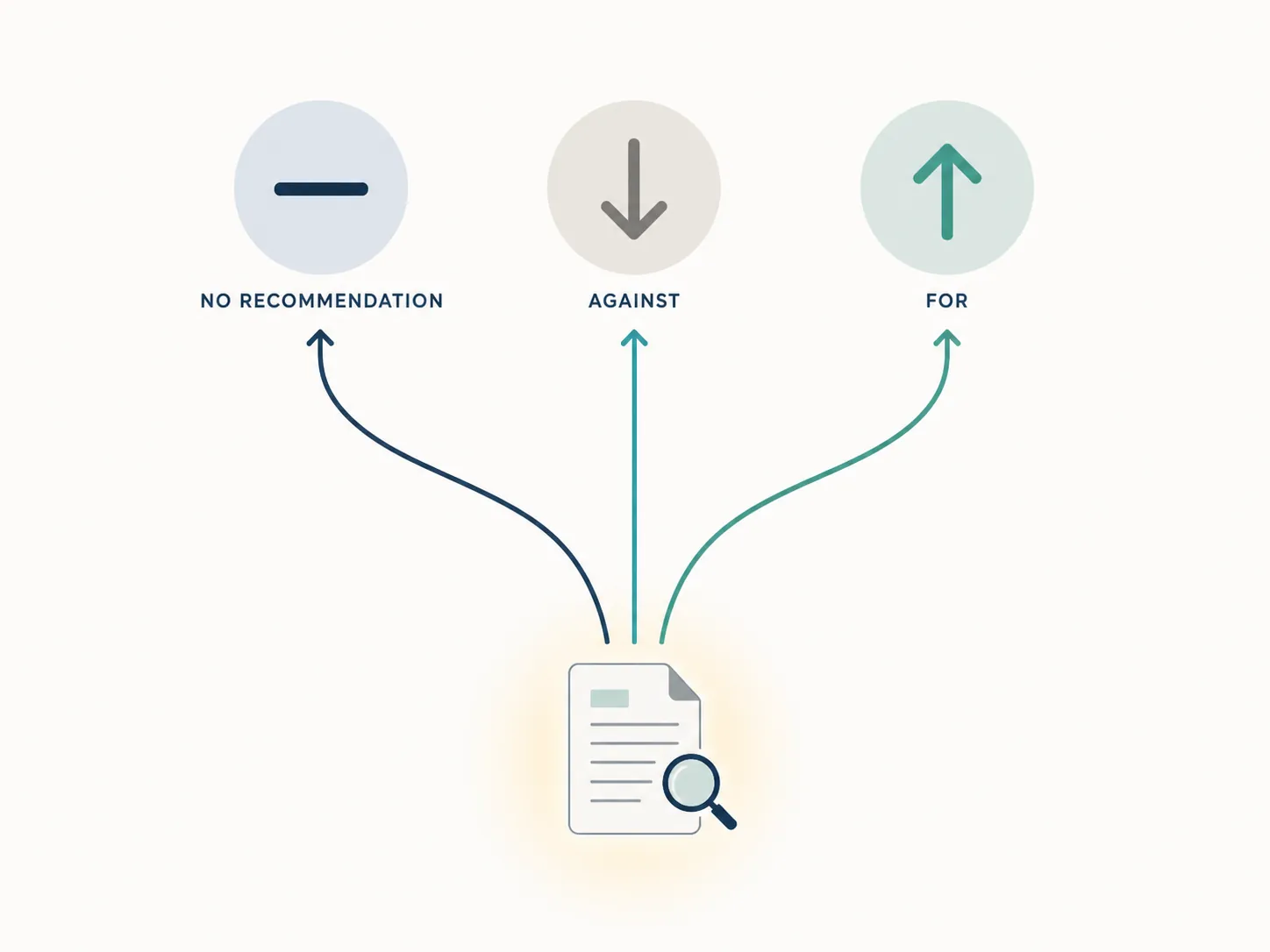
The AGA living clinical practice guideline made no recommendation. Its modeled tradeoff is the hinge for governance: CADe was modeled as producing 11 fewer colorectal cancers per 10,000 people over 10 years, but that benefit was very uncertain, while surveillance colonoscopies increased by 635 per 10,000. [5] That is the moment the endpoint gap becomes a scheduling, staffing, and patient-burden problem rather than an abstract methods concern.
The BMJ living guideline landed more conservatively, issuing a weak recommendation against routine use of computer-aided detection in colonoscopy. [6] A weak recommendation against does not mean the detection effect is imaginary. It means the panel did not think the balance of benefits, burdens, certainty, and routine-use implications justified adoption as a default.
The ESGE position statement moved in the other direction, giving a weak recommendation in favor of CADe use. [7] That, too, is understandable if a panel is willing to act on improved detection while accepting uncertainty about downstream outcomes. The important word is still “weak.” None of these positions turns CADe into a proven colorectal-cancer mortality intervention.
For a value-analysis committee, the split should prevent false certainty in either direction. A no-recommendation stance, a weak recommendation against routine use, and a weak recommendation in favor all fit a field where the proximal signal is convincing and the distal outcome remains unproven.
How a purchase decision should treat product claims
GI Genius, SKOUT, ENDO-AID, CAD EYE, EndoVigilant, and similar systems enter the committee room as products, but the evidence question should not become a product tour. The first separation is regulatory from clinical: FDA clearance, de novo status, and incident monitoring belong in a clearance and incident tracker. They do not substitute for local evidence review.
The second separation is detection from outcome. A defensible proposal can say: the RCT and meta-analysis base supports a modest, real ADR improvement and a meaningful reduction in miss-rate surrogates. It should not say: this system has been proven to prevent colorectal cancers or reduce deaths. That stronger claim would need trials or outcome evidence the current record does not provide.
The third separation is vendor-average effect from local effect. A center with high baseline ADR, strong withdrawal technique, and rigorous quality feedback may not see the same absolute gain as a trial average. A center with variable detection performance may value the assistive prompt differently. Neither case is settled by the relative risk alone.
If CADe is deployed, measure what it changes
Deployment on ADR grounds can be reasonable if the institution is explicit about what it is buying: a detection aid, not a proven cancer-prevention program. That framing changes the implementation plan. It puts measurement, training safeguards, and downstream burden into the purchase order rather than treating them as optional quality work later.
| Governance question | What to track locally |
|---|---|
| Does the detection effect appear here? | ADR before and after deployment, stratified by endoscopist, indication, setting, and baseline performance where feasible. |
| What kinds of lesions increased? | Adenomas per colonoscopy, diminutive adenomas, advanced colorectal neoplasia, sessile serrated lesions, and non-neoplastic resections. |
| What burden moved downstream? | Pathology volume, polypectomy time, surveillance interval changes, repeat colonoscopy demand, and scheduling capacity. |
| Are clinicians becoming dependent on prompts? | Ongoing withdrawal technique review, image-quality standards, and audit of misses or near-misses where case review is available. |
| Are claims staying inside the evidence? | Committee-approved language for patient materials, executive dashboards, quality reports, and ROI models. |
The strongest case for CADe is not that it has already closed the cancer-outcome loop. It is that it improves a meaningful detection surrogate in randomized evidence and may help clinicians notice lesions they would otherwise miss. The strongest case against careless adoption is that the incremental yield is concentrated in smaller lesions, advanced colorectal neoplasia has not clearly increased per colonoscopy in the corrected Annals synthesis, non-neoplastic resections rise, and no trial has shown fewer cancers or deaths.
That leaves a narrow but workable governance judgment: CADe may be worth deploying where an endoscopy service is willing to measure the detection gain, protect core colonoscopy skills, monitor surveillance burden, and keep outcome claims disciplined. ROI models built on proven colorectal-cancer prevention should not survive the appraisal.
References
- Artificial intelligence for adenoma detection during colonoscopy: a systematic review and meta-analysis of randomized controlled trials. Gastrointestinal Endoscopy. 2025.
- Computer-Aided Detection in Colonoscopy: A Systematic Review and Meta-analysis. Annals of Internal Medicine. 2024; corrected April 15, 2025.
- Artificial intelligence for colorectal neoplasia detection during colonoscopy: a systematic review and meta-analysis of randomized controlled trials. eClinicalMedicine. 2023.
- Effect of a deep-learning computer-aided detection system on adenoma miss rate: a multicenter randomized tandem colonoscopy study. Gastroenterology. 2020.
- AGA Living Clinical Practice Guideline on the Use of Computer-Aided Detection Systems in Colonoscopy. Gastroenterology. 2025.
- Computer aided detection systems in colonoscopy: a clinical practice guideline. BMJ. 2025.
- Artificial intelligence-assisted colonoscopy: European Society of Gastrointestinal Endoscopy position statement. Endoscopy. 2025.