
As of Q3 2026, the peer-reviewed evidence does not show that a dedicated AI meal-sequencing system improves blood sugar control. The more precise statement is narrower: eating carbohydrates later in a meal has biologic plausibility and may reduce acute postprandial glucose excursions, but sustained HbA1c evidence is low-certainty and borderline; separately, several AI nutrition or diabetes tools have been studied, but none has tested food-order recommendations as the primary AI intervention.
That distinction matters because AI meal sequencing is often treated as one evidence claim when it is really two claims with different evidence burdens. First, does meal sequencing itself improve glycemic outcomes? Second, does AI delivery add a proven clinical benefit beyond ordinary education, coaching, carbohydrate estimation, glucose prediction, or bundled digital care? A product may have evidence for one of those adjacent functions without having evidence for AI-driven food-order sequencing.

The first claim: meal sequencing has a modest and uncertain long-term signal
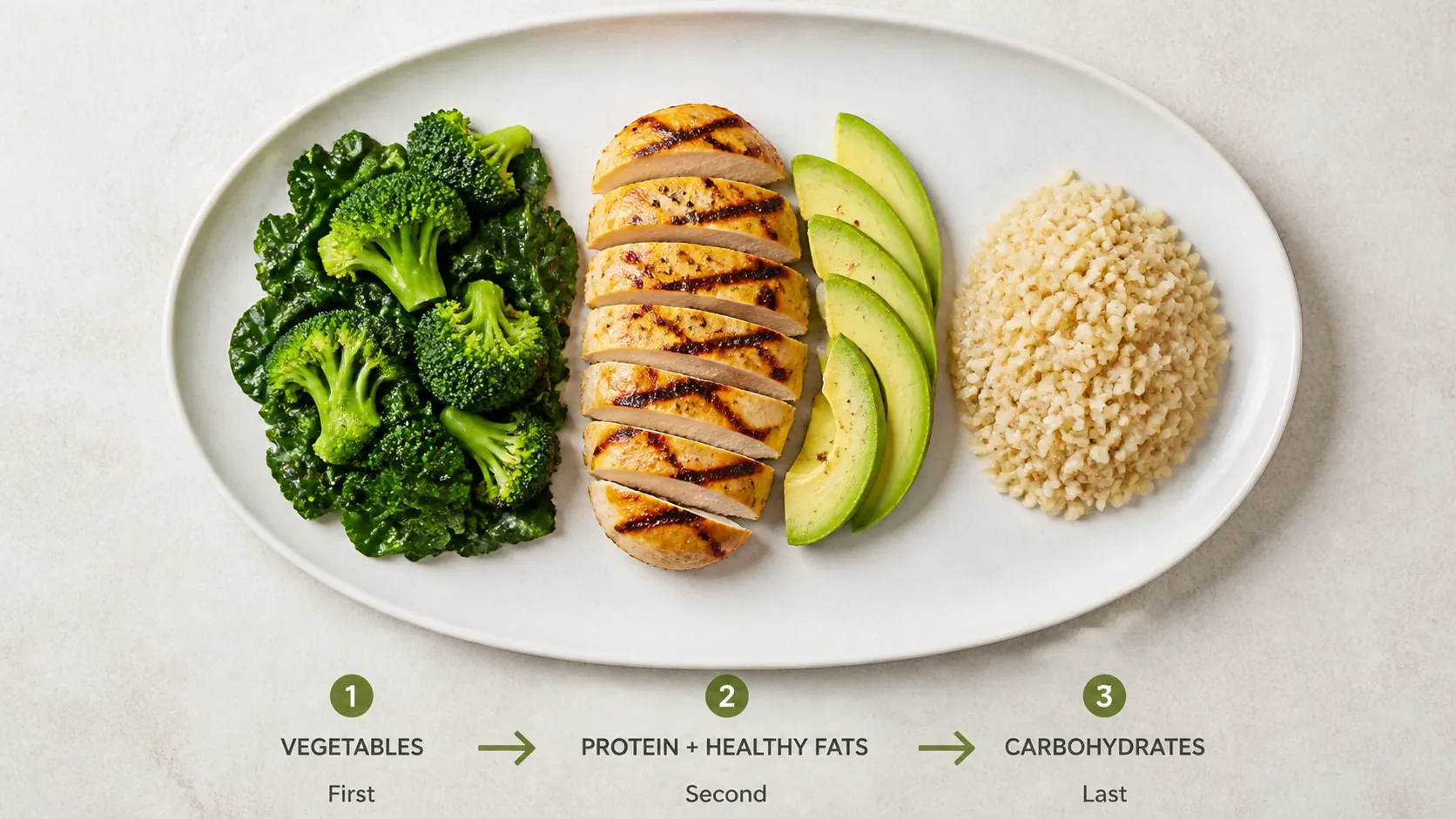
The strongest consolidated evidence for meal sequencing is the 2022 systematic review and meta-analysis by Okami and colleagues in BMJ Open Diabetes Research & Care. It included 8 randomized controlled trials with 230 participants and assessed carbohydrate-later meal patterns, such as eating vegetables or protein before carbohydrates. For HbA1c, the pooled mean difference was −0.21 percentage points, with a 95% confidence interval from −0.44 to +0.03. The authors rated the certainty of evidence as low and concluded that carbohydrate-later patterns produced “slight to no difference” in HbA1c.[1]
That is not a null result in the casual sense; the point estimate favors carbohydrate-later eating. But for clinical appraisal, the interval crossing zero matters, and so does the size of the effect. The review notes that the estimate is below the commonly cited 0.3–0.5 percentage-point HbA1c reduction threshold associated with cardiovascular-event relevance.[1] A hospital value-analysis discussion should not treat that as the same category of evidence as a durable medication effect, a validated insulin-dosing tool, or a diabetes technology trial with hard implementation endpoints.
The review also sets limits on generalizability. Only 8 RCTs were available, the total sample was small, and 5 of the 8 studies were conducted in Asian populations.[1] That does not make the findings inapplicable elsewhere, but it does mean the evidence base is thinner than the simplicity of the behavioral instruction suggests. “Eat carbohydrates last” is easy to say; sustained adherence across food cultures, household routines, insulin regimens, work schedules, and restaurant meals is a different intervention.
Why the idea remains compelling
The meal-order hypothesis did not appear out of nowhere. In small controlled meal studies, Shukla and Aronne reported large postprandial glucose reductions when carbohydrates were eaten after vegetables and protein. In the 2015 Diabetes Care study, 11 participants with type 2 diabetes consumed the same meal on two separate days one week apart, with food order changed between test conditions; post-meal glucose excursions were reduced by 29–37% when carbohydrates were eaten last.[2]
Those findings are exactly the kind that catch clinical attention. Postprandial glucose is visible on CGM, understandable to patients, and responsive to meal composition. The physiologic rationale is also credible. Reviews of nutrient sequence and incretin biology describe mechanisms by which protein or fat preload can slow gastric emptying, alter insulin and glucagon responses, and enhance GLP-1 activity, providing a plausible pathway for lower post-meal glucose exposure.[3]
But plausibility and acute signal do not answer the procurement question. A two-day laboratory meal test does not show that an app, algorithm, or coaching program will change real-world eating order often enough to improve HbA1c over months. It also does not tell an endocrinology chair whether the effect survives mixed meals, skipped meals, varied carbohydrate loads, different medications, insulin adjustments, food insecurity, or simple fatigue with one more diabetes rule.
The second claim: AI has adjacent evidence, not meal-sequencing evidence
The AI evidence in diabetes nutrition is not empty. It is just not evidence for AI meal sequencing. The published examples address carbohydrate estimation, glucose forecasting, or bundled coaching. Those are legitimate functions to evaluate on their own terms, but they do not isolate food order as the active intervention.
| Tool or program | Published evidence | What the AI appears to do | Why it does not prove AI meal sequencing |
|---|---|---|---|
| SNAQ | Randomized evidence in 44 people with type 1 diabetes using automated insulin delivery; time in range improved by 6.6 percentage points, with 95% CI 2.9–10.3 and p<0.001.[4] | AI-powered carbohydrate estimation from food photos. | The studied mechanism was carbohydrate estimation, not food-order recommendation; benefits were not sustained after discontinuation, and app suggestions were accepted 19.2% of the time.[4] |
| Twin Precision Treatment | Randomized evidence in 150 people with type 2 diabetes; 71% reached HbA1c <6.5% with medication de-escalation versus 2.4% in control.[5] | A bundled program using CGM, AI food scoring, human coaching, activity tracking, and other connected inputs. | The design cannot isolate meal sequencing, AI food scoring, coaching, CGM feedback, or activity tracking as the responsible mechanism; the trial was commercially funded.[5] |
| Glucoracle | A 2017 feasibility pilot in 5 participants reported glucose prediction accuracy comparable to diabetes educators.[6] | Personalized glucose forecasting. | It was a tiny feasibility study, not a randomized trial, and no subsequent published RCT was identified as of Q3 2026.[6] |
SNAQ is a useful example of why claim discipline matters. A food-photo carbohydrate estimator can plausibly reduce meal-bolus error for people using automated insulin delivery. In the published study, the population was already relatively well controlled at baseline, with time in range around 75%, and the intervention improved time in range while the tool was in use.[4] That is a meaningful digital-nutrition signal. It is not a test of whether an AI system should tell patients to eat the rice after the chicken and vegetables.
The Twin Precision Treatment result is more dramatic, but also more difficult to attribute. A bundled intervention that includes CGM, algorithmic food scoring, coaching, activity tracking, and medication management may improve outcomes through several interacting pathways.[5] If the marketing language later highlights one attractive mechanism, such as sequencing or food order, the trial still has not isolated that mechanism. The appropriate evidence label is “AI-supported bundled diabetes coaching,” not “AI meal sequencing.”
Glucoracle sits even farther from the claim. Predicting a glucose response to a meal is an important technical problem, and the 2017 pilot showed feasibility in 5 participants.[6] But prediction is not the same as behavior change, and behavior change is not the same as sustained glycemic improvement. Without a randomized trial that assigns patients to AI-generated food-order recommendations and tracks durable outcomes, it cannot carry the meal-sequencing claim.
Recent signals do not close the gap
Newer meal-order literature keeps the question alive, but it does not change the evidence category. A 2025 Diabetes Care letter reported that carbohydrates-last food order improved time in range, but the analysis was observational rather than randomized.[7] Observational CGM signals can be useful for hypothesis generation, especially when they align with physiology and meal-test findings, but they are not enough to establish a digital therapeutic mechanism.
Other recent work also remains adjacent. A 2026 systematic review of meal-sequence intervention in healthy adults addresses a population without diabetes, and a 2024 gestational diabetes study addresses a distinct metabolic and clinical setting. Both can inform plausibility; neither substitutes for a trial in the intended diabetes population using an AI food-order recommendation system as the primary intervention.
What a credible AI meal-sequencing trial would need to show
A credible claim would not require a perfect trial, but it would require the right trial. The intervention would need to be an AI system whose primary function is recommending food order or meal sequence, not merely estimating carbohydrates, scoring foods, or delivering broad coaching. The comparator would need to separate AI sequencing from standard nutrition education and from CGM feedback alone. Otherwise, the trial would again answer a bundled-care question while being used to support a mechanism-specific claim.
- Primary intervention: AI-generated food-order recommendations, specified before the trial starts.
- Comparator: usual care, non-AI meal-sequencing education, or another control that isolates the incremental value of AI delivery.
- Outcomes: HbA1c, CGM time in range, postprandial excursions, adherence, hypoglycemia, medication changes, and patient burden.
- Duration: long enough to test sustained behavior, not just a meal challenge or short app-engagement period.
- Population: broad enough to address generalizability across type 1 diabetes, type 2 diabetes, insulin regimens, baseline control, and food routines if those populations are in the commercial claim.
External validation would also matter. An algorithm that performs well in one developer-run program may not perform the same way after integration into a health system portal, a different coaching model, or a population with lower digital literacy. If a product asks clinicians to put institutional trust behind patient-facing advice, the evidence should survive beyond the original development setting.
FDA status and procurement relevance
No FDA-cleared or FDA-authorized dedicated AI meal-sequencing product was identified in the materials reviewed for this appraisal. If a vendor presents a related diabetes app, the regulatory status should be checked for the specific product, version, indication, and function being purchased. Clearance for logging, education, glucose prediction, insulin support, or wellness coaching would not automatically validate a claim that AI-guided food order improves glycemic control.
For value-analysis teams, the practical classification is straightforward. Meal sequencing itself is biologically plausible and may reduce acute postprandial glucose excursions. The best meta-analytic HbA1c signal is small, low-certainty, and statistically compatible with no effect.[1] AI nutrition tools have emerging evidence in adjacent areas, but no published trial has tested food-order recommendations as the primary AI intervention. A product may be worth evaluating for engagement, carbohydrate estimation, coaching efficiency, or glucose prediction, but those claims should not be collapsed into evidence-based AI meal sequencing.
Evidence verdict
| Domain | Appraisal |
|---|---|
| Study design | No published RCT has tested a dedicated AI system whose primary intervention is meal sequencing for blood sugar control. |
| Underlying behavioral evidence | Meal sequencing has plausible acute effects, but the consolidated HbA1c evidence is low-certainty and borderline. |
| Mechanism isolation | Current AI studies evaluate carbohydrate estimation, glucose prediction, or bundled coaching; they do not isolate food-order recommendations. |
| External validation | Evidence is limited by small samples, narrow populations, short follow-up, and developer-linked or bundled intervention designs. |
| Generalizability | Uncertain across Western populations, type 2 diabetes subgroups, insulin regimens, lower-engagement users, and routine clinical deployment. |
| Risk of overclaiming | High when acute postprandial findings or bundled digital-health outcomes are presented as proof of AI meal sequencing. |
Decision rule: credit an AI diabetes product for the function that was actually tested. If the evidence is for carbohydrate estimation, call it carbohydrate-estimation evidence. If the evidence is for glucose prediction, call it prediction evidence. If the evidence is for a CGM-plus-coaching bundle, call it bundled-program evidence. Unless a trial tests AI-generated food-order recommendations as the primary intervention, it should not be credited as evidence-based AI meal sequencing.
References
- Effect of eating vegetables before carbohydrates on glucose excursions in patients with type 2 diabetes: a systematic review and meta-analysis, BMJ Open Diabetes Research & Care, 2022.
- Food Order Has Significant Impact on Glucose and Insulin Levels, Weill Cornell Medicine.
- A Review of Recent Findings on Meal Sequence: An Attractive Dietary Approach to Prevention and Management of Type 2 Diabetes, Nutrients, 2020.
- AI-assisted carbohydrate estimation for type 1 diabetes using automated insulin delivery, eClinicalMedicine, 2025.
- Randomized Clinical Trial Demonstrates AI-Supported Coaching Program Improved Outcomes in Patients with T2D, Cleveland Clinic Consult QD.
- Diabetes App Forecasts Blood Sugar Levels, Columbia University Irving Medical Center.
- Carbohydrates-Last Food Order Improves Time-in-Range in Type 2 Diabetes: A Pilot Study, Diabetes Care, 2025.