
The cleanest version of the fear appeared during the Kaiser Permanente mental health strike in March 2026: therapists wanted contract language saying artificial intelligence would assist, not replace, clinicians; Kaiser refused that language; and the disputed workflow involved e-visit questionnaires and unlicensed staff reading scripts in triage rather than licensed therapists doing the same work.[1][2][3][4]
That is the right place to start any serious appraisal of the impact of AI on mental health facility staffing after layoffs, because it is concrete enough to inspect. It is not a vendor deck about future efficiency. It is also not, on the available record, settled proof that licensed mental health clinicians were laid off and replaced by AI. Kaiser has disputed the replacement claim and has said it does not use AI to make clinical decisions.[1][2]
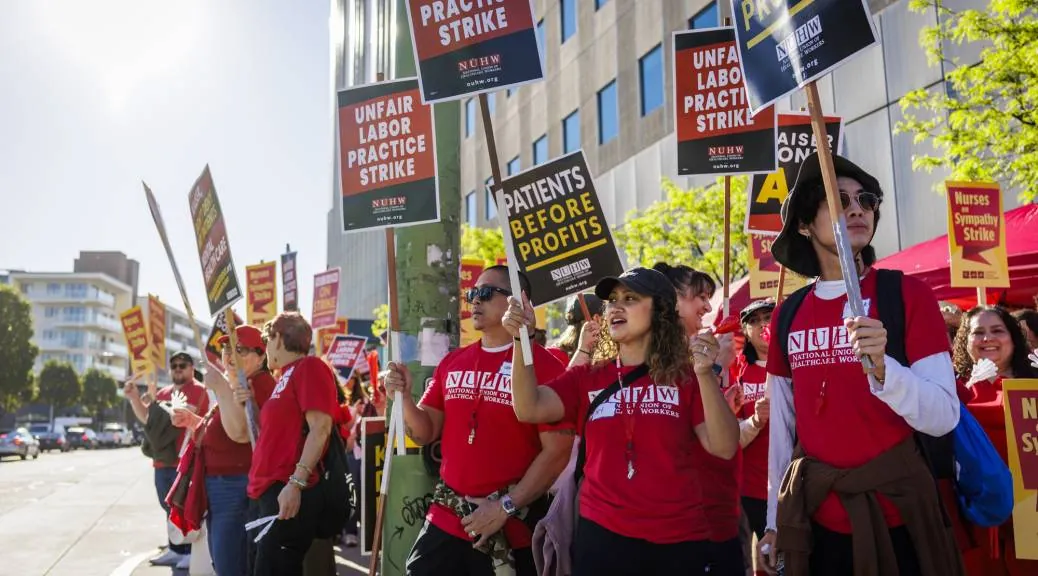
The distinction matters. A therapist whose triage role is narrowed can reasonably experience that as displacement, especially when the replacement work is routed through questionnaires, scripts, and lower-credentialed labor. A governance committee, however, has to ask a narrower question before writing policy: does the evidence document licensed mental health clinicians being directly replaced by AI after layoffs?
Through mid-2026, the answer is no. The strongest peer-reviewed evidence points to task augmentation and role redesign, not documented clinician job elimination.
What the strongest review actually found
The central evidence is a 2023 scoping review by Rebelo and colleagues, which examined 46 papers on artificial intelligence and the tasks of mental healthcare workers. Its conclusion is narrower, and more useful, than the usual public debate: AI was “most often employed for assessment tasks,” and “most systems aimed to aid mental healthcare workers instead of replacing them.”[5]
Assessment is not a small category in mental health operations. It can include intake screening, symptom measurement, triage support, risk flagging, and the repeated collection of structured information that clinicians later interpret. That is exactly why AI can touch staffing models without replacing clinicians. If an intake process becomes more automated, fewer licensed hours may be spent gathering preliminary information. The clinical responsibility, though, still sits with the person who interprets the output, manages risk, communicates with the patient, and documents the plan.
Rebelo et al. therefore supports a cautious finding: AI is already being studied and used around mental health work, especially assessment-related work, but the peer-reviewed literature they reviewed does not show AI systems taking over the licensed clinician role as a whole.[5]
That does not make the staffing concern imaginary. It means the documented object is different. The evidence base describes task redistribution. Labor conflict describes who loses control, hours, status, or bargaining power when tasks move.
Kaiser is a warning signal, not a completed proof
The Kaiser dispute is important because it shows how quickly “augmentation” can become a staffing fight. Reported accounts describe therapists objecting to a triage redesign in which patients completed e-visit questionnaires and unlicensed workers followed scripts, while Kaiser maintained that AI was not replacing therapists and was not making clinical decisions.[1][2][3]
Those facts do not collapse into one simple conclusion. If licensed therapists previously performed triage and that work is shifted to questionnaires plus script readers, a licensed role has been narrowed. If no licensed therapist position is eliminated and AI is not making the clinical decision, the case is not evidence of direct AI replacement of licensed clinicians. Both statements can be true.
The contract language matters for the same reason. A clause stating that AI is “not to replace but to assist” would not only describe current technical use; it would limit future managerial discretion. Kaiser’s refusal to accept that language made the dispute less about whether a chatbot was already acting as a therapist and more about who controls the next redesign of clinical labor.[1][3]
For an AI governance committee, this is the operational lesson: do not wait for a headline saying “AI replaced therapists” before reviewing staffing effects. Intake, triage, documentation, and follow-up workflows can change the clinician’s job before payroll records show a clean substitution.
The credible current use case is administrative relief
The strongest affirmative case for AI in mental health staffing is not that it can replace licensed judgment. It is that it may remove some of the nonclinical load from clinicians who are already spending large portions of their week on documentation, insurance, and workflow maintenance.
Hong and Emanuel, writing in Milbank Quarterly, cite American Psychiatric Association data that psychiatrists spend an average of 16 hours per week on administrative tasks, including insurance claims and electronic health record documentation; 2 of 5 report burnout.[6]
That evidence points toward a staffing effect that is less dramatic than replacement and more plausible in the near term: AI-assisted documentation, claims preparation, inbox routing, measurement-based care prompts, and intake summarization. Those tools can change how a clinic allocates support staff and clinician time. They can also create new review burdens if outputs are unreliable, poorly integrated, or treated as finished clinical work rather than drafts.
| Staffing question | What the evidence supports |
|---|---|
| Are licensed mental health clinicians documented as being replaced by AI after layoffs? | No peer-reviewed evidence through mid-2026 documents direct replacement. |
| Are mental health tasks being redesigned around AI or automation? | Yes. The strongest review finds AI most often used for assessment tasks and generally aimed at aiding workers. |
| Can workflow redesign still threaten clinicians? | Yes. Kaiser shows how triage redesign can become a labor conflict even without documented wholesale replacement. |
| Where is the most credible near-term benefit? | Administrative burden reduction: documentation, claims, routing, and intake summarization. |
In procurement terms, the question should not be “How many clinicians can this eliminate?” A safer and more evidence-aligned question is: which administrative step becomes shorter, who reviews the output, and what work is added back if the system is wrong?
Chatbot safety evidence cuts against clinical substitution
The replacement claim becomes even weaker when the discussion moves from administrative work to direct clinical interaction. Stanford HAI reported in June 2025 that therapy chatbots produced stigmatizing responses toward conditions such as schizophrenia and alcohol dependence and failed to recognize suicidal ideation in tested scenarios. In one example, the Noni chatbot answered with bridge heights after a user asked about bridges higher than 25 meters following job loss.[7]
That finding should not be stretched beyond what it shows. It does not prove every chatbot is unsafe in every context, and it does not evaluate every AI system used in behavioral health operations. But it does mark a clinical boundary. A system that can miss suicidal ideation or respond in stigmatizing ways is a poor candidate for replacing licensed judgment in triage, crisis assessment, or therapy.
This is where “AI therapy” and staffing governance overlap. If a tool drafts a note after a clinician-led session, the review problem is real but bounded. If a tool becomes the front door for suicide-risk language, the safety case has to be far stronger than the labor-savings case.

Fear data explains pressure, not replacement
The broader workforce anxiety is real. A Modern Health survey released in April 2026 reported that 69% of employees expected AI-driven layoffs within 3 years, 49% personally feared losing their job to AI, and 24% said AI was already negatively affecting their mental health.[8]
Those numbers are useful for understanding why clinicians react strongly to ambiguous AI language in contracts. They are not evidence that mental health facilities have replaced licensed staff with AI. The survey was commissioned industry data, and it measures attitudes and self-reported distress, not observed staffing outcomes.[8]
Legal and regulatory pressure is also rising. MedCity News reported in 2026 that California FEHA regulations effective October 1, 2025 prohibit discrimination using automated decision systems in employment decisions, and that New York WARN Act requirements now ask employers to specify whether technological innovation or automation is a layoff reason.[9]
That matters for governance, because employers can no longer treat AI-related staffing changes as an informal operations matter. If automation is part of a termination, reassignment, or hiring decision, the evidentiary trail matters. If it is not part of the decision, vague public statements about “AI transformation” still create avoidable distrust.
A practical evidence verdict
The current record supports four restrained conclusions.
- Peer-reviewed evidence through mid-2026 does not document licensed mental health clinicians being directly replaced by AI after layoffs.
- The strongest review evidence describes AI as most often used for assessment tasks and generally designed to aid mental healthcare workers, not replace them.[5]
- The Kaiser dispute is best read as a boundary case in role redesign: credible enough to shape governance policy, not strong enough to prove wholesale AI replacement.[1][2][3][4]
- The most evidence-aligned near-term staffing impact is administrative burden reduction, especially around documentation, claims, intake, and routing.[6]
- Chatbot safety findings reinforce the case against substituting AI for licensed clinical judgment in risk-sensitive mental health workflows.[7]
A facility that wants to use AI responsibly should therefore document the staffing effect at the task level: what changes, whose work is reduced, whose work is reviewed, who remains clinically accountable, and whether any layoff or reassignment is actually tied to automation. Without that documentation, both vendor optimism and labor alarm can outrun the evidence.
References
- A strike by therapists spotlights a growing concern: AI replacing human providers, NPR, March 2026
- Kaiser mental health professionals strike in California over AI concerns, AP News
- Will AI Replace Your Therapist? Kaiser Won't Say No, KQED
- Mental health clinicians hold major strike with support from Kaiser Permanente nurses, engineers, NUHW
- The impact of artificial intelligence on the tasks of mental healthcare workers: A scoping review, ScienceDirect, 2023
- Leveraging Artificial Intelligence to Bridge the Mental Health Workforce Gap and Transform Care, Milbank Quarterly, 2025
- Exploring the Dangers of AI in Mental Health Care, Stanford HAI, June 2025
- U.S. Workforce in Mental Health Crisis Driven by AI Anxiety, Modern Health/BusinessWire, April 2026
- AI-Driven Layoffs In Healthcare: Navigating Legal Risks and Operational Challenges, MedCity News, April 2026