
The procurement question around AIDP is not whether a model can find a signal in MRI data. It is whether that signal is strong enough, specific enough, and operationally usable enough to change a diagnostic pathway without being sold as more than it is. AIDP, commercialized by Neuropacs, now has FDA De Novo classification DEN240071 as a parkinsonian syndrome diagnostic aid, described in secondary reporting as the first FDA De Novo classification for this category of diagnostic aid.[1] Its strongest published support is a March 2025 JAMA Neurology study by Vaillancourt and colleagues reporting greater than 96% AUROC for differentiating Parkinson disease from atypical parkinsonian syndromes across 21 sites in an NIH-funded, prospective study with more than 1,000 patients.[2]
That combination deserves attention. It is also narrower than much of the surrounding language about AI and Parkinson disease tends to imply. AIDP is not evidence that AI can diagnose de novo Parkinson disease in an undifferentiated patient. It is not evidence of disease monitoring, progression forecasting, treatment selection, or longitudinal management. The claim worth evaluating is more disciplined: in patients with suspected parkinsonism, can diffusion-MRI software help distinguish Parkinson disease from atypical parkinsonian syndromes such as progressive supranuclear palsy and multiple system atrophy?
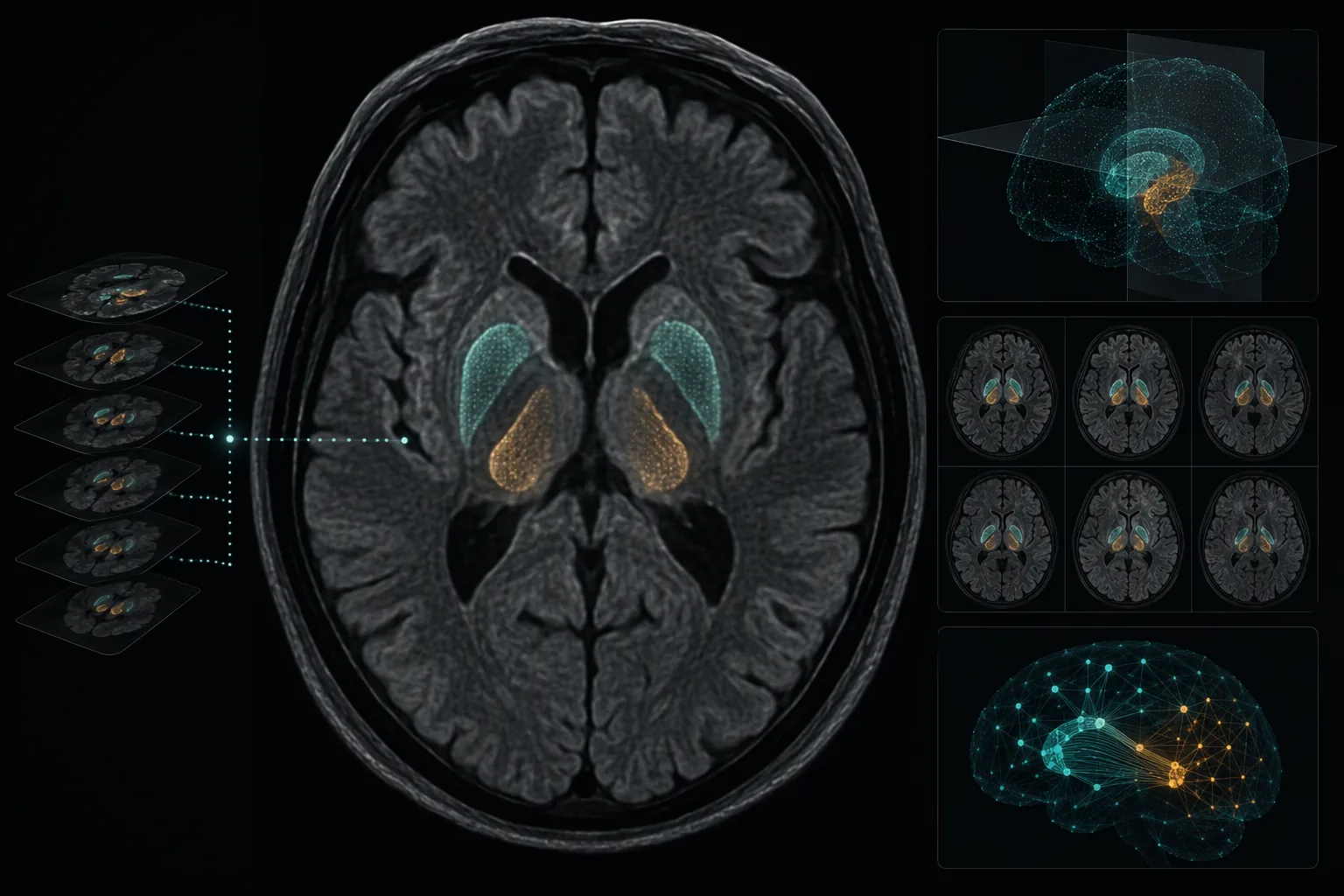
What AIDP Is Actually Being Asked to Do
The clinically relevant distinction is not “Parkinson disease versus healthy.” It is Parkinson disease versus disorders that can look similar early but behave differently, including progressive supranuclear palsy and multiple system atrophy. Those distinctions affect counseling, referral urgency, expectations for medication response, trial eligibility, and care planning. They also affect how much uncertainty a neurologist must carry while a patient’s symptoms evolve.
That is why the baseline comparator matters. Early clinical diagnostic accuracy for Parkinson disease has been described as 55% to 78% in the first five years, implying that roughly 22% to 45% of patients may be misdiagnosed during the period when families are making real decisions.[3] A tool that reduces misclassification inside that window would not need to be glamorous to be useful. It would need to be reliable, reproducible, and correctly inserted into the clinician’s decision process.
| Question | What the available evidence supports | What it does not support |
|---|---|---|
| Regulatory status | FDA De Novo classification DEN240071 as a diagnostic aid for parkinsonian syndromes | A conclusion that the tool is clinically superior in every relevant setting |
| Clinical task | Differentiating Parkinson disease from atypical parkinsonian syndromes in suspected parkinsonism | Screening undifferentiated patients or diagnosing de novo Parkinson disease |
| Evidence strength | Prospective, multi-center JAMA Neurology study with greater than 96% AUROC | Independent confirmation by multiple unaffiliated real-world implementation studies |
| Operational readiness | Cross-vendor MRI compatibility is a meaningful implementation feature | Published proof that routine workflow, reporting, and follow-up processes improve after installation |
Why the JAMA Neurology Evidence Stands Out
Most diagnostic AI products arrive at governance review with retrospective performance, one or two friendly sites, and a validation story that depends heavily on the same data ecology that produced the model. AIDP is different in a way that matters. The Vaillancourt et al. study was prospective, included 21 sites, had NIH funding, enrolled more than 1,000 patients, and reported greater than 96% AUROC for discriminating Parkinson disease from atypical parkinsonian syndromes using a diffusion-MRI biomarker.[2]
AUROC is not a deployment plan, but it is still a useful measure here. In a differential-diagnosis problem, a high receiver-operating-characteristic result indicates that the model separates the diagnostic groups well across operating thresholds. When the clinical comparator is an early diagnostic accuracy range of 55% to 78%, a greater than 96% AUROC is not a decorative statistic; it suggests the imaging biomarker may add information at exactly the point where routine clinical judgment is known to be unstable.[2][3]
The multi-center design is also not a minor detail. Parkinsonian syndrome imaging AI is vulnerable to scanner effects, acquisition variability, site-specific protocols, referral patterns, and diagnostic labeling practices. A 21-site prospective study does not eliminate those risks, but it puts more stress on the tool than a single-center retrospective dataset would. For a radiology department, this matters because the operational question is not whether the algorithm worked on immaculate research images. It is whether routine diffusion MRI can be acquired and analyzed consistently enough to support a reportable clinical aid.
The broader AI-Parkinson literature makes that design choice look even more important. A 2025 systematic review in npj Parkinson’s Disease examined 133 AI studies and reported that only 19% used independent test sets.[4] That statistic should not be used to inflate AIDP beyond its evidence. It simply explains why a prospective, multi-site diagnostic study is unusually valuable in this field.
The Clinical Value Is Misclassification Reduction, Not General Parkinson AI
The most defensible clinical value proposition is reduction of misclassification among established parkinsonian syndromes. That is narrower than “AI for Parkinson diagnosis,” and it is more useful. A movement-disorders specialist seeing a patient with suspected parkinsonism may already know the patient has a neurodegenerative motor syndrome. The costly uncertainty is whether the patient has idiopathic Parkinson disease or an atypical syndrome with different prognosis and management implications.
That distinction can change what happens next. A patient thought to have Parkinson disease may be counseled about dopaminergic response, expected trajectory, and follow-up intervals differently from a patient in whom progressive supranuclear palsy or multiple system atrophy is more likely. Earlier diagnostic confidence can also affect which specialist reviews the case, whether additional testing is pursued, and how quickly supportive services are introduced. The evidence does not prove all of those downstream changes occurred after AIDP installation; it supports the more limited claim that the tool may improve the diagnostic discrimination feeding those decisions.
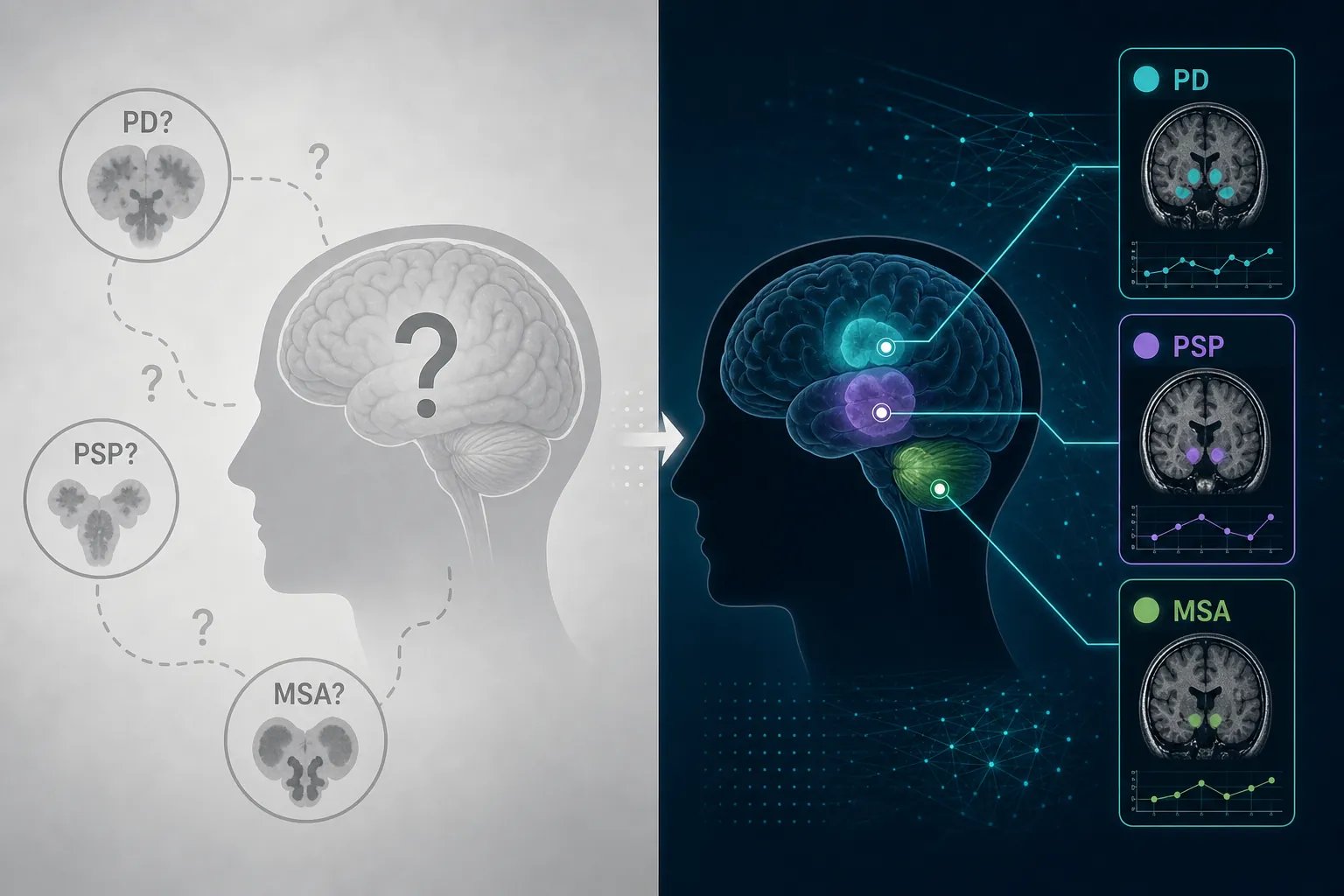
This is where sloppy scope language becomes harmful. AIDP should not be described as proving AI can manage Parkinson disease. It should not be placed in the same bucket as wearable monitoring, adaptive stimulation, medication timing tools, or progression models. Those may be valid lines of work, but they are different evidentiary questions. The AIDP evidence is strongest when the use case remains exactly where the study placed it: differential diagnosis among parkinsonian syndromes.
What FDA De Novo Classification Does and Does Not Settle
FDA De Novo classification is a real regulatory milestone. It indicates that the agency reviewed a novel device type and classified it through the De Novo pathway rather than through a traditional predicate-based clearance route. For procurement purposes, that matters because it gives the product a defined regulatory status and intended-use frame rather than leaving it as a research algorithm or wellness-adjacent claim.[1]
It does not settle clinical adoption. FDA classification does not mean the software has been proven in every scanner environment, every reporting workflow, every patient subgroup, or every institutional pathway. It also does not convert a diagnostic aid into an autonomous diagnostic authority. The distinction is not pedantic. If the purchase request says “FDA-cleared AI diagnoses Parkinson disease,” it overstates both the regulatory and clinical evidence. If it says “FDA De Novo-classified diagnostic aid for differentiating parkinsonian syndromes, supported by prospective multi-center evidence,” it is much closer to the available record.
The Caveats That Should Survive the Governance Meeting
The strongest objection is not that the evidence is weak. It is that the evidence is still concentrated. The central published support remains a single multi-center study rather than a sequence of independent replications from unaffiliated groups. A prospective 21-site study is a meaningful external validity test, but it is not the same as post-market evidence across unrelated health systems, different radiology operations, and independently managed analysis pipelines.[2]
The reference standard also needs scrutiny. If clinical diagnosis is imperfect in early Parkinson disease, then using clinical diagnosis as a reference point can introduce circularity or misclassification into performance estimates. This does not invalidate the study. It means the reported AUROC should be read as performance against the study’s diagnostic standard, not as direct proof of pathological truth in every case. That distinction becomes important when a committee asks whether false positives and false negatives will be auditable after deployment.
Single-modality dependence is another practical limitation. AIDP’s evidence centers on diffusion-weighted MRI. That has advantages: diffusion MRI is familiar to radiology departments, and cross-vendor MRI compatibility addresses a standardization problem that often weakens imaging AI adoption. But dependence on one acquisition type also means implementation quality is inseparable from MRI protocol discipline. Scanner compatibility on paper still has to become acquisition consistency in the schedule, technologist workflow, PACS routing, and report generation process.
The missing evidence is not only another AUROC. It is workflow integration. Published performance does not yet answer how often clinicians accept or override the result, how reports are phrased, whether equivocal cases increase, whether MRI slots become a bottleneck, whether follow-up diagnostic confidence improves, or whether patient counseling changes in measurable ways. A governance committee can reasonably proceed without all of that if the diagnostic pain point is substantial, but it should not pretend those questions have already been answered.
A procurement review should separate four checks
- Intended use: the purchase case should specify suspected parkinsonism and differential diagnosis among parkinsonian syndromes, not broad Parkinson screening or monitoring.
- Evidence fit: the clinical population, MRI acquisition, and comparator used locally should resemble the studied use case closely enough to make the published performance relevant.
- Operational readiness: radiology must confirm diffusion MRI protocol requirements, scanner coverage, routing, result display, reporting language, and exception handling before go-live.
- Post-deployment audit: neurology and radiology should define how discordant cases, clinician overrides, delayed diagnostic revisions, and downstream pathway changes will be reviewed.
Where the Evidence Likely Justifies Use
The most plausible early adopters are centers with a real movement-disorders referral base, access to standardized diffusion MRI, and enough diagnostic volume for the tool to be used regularly rather than as an occasional novelty. In that setting, the study’s performance could support a practical aim: adding objective imaging evidence when the clinician is trying to distinguish Parkinson disease from progressive supranuclear palsy or multiple system atrophy.
The weaker case is a general hospital that wants to advertise AI-powered Parkinson diagnosis without a defined pathway for suspected atypical parkinsonism. If the tool is ordered inconsistently, interpreted without movement-disorders context, or reported as a standalone answer, the evidence base is being stretched beyond its useful shape. A diagnostic aid can improve a decision only if the decision already exists in the workflow.
There is also a reimbursement and utilization question that the published materials do not resolve. A strong AUROC does not specify who pays, which patient qualifies, how often the scan is repeated, or whether the result reduces other testing. Those are local implementation questions, and they should be handled as such rather than hidden inside enthusiasm for a regulatory first.
Procurement Verdict
AIDP has a stronger evidence package than most clinical AI tools brought to hospital review. FDA De Novo classification gives it a legitimate regulatory frame, and the March 2025 JAMA Neurology evidence is unusually serious: prospective, multi-center, NIH-funded, more than 1,000 patients, and greater than 96% AUROC for the specific task of differentiating Parkinson disease from atypical parkinsonian syndromes.[1][2]
That is enough to justify serious consideration for the cleared differential-diagnosis use case. It is not enough to support broad claims about early detection, disease monitoring, autonomous diagnosis, or general AI-enabled Parkinson disease management. The right procurement posture is conditional approval logic: treat clearance, performance, independent validation, reference-standard limitations, and workflow readiness as separate checks. If those checks remain separate, AIDP is not just an impressive paper attached to a vendor claim; it is a plausible diagnostic aid for a painful and well-defined clinical uncertainty.
References
- Diffusion MRI Software for Parkinsonian Syndromes Gets FDA De Novo Classification, Diagnostic Imaging.
- Automated Imaging Differentiation for Parkinsonism, JAMA Neurology, March 2025.
- Research shows AI technology improves Parkinson’s diagnoses, UF Health, 2025.
- npj Parkinson's Disease SLR, npj Parkinson’s Disease, 2025.