
The published evidence for AI-powered support groups for Parkinson’s patients is not a clinical evidence base yet. It is a proof-of-concept evidence base with one small patient-outcome study of a conversational prototype, several adjacent digital or sensing tools, and a systematic review of online peer support that found no AI chatbot or conversational-agent intervention at all.
That distinction matters because “support” is not a decorative feature for Parkinson’s disease. A patient who asks a chatbot about tremor embarrassment, medication timing, freezing, loneliness, or whether a symptom is frightening enough to call the clinic is not merely browsing content. A caregiver reading the answer may decide whether to wait, message neurology, or spend another sleepless night monitoring a partner. If the tool is marketed as companionship, support, or peer connection, the relevant question is not whether it can produce fluent text. The question is what was tested, in whom, for how long, against what comparator, and with what patient-relevant outcome.

The Evidence Map Starts With Online Peer Support, Not Chatbot Marketing
The most useful starting point is the Gerritzen et al. systematic review in JMIR Aging, because it looked at online peer support for people with Parkinson’s disease before the current product vocabulary began collapsing peer forums, education bots, sensing apps, and AI companions into one category. The review screened 10,987 records and found only 8 eligible studies of online peer support for Parkinson’s disease. None tested an AI chatbot or conversational agent intervention.[1]
That finding does not prove AI support tools cannot help Parkinson’s patients. It proves something narrower and more operationally important: the peer-reviewed online peer-support literature had not established an AI-mediated support model for Parkinson’s disease. If a purchasing committee is evaluating a current AI support product, it should not treat the existence of online peer-support studies as evidence that a chatbot, companion, or AI-moderated group will reproduce the same effect.
The review also has a time boundary. Its search was conducted in April 2020, before the recent large-language-model wave that made public conversational agents cheap to launch and easy to brand. That limits what it can say about tools released later. But it still sets the baseline: as of that evidence map, online peer support for Parkinson’s disease was already thin, and AI-mediated peer support was absent from the eligible intervention literature.[1]
Online Peer Support and AI-Mediated Support Are Different Claims
Human peer support has a mechanism that is easy to name and hard to automate: recognition from someone living through a similar illness, social permission to disclose fear, practical experience from daily life, and the emotional safety of not having to explain every symptom from scratch. An AI system can imitate parts of that exchange. It can answer at night, remember preferences, translate educational material, and reduce the friction of asking a question that feels too small or embarrassing for a clinic message.
Those are plausible support functions, not demonstrated Parkinson’s peer-support outcomes. The literature located here does not show whether an AI group or conversational companion improves isolation, confidence, care burden, quality of life, or sustained engagement compared with human-facilitated online support. It also does not show whether AI changes the social texture of support by making patients feel accompanied, monitored, managed, or politely deflected.
This is where procurement language often becomes too generous. “AI-powered support group,” “chatbot,” “companion,” “recommender,” and “FDA-cleared digital tool” may appear in the same slide deck, but they are not the same evidentiary object. A symptom-detection feature is not a support-group intervention. A public educational chatbot is not a tested care model. A co-design concept is not a deployed conversational agent with outcomes.
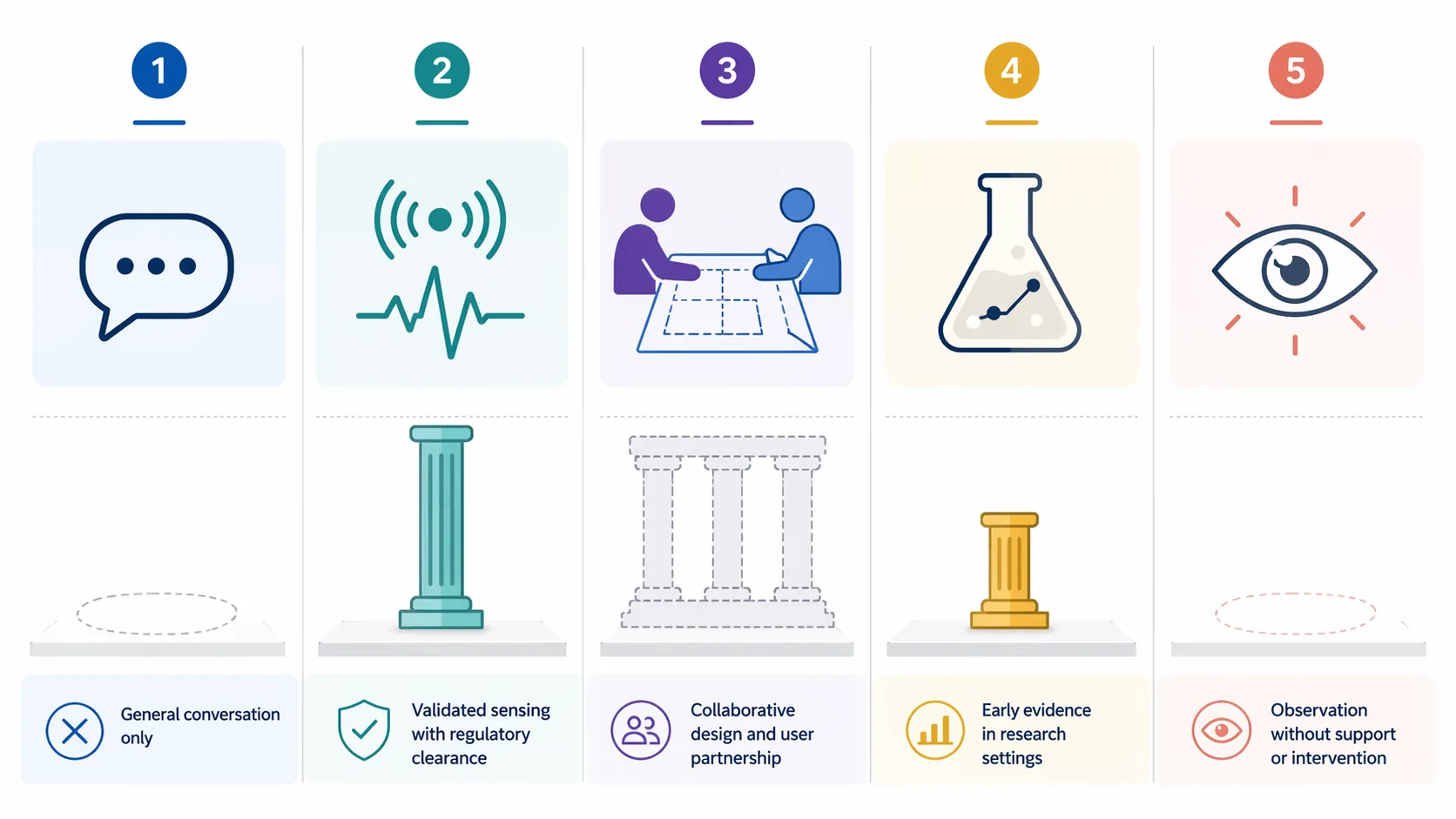
Patrika Is the Only Patient-Outcome Study, and It Is Still Early Work
Patrika deserves more attention than the surrounding product claims because it is the one identified peer-reviewed study of an LLM-powered conversational agent for Parkinson’s disease with patient-participant outcomes. Rashik et al., published at CHI ’25, reported 99% intent-identification accuracy and an 81% personalization rate for the system.[2]
Those engineering results are not trivial. Intent recognition matters when patients describe symptoms indirectly, mix emotional distress with practical questions, or ask for help in language that does not match a clinic intake form. Personalization also matters in Parkinson’s disease because the same word—“off,” “freezing,” “shaking,” “tired”—can mean different things depending on disease stage, medication schedule, living situation, and caregiver involvement.
The patient-outcome evidence remains very small. The Patrika study lasted 2 weeks, enrolled 8–9 participants, used no active comparator, and did not measure quality-of-life or clinical endpoints.[2] That is appropriate for an early prototype study. It is not enough to support a claim that the tool is clinically validated as a Parkinson’s support intervention, nor enough to infer how it would perform when deployed across a neurology practice with heterogeneous patients, caregivers, escalation needs, language preferences, cognitive status, and comorbidities.
The useful conclusion from Patrika is therefore modest but real: a Parkinson’s-specific conversational prototype can be built, tested with patients over a short period, and evaluated for interaction performance and early user experience. The unsupported conclusion would be that AI companions for Parkinson’s disease have proven patient benefit. They have not.
A Sorting Exercise: What the Other Tools Actually Are
Once the evidence categories are separated, the landscape becomes less impressive but more intelligible. The identifiable tools and papers do not line up as competing clinical trials. They occupy different evidentiary lanes.
| Material | What It Supports | What It Does Not Support |
|---|---|---|
| Ask PAM | A publicly available Parkinson’s Foundation AI chatbot for general education. | No published peer-reviewed patient outcomes for support, triage, loneliness, confidence, or quality of life. |
| StrivePD Guardian | FDA-cleared tremor and dyskinesia detection as a quantitative sensing function. | No published outcomes for unlimited chat, companion, or support-group functions. |
| Patrika | A research prototype with short-term patient-participant outcomes and reported intent/personalization performance. | No comparator, no quality-of-life endpoint, no clinical endpoint, and no deployment-scale evidence. |
| eCARE-PD | Co-design and real-world usage insights for an AI-enhanced self-care concept. | The conversational recommender system was still in design phase, not built and tested as an intervention. |
| Ogawa et al. | A single-group observation of an AI-based chatbot associated with smile and speech feature changes. | Not evidence of Parkinson’s peer support or a controlled support intervention. |
| PANDORA and inaccessible Alves material | Potentially relevant to the broader landscape. | Not usable here as outcome evidence because readable or full content was unavailable in the reviewed materials. |
Ask PAM: Public Chatbot, Educational Disclaimer
Ask PAM is a public AI chatbot from the Parkinson’s Foundation. The important evidence point is not that it exists; it is that no published peer-reviewed outcomes were identified for the chatbot. The Foundation’s own language narrows the tool’s role: it is for “general educational purposes only” and is “not medical advice.”[3]
That disclaimer is clinically sensible. It also prevents a procurement team from treating the chatbot as if it had been tested for patient support outcomes. Education can be useful, but education is not the same as evidence that an AI system reduces isolation, improves self-management, or safely handles vulnerable questions between visits.
StrivePD Guardian: FDA-Cleared Sensing Is Not FDA-Cleared Support
StrivePD Guardian is the clearest example of how FDA-adjacent language can migrate beyond its proper boundary. The tool is described as FDA-cleared for tremor and dyskinesia detection, a quantitative sensing function.[4] That is materially different from proving an AI companion, unlimited chat feature, or support-group function improves Parkinson’s patient support outcomes.
A clearance for measuring or detecting motor features should not be allowed to confer credibility on unrelated conversational support claims. The support feature must stand on its own evidence: tested users, duration, comparator, safety monitoring, escalation design, patient-relevant endpoints, and real-world failure analysis.
eCARE-PD: Co-Design, Not Yet an Intervention Trial
eCARE-PD is better read as design-stage work. The co-design study involved 20 participants over 8 weeks and reported qualitative improvements in self-management confidence, but the AI conversational recommender system was still in the design phase rather than built and tested as a completed intervention.[5]
Co-design is valuable, especially in Parkinson’s disease where daily support needs rarely match a generic wellness workflow. But co-design does not answer whether an AI support tool works after launch. It answers a prior question: what patients and stakeholders may want such a system to do, and what practical friction appears when people try to use a self-care technology.
Ogawa et al. and Singh et al.: Adjacent Signals, Not Support-Group Evidence
Ogawa et al. reported a single-group observation in which an AI-based chatbot improved smile and speech features in Parkinson’s disease patients.[6] That is not a controlled support intervention, and it does not test whether a chatbot provides peer support, reduces loneliness, improves care confidence, or changes clinical burden.
Singh et al., writing in 2026, stated directly that “there is a lack of research on the use of AI chatbots in treating PD, suggesting the need for future research.”[7] That statement is broad, but it aligns with the narrower support-tool appraisal here: the literature has not caught up with the way AI chatbot capability is now being presented to patients and health systems.
What Would Count as Evidence for an AI Parkinson’s Support Tool?
A health system does not need to demand a definitive multicenter trial before allowing any carefully governed pilot. It does need to stop accepting borrowed evidence. A vendor selling conversational support should produce evidence for the conversational support feature, not for a sensor, a content library, a general chatbot, or a foundation partnership.
- Population: Parkinson’s patients and caregivers resembling the intended deployment group, including variation in age, disease stage, digital comfort, cognitive status, and caregiver involvement.
- Intervention: the actual chatbot, AI companion, recommender, or AI-mediated group being purchased, not an earlier design mock-up or adjacent feature.
- Comparator: usual education, existing portal messaging, human-facilitated online support, or another clearly defined support pathway.
- Duration: long enough to detect whether novelty fades, dependency grows, escalation fails, or staff workload shifts.
- Outcomes: patient isolation, self-efficacy, caregiver burden, quality of life, safety events, escalation appropriateness, clinician workload, and sustained engagement.
- Governance: review logs, hallucination handling, crisis routing, privacy controls, patient disclosure, and accountability when advice is wrong or incomplete.
Those questions map closely to a broader health system AI procurement checklist: define the intended use, separate regulatory claims from marketing claims, require evidence for the purchased function, and decide in advance who owns monitoring after go-live.
The Risk Discussion Belongs After the Evidence Discussion
The ethical concerns are not speculative just because the Parkinson’s-specific outcomes literature is thin. Fortuna et al. warned that artificial peer support raises issues around privacy, stigmatization, deception, and loss of human contact, and argued that such technologies should not replace human relations.[8] Those cautions become sharper when the user population includes people with progressive neurologic disease, caregivers under strain, and patients who may already feel underserved between visits.
Privacy is not only a data-storage problem. A support chatbot may invite disclosure of medication routines, falls, mood symptoms, hallucinations, caregiver conflict, or fears about decline. Deception is not limited to whether the bot says “I am not human.” It includes product experiences that feel clinically responsive while routing patients away from human contact, or language that implies companionship without making clear what the system can and cannot do.
Hallucination risk is also not an abstract LLM defect in this setting. A confident but inaccurate response about a symptom, adverse effect, or urgency threshold can create work for clinic staff later—or worse, delay a needed call. Any Parkinson’s support deployment needs explicit handling for hallucination in clinical LLMs, including scope limits, retrieval controls, escalation triggers, audit review, and patient-facing uncertainty language.
Governance cannot be added as a footer after procurement. An AI support tool that chats with patients outside office hours is a monitored clinical-adjacent service, even when labeled educational. A practical governance blueprint for agentic AI in healthcare should define escalation, human review, post-market monitoring, incident response, and retirement criteria before patients are invited to rely on the tool.
A Practical Procurement Position
The defensible position is not to reject every AI support tool for Parkinson’s disease. Patients and caregivers plainly need more support between neurology visits, and tools that lower the barrier to asking for help may have value. The defensible position is to classify current AI-powered Parkinson’s support tools as unvalidated support experiments unless the vendor can produce peer-reviewed outcomes for the actual conversational or support feature being purchased.
For a pilot, that classification changes the operating model. The tool should be presented to patients as educational or experimental support, not as a proven companion or support-group substitute. The clinic should know which questions trigger escalation, who reviews transcripts or safety events, how often performance is audited, and what happens when the system gives a poor answer. Staff should not discover after launch that the “support” feature has created a hidden inbox of confusion.
It is reasonable for AI committees and value-analysis teams to ask vendors for evidence packages that separate adoption from effectiveness. High usage, favorable comments, intent-recognition accuracy, or a foundation badge may justify further study. They do not prove improved patient outcomes. In the broader healthcare AI market, the conversation has already been moving from excitement toward governance, regulation, and return on evidence; Parkinson’s support tools should not be exempt from that shift simply because the emotional need is real.
The unanswered question is still the patient-support mechanism itself. No study identified here has shown whether AI improves, replicates, or dilutes the benefits of human-facilitated peer support in Parkinson’s disease. Until that is tested, marketing language is ahead of the literature.
References
- Online Peer Support for People With Parkinson Disease: Narrative Systematic Review. JMIR Aging. 2022.
- Patrika: An LLM-Powered Conversational Agent for Supporting People with Parkinson’s Disease. arXiv / CHI ’25. 2025.
- Ask PAM: Parkinson’s AI Mentor. Parkinson’s Foundation.
- StrivePD Guardian. Strive Group.
- Co-designing an AI-enhanced self-care technology for Parkinson’s: Real-world usage insights. Canadian Science Publishing. 2025.
- Can AI-based chatbot improve smile and speech features in Parkinson's disease?. Parkinsonism & Related Disorders. 2022.
- Artificial intelligence chatbots in Parkinson's disease: A new era of digital therapeutics?. Dementia & Neuropsychologia. 2026.
- Artificial Intelligence and Group Psychotherapy: Practical and Ethical Issues. JAMA Psychiatry. 2019.