
ClinicalMind logoClinicalMind

When AI Says Act vs. Withhold: The Asymmetric Influence of Clinical Decision Support on Primary Care Physicians

AI clinical decision support (CDSS) improves diagnostic accuracy and treatment outcomes in primary care, but a 2025 study of 420 physicians reveals a critical behavioral asymmetry: clinicians are 9x more likely to follow an AI recommendation to act than to withhold treatment. This article examines the evidence, the decision-making gap, and what it means for safe deployment.

Tool
When AI Says Act vs. Withhold: The Asymmetric Influence of Clinical Decision Support on Primary Care Physicians
Published
Updated

Reviewer

Not reported

Not reported

FDA clearance status

Not reported

A regulatory fact, reported separately from the evidence verdict.

Risk-of-bias verdict

Not yet rated

The Promise of AI CDSS in Primary Care: Expanding Specialist-Level Capabilities

Primary care physicians operate at the front line of medicine, managing an extraordinary breadth of conditions — from acute infections and chronic metabolic disease to early cancer detection and mental health — often with limited access to specialist consultation in the moment. This diagnostic and therapeutic breadth creates a natural opening for clinical decision support systems (CDSS) powered by artificial intelligence. The core promise is straightforward: give a generalist a tool that can match or exceed specialist-level pattern recognition for specific tasks, and you raise the floor of care quality across the entire population.

A 2025 scoping review of 73 studies, published in PMC and following PRISMA-ScR methodology, mapped AI applications in primary care into four domains: early intervention and decision support (29% of studies), chronic disease management (22%), operations and patient management (16%), and acceptance and implementation (33%). The decision-support cluster — the focus of this article — includes tools for diagnostic triage, treatment selection, cancer screening, cardiovascular risk assessment, and antibiotic stewardship. These are not speculative prototypes. Many have been tested in real clinical workflows with measurable outcomes.
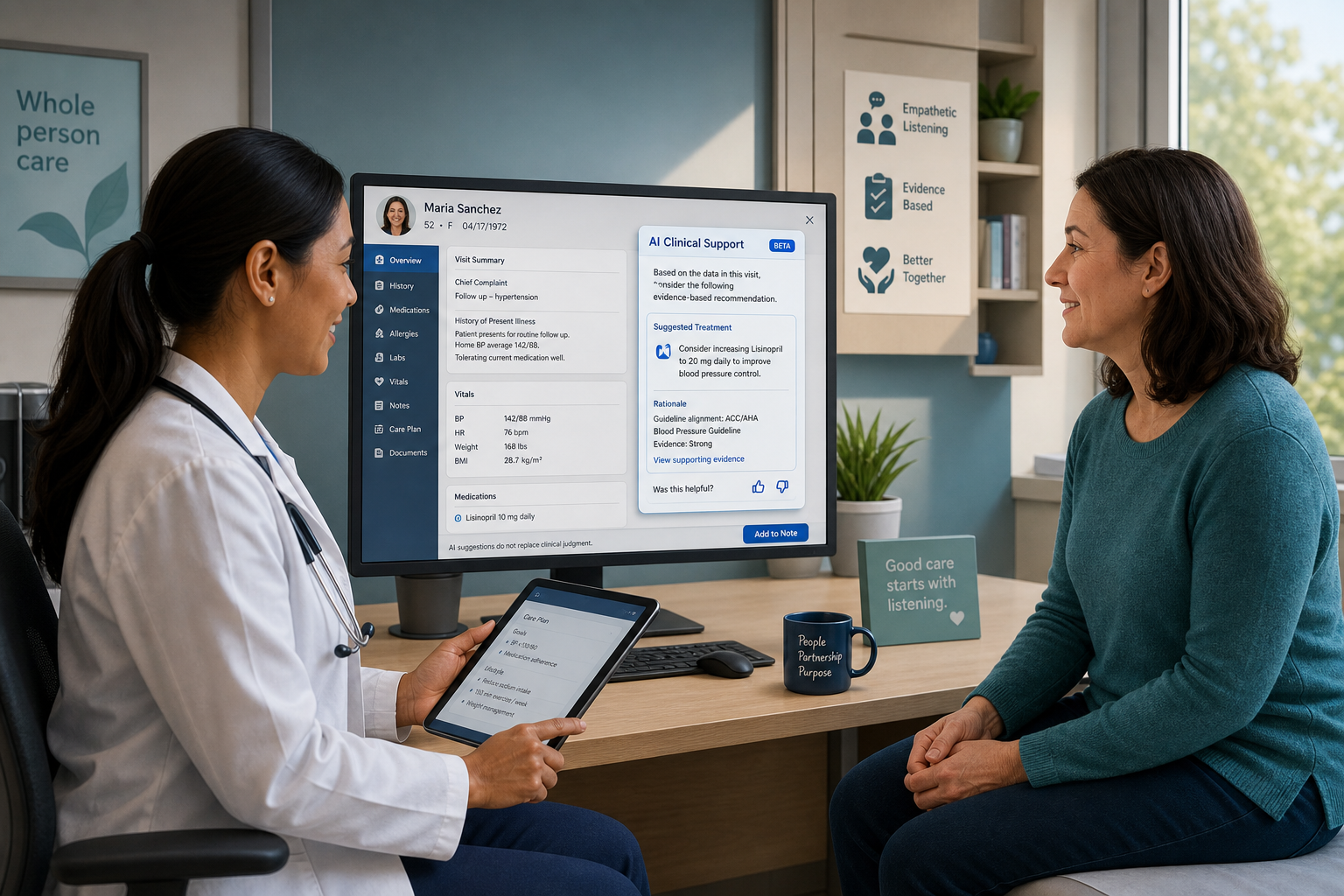
A primary care clinician in a modern exam room with a patient seated nearby, consulting a tablet and a computer screen showing a subtle clinical decision support interface overlay.
AI CDSS tools are designed to augment, not replace, the clinician-patient relationship in primary care.

Risk-of-bias scorecard

Study design
Not reported in the cited evidence
External / prospective validation
Not reported in the cited evidence
Key performance metric
Not reported in the cited evidence
Overall rating
Not yet rated

Informational only — read the full disclaimer. This content supports procurement and research judgment, not clinical care decisions.

Submit a correction or sourcing issue

Blogarama - Blog Directory