
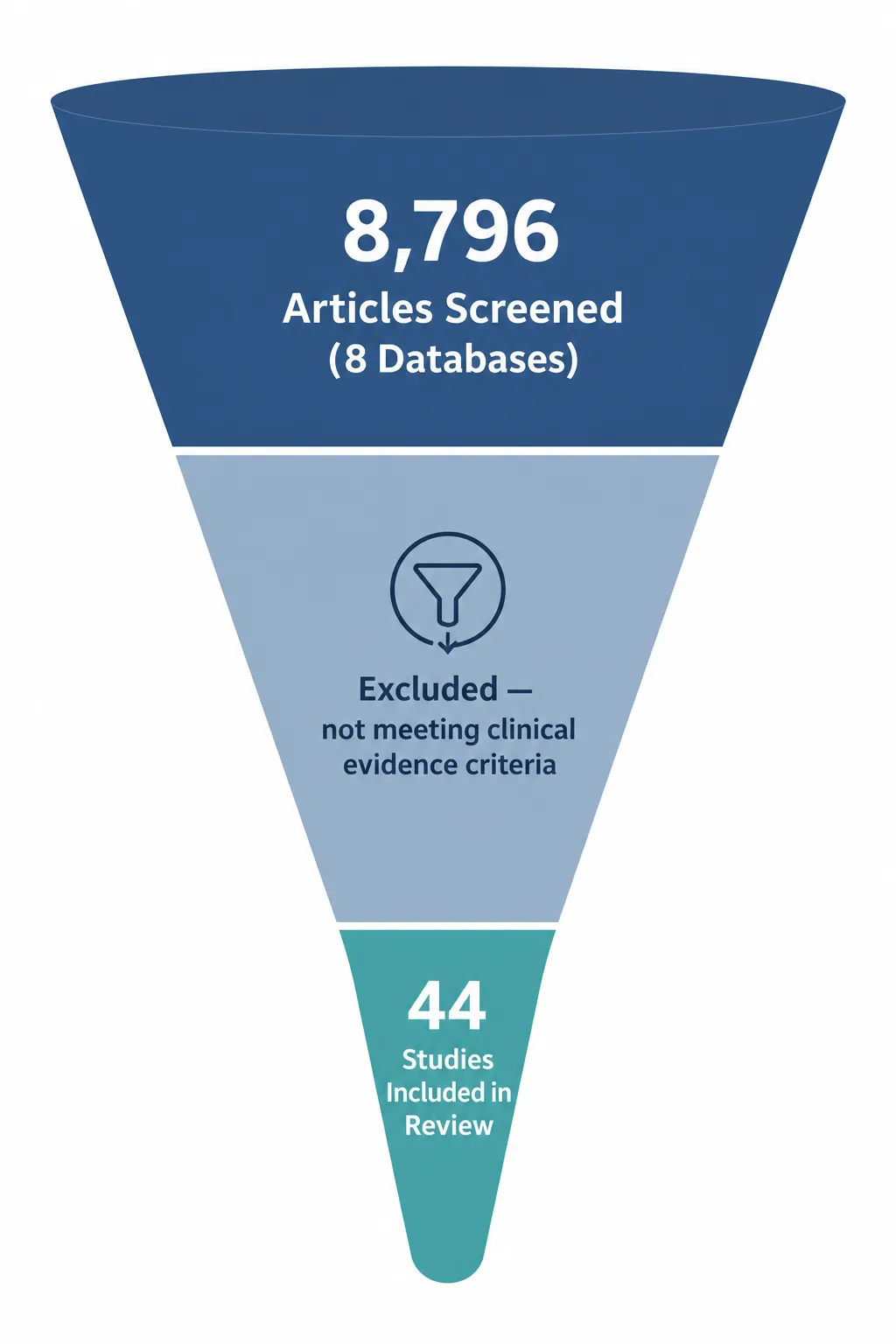
A healthcare leader who hears that AI will soon surpass all clinicians has a practical verification problem, not a philosophical one. The relevant question is not whether the phrase “AI singularity” sounds plausible in technology circles. It is what evidence would have to exist before that claim should influence clinical procurement, credentialing, liability planning, or patient-care workflows. On that test, the published clinical evidence is much narrower than the public claim: a 2024 narrative review by Chustecki screened eight databases and 8,796 articles, but only 44 studies met inclusion criteria, with persistent concerns about algorithmic bias, transparency, data privacy, and a lack of prospective randomized evidence confirming AI-based treatment efficacy [1].

Medical-information disclaimer: this article is an evidence appraisal for healthcare technology governance and does not provide medical advice, diagnosis, treatment guidance, or device-specific purchasing approval.
| Claim or evidence type | What it can support | What it cannot support |
|---|---|---|
| Singularity timeline predictions | A public forecast that some AI leaders expect very rapid capability gains, including predictions associated with 2026 and roughly 2030 timelines [2]. | Clinical validation, patient benefit, local safety, or superiority over clinicians in deployed care. |
| AGI expert surveys | Context on expert expectations; the AI Impacts 2023 survey reported a median 50% probability of AGI by 2047, down from 2060 in prior surveys [3]. | Medical evidence. It is expert opinion about AGI timelines, not prospective clinical outcome data. |
| FDA AI device listings | Evidence that many AI-enabled medical devices have regulatory authorization for specified uses; the FDA maintains a public list of AI-enabled medical devices [4]. | Proof that AI has reached general clinical superiority, or that cleared devices improve patient outcomes in routine deployment. |
| Clinical validation and governance studies | Evidence about what has actually been studied, deployed, monitored, and audited in healthcare settings [1][5]. | A warrant to generalize from narrow performance claims to singularity-level clinical capability. |
The claim is broad; the evidence standard should be broad too
In healthcare, “AI singularity” usually arrives with an implied escalation: AI will not merely assist radiologists, flag sepsis risk, summarize records, or draft patient messages. It will outperform clinicians across diagnosis, treatment selection, prognostication, workflow coordination, and perhaps bedside judgment. If that is the claim, then a benchmark score in one task is not enough. The evidence would need to show performance across intended uses, clinical populations, care settings, and outcome measures that matter to patients.
A clinically meaningful version of “surpass all human clinicians” would require more than model accuracy on held-out data. It would require external validation in populations unlike the development cohort, prospective testing in live workflows, bias assessment across relevant subgroups, monitoring after deployment, and evidence that the model changes decisions in ways that improve outcomes or reduce harm. It would also need to show who remains accountable when the system is wrong: the clinician, the hospital, the vendor, or some combination of all three.
This does not make near-term AI progress irrelevant. A well-scoped model with a clear intended use can be clinically valuable without being close to singularity-level capability. The problem begins when evidence from such narrow systems is used as if it supports a claim about general clinical superiority.
Timeline forecasts are not clinical validation
Short AGI or singularity timelines deserve to be stated fairly. Public summaries have attributed a 2026 timeline to Dario Amodei and an approximately 2030 timeline to Sam Altman [2]. Those predictions matter as signals about how some frontier-AI leaders think capability development may unfold. They do not, by themselves, establish that a hospital can safely substitute an AI system for physician judgment across clinical domains.
The broader expert-survey context is more cautious. The AI Impacts 2023 survey reported a median estimate of a 50% probability of AGI by 2047, earlier than the 2060 median reported in prior surveys but still not a near-term clinical validation result [3]. The same source treats especially short timelines from frontier-company leaders as a conflict-of-interest pattern to notice, not as a reason to dismiss a prediction by personal attack [3]. For a governance committee, the practical conclusion is simpler: a timeline forecast belongs in a risk-scenario discussion, not in the evidence section of a procurement file.
When the medical literature is screened, the claim gets smaller
The Chustecki 2024 review is useful because it does the work that singularity language usually skips. It does not ask whether AI sounds transformative in the abstract. It searches eight databases, begins with 8,796 articles, and ends with 44 included studies that met the review criteria [1]. That narrowing is not a minor methodological detail. It shows how quickly a large AI-in-medicine literature becomes a much smaller body when it is filtered for relevance to clinical evidence.
The review’s recurring concerns are exactly the kinds of issues that determine whether a model can move from demonstration to deployment: algorithmic bias, transparency, privacy, and the lack of empirical evidence confirming AI-based treatment efficacy in prospective trials [1]. These are not peripheral implementation annoyances. Bias changes who is harmed. Transparency affects whether clinicians can interrogate a recommendation. Privacy constrains what data can be used and shared. Prospective efficacy evidence is the difference between a model that predicts something and an intervention that improves care.
The distinction is especially important for treatment claims. A model may identify patterns associated with response, deterioration, or diagnosis in retrospective data. That does not show that acting on the model improves patient outcomes. For that, a hospital would want prospective evidence: the model is introduced into a real workflow, clinicians use or respond to it under defined conditions, and patient-relevant outcomes are measured. The review’s finding that prospective randomized efficacy support is lacking makes it difficult to treat current healthcare AI evidence as a stepping-stone to near-term singularity-level clinical authority [1].
This is also where benchmark excitement can mislead. A benchmark can be appropriate for model development, and a high score may justify further study. But the benchmark does not carry the burdens of deployment. It does not prove calibration after a change in patient mix, robustness after a coding-policy change, usability during a night shift, or safety when clinicians over-trust an output. The clinical question is not whether the model can answer under test conditions; it is whether the system improves decisions when inserted into care.
FDA clearance volume does not solve the evidence gap
Regulatory authorization is often pulled into singularity arguments as if a growing device count proves clinical inevitability. It does not. The FDA’s list of AI-enabled medical devices is a useful inventory of authorized products, but authorization is tied to device-specific indications and regulatory pathways; it is not a finding that AI systems generally outperform clinicians across medicine [4].
The same pattern appears in ClinicalMind’s appraisal of 1,451 FDA-Cleared AI Devices: Why Only 2% Have Clinical Trial Evidence. That review found that approximately 97% of FDA-cleared AI devices were cleared through 510(k) pathways for locked algorithms, and fewer than 2% had randomized clinical trial evidence. The point is not that these devices are useless. The point is that a large authorization count should not be mistaken for evidence of clinical superiority, much less evidence of general intelligence in healthcare.
A hospital procurement committee usually understands this distinction in other categories. A device can be legally marketed for a defined use and still require local validation, workflow testing, user training, monitoring, and review of failure modes. AI should not receive a lighter evidentiary burden simply because its marketing vocabulary is more ambitious.
Deployment governance is still behind the claims
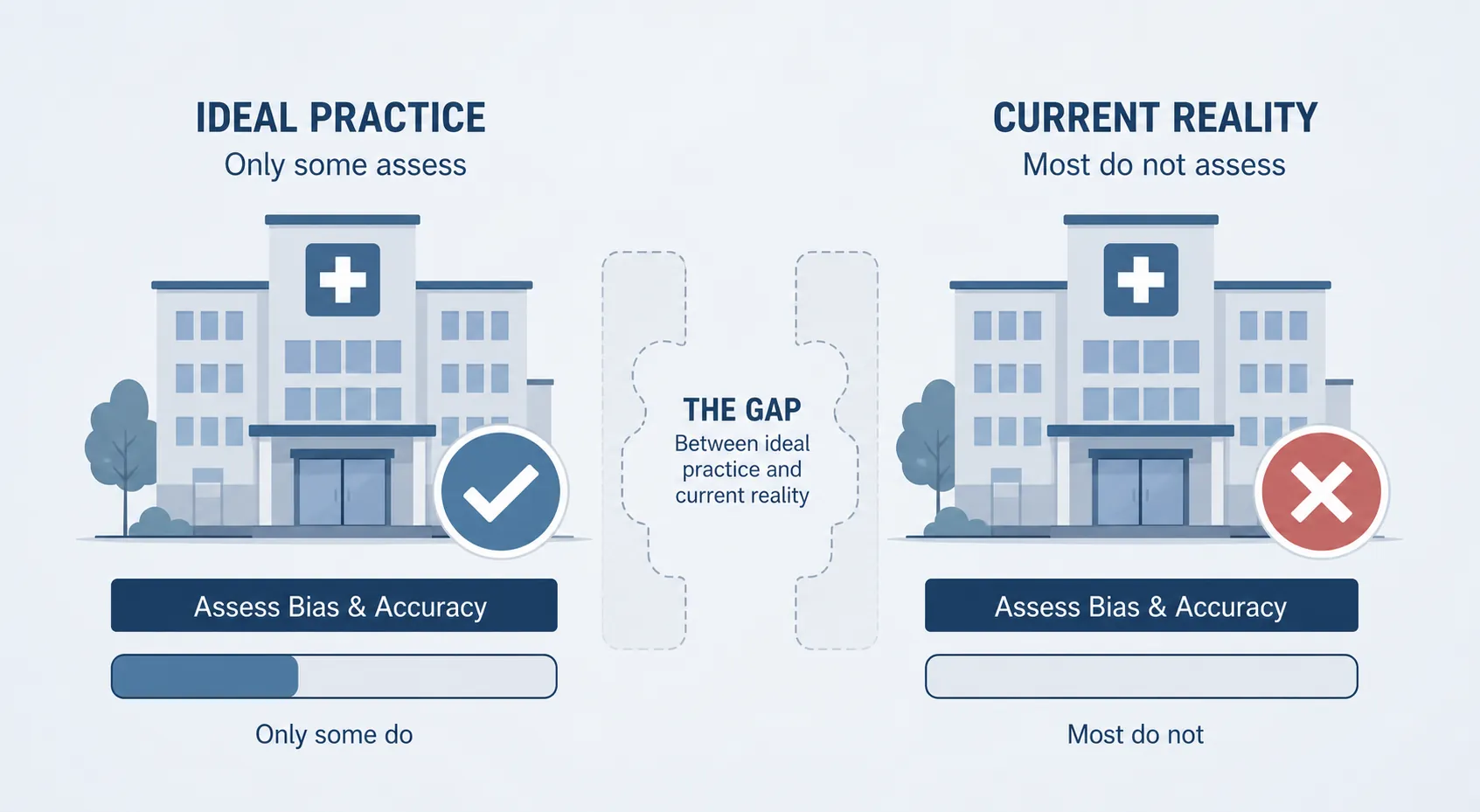
The Hussein et al. 2026 governance review moves the issue from speculative capability to hospital practice. It reports that only half of U.S. hospitals using predictive AI assess bias, and only two-thirds assess accuracy [5]. Those figures are hard to reconcile with claims that healthcare is on the edge of AI systems surpassing clinicians in a general way. If many hospitals using predictive models are not yet checking bias or accuracy, then the deployment environment is not ready to absorb far more consequential autonomy.
Bias assessment is not a paperwork exercise. A predictive model can perform acceptably on average while underperforming in a subgroup defined by race, sex, age, language, disability, socioeconomic position, site of care, or disease severity. Accuracy assessment also cannot be treated as a one-time vendor claim. Data drift, changing clinical practice, new documentation habits, and local patient mix can all change performance after a model leaves the development setting.
Hussein et al. also discuss the HAIRA maturity model, but that tool should be used with an explicit caveat: as of the review, it was very recent and had no independent validation studies [5]. That does not make it worthless. It means it should not be treated as a proven benchmark for governance maturity. The same evidence discipline applied to AI models should apply to the governance tools used to evaluate them.
What evidence would make a singularity-level healthcare claim clinically relevant?
A governance committee does not need to adjudicate the metaphysics of AGI before asking for ordinary clinical proof. If a vendor, researcher, or executive claims that a system is approaching clinician-surpassing capability, the claim should be translated into inspectable evidence requirements.
- A stated intended use, including what clinical decision the model informs and who is expected to act on the output.
- A visible validation population, including whether the test cohort resembles the hospital’s patients, sites, acuity, language mix, and data systems.
- External validation beyond the development setting, with performance reported for clinically relevant subgroups.
- Prospective evidence showing how the model changes clinician behavior and patient-relevant outcomes in a real workflow.
- Calibration, bias, and accuracy monitoring plans after deployment, including thresholds for retraining, suspension, or withdrawal.
- A clear accountability model for review, override, escalation, documentation, and adverse-event investigation.
These requirements are not anti-AI. They are the minimum conditions for taking a high-consequence clinical claim seriously. A model that satisfies them for a narrow use case may be worth deploying. A model that lacks them may still be worth studying. Neither category needs to be described as evidence that medicine is approaching the singularity.
The defensible Q3 2026 appraisal
As of Q3 2026, peer-reviewed clinical validation data do not support near-term singularity-level claims in healthcare. The available evidence supports a narrower conclusion: healthcare AI is advancing in specific tasks, but the clinical literature remains thin when screened for prospective evidence, efficacy, bias assessment, transparency, and deployment monitoring. FDA clearance counts and AGI timeline forecasts may be relevant context, but they do not substitute for patient-centered clinical validation.
That is not a claim that singularity-level healthcare AI is impossible. It is a procurement and governance judgment: until the claim is matched by prospective, externally validated, bias-assessed, clinically meaningful evidence, it should be treated as an extrapolation rather than a clinical finding.
References
- Artificial intelligence in medicine: a narrative review — PMC, 2024.
- Predictions for the Arrival of Singularity as of Dec 2025 — ETC Journal, December 26, 2025.
- 2023 Expert Survey on Progress in AI — AI Impacts, 2023.
- Artificial Intelligence-Enabled Medical Devices — U.S. Food and Drug Administration.
- Health AI readiness and governance: a systematic review and maturity model — npj Digital Medicine, 2026.