
The strongest peer-reviewed evidence for AI in snakebite treatment is not a chatbot, a triage tool, or a bedside decision aid. It is a Nature paper reporting de novo proteins designed with RFdiffusion that bind elapid venom neurotoxins at 0.9-1.9 nM, match their intended structures by X-ray crystallography, remain stable at high temperature, and rescue mice after toxin exposure rather than only in a pre-mix experiment.[1]
Taken at full strength, the Vázquez Torres et al. study is an impressive preclinical result. The short-chain alpha-neurotoxin binder reached a reported Kd of 0.9 nM, the long-chain alpha-neurotoxin binder reached 1.9 nM, and crystal structures aligned with the designs at 0.42-1.32 A RMSD.[1] Some variants had melting temperatures above 95 C, and the binders were designed for microbial production rather than the plasma-derived manufacturing model behind conventional antivenoms.[1]
The in vivo neurotoxin result is the part that deserves attention. In the short-chain neurotoxin assay, mice receiving binder 15 minutes after toxin exposure survived at 20/20 across the tested 1:10 and 1:5 molar ratios; for the long-chain neurotoxin assay, survival ranged from 80% to 100%.[1] That timing matters. A rescue design is still far from a real snakebite, but it is more clinically serious than neutralizing toxin in a syringe before injection.
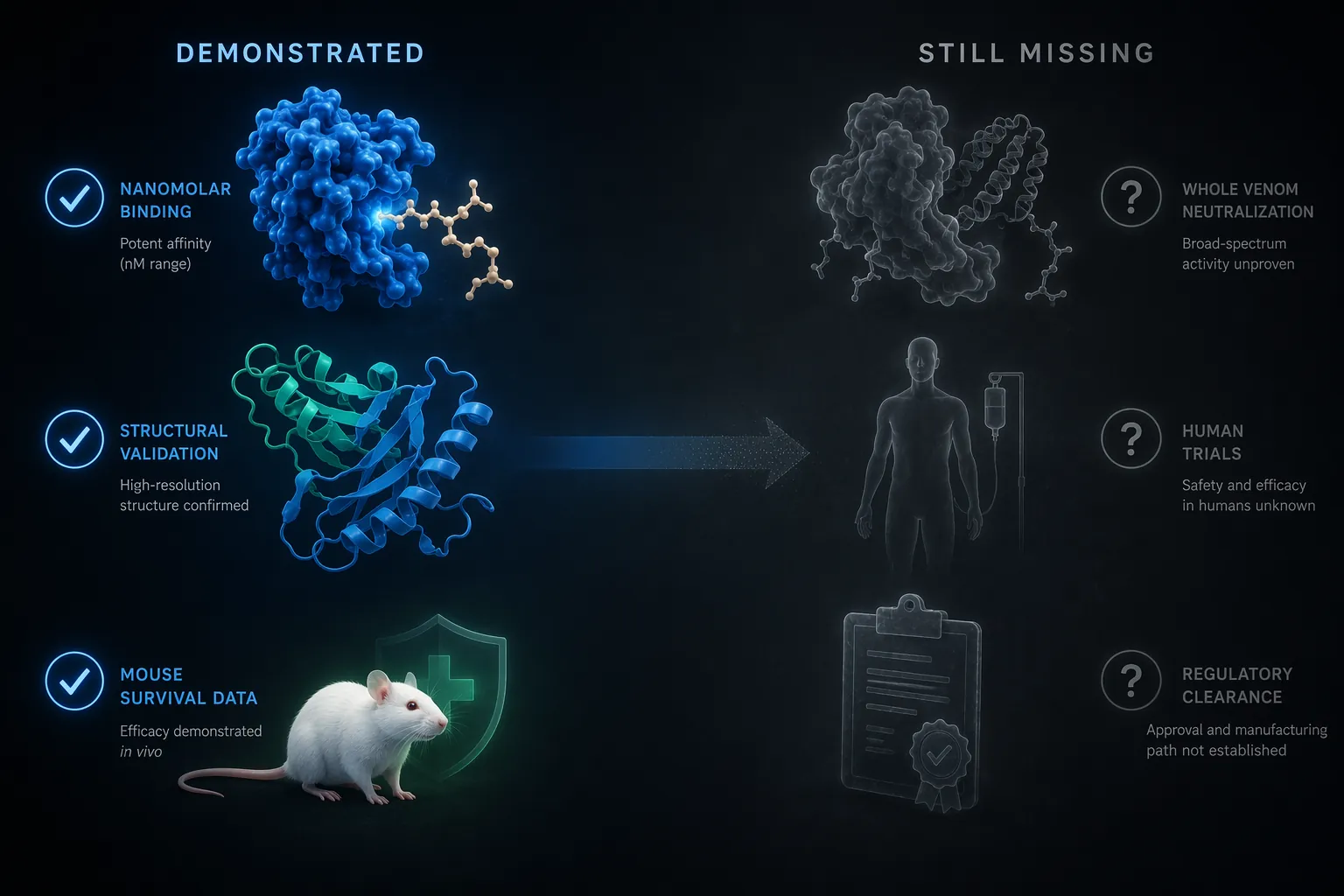
That is the favorable case. It is also the boundary of the case. The study shows that AI-designed proteins can neutralize selected isolated three-finger toxin subfamilies in preclinical models. It does not show that an AI-designed antivenom treats whole snakebite envenomation in humans.
What RFdiffusion Actually Contributed
RFdiffusion is deep-learning protein design. In this study, it was used to generate new protein binders aimed at venom toxin surfaces, not to diagnose snakebite, recommend a dose, or manage emergency department operations.[1] That distinction is important for anyone reading the phrase “AI antivenom.” The AI contribution sits upstream, in molecular design.
The experimental sequence matters because the paper did not stop at computer-generated structures. The authors moved from design to expression, binding measurement, structural validation, stability testing, and animal rescue assays.[1] This is why the study is more substantial than a model-performance announcement. Nanomolar affinity is not clinical efficacy, but it is a meaningful biochemical starting point when the target is a potent neurotoxin.
The structural data also do useful work. If a designed binder rescues animals but its interface is not what the model predicted, the result may still be interesting, but the design claim becomes fuzzier. Here, X-ray crystal structures supported the intended binding modes, with reported RMSD values from 0.42 to 1.32 A.[1] For a platform argument, that is not cosmetic; it is part of the evidence that the design process produced what it claimed to produce.
The production and stability details are not incidental either. The paper reports E. coli production and heat-stable binders, including variants with Tm values above 95 C.[1] For snakebite, where treatment access, cold-chain constraints, and affordability shape what actually reaches patients, those properties are deployment-relevant. They still do not substitute for efficacy, dosing, safety, or regulatory evidence.
The Mouse Rescue Result Is Strong, but Narrow
The 15-minute post-toxin design gives the neurotoxin rescue assays real weight. It tests whether the binder can work after toxin exposure, not only whether toxin and binder can be neutralized before the animal ever sees them.[1] That is the right direction for translational relevance.
The limitation is in what was administered. These were isolated toxin challenges, not whole-venom snakebite models.[1] A patient is not exposed to a purified short-chain alpha-neurotoxin at a known molar ratio under controlled timing. Whole venom brings a mixture of toxin families, tissue distribution, evolving local injury, systemic effects, and a treatment delay that may be measured in hours rather than minutes.
So the correct claim is not “AI treats snakebite.” It is narrower and more defensible: AI-designed proteins neutralized selected lethal elapid neurotoxins in a preclinical rescue model. That is a serious result. It is not a clinical product claim.
The Whole-Venom Gap Is Not a Technicality
Snakebite treatment is not only a binding problem. It is a clinical and logistics problem: which species bit the patient, how much venom was delivered, how long it took to reach care, which tissues are already injured, what antivenom is available, and whether the product can be stocked, paid for, and administered safely.
That is why the absence of whole-venom challenge is a central gap. A clinically useful antivenom has to neutralize the relevant venom cocktail, not just one purified component. Science coverage of the work framed the attraction of AI-designed antivenoms around the possibility of cheaper, faster, and more effective products, but that possibility still depends on showing coverage across venom complexity.[2]
The study also did not compare the designed binders against existing commercial antivenom in the same experimental system.[1] Without that comparison, it is hard for procurement or value-analysis teams to place the result beside current care. A novel binder may be easier to manufacture, more stable, or more target-specific; it still has to prove what it adds when the comparator is the product clinicians can actually order.
For conventional snakebite management, the relevant comparison is not an idealized antivenom but the messy reality of assessment, supportive care, antivenom selection, and monitoring. Readers who need that clinical anchor can treat existing guidance on adder bite first aid and treatment as the contrasting frame: the therapeutic question is what changes for the person already envenomed, waiting for treatment, and accumulating injury.
The Dermonecrosis Result Deserves More Than a Footnote
The cytotoxin arm is where the platform meets a harder clinical endpoint and does not yet clear it. The CYTX binder showed 70-90% in vitro protection against cobra whole-venom cytotoxicity, but it failed to reduce dermonecrotic lesion size in mice.[1]
That matters because local tissue injury is not a cosmetic outcome in cobra envenomation. Necrosis can drive surgery, disability, infection risk, and long-term functional loss. Current antivenoms are often weakest against established local tissue damage, so a new platform would be especially valuable if it improved that endpoint. In this study, it did not.
The failure does not invalidate the neurotoxin result. It does prevent a broad snakebite-treatment claim. If the strongest animal survival data come from purified neurotoxin rescue and the local-injury model remains unresolved, the evidence supports a targeted preclinical advance rather than a general therapeutic solution.
Media Context Helps, but It Can Also Blur the Claim
Nature News described the study as AI-designed proteins tackling a century-old problem, and that framing is understandable: antivenom production has long been difficult, and a programmable design route is scientifically attractive.[3] The study came from the University of Washington’s Institute for Protein Design ecosystem, a group with unusual credibility in de novo protein design.[1][3]
The trouble begins when “tackling” becomes “solved.” A protein binder that neutralizes a purified toxin in mice is not the same thing as a field-ready antivenom, a hospital formulary item, or an emergency medicine protocol. The distinction is not pedantry. It determines whether a governance committee treats the work as a research signal or a product candidate ready for operational review.
The same caution applies to broader discussions of AI in toxicology and emergency care. AI can be useful at different levels: molecular design, literature synthesis, first-aid guidance, diagnostic support, logistics, or pharmacovigilance. Evidence for one layer should not be borrowed to certify another.
What a Deployment Review Can and Cannot Conclude in Q3 2026
As of Q3 2026, the evidence does not support deploying AI-designed proteins for snakebite treatment in clinical care. There is no human efficacy evidence, no reported human dosing evidence, no reported IND filing, no FDA clearance, and no CE marking for these designed binders. The evidence base remains preclinical.
A governance team can still give the work a high scientific score. The paper demonstrates a plausible way to generate stable, high-affinity toxin binders and shows that at least some of them can rescue animals after exposure to isolated lethal neurotoxins.[1] That is exactly the kind of result that should prompt follow-on studies, independent replication, whole-venom testing, safety work, and manufacturing assessment.
| Evidence category | What the current evidence supports | What it does not yet support |
|---|---|---|
| Demonstrated | Nanomolar binding to selected elapid neurotoxins; accurate crystal structures; high thermal stability; mouse rescue after isolated neurotoxin exposure. | Clinical treatment claims. |
| Plausible | A platform for designing lower-cost, heat-stable antivenom components that could be combined or optimized. | Assuming those components will neutralize complete venoms in real-world bites. |
| Absent | Human trials, regulatory clearance, IND movement, whole-venom efficacy, commercial antivenom comparison, and successful dermonecrosis protection. | Procurement, formulary adoption, bedside deployment, or replacement of existing antivenom. |
For procurement, clinical governance, or AI oversight, the verdict is therefore straightforward: promising preclinical proof-of-concept, not clinically deployable therapy. The Nature study earns credit for what it actually tested. It should not be made responsible for the headline version of itself.