
Evidence verdict for evidence-appraisals: AI sports injury recovery prediction is not ready to direct individual return-to-sport clearance. The best current synthesis found 11 machine learning studies predicting return to sport in athletes, with reported AUCs ranging from 0.57 to 0.96 and sample sizes from 32 to 1,611, yet only 4 of the 11 studies were rated low risk of bias under PROBAST appraisal.[1]
That is not a trivial evidence base, and it should not be dismissed as empty. Some models can separate higher- and lower-risk groups in selected retrospective datasets. The problem is the decision being implied. Return to sport is not a lab value. It can mean playing any minutes, missing no more than a set number of games, completing rehabilitation milestones, or returning to prior performance. A model that predicts one of those endpoints may be irrelevant, or actively misleading, when used for another.
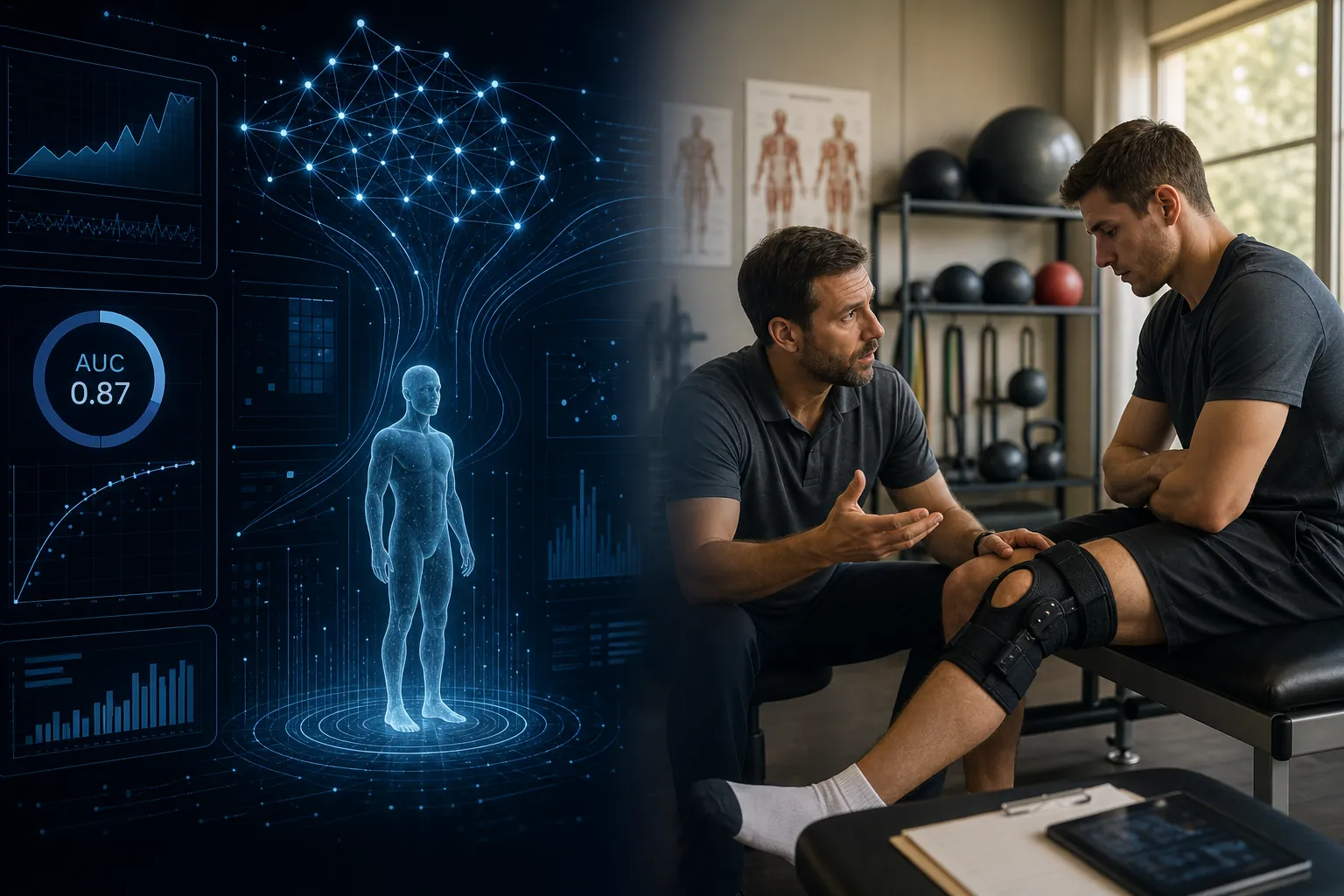
As of July 2026, no FDA-cleared AI tool specifically for sports injury recovery prediction or individualized return-to-sport timing was identified in the evidence reviewed here. That matters because readers looking for ai sports injury recovery prediction evidence are often asking three different questions at once: whether published models perform well, whether they have been clinically validated in the settings where they will be used, and whether regulatory oversight has reviewed the intended use. The current answer differs sharply across those questions.
What the strongest review actually supports
Yuan et al. provide the main evidence because they reviewed machine learning models designed to predict return to sport after athletic injury, rather than adjacent tasks such as diagnosing injury, forecasting injury risk, or planning surgery. Their review included 11 studies, reported an AUC range of 0.57 to 0.96, and found that 6 of the 11 studies were high risk of bias, 4 were low risk, and 1 was unclear.[1]
| Evidence Feature | What Yuan et al. Found | Why It Matters for RTS Use |
|---|---|---|
| Number of studies | 11 studies | A small base for a heterogeneous clinical decision |
| Sample sizes | 32 to 1,611 participants | High performance in small cohorts is fragile when moved into broader use |
| Discrimination | AUC 0.57 to 0.96 | Some models rank-order risk well, but discrimination alone does not clear an athlete |
| Risk of bias | 4 low, 6 high, 1 unclear | Most studies do not yet meet the stability expected for clinical deployment |
| Study design concern | 55% retrospective | Retrospective convenience data can fit past documentation patterns rather than future decisions |
| Outcome variation | Definitions ranged from missing more than 5 games to full return to pre-injury performance | The predicted endpoint may not match the clearance question |
The cleanest procurement reading is narrower than the best AUCs suggest: selected models discriminate in selected settings, but the evidence base does not yet support using those predictions to materially direct an individual athlete’s return-to-sport decision. The weak point is not simply model performance. It is the chain between the model output and the decision that follows.
A return-to-sport committee does not merely ask whether one athlete resembles others who returned earlier. It asks whether the athlete can tolerate specific sport demands, whether symptoms and function are stable, whether load can progress safely, whether recurrence risk is acceptable, and whether the athlete understands the remaining uncertainty. A retrospective model trained on the endpoint “missed more than 5 games” may be useful for research stratification. It is not the same as a clearance instrument.
High AUC is a starting point, not a clearance decision
An AUC above 0.90 deserves attention. It says the model, in that dataset and for that outcome, often ranked athletes who experienced the event above those who did not. In Yuan et al., the upper end of reported discrimination reached 0.96.[1] But an AUC does not say whether the model is calibrated, whether the threshold is clinically safe, whether the population resembles the next team using it, or whether the outcome means the same thing to the athlete, clinician, coach, and insurer.
This is where sports recovery prediction becomes unusually vulnerable to overclaiming. A model can look excellent if it predicts a narrow administrative outcome, such as time missed or game availability, while missing the harder clinical reality: partial participation, reduced performance, recurrence risk, persistent symptoms, or fear-driven movement avoidance. The model may be statistically coherent and still not answer the question being asked in the exam room.
The review also found that tree-based models such as random forest and XGBoost performed best in 60% to 64% of included studies.[1] That is interesting, but it should not be read as a mandate to buy tree-based software. In a small, heterogeneous field, algorithm family is rarely the main bottleneck. The larger problems are who entered the dataset, how recovery was labeled, which predictors were available before the decision point, and whether the model was tested outside its original development setting.
Leckey et al. make that caution harder to ignore. In a broader scoping review of machine learning approaches to injury risk prediction in sport, logistic regression outperformed more complex machine learning models in 4 of 12 studies where direct comparisons were available.[2] That does not prove logistic regression is generally superior. It does show that algorithmic complexity is a poor substitute for clean endpoints, defensible predictors, and honest validation.
Three kinds of evidence are being mixed together
Published model performance, clinical validation, and regulatory clearance are often treated as if they form a single ladder. They do not. A paper can report strong discrimination without proving clinical utility. A product can be deployed without having been prospectively validated for the decision it is influencing. A cleared orthopedic AI device can be legitimate for diagnosis or planning while saying little about return-to-sport prediction.
| Signal | What It Can Show | What It Does Not Show |
|---|---|---|
| Published model performance | A model separated outcomes in a study dataset | That it will safely guide one athlete’s clearance |
| External or prospective validation | Performance was tested beyond the original development setting | That all RTS definitions and clinical thresholds are appropriate |
| Regulatory clearance | A device met requirements for a reviewed intended use | That it is cleared or useful for sports injury recovery prediction unless that use was reviewed |
| Real-world deployment | A system is being used operationally | That it improves outcomes or performs reliably across populations |
Lee et al. found 70 FDA-cleared AI medical devices in orthopaedic surgery as of February 2025, a 5.5-fold increase since 2017.[3] That growth can create a misleading sense that orthopedic AI as a category has crossed the clinical validation threshold. In the same review, only 8.6% of cleared devices were validated through prospective clinical trials.[3]
The distinction is especially important here because most cleared orthopedic AI devices described in that evidence base are diagnostic or surgical planning tools, not individualized sports recovery prediction systems. Regulatory maturity in fracture detection, imaging workflows, or operative planning does not transfer automatically to return-to-sport timing after injury.
Deployment is also an unreliable shortcut. Hando et al. evaluated commercially deployed AI injury prediction systems in large military cohorts and reported “poor predictive performance and limited reliability,” with some systems “performing little better than chance.”[4] Military readiness and sports return-to-play are not identical domains, but the lesson travels: operational use does not prove clinical reliability.
The NFL Digital Athlete is a useful example of the boundary. Public reporting describes a flagship program aggregating data across all 32 teams, yet the same report acknowledged the difficulty of proving that the AI system caused injury reduction, quoting the program’s caution that “Everybody is always going to want the smoking gun... It doesn’t ever work like that.”[5] That is a reasonable statement about complex prevention programs. It is not validation evidence for individualized return-to-sport recovery prediction.
The endpoint problem is not cosmetic
Return to sport sounds like a binary endpoint until someone has to sign the clearance note. Did the athlete return to practice, competition, unrestricted minutes, pre-injury workload, or pre-injury performance? Was the endpoint chosen because it reflects recovery, or because it was available in the record?
Yuan et al. documented inconsistent RTS definitions, including endpoints as different as missing more than 5 games and returning fully to pre-injury performance.[1] Those are not interchangeable labels. One is partly a scheduling and availability measure. Another is closer to functional recovery. A model trained on the first can be useful for roster planning while still being inadequate for clinical clearance.
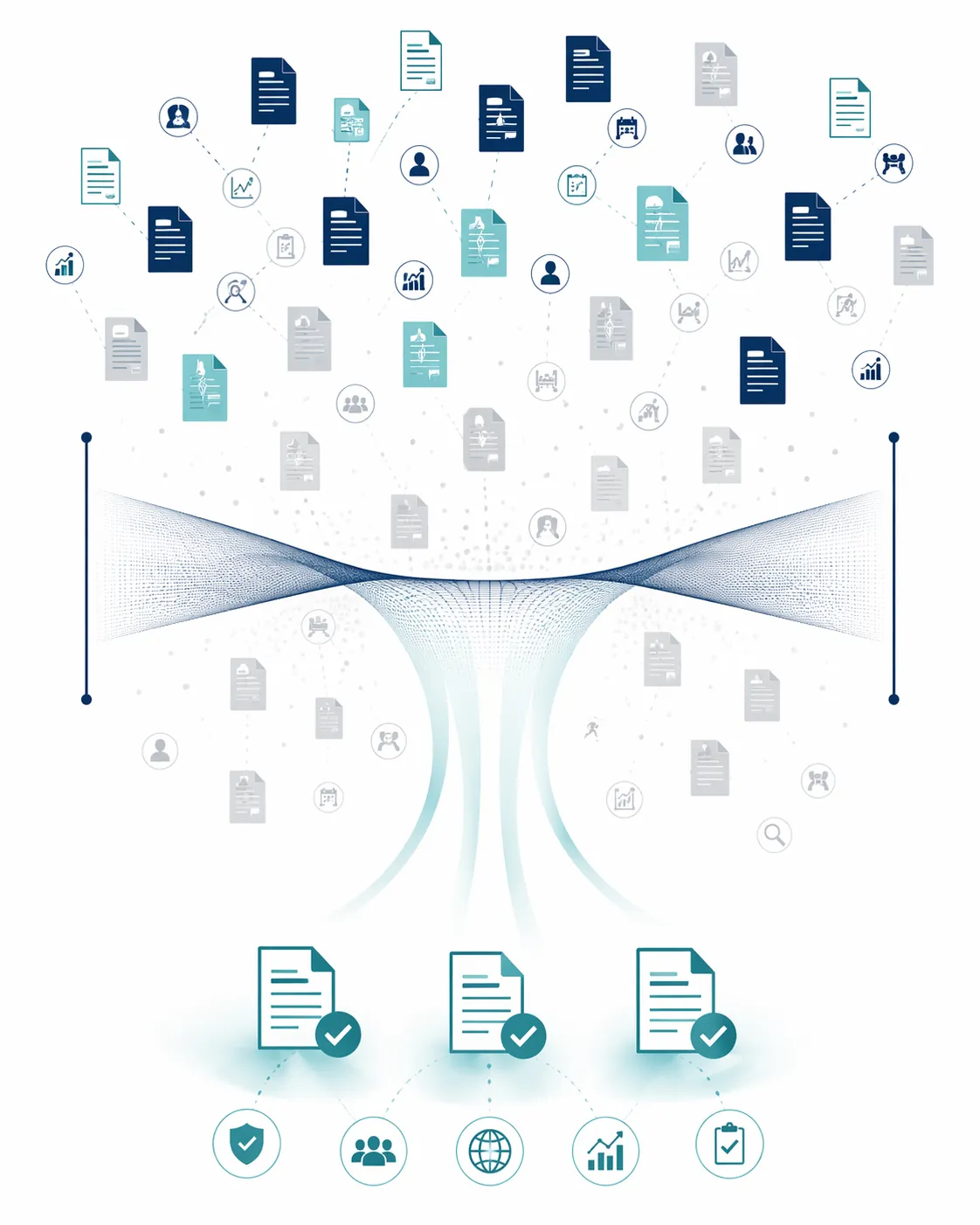
This is also where small samples become more than a statistical inconvenience. When a study has 32 athletes, even careful modeling can be dominated by local practice patterns: how one clinic documents symptoms, how one league reports participation, how one rehabilitation team progresses workload, or how one sport defines meaningful competition. The model may learn the setting as much as the biology.
External validation is the practical test of whether that has happened. If a model survives a new site, new sport, new documentation pattern, and new patient mix, confidence begins to rise. When external validation is infrequent, the adoption committee is being asked to accept transportability on faith.
The missing psychological variables are a clinical warning
Recovery after sports injury is partly tissue healing, partly load tolerance, partly sport demand, and partly confidence. Yet psychological factors such as fear of reinjury and confidence appeared in only 18% of return-to-sport prediction studies in the reviewed evidence base.[1] That omission is not a soft-science footnote. It changes what the model can claim to know.
An athlete may pass strength testing and still move guardedly in competition. Another may be physically ready but not psychologically prepared to cut, collide, sprint, or land under pressure. A model that ignores that domain may still predict calendar availability, but it is thinner as a recovery tool.
This gap also affects fairness and workflow. Psychological readiness is not captured equally across programs. Elite teams may collect structured questionnaires and repeated performance data. Smaller programs may rely on narrative notes and brief check-ins. If the model treats absent psychological data as irrelevant, it may reward the places that collect the easiest variables rather than the variables most relevant to the athlete’s actual return.
Adjacent concussion models show promise, not proof
Some of the most encouraging sports AI work sits near this question rather than inside it. Buckley et al. reported 95% accuracy for a University of Delaware concussion model predicting post-concussion musculoskeletal injury from more than 100 variables.[6] That is clinically interesting because secondary injury risk after concussion can affect monitoring and return planning. But it predicts a downstream injury-risk outcome, not individualized return-to-sport timing.
Czerniak et al. studied about 3,200 NCAA athletes and found that baseline evaluation mattered more than concussion frequency or intensity, challenging a common assumption about what should dominate concussion-related prediction.[7] That kind of finding can improve feature selection and clinical reasoning. It still does not validate a general AI system for sports injury recovery prediction.
These studies are worth watching because they show that carefully assembled sports datasets can produce useful prediction questions. They should not be laundered into evidence for a different endpoint. Injury risk, secondary injury after concussion, and recovery timing are related, but they are not the same model task.
A governance scorecard for adoption
The appropriate question for a procurement or AI governance committee is not whether the models are promising. Some are. The question is whether the evidence is strong enough to let a prediction change rehabilitation, clearance, or monitoring for an individual athlete. On the current evidence, that threshold has not been met.
| Governance Criterion | Current Appraisal |
|---|---|
| Clinical task match | Weak to mixed: RTS definitions vary and may not match clearance decisions |
| Discrimination | Mixed to promising: reported AUCs range from poor to excellent |
| Calibration and threshold safety | Insufficiently established in the evidence reviewed here |
| External validation | Not stable enough to support broad individual use |
| Risk of bias | Concerning: only 4 of 11 studies rated low risk of bias |
| Prospective clinical utility | Not established for individualized RTS prediction |
| Regulatory status | No identified FDA-cleared AI tool specifically for sports injury recovery prediction |
| Psychological recovery capture | Limited: fear of reinjury and confidence appear in only a small minority of studies |
PROBAST+AI gives committees a useful way to formalize that judgment. The updated tool uses 16 to 18 signaling questions across 4 domains: participants, predictors, outcomes, and analysis.[8] Applied to sports RTS prediction, those domains point directly to the weak spots already visible in the literature: selected cohorts, convenience predictors, inconsistent recovery endpoints, and analysis plans that may not survive transport to a new setting.
A defensible adoption position is therefore restrained. These models may be appropriate for research monitoring, registry enrichment, retrospective audit, hypothesis generation, and possibly decision support pilots where outputs are clearly non-directive and prospectively evaluated. They should not replace clinician judgment, and they should not materially direct individualized return-to-sport clearance until externally validated, prospectively tested, consistently defined, low-risk-of-bias evidence exists for the intended use.
References
- Systematic review of machine learning models predicting return-to-sport in athletes, Digital Health, 2026.
- Machine learning approaches to injury risk prediction in sport, British Journal of Sports Medicine, 2025.
- FDA-cleared AI medical devices in orthopaedic surgery, JAAOS Global Research & Reviews, 2026.
- AI injury prediction in military settings, Medicine & Science in Sports & Exercise, 2026.
- NFL tries using AI to help players stay healthier, AP News, 2025.
- UDelaware concussion model, Sports Medicine, 2025.
- Michigan concussion study, Annals of Biomedical Engineering, 2025.
- PROBAST+AI, BMJ, 2025.