
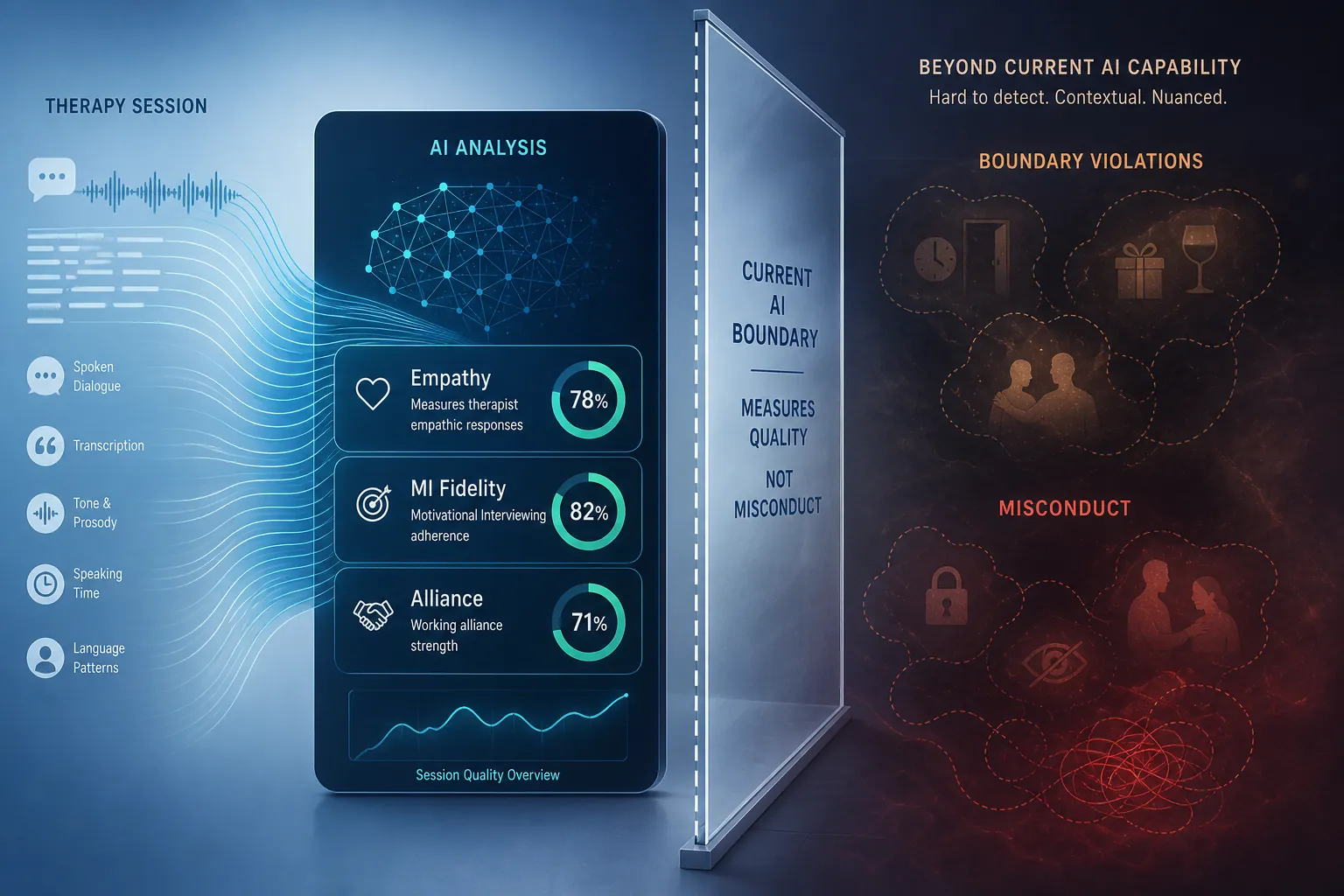
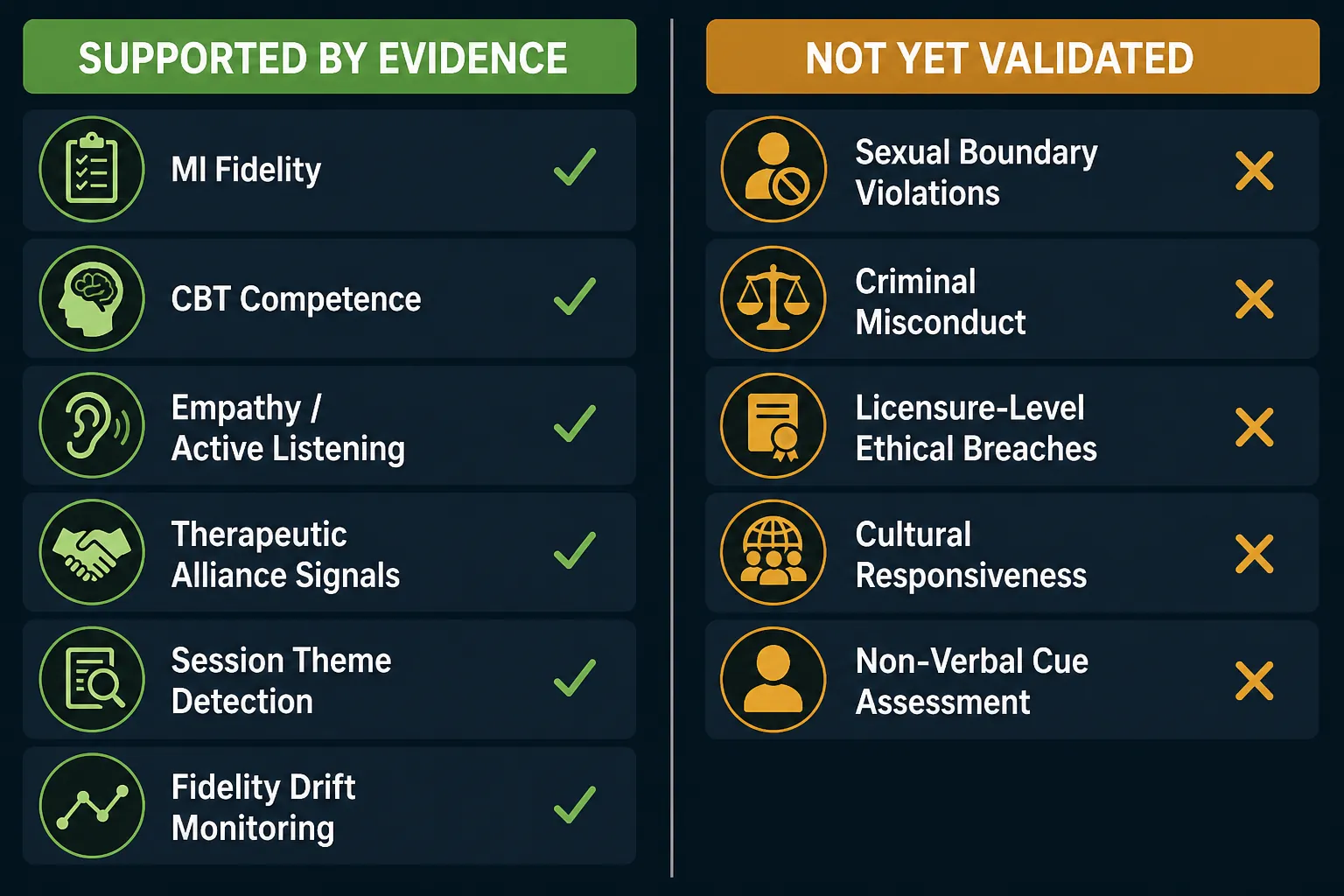
The evidence for AI in detecting therapist misconduct in psychiatry is strongest only if “misconduct” is narrowed to something less than misconduct: measurable lapses in therapy quality, fidelity, structure, empathy, alliance, or supervision-relevant behavior. Peer-reviewed studies support AI-assisted monitoring of those domains. They do not yet validate AI as a detector of sexual boundary violations, criminal conduct, or licensure-level ethical breaches.
That distinction matters at procurement time. A system that helps supervisors review more sessions, find fidelity drift, and notice relational weak spots may be worth serious consideration. The same system should not be governed, marketed, or relied on as an ethics-detection engine unless the evidence has tested that specific decision.
This is an evidence appraisal for clinical informatics and behavioral-health governance teams. It is not legal advice, licensure advice, or a substitute for human clinical supervision, patient-safety review, or mandatory reporting processes. The tool category under review is AI-assisted therapy quality and fidelity monitoring, not autonomous misconduct adjudication.
Evidence Scorecard
| Claim | Evidence status | Procurement reading |
|---|---|---|
| AI can measure motivational interviewing fidelity, CBT competence, empathy, active listening, alliance-related signals, and other session-quality metrics. | Supported by a fidelity-monitoring evidence base, especially Lyssn’s reported 70+ peer-reviewed publications, more than 35,000 expert-evaluated sessions, more than 4.3 million analyzed sessions, and 54+ quality metrics, with underlying publications still needed for precise metric-by-metric verification.[1] | Reasonable to evaluate as quality monitoring and supervision support. |
| AI can predict client-rated therapeutic alliance from transcripts. | Peer-reviewed support exists, but the reported association was modest: Goldberg et al. found transcript-derived NLP/ML predictions correlated with client-rated alliance at ρ=.15, p<.001 across 1,235 sessions.[2] | Relevant to relational quality; not enough to infer misconduct detection. |
| Clinicians and leaders will accept AI fidelity monitoring for supervision. | Creed et al. found post-demonstration median acceptability, appropriateness, and feasibility ratings of at least 4 out of 5 among community therapists and clinical leadership, while also documenting concerns about rapport, cultural responsiveness, and non-verbal communication.[3] | Acceptability helps implementation planning; it does not remove evidence gaps. |
| AI can identify session themes and key moments for supervision. | Eleos Health reports two peer-reviewed papers from a Palo Alto University training setting using AI to identify themes and key moments for supervisory intervention.[4] | Useful directionally for supervision workflows; not a misconduct-validation study. |
| AI can provide real-time fidelity feedback. | A 2024 feasibility study described an automated machine-learning feedback system for motivational interviewing fidelity scoring.[5] | Supports a technical pathway toward earlier coaching signals, not autonomous ethics escalation. |
| AI can detect sexual boundary violations, criminal misconduct, or board-reportable ethical breaches. | No peer-reviewed validation study in the supplied evidence directly supports this claim. | Do not approve as a validated misconduct detector. |
First, Separate Misconduct From Quality Lapse
“Therapist misconduct” is too broad for an AI evidence review unless it is split into decision types. A missed agenda, weak reflection, poor session structure, low empathy, or drift from an evidence-based protocol may be clinically important, but those are not the same as sexual boundary violations, fraud, criminal behavior, or a reportable licensure breach.
A practical vocabulary is more useful:
- Deficient practice: care that falls below an expected clinical or training standard, such as poor use of a treatment model.
- Fidelity lapse: deviation from a defined therapy protocol or coding system, such as motivational interviewing or CBT competence measures.
- Boundary erosion: a concerning relational pattern that may warrant supervision, documentation, or closer review but is not automatically misconduct.
- Supervision trigger: an AI-generated signal that a human supervisor should inspect a session, not a finding that misconduct occurred.
- Misconduct: conduct that may require formal investigation, reporting, employment action, licensing review, or legal response.
Most of the current evidence sits in the first four categories. That is not a small contribution. Supervisors often work from tiny samples of recorded or observed sessions, and quality drift can hide in ordinary caseload volume. But the distinction changes what a governance committee can honestly approve.
What Fidelity-Monitoring Systems Have Actually Been Validated To Measure
Lyssn is the main anchor in this evidence cluster because its scientific claims are tied to established therapy coding systems rather than only to product demonstrations. Its science page reports more than 70 peer-reviewed publications, more than 35,000 expert-evaluated sessions, more than 4.3 million analyzed sessions, and more than 54 quality metrics, including motivational interviewing fidelity, CBT competence, therapeutic alliance, empathy, and active listening.[1]
Those are the right kinds of measures for supervision. Motivational interviewing fidelity can show whether a clinician is using reflections, open questions, and MI-consistent behavior. CBT competence can show whether a therapist is structuring sessions and applying model-relevant interventions. Empathy and active listening scores can point to relational failures that a supervisor may want to hear directly. Alliance-related measures can help identify sessions where the working relationship may be weak.
The strongest reading is not that AI understands therapy the way a skilled supervisor does. It is that AI can scale parts of the measurement process that human supervision already uses: coding language, locating moments, summarizing themes, and comparing therapist behavior with a defined standard. That can change what supervision sees. A director who previously reviewed one selected recording may now see patterns across many sessions, including clinicians who are quietly drifting from the model or clients whose sessions repeatedly show poor alliance signals.
The caution is metric precision. A vendor science page is useful for mapping the evidence base, but exact claims that an AI system “matches” human raters should be checked against the underlying publication, population, coding system, and outcome. Human-rater reliability on MITI codes is not the same claim as misconduct detection. CBT competence scoring is not the same claim as identifying an exploitative therapist. Alliance measurement is not the same claim as detecting grooming or coercion.
The Goldberg Alliance Study Is Relevant, But Modest
Goldberg et al. is especially important because it moves closer to the relational terrain where supervision concerns often arise. The study used natural language processing and machine learning to predict client-rated therapeutic alliance from session transcripts in 1,235 sessions from a large randomized clinical trial. The reported correlation was statistically significant but modest: ρ=.15, p<.001.[2]
For governance purposes, that result should be neither dismissed nor inflated. It supports the idea that session language contains measurable signals related to how clients rate alliance. It does not show that an algorithm can decide whether a therapist crossed a boundary. A modest association with client-rated alliance may justify a supervision dashboard signal; it does not justify an automatic misconduct label.
CORE-MI And Real-Time Feedback Point Toward Earlier Coaching
The 2024 feasibility study of an automated machine-learning feedback system for motivational interviewing adds a different kind of evidence. It supports the technical feasibility of real-time fidelity scoring, which matters because many supervision problems are discovered late, after the session, after the training rotation, or after a pattern has already hardened.[5]
Real-time or near-real-time feedback could help a trainee correct MI-inconsistent behavior sooner, or help a supervisor notice that a clinician is repeatedly missing core elements of the model. That is quality improvement and training support. It may reduce the distance between lapse and coaching. It still leaves the misconduct question untouched unless the system is tested against adjudicated misconduct outcomes.
Eleos Shows Supervisory Usefulness, Not Misconduct Validation
Eleos Health’s work at Palo Alto University is useful because it is framed around training supervision. The company describes two peer-reviewed papers in which AI identified session themes and key moments for supervisory intervention in a training setting.[4]
That is exactly the kind of operational task AI may do well: reduce the time a supervisor spends searching for material and increase the chance that a meaningful moment is reviewed. A system that surfaces a rupture, missed intervention, or repeated topic can improve the supervision conversation. But identifying “key moments” is not the same as detecting abuse, exploitation, criminal behavior, or a reportable ethics violation.
Where The Misconduct Claim Breaks
The bridge from fidelity monitoring to misconduct detection is tempting because some warning signs overlap. A therapist who shows persistently low empathy, ignores client distress, fails to maintain structure, dominates sessions, or generates repeated alliance concerns may deserve closer supervision. Some of those patterns could appear before more serious harm becomes visible.
But overlap is not validation. To validate misconduct detection, a study would need a defensible reference standard: confirmed boundary violations, adjudicated complaints, board findings, documented criminal conduct, or rigorously reviewed case determinations. It would need to show how often the AI detects those events, how often it misses them, how often it falsely flags clinicians, and how performance varies across patient populations, clinician styles, therapy modalities, languages, and settings.
None of the supplied peer-reviewed evidence does that. The current evidence validates measurement of therapy quality signals and supervision-relevant patterns. It does not validate direct detection of sexual boundary violations, criminal misconduct, or licensure-level ethical breaches.
This is not a semantic complaint. It determines who bears the consequence of a flag. If a dashboard says a clinician’s MI fidelity has drifted, the next step is usually coaching, review, or training. If a dashboard implies misconduct, the next step may involve documentation, human resources, risk management, legal counsel, licensure reporting, or removal from patient care. The evidentiary threshold is different because the consequence is different.
Acceptability Does Not Solve The Blind Spots
Creed et al. helps answer a separate question: whether AI-based fidelity measurement is acceptable, appropriate, and feasible to people who might actually use it. In that study, community therapists and clinical leadership gave post-demonstration median ratings of at least 4 out of 5 on those dimensions.[3]
That finding matters. A technically impressive system that supervisors reject will not improve supervision. A tool that clinicians understand as feedback support has a better chance of becoming part of ordinary quality review. The study’s qualitative concerns are just as important, though. Stakeholders worried that AI could not assess rapport, cultural responsiveness, or non-verbal communication.[3]
Those are not peripheral objections. Rapport and cultural responsiveness shape whether a phrase is empathic, intrusive, dismissive, or clinically appropriate. Non-verbal behavior can change the meaning of a silence, a pause, a shift in tone, or a client’s discomfort. Misconduct and boundary erosion often live partly in context: repetition, timing, power, dependency, cultural meaning, body language, and what happens outside the transcript.
A transcript-based or audio-based system may still be useful despite those limits. The mistake is treating acceptability for supervision as evidence that the system can safely classify ethics violations. Creed et al. supports cautious implementation for fidelity measurement; it also names the areas where overclaiming would be most dangerous.
Privacy Becomes A Procurement Condition, Not A Footnote
Once therapy audio or transcripts enter an AI workflow, patient trust has to be earned again. That is especially true if the deployment is described as risk detection rather than routine quality improvement. A 2026 NPR report found that 77% of Americans expressed concern about health data storage in AI systems.[6]
For behavioral health, storage is only one part of the question. A governance review should also ask who records the session, whether the patient can decline, how consent is documented, whether raw audio is retained, whether transcripts are generated, what data are used for model improvement, who can view flags, how long records persist, and whether supervisors, compliance teams, or vendors can access identifiable content.
Misconduct-detection language raises the sensitivity further. Patients may consent differently to a tool used for trainee coaching than to a tool positioned as monitoring for clinician wrongdoing. Clinicians may also behave differently if they believe every utterance is being scored for possible ethics escalation. That does not mean organizations should avoid AI review. It means the governance language must match the actual use.
How To Govern The Tool Without Overstating The Evidence
A defensible deployment starts by approving the claim the evidence can support: AI-assisted quality and supervision support. The system may help identify fidelity drift, weak alliance signals, missed structure, low empathy, active-listening problems, session themes, and moments worth supervisor review. Those are meaningful uses.
The same deployment should reject unsupported claims. Procurement and governance documents should not say or imply that the tool detects sexual boundary violations, criminal misconduct, licensure-level ethical breaches, abuse, exploitation, or reportable conduct unless direct peer-reviewed validation exists for that use.
| Governance item | Minimum defensible position |
|---|---|
| Approved use | Quality monitoring, fidelity measurement, supervision support, training feedback, and case review prioritization. |
| Prohibited or restricted claim | Direct AI detection of misconduct, abuse, criminal conduct, sexual boundary violations, or licensure-level ethical breaches. |
| Human review | Every high-risk flag should be reviewed by an authorized supervisor or clinical leader before documentation, escalation, or employment action. |
| Escalation protocol | Separate coaching concerns from patient-safety concerns, compliance concerns, and mandatory-reporting concerns. |
| Patient consent | Explain recording, transcription, AI analysis, storage, access, retention, and whether refusal affects care. |
| Performance monitoring | Track false positives, false negatives discovered through other routes, clinician burden, patient complaints, and subgroup concerns where feasible. |
The hardest operational category is the supervision trigger that looks serious but ambiguous. A therapist may have several low-empathy sessions, a client may show poor alliance, or a transcript may contain language that seems boundary-blurring without proving misconduct. The protocol should say who listens to the session, what context they review, whether the clinician is notified, whether the patient is contacted, and what threshold moves the issue from coaching into formal escalation.
That protocol protects patients, but it also protects supervisors and trainees from a dashboard becoming an unofficial disciplinary system. AI can broaden the sample of care under review. It should not quietly lower the standard for accusing a clinician of misconduct.
Appraisal Conclusion
Peer-reviewed evidence supports AI-assisted detection of therapy quality lapses through fidelity monitoring. Lyssn-style systems, supported by related work from CORE-MI and Eleos, can plausibly improve supervision by measuring treatment fidelity, competence, empathy, active listening, alliance-related signals, session themes, key moments, and fidelity drift.
The evidence does not support buying or governing these tools as validated detectors of therapist misconduct in the strict sense. No supplied peer-reviewed study directly validates AI detection of sexual boundary violations, criminal misconduct, or licensure-level ethical breaches.
The practical decision is therefore narrow: approve language such as “quality and supervision support,” require separate human review and escalation protocols for alleged misconduct, and reject vendor claims that imply direct detection of licensure-level breaches without peer-reviewed validation.
References
- The Science, Lyssn.
- Predicting Psychotherapy Outcomes From Session Transcripts Using Natural Language Processing, JAMA Network Open, 2020.
- Community Mental Health Clinicians’ Perspectives on Using Artificial Intelligence to Assess Psychotherapy Fidelity, 2021.
- Enhancing Therapy Supervision With AI, Eleos Health.
- Designing a Machine Learning–Based Feedback System for Motivational Interviewing, 2024.
- NPR report on Americans’ concerns about health data storage in AI systems, NPR, May 26, 2026.