
ARUP Laboratories' AI-enhanced ova-and-parasite screening for Cyclospora deserves attention, but not the kind of attention that turns one strong validation into a portable procurement claim. The best evidence is the 2025 Journal of Clinical Microbiology wet-mount validation of a Techcyte convolutional neural network in ARUP's laboratory workflow: 94.3% initial positive agreement, 98.9% positive agreement after discrepant resolution, 193 additional true-positive organisms detected across 100 validation specimens, and 10/10 accuracy for Cyclospora species after adjudication.[1] A 2020 trichrome validation supports continuity of the platform and reported 98.88% agreement with a fivefold limit-of-detection improvement, but it was not a Cyclospora-focused outbreak study.[2] The July 2026 outbreak reporting from ARUP is operationally important, including roughly two-minute AI read time, about 50 Cyclospora-positive cases per day, and a 200% volume surge, but it is not peer-reviewed diagnostic-yield evidence.[3]
That distinction matters for anyone evaluating AI-supported Cyclospora detection during foodborne outbreak response. Inside ARUP's validated laboratory-developed-test environment, the published data support a clinically meaningful sensitivity gain over conventional microscopy. Outside that environment, the evidence thins quickly: no FDA clearance or approval is described, no published prospective real-time diagnostic-yield study was available as of July 2026, and the validation evidence does not show whether the same performance travels to other laboratories, scanners, specimen-processing practices, or review workflows.[1][3]

What is being appraised
The object of review is not a generic AI model for foodborne outbreaks. It is ARUP's AI-enhanced ova-and-parasite screening workflow using the Techcyte CNN, evaluated in peer-reviewed studies using ARUP-processed parasitology specimens and ARUP's scanning and review environment. That makes the evidence unusually concrete compared with many AI claims: there are organism-level findings, comparator methods, discrepant review, and practical bench relevance.
It also fixes the boundary of the claim. A laboratory director can reasonably ask whether ARUP's own validated service detects organisms that a conventional microscopy workflow might miss. A hospital AI committee should ask a different question before buying, routing referrals, or treating the technology as externally established: what happens when the specimen mix, preparation quality, scanner platform, technologist review pattern, or adjudication process changes?
The 2025 wet-mount validation carries the main evidence
The 2025 JCM study is the central source because it evaluates concentrated wet mounts, the specimen preparation most relevant to Cyclospora detection in this appraisal. Its headline results are strong: the AI-assisted method had 94.3% initial positive agreement and 98.9% positive agreement after discrepant resolution.[1] For Cyclospora specifically, the validation set included 10 Cyclospora species findings, and all 10 were correctly identified after discrepant resolution.[1]
The most clinically tangible result is not only the agreement percentage. Across 100 validation specimens, the AI-enhanced workflow identified 193 additional true-positive organisms.[1] For a parasitology bench, that is not an abstract model statistic. It means additional organism calls were present after expert review, in the kind of visually repetitive work where fatigue, low organism burden, and scan-field coverage can matter.
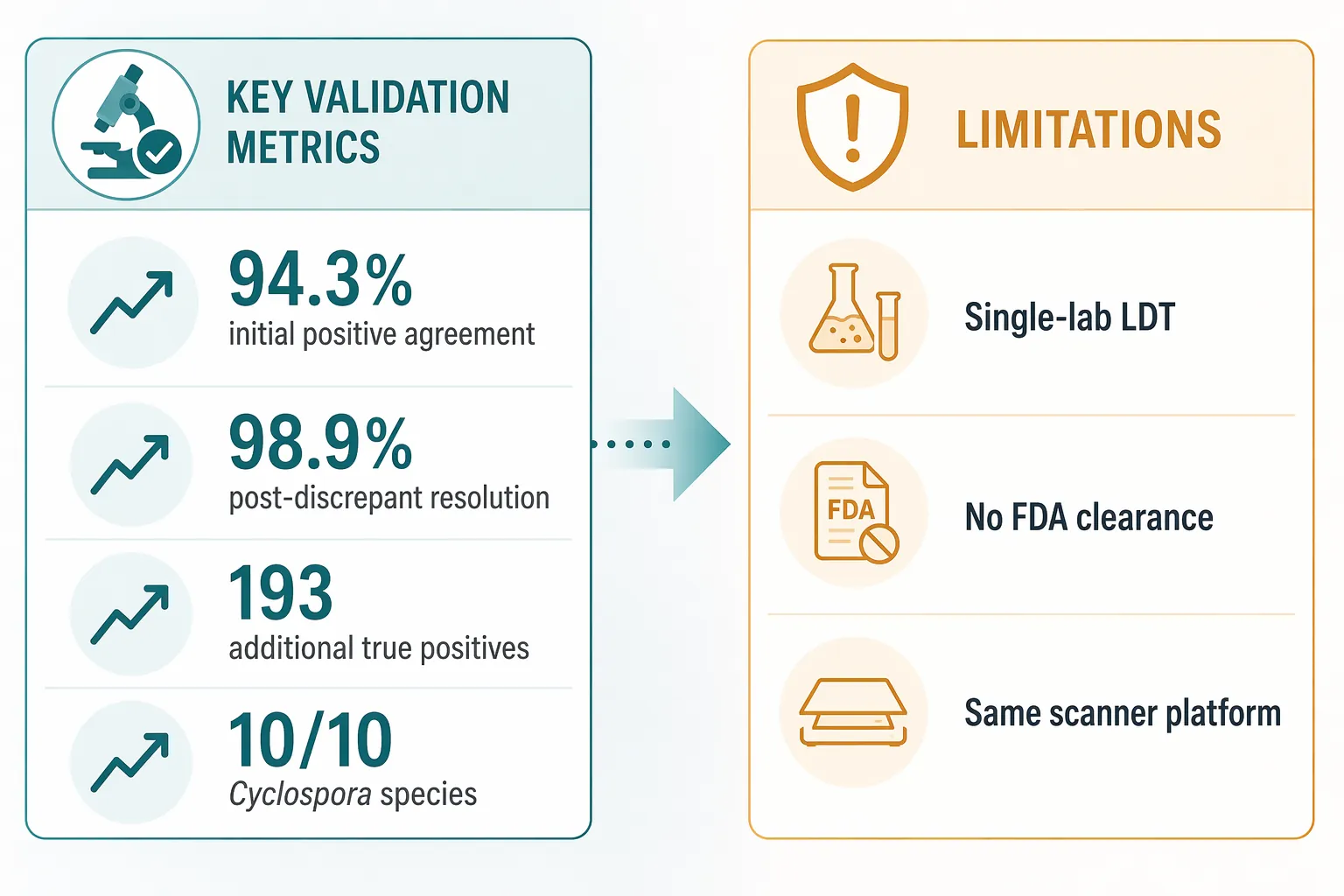
Discrepant resolution is doing important work in those numbers. In a validation study, expert adjudication is appropriate because neither conventional microscopy nor AI should be treated as infallible when findings diverge. But the post-resolution 98.9% figure should not be read as standalone AI performance in ordinary use. It reflects performance against an adjudicated reference process after disagreements are investigated.[1] That is a stronger clinical-laboratory validation design than a vendor screenshot, but it is still a bounded workflow result.
| Finding from the 2025 wet-mount validation | What it supports | What it does not prove |
|---|---|---|
| 94.3% initial positive agreement | Strong agreement before discrepant review | Independent performance in other laboratories |
| 98.9% positive agreement after discrepant resolution | High agreement against an expert-adjudicated validation reference | Standalone AI accuracy without adjudication |
| 193 additional true-positive organisms in 100 validation specimens | A meaningful sensitivity signal over conventional review in this workflow | Prospective real-world diagnostic yield across routine deployment |
| 10/10 Cyclospora species accuracy after discrepant resolution | Encouraging Cyclospora-specific performance in the validation set | Precision around performance for all outbreak settings or specimen mixes |
The Cyclospora result is therefore encouraging and narrow. Ten correct Cyclospora calls after discrepant resolution are exactly the kind of signal that justifies operational interest, especially when conventional wet-mount reading is labor-intensive. But 10 organisms in one validation setting cannot carry claims about broad foodborne-outbreak detection performance across institutions.
The 2020 trichrome study shows continuity, not interchangeability
The 2020 JCM trichrome study is worth taking seriously because it shows the platform was not assembled overnight in response to the 2026 Cyclospora surge. In that earlier validation, the AI-assisted approach reported 98.88% agreement and a fivefold improvement in limit of detection.[2] For stool parasitology, a limit-of-detection improvement is meaningful because the diagnostic problem is often not the dramatic organism in the perfect field, but the sparse or easily overlooked finding.
The same study also keeps the appraisal grounded. It noted degraded-organism detection gaps and class confusion involving morphologically similar small protozoans.[2] Those are not cosmetic limitations. They are the kinds of errors that appear when real stool specimens, staining quality, organism preservation, and look-alike morphology meet an image classifier. The 2025 wet-mount paper strengthens the Cyclospora-specific evidence, but it does not erase the need to ask how the system behaves when morphology is poor or the differential includes visually similar organisms.
Where the evidence stops traveling
Both peer-reviewed studies sit inside a single-laboratory ecosystem. The specimens were processed at ARUP, and the scanning systems used in validation were the same scanner systems associated with model development and deployment.[1][2] That does not weaken the finding for ARUP's own validated workflow; it defines it. A well-controlled internal validation can be exactly what a CLIA laboratory needs to support an LDT. It is not the same evidence package a buyer would expect for externally generalizable device performance.
Generalizability is not a ceremonial objection here. Stool concentration methods vary. Slide preparation quality varies. Scanner optics, focus behavior, image tiling, compression, and review interfaces vary. Even the distribution of organisms and commensals can vary with referral population. A model that performs well inside one mature parasitology program may still need independent multi-site testing before another laboratory can assume equivalent sensitivity, false-positive burden, or technologist review time.
The regulatory boundary is similarly plain. ARUP describes the service in the context of its own laboratory-developed testing rather than an FDA-cleared or FDA-approved system.[3] For a referral decision, that may be acceptable if the question is whether to use ARUP's service. For procurement of a platform, or for a governance committee that requires FDA-cleared software as a medical device, it is a material limitation.
The 2026 outbreak surge is operational evidence
The July 2026 ARUP report is easy to understand emotionally if one has watched a parasitology bench absorb outbreak-volume pressure. ARUP reported that during the cyclosporiasis surge, its AI-enhanced testing supported roughly two-minute AI read time, about 50 Cyclospora-positive cases per day, and a 200% increase in volume.[3] That is not a trivial operational detail. When cases rise, patients wait, technologists read more fields, and the laboratory's ability to keep up can affect clinical and public-health response.
CDC's outbreak page provides the public-health context, while also warning against overreading real-time numbers. CDC described July 2026 cyclosporiasis outbreak data as preliminary and evolving, with actual case counts likely higher than reported because of an approximately six-week reporting lag.[4] That lag is one reason high-throughput diagnostic support matters during an outbreak, even before a prospective yield paper is published.
BankInfoSecurity's coverage similarly framed AI as part of the response to the Cyclospora outbreak, but it remains third-party reporting of operational use rather than an independent clinical validation study.[5] The useful takeaway is not that the news coverage proves improved diagnostic yield. It is that ARUP's deployment occurred under real pressure, at a scale where manual microscopy bottlenecks become visible.
The missing piece is a published prospective study showing what changed during routine or outbreak deployment: additional cases detected, false-positive review burden, time to result, adjudication workload, and performance across representative specimen streams. The 2025 paper stated that prospective real-time studies were underway, but published results were not available as of July 2026.[1]
Procurement confidence requires a different evidence package
For a clinical laboratory deciding whether ARUP's referred ova-and-parasite testing may offer better Cyclospora sensitivity than conventional microscopy, the answer is reasonably favorable. The peer-reviewed wet-mount validation gives a concrete sensitivity signal, and the trichrome predecessor suggests a continuing development path rather than a one-off claim.[1][2]
For a laboratory buying or implementing its own AI parasitology platform, the answer is more constrained. The current evidence does not demonstrate multi-site reproducibility, scanner-independent performance, FDA clearance, or prospective diagnostic yield in non-ARUP settings. A procurement review should therefore separate three decisions that are often collapsed into one.
- Referral decision: ARUP's own validated LDT workflow has peer-reviewed support for improved detection in its laboratory setting.
- Platform procurement decision: the published studies do not establish performance across other laboratories, scanners, or processing workflows.
- Outbreak-response decision: the 2026 surge data support operational usefulness, but not peer-reviewed prospective diagnostic-yield conclusions.
That separation is not bureaucratic caution for its own sake. It protects the part of the evidence that is genuinely impressive. The 193 additional true-positive organisms in the 2025 validation should not be diluted into a generalized AI marketing claim. It should be treated as a strong finding from a defined laboratory system, with defined preparation, scanning, comparison, and adjudication.
Evidence scorecard
| Dimension | Appraisal |
|---|---|
| Evidence source quality | Strong for peer-reviewed single-lab validation; weak for independent multi-site evidence. |
| Diagnostic performance | Strong sensitivity signal, especially in the 2025 wet-mount validation and Cyclospora adjudication results. |
| Regulatory status | Limited for procurement settings requiring FDA-cleared or FDA-approved technology. |
| Generalizability | Unproven outside ARUP's specimen-processing, scanner, and review ecosystem. |
| Real-world validation | No published prospective diagnostic-yield study available as of July 2026. |
| Operational evidence | Promising during the 2026 outbreak surge, but based on operational reporting rather than peer-reviewed yield data. |
The evidence supports ARUP's AI-enhanced Cyclospora detection as a meaningful advance inside ARUP's own validated laboratory ecosystem. It does not yet support broad procurement confidence for organizations that require FDA clearance, independent multi-site validation, scanner-platform generalizability, or published prospective real-world diagnostic-yield data.
References
- Mathison et al. 2025 wet-mount validation, Journal of Clinical Microbiology, 2025, https://journals.asm.org/doi/10.1128/jcm.01062-25
- Mathison et al. 2020 trichrome validation, Journal of Clinical Microbiology, 2020, https://journals.asm.org/doi/10.1128/JCM.02053-19
- Cyclosporiasis cases surge; ARUP's AI-enhanced testing aids, ARUP Laboratories, July 13, 2026, https://www.aruplab.com/news/07-13-2026/cyclosporiasis-cases-surge-arups-ai-enhanced-testing-aids
- Cyclosporiasis outbreak investigation, CDC, July 2026, https://www.cdc.gov/cyclosporiasis/outbreaks/07-26/investigation.html
- AI Takes on Cyclospora Outbreak, BankInfoSecurity, https://www.bankinfosecurity.com/ai-takes-on-cyclospora-outbreak-a-32261