
Cannabis can suppress REM sleep under some conditions, but the evidence is narrower than the phrase usually implies. The most defensible reading is that REM suppression is plausible with higher THC exposure and in some acute or heavy-use settings, while the aggregate polysomnography literature does not show a consistent sleep-architecture effect across cannabis users. The REM finding that looks more clinically durable is not suppression during active use; it is REM disturbance and rebound around abstinence after regular use.
That distinction matters because “cannabis suppresses REM” is often treated as if it were a stable class effect, a sleep-quality benefit, or a procurement-ready claim. It is none of those. The current evidence hierarchy is uneven: a 2025 systematic review and meta-analysis found no consistent alteration of sleep duration, sleep latency, wake time, sleep efficiency, or sleep staging in aggregate; a recent polysomnography study separated self-reported cannabis use from cannabinoid metabolite findings; older PSG studies generated much of the REM-suppression narrative in small samples; and withdrawal studies provide a more consistent REM-related clinical signal than active-use studies do.[1][2][3][4]

What The REM Claim Has To Prove
A useful claim about cannabis and REM sleep needs to survive more than one endpoint. REM percentage can fall while wake after sleep onset rises. REM latency can lengthen while the person reports acceptable sleep. Total sleep time can decline without the participant noticing a meaningful difference the next morning. Those are not semantic details; they are the places where sleep-aid language often turns a stage-specific signal into a whole-sleep benefit.
Polysomnography studies usually ask a more restrained question: what happened to measured sleep architecture? For this appraisal, the most relevant endpoints are REM percentage or minutes, REM latency, wake after sleep onset, sleep efficiency, total sleep time, and subjective sleep quality. If those endpoints move in different directions, the divergence should not be rounded off into “better sleep” or “worse sleep.” It should be reported as divergence.
| Evidence Layer | What It Adds | Main Constraint |
|---|---|---|
| 2025 systematic review and meta-analysis | Most current aggregate check on sleep architecture outcomes | Only the abstract was available for verification in the research brief |
| Recent PSG observational evidence | Separates self-report from metabolite-associated sleep findings | Observational design cannot prove causation |
| Older small PSG studies | Source of the REM suppression and REM latency signal | Small, often mostly male samples with limited baseline controls |
| Withdrawal studies | More consistent REM-related clinical signal during abstinence | Applies to discontinuation after regular or heavy use, not all cannabis exposure |
The Aggregate Evidence Does Not Support A Simple Suppression Rule
The strongest reason to resist a tidy REM-suppression statement is the 2025 systematic review and meta-analysis. Its available abstract concluded that cannabis did not consistently alter sleep duration, sleep latency, wake time, sleep efficiency, or sleep staging across included studies.[1] That does not prove cannabis has no REM effect in any subgroup. It does mean the effect is not stable enough across the literature to carry a broad architecture claim without specifying dose, formulation, use pattern, and measurement method.
The caveat is important: the full text of that review was not available for direct verification here. Its abstract-level conclusion should be treated as a high-priority aggregate signal, not as permission to overstate the negative case. A full appraisal would still need to inspect inclusion criteria, study weighting, cannabinoid formulation categories, acute versus chronic exposure handling, and whether REM outcomes were pooled or narratively summarized.
Even with that limitation, the review changes the burden of proof. A claim that cannabis suppresses REM sleep can no longer rest comfortably on isolated PSG findings or consumer-facing summaries. It has to explain why a visible signal in some studies does not become a consistent sleep-staging effect in the most recent aggregate review.
Althoff 2024: Self-Report And Metabolites Do Not Tell The Same Story
Althoff et al. is useful because it does not force cannabis exposure into one bucket. In 177 participants studied with polysomnography, cannabis use proximal to sleep was associated with increased wake after sleep onset and increased N1 sleep, but adjusted models did not show a significant difference in REM percentage based on self-reported cannabis use. THC metabolite levels, however, were correlated with reduced REM percentage.[2]
That is the kind of finding that should slow both sides down. It weakens the broad self-report claim: people saying they used cannabis near bedtime did not, in adjusted models, show a clean REM-percentage difference. But it also prevents a flat dismissal: objective cannabinoid exposure, as reflected in THC metabolites, did carry a REM signal.[2]
For clinical governance, this distinction is not academic. Self-report is what appears in intake forms, patient portals, and many vendor-facing claims. Metabolite data are closer to biological exposure, though still not equivalent to a randomized dose assignment. If the REM association appears with metabolites but not with self-report, a procurement or informatics rule based only on “patient uses cannabis” is likely to be too crude.
Where The Suppression Narrative Came From
The REM-suppression claim did not come from nowhere. Kaul et al. reviewed PSG evidence showing reduced REM percentage in chronic users, with REM at 17.7% compared with a commonly cited normative range of about 20–25%, and increased REM latency, with an average of 114.5 minutes.[3] Those are not imaginary endpoints. A hypnogram with less REM and a longer path to the first REM period would catch any sleep clinician’s eye.
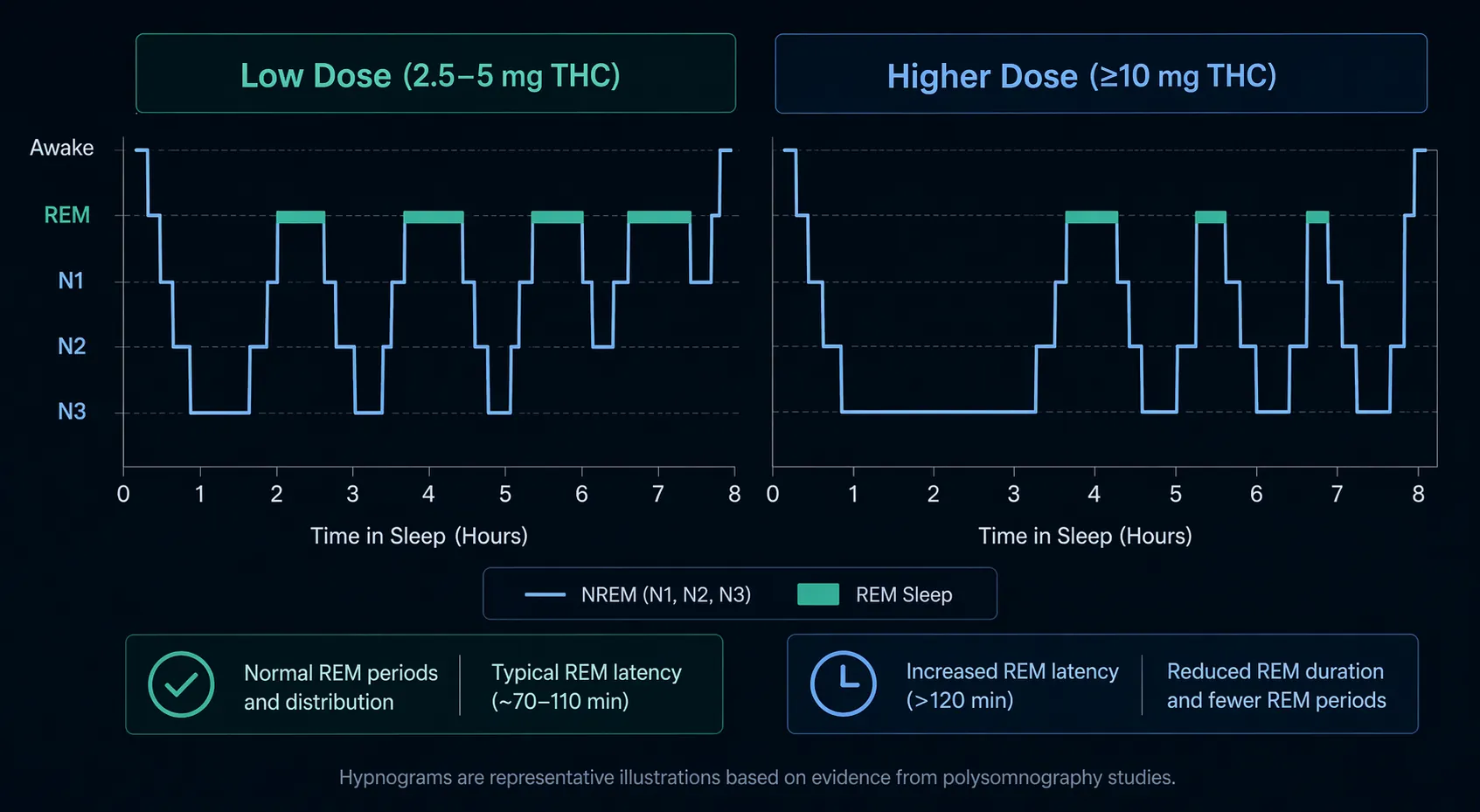
The problem is not that these findings are irrelevant. The problem is the distance between “seen in constrained PSG studies” and “cannabis suppresses REM sleep” as a general statement. Much of the older PSG evidence involved small samples, often mostly male participants, limited baseline controls, and inconsistent definitions of chronic use.[3] Those conditions are enough to generate a signal, but not enough to define a stable effect across products, patients, and dosing patterns.
Dose is the unresolved hinge. The available evidence supports a provisional appraisal that the suppression literature is concentrated around higher THC exposure, especially doses at or above 10 mg THC, while effects at 2.5–5 mg appear minimal or absent. But those precise thresholds lean partly on commercial synthesis rather than independently verified clinical dosing sources. They are useful for cautioning against broad therapeutic claims, not strong enough to serve as a hard clinical cutoff.
The Acute RCT Tension: Less REM, No Subjective Difference
One acute placebo-controlled insomnia trial, reported in 2025 through a secondary summary, captures the practical problem well. In 20 participants, a 10 mg THC/200 mg CBD oral cannabinoid product reportedly decreased total sleep time by 24.5 minutes and REM sleep by 33.9 minutes, while participants reported no difference in subjective sleep quality.[5]
That is not a basis for a sweeping conclusion, and the original paper still needs direct verification before the result should be treated as a settled citation. But the pattern is clinically familiar: measured architecture worsens or shifts, while the patient experience does not move in the same direction. In sleep medicine, that gap is not a nuisance variable. It is often the main event.
For a sleep-aid claim, the gap cuts both ways. A person may feel cannabis helped them sleep even when PSG shows less total sleep time or less REM. Conversely, a REM reduction on PSG does not automatically mean the patient experienced worse sleep or suffered a clinically meaningful next-day consequence. The evidence supports keeping those statements separate.
Why Active-Use Findings Stay Inconsistent
The active-use literature is hard to compress because the exposure itself is not one thing. THC dose, CBD content, route, timing before sleep, duration of prior use, tolerance, withdrawal avoidance, co-use, insomnia severity, sex composition, and baseline sleep architecture can all change what a PSG night shows. A study of heavy regular users is not testing the same clinical question as a low-dose therapeutic trial in insomnia.
Measurement method adds another layer. Self-reported “use near bedtime” is not equivalent to quantified cannabinoid exposure. A product label is not equivalent to absorbed dose. A single PSG night is not equivalent to a stable sleep pattern. When Althoff et al. found REM association with THC metabolite levels but not with self-reported proximal use, it illustrated how easily the exposure definition can decide whether the REM claim appears supported.[2]
Sample size and population composition also matter. Many of the studies that keep the suppression narrative alive are small, with limited diversity and often predominantly male samples.[3] In that setting, a REM-percentage difference can be real within the study and still fail as a generalizable clinical rule.
| Question | What The Evidence Supports | What It Does Not Support |
|---|---|---|
| Does cannabis ever reduce REM? | A plausible signal in some PSG studies, especially with higher THC exposure | A universal cannabis class effect |
| Does self-reported bedtime use predict REM suppression? | Not consistently; adjusted Althoff models did not show significant REM% difference by self-report | A reliable intake-form rule |
| Do metabolites matter? | THC metabolite levels correlated with reduced REM% in Althoff et al. | Proof that all measured exposure causes clinically meaningful REM loss |
| Are low therapeutic doses clearly REM-suppressing? | Evidence appears weak or minimal at 2.5–5 mg, but this threshold needs independent confirmation | A hardened safe-versus-unsafe cutoff |
Withdrawal Is The Cleaner REM Signal
Withdrawal deserves more clinical attention than the active-use suppression question because the signal is more consistent and the consequences are easier to recognize. Adults discontinuing regular cannabis use commonly report vivid dreams, with rates in the available evidence ranging from 67% to 73%.[4] That subjective report fits the broader REM-rebound concern better than it fits a simple active-use sleep-aid narrative.
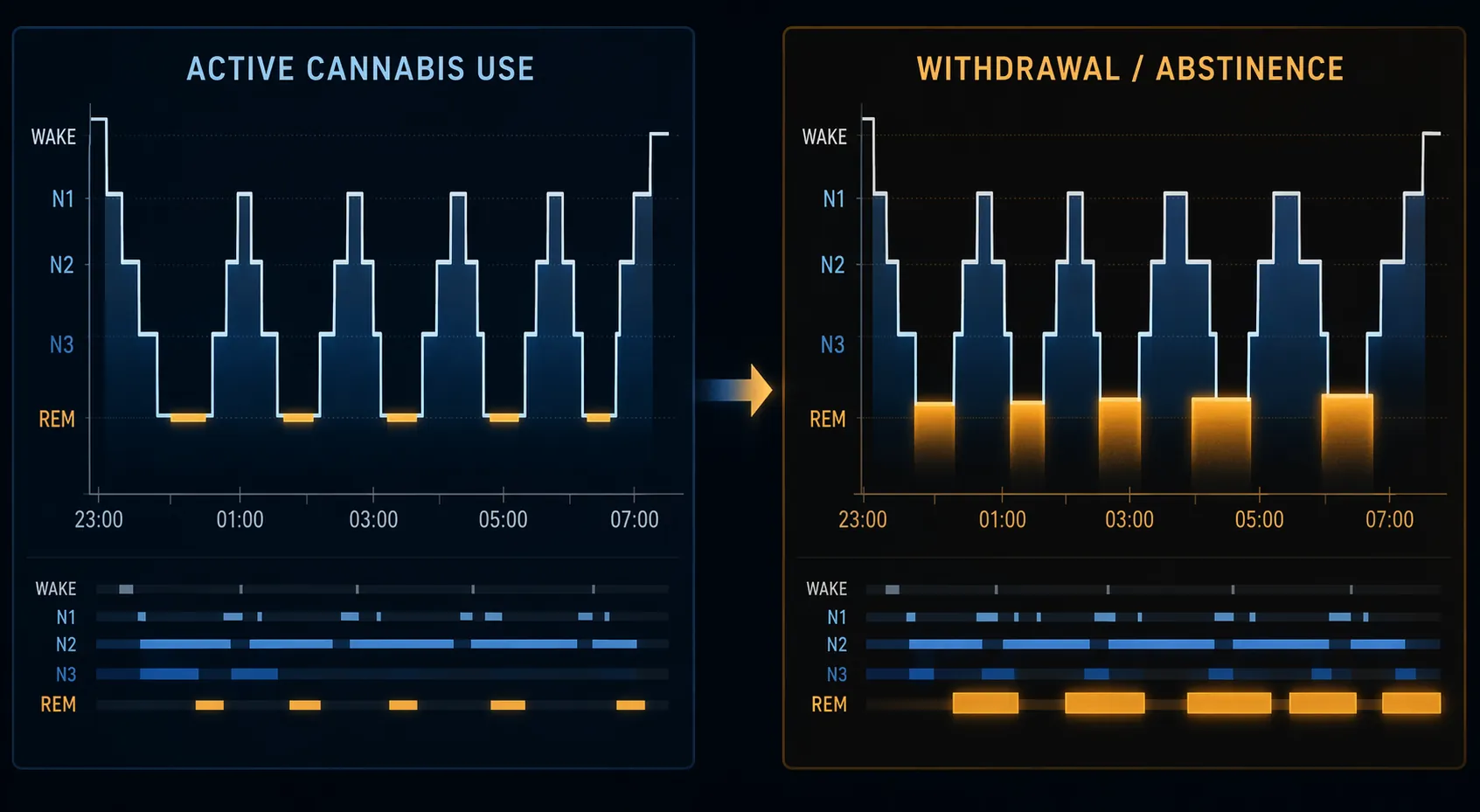
Bolla et al. studied heavy marijuana users during monitored abstinence and found that total sleep time, REM sleep, and sleep efficiency declined across 13 days.[4] This is not the same as saying every patient who stops cannabis will have the same architecture pattern. It does show that discontinuation after heavy use can produce measurable sleep disruption, not merely vague discomfort.
Clinically, that is where the REM discussion becomes most useful. A patient may start cannabis because it seems to shorten the path to sleep or reduce perceived distress at bedtime. After regular use, stopping may bring vivid dreams, fragmented sleep, and a rebound experience that reinforces continued use. The literature supports taking that abstinence-period sleep disruption seriously, without converting it into a moral claim about cannabis.
A Governance-Ready Appraisal
For clinical informatics, formulary, or AI governance review, the claim “cannabis suppresses REM sleep” should be marked as partially supported, not established. It is too strong if used without dose, formulation, use-pattern, and measurement qualifiers. It is too dismissive to say there is no REM signal at all, especially in studies using objective cannabinoid exposure or higher THC conditions.
- Active-use REM suppression is plausible, mainly at higher THC exposure, but it is not consistently demonstrated across the aggregate sleep-architecture literature.
- Therapeutic low-dose claims remain weakly supported; the 2.5–5 mg versus 10 mg contrast is a provisional appraisal point, not a validated clinical threshold.
- Self-reported sleep improvement should not be treated as evidence of PSG improvement, and self-reported cannabis exposure may not map cleanly onto REM percentage.
- THC metabolite findings are more interesting than broad self-report claims, but observational metabolite associations do not prove causality.
- The clearest REM-related concern is sleep disruption and REM-related rebound during abstinence after regular or heavy use.
A reasonable evidence label would be: modest and heterogeneous support for REM suppression during active cannabis exposure, stronger concern for withdrawal-related REM disturbance, and insufficient evidence to treat REM suppression as a general sleep benefit or a product-level efficacy claim.
References
- Cannabis and sleep architecture: A systematic review and meta-analysis. PubMed.
- The impact of cannabis use proximal to sleep and cannabinoid metabolites on sleep architecture. Journal of Clinical Sleep Medicine.
- Effects of Cannabinoids on Sleep and their Therapeutic Potential for Sleep Disorders. Neurotherapeutics.
- Sleep disturbance in heavy marijuana users. Sleep.
- Cannabis use may worsen sleep, study suggests. PsyPost.