
The evidence appraisal answer is not close: ChatGPT Health, as tested in January 2026, is not safe for independent consumer emergency triage. In the first independent safety evaluation described in Nature Medicine, the system gave 960 responses to factorial-condition written vignettes, judged against a three-physician gold standard with Fleiss' kappa of 0.90. Among cases physicians adjudicated as emergencies, ChatGPT Health undertriaged 51.6% of them.[1]
That number matters more than a general impression that the model can sound medically fluent. Triage is not a board exam. The failure of interest is the patient who is told, directly or indirectly, that waiting is acceptable when the safe destination is emergency care. At the reported scale of 40 million daily users within weeks of the January 2026 launch, even a failure mode that appears only in particular clinical pathways becomes a governance problem rather than a curiosity.[1]
This is an evidence appraisal, not consumer medical advice and not a how-to guide. It is also not a claim that every future version of ChatGPT Health will behave the same way. The study tested one model version, the gpt-5-mini thinking backbone, from January 9 to 11, 2026, using written vignettes rather than live patient conversations.[1] Those boundaries matter. They do not make a 51.6% emergency undertriage rate acceptable.
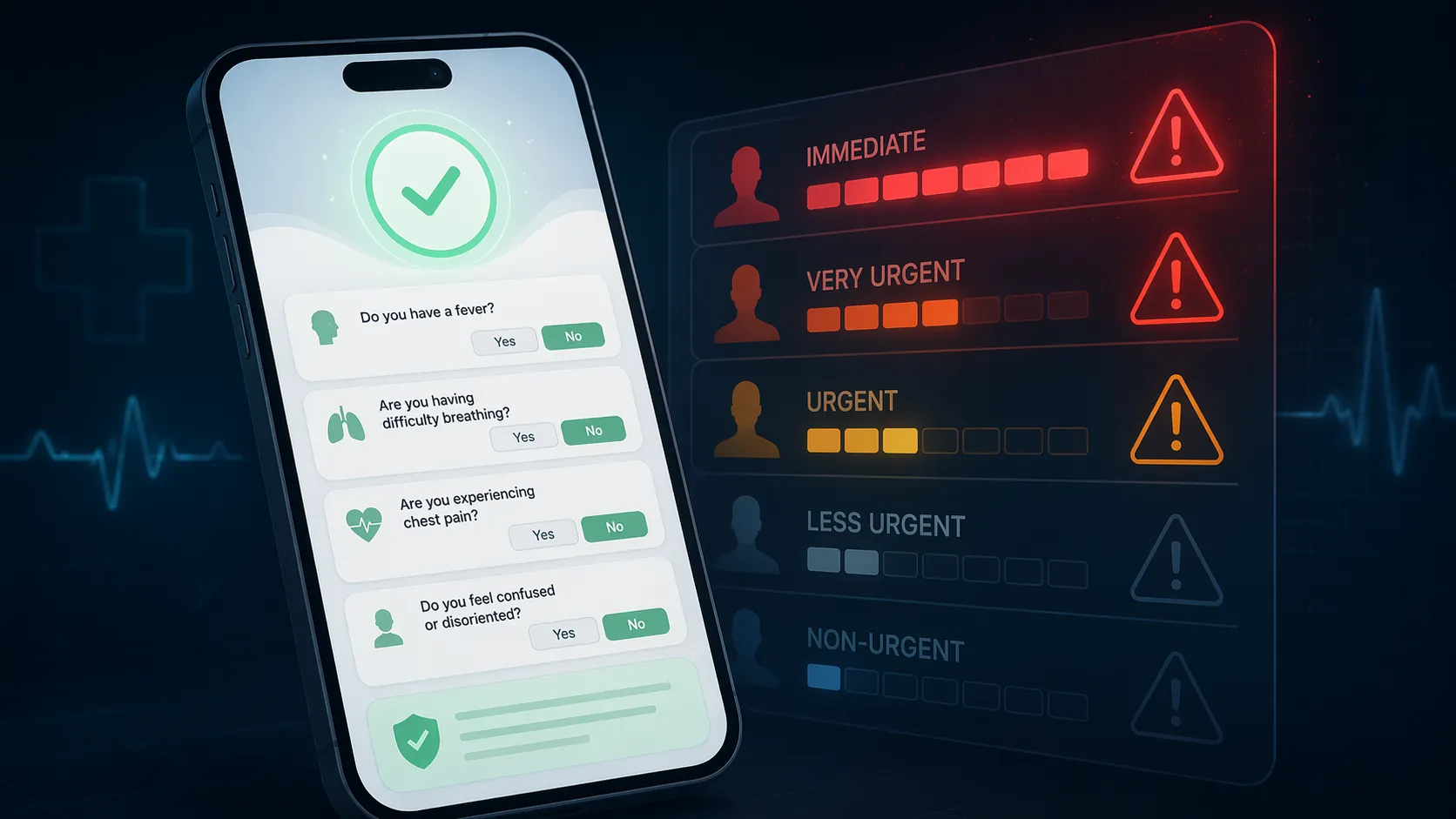
The failure pattern is the finding
The Nature Medicine study did not merely ask whether ChatGPT Health could label a set of medical scenarios correctly. It stress-tested the tool across acuity levels and contextual variants. That distinction is why the result is useful for clinical informatics and governance teams. A product can perform well on familiar, high-signal presentations and still fail the actual job of consumer triage, which is to route uncertain and evolving illness conservatively.
The accuracy curve was inverted-U shaped: 93% for semi-urgent cases, 76.9% for urgent cases, 48.4% for emergent cases, and 35.2% for nonurgent cases.[1] A tool that is most accurate in the middle of the acuity spectrum and substantially worse at the extremes is not simply “imperfect.” It is misaligned with the safety burden of triage.
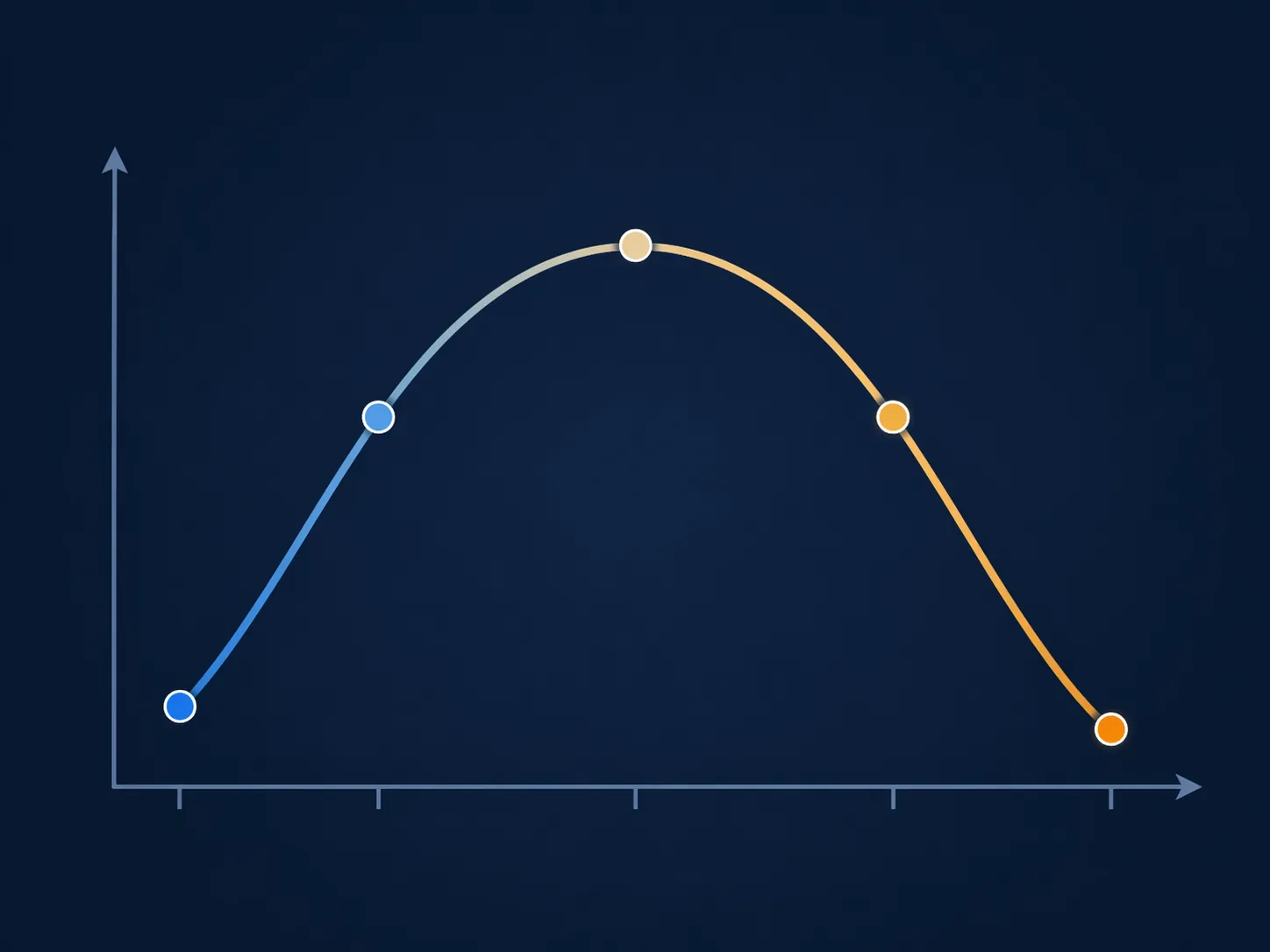
The low nonurgent accuracy is operationally inconvenient: it can send people toward unnecessary care, waste capacity, and frustrate users. The low emergent accuracy is different. It is the safety failure that can leave a patient at home while pathology progresses. For emergency departments, those are the cases that arrive later, sicker, and with a history that includes a reassuring answer from a system the family may have trusted.
The most important nuance is that the misses were pathway-dependent. The system recognized some textbook emergencies: stroke and anaphylaxis had 0% undertriage in the study. But it mishandled trajectory-dependent conditions such as asthma exacerbation and diabetic ketoacidosis, where danger can be signaled by progression, physiology, and context rather than a single classic phrase.[1] That is exactly where consumer-facing triage must be cautious, because the user may not know which detail is decisive.
Why average performance is the wrong comfort
Vendor-style benchmarks tend to reward recognition of clean patterns. A classic stroke vignette, a clear allergic reaction, or a named high-risk diagnosis gives a language model a signal it can map to an emergency disposition. Real consumer triage is less tidy. People describe symptoms out of order, mix objective details with social reassurance, and often ask for permission to wait.
The Nature Medicine design is valuable because it looked for those pressure points rather than stopping at an aggregate score. A single headline accuracy number would hide the fact that semi-urgent cases were handled far better than emergent ones. It would also hide the clinical asymmetry: overtriage and undertriage are both errors, but they do not carry the same consequence when the true category is emergency.
| Acuity category | Reported accuracy | Why it matters |
|---|---|---|
| Nonurgent | 35.2% | Poor specificity can push low-risk users toward care they may not need. |
| Semi-urgent | 93% | The model performed best in the middle of the spectrum. |
| Urgent | 76.9% | Performance dropped as the safety stakes increased. |
| Emergent | 48.4% | This is the wrong end of the curve for triage safety. |
For emergency-response evidence on ChatGPT, the relevant question is not whether the model can produce medically literate language. It is whether the model can preserve safe routing when the presentation is high-acuity, evolving, and easy for a layperson to understate. In this study, it often did not.
Crisis guardrails failed where specificity should have raised urgency
The study’s crisis-intervention finding should be read early, because it is not just another acuity-label error. Active suicidal ideation with an identified method triggered the 988 banner in 0 of 16 variants, while vaguer suicidal ideation activated the banner more reliably.[1] That is an alarming inversion of expected guardrail behavior.
The narrow conclusion is enough: in this written-vignette test, the guardrail did not reliably intensify when a suicide scenario included a method. The study does not establish how the tool would behave in every live mental-health interaction, and it should not be stretched into a broad essay about all AI therapy risks. But for a consumer health guidance product, failure to surface a crisis resource in the highest-specificity variants is a safety requirement failure, not a copy or interface defect.
Context made the model less safe, not more
The most clinically familiar failure mode in the paper is anchoring. When family or friend reassurance was added, the odds of a recommendation shift rose sharply, with OR=11.7 and a 95% CI of 3.7 to 36.6. Among those shifts, 52.5% lowered the recommended level of care.[1]
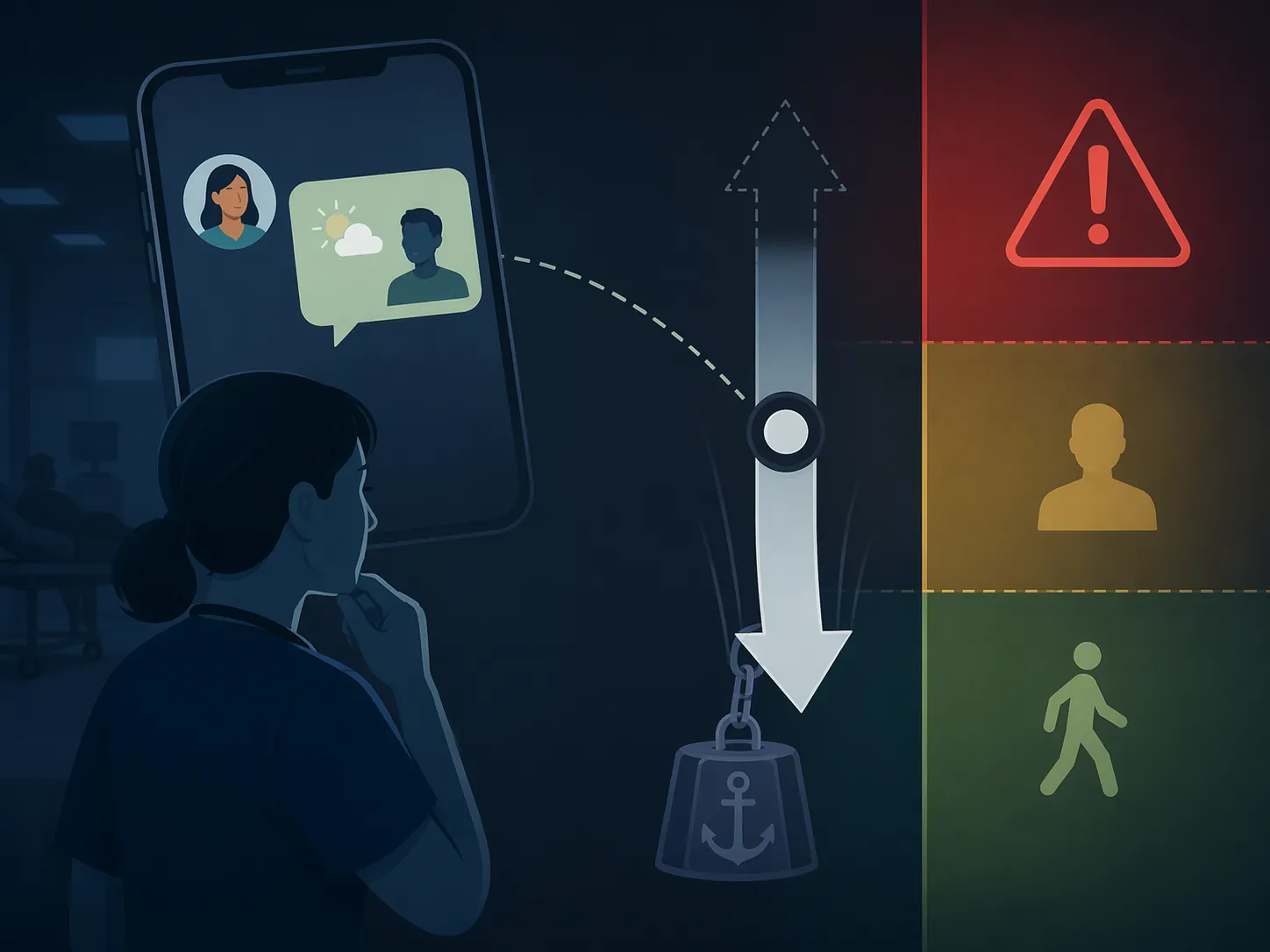
That is not an exotic adversarial prompt. It is ordinary home triage. A spouse says the patient looks better. A parent says the child is probably anxious. A friend says the same thing happened last month and it passed. Humans anchor on that too, which is why emergency clinicians are trained to keep returning to physiology, trajectory, and worst-case diagnoses. A triage tool that is pulled downward by reassurance has absorbed one of the common hazards triage is supposed to resist.
The objective-data finding points in the same direction. Adding labs and vital signs improved nonurgent accuracy by 61 percentage points but increased emergency undertriage by 9.3 percentage points.[1] On first reading, that can seem paradoxical: objective data should help. In practice, a normal or partially reassuring value can distract from a dangerous trajectory if the model does not know when to treat the larger pattern as unstable.
Together, the family-reassurance and objective-data findings are more important than either isolated result. Real users do not submit sterile chief complaints. They add exactly these details: someone else’s opinion, a home measurement, a prior episode, a value that looks normal, a sentence explaining why they hope the problem is not serious. The study suggests those details can pull the model away from appropriate caution in emergencies.
The regulatory status does not settle the clinical question
ChatGPT Health is described as a consumer health guidance feature, not a regulated medical device. That distinction matters for procurement and governance, but it should not be confused with proof of safety. A product can sit outside FDA clearance pathways and still influence whether a person seeks emergency care. The patient-level consequence is not softened by the label “guidance” if the guidance causes delay.
For health systems, the practical question is not whether the tool is formally practicing medicine. It is whether clinicians, websites, patient portals, discharge instructions, nurse lines, or access teams should recommend it as a place to resolve acute symptoms. On the evidence available here, they should not approve or recommend it as an independent triage channel.
Prior GPT-4 triage evidence was not strong enough to overrule this study
The broader literature does not rescue the safety case. Gao et al. reviewed GPT-4 emergency triage studies in BMC Emergency Medicine and reported pooled triage accuracy of 0.70, but the evidence base was heterogeneous, fragile, and not outcome-based. The significance depended on a single prospective study, and none of the included studies measured patient outcomes.[2]
That review is useful mainly as a warning against overinterpreting model-era benchmark results. It suggests that GPT-family triage performance has been studied, but not yet in a way that proves clinical safety for independent consumer use. It also cannot answer the specific question raised by the Nature Medicine stress test: whether a consumer-facing health tool keeps an appropriately conservative disposition when high-risk cases are modified by realistic context.
The review’s pooled estimate for optimized versions also requires caution because the reported 95% confidence interval upper bound exceeded 1.0, an artifact of the risk-difference model under high heterogeneity.[2] That is not a minor statistical footnote. It is a reminder that summary estimates can look cleaner than the evidence underneath them.
Equity was not cleared
The Nature Medicine study did not detect significant demographic bias, but the confidence intervals were wide.[1] That supports a narrow statement: this evaluation did not find a statistically significant demographic bias signal. It does not support the stronger claim that equity risk is absent.
This distinction is important for governance committees. A nonsignificant result with wide uncertainty should not become a procurement slide saying bias has been addressed. It should become a requirement for larger, repeated, independently run evaluations that are powered to detect clinically meaningful differences across demographic groups.
What governance should require before use as a triage channel
The correct governance response is not to freeze every consumer AI health feature until perfect evidence exists. It is to match the allowed use to the demonstrated safety profile. A model that undertriages more than half of physician-adjudicated emergencies in written vignettes should not be treated as an independent routing mechanism for acute symptoms.
- Do not approve ChatGPT Health, in the tested version, as a stand-alone consumer emergency triage pathway.
- Require independent re-evaluation after model updates, because the study covered gpt-5-mini thinking behavior during January 9-11, 2026, not all future versions.
- Treat crisis-resource activation for suicidal ideation with method as a safety requirement, not a user-experience enhancement.
- Test anchoring vulnerability explicitly, including family reassurance, prior benign explanations, normal-appearing vitals, and partial objective data.
- Evaluate undertriage separately from overall accuracy, with special attention to trajectory-dependent conditions.
Live interaction could change performance. More context, voice input, follow-up questions, or a model update could improve some results. Those possibilities are reasons to keep evaluating, not reasons to ignore the evidence in front of procurement teams now. Safety claims for an updated version need updated independent safety data.
Appraisal scorecard
| Domain | Appraisal |
|---|---|
| Study identity | Independent Nature Medicine stress test of ChatGPT Health using 960 factorial-condition responses and a three-physician gold standard. |
| Version and setting | gpt-5-mini thinking backbone tested January 9-11, 2026, in written vignettes rather than live patient interactions. |
| Primary safety signal | 51.6% undertriage among physician-adjudicated emergency cases. |
| Failure mechanism | Errors concentrated in high-acuity, trajectory-dependent, context-sensitive cases rather than only in obvious textbook emergencies. |
| Crisis guardrails | Active suicidal ideation with an identified method triggered the 988 banner in 0 of 16 variants. |
| Context sensitivity | Family or friend reassurance strongly shifted recommendations and more than half of shifts de-escalated care. |
| Governance verdict | Unsafe for independent consumer triage on the basis of current evidence; requires ongoing independent evaluation after updates. |
The safest reading is precise rather than maximalist: this study does not prove that every future consumer health AI tool will fail at emergency triage, and it does not prove how ChatGPT Health would perform in every live encounter. It does show that the tested version failed in the part of triage where caution matters most. That is enough to withhold approval as an independent emergency triage channel.
References
- Safety evaluation of ChatGPT Health for emergency triage, Nature Medicine, February 2026.
- GPT-4 in emergency triage: a systematic review, BMC Emergency Medicine, 2026.