
Short verdict: the CMLase enzyme study is credible early preclinical evidence that one aging-associated chemical modification can be enzymatically reduced in prepared human tissue sections. It is not evidence that an enzyme reverses aging in humans.
That distinction matters because the strongest result is genuinely interesting. In the July 2026 Nature Communications paper, Trabosh and colleagues report a bioengineered enzyme, CMLase, developed through directed evolution from more than 500 million bacterial glycine oxidase variants and selected for activity against CML-modified lysine, a major advanced glycation end-product that accumulates in aging tissues.[1] The most attention-grabbing experiment showed a 78% reduction of CML-modified lysine in 75-year-old human lens tissue, reportedly bringing levels down to those seen in approximately 31-year-old tissue.[1]
The clinical-readiness appraisal is much narrower: ex vivo tissue, single AGE target, single-donor age comparisons, biochemical endpoints only, no in vivo delivery strategy, and no patient-level outcomes. For a clinical innovation committee, longevity clinic reviewer, or procurement team, this belongs in the “track closely” file, not the “evaluate for service line” file.
| Question | Evidence-supported answer |
|---|---|
| Does the study show CML can be enzymatically reduced? | Yes, in prepared human tissue sections tested ex vivo. |
| Does it show reversal of one molecular aging marker? | Reasonably, for CML-modified lysine under the study conditions. |
| Does it show restored tissue function? | No. Vision, arterial stiffness, skin elasticity, and other functional endpoints were not measured. |
| Does it show an in vivo therapy can reach and treat living tissue? | No. No intact-organism data or validated delivery strategy was tested. |
| Does it support human age-reversal claims? | No. It supports a proof-of-concept for enzymatic deglycation of one AGE target. |
What CMLase Actually Did
CML, or Nε-carboxymethyl-lysine, is one form of advanced glycation end-product. AGEs are chemical modifications that can accumulate on long-lived proteins in tissues such as the aorta, skin, and eye lens. Those tissues are not incidental choices: they contain structural proteins where accumulated chemical damage is biologically plausible and clinically tempting to interpret.
The important technical move in the study was not simply that an enzyme was applied to old tissue. The investigators engineered CML-cleaving activity through a directed-evolution process, starting from bacterial glycine oxidase and screening an enormous variant space for a property the native enzyme was not built to optimize.[1] That is why the work deserves attention as platform science. If enzyme engineering can be aimed at one persistent chemical lesion in aged tissue, it may eventually be aimed at others. The paper does not yet show that broader platform, but it makes the idea harder to dismiss.
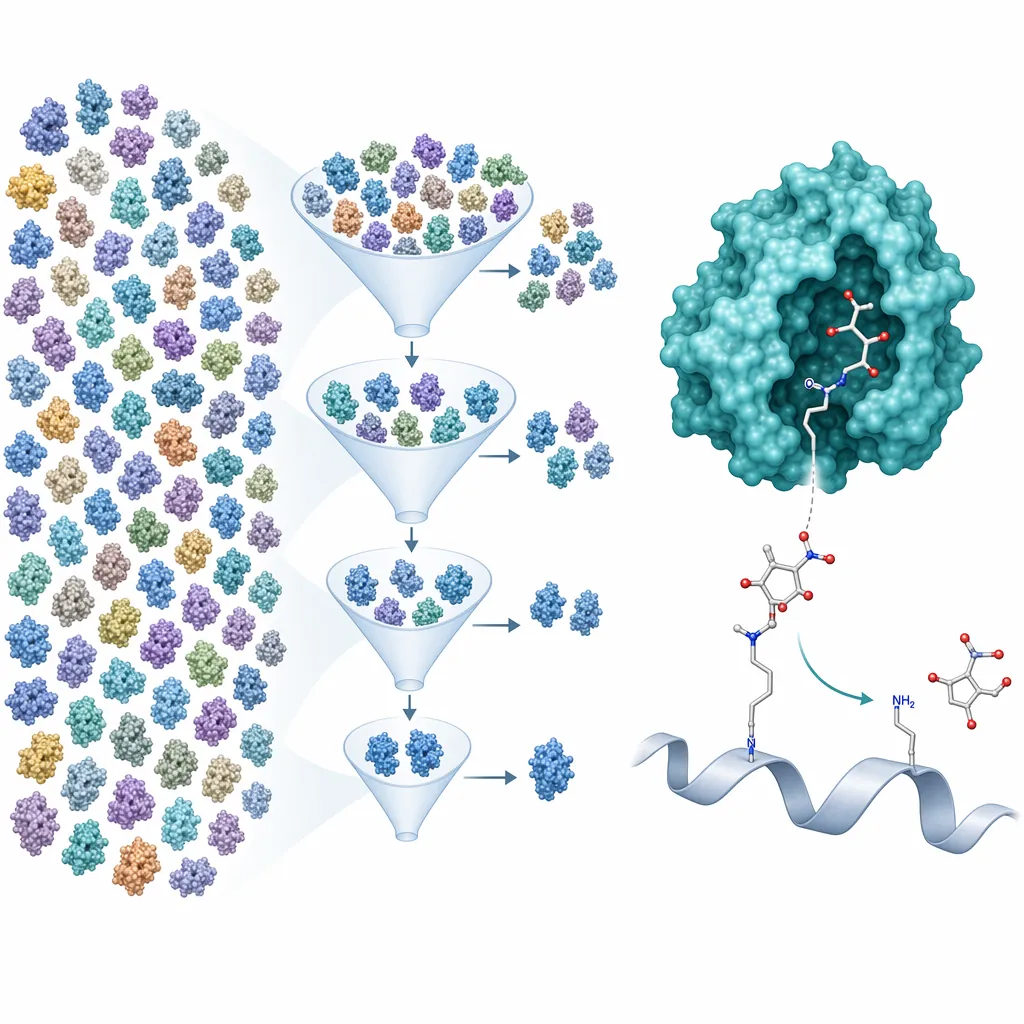
The study then tested CMLase in human aorta, skin, and lens tissue sections, all sites where CML accumulation is relevant to aging biology.[1] The lens result is the cleanest headline because the reported reduction was large and mapped onto an age-comparison frame: 75-year-old tissue after CMLase treatment resembled approximately 31-year-old tissue by that biochemical measure.[1]
That sentence needs to stop there. It says “by that biochemical measure.” It does not say the lens became younger in any functional sense, that optical properties improved, that cataract biology was reversed, or that the same effect would occur inside a living eye.
The Unit of Evidence Is a Prepared Tissue Section
The strongest way to protect this study from overclaiming is to identify the unit of evidence. It is not a treated person. It is not a treated animal. It is not even a whole living organ. The core human-tissue evidence comes from thin ex vivo tissue sections exposed to CMLase under experimental conditions.[1]
Thin sections are useful because they let an enzyme access modified proteins in a controlled way. They are also precisely why the clinical inference is limited. A living tissue has barriers, transport constraints, immune exposure, clearance, off-target considerations, dose limitations, and architecture that a prepared section does not reproduce. Enzyme accessibility in a thin slice is not a proxy for delivery into an intact human aorta, dermis, or lens.
This is where many conversations about enzyme-based age-reversal evidence drift. A biochemical endpoint measured in an accessible experimental preparation gets mentally upgraded into a therapeutic outcome. The upgrade is not supported by the study design.

The single-donor age comparison is another boundary. The study’s age-framed tissue comparisons involved donors in the 20–25-year range and a 75-year-old donor, rather than replicated donor groups with statistical comparison across biological replicates.[1] That does not invalidate the signal. It does mean the result should be read as proof-of-concept, not as an estimate of expected effect size across older adults.
Biochemical Reversal Is Not Clinical Age Reversal
The phrase “reversal” is doing two different jobs here. In the paper’s mechanistic sense, reversing protein chemical aging means reducing a specific accumulated chemical modification on proteins. In a clinical or commercial sense, “age reversal” usually implies restored tissue performance, reduced disease risk, improved function, or a measurable healthspan effect. The CMLase paper supports the first meaning for CML under ex vivo conditions. It does not support the second.
No functional endpoints were measured. The study did not show improved vision in lens tissue, reduced arterial stiffness in aorta, or restored elasticity in skin.[1] Those are not minor omissions; they are the outcomes that would begin to connect molecular change to clinical relevance.
CML is also one AGE type among many. Reducing CML-modified lysine does not erase the broader burden of protein modification, crosslinking, extracellular matrix remodeling, cellular senescence, inflammation, mitochondrial dysfunction, or other aging-associated processes. The broader hallmarks-of-aging framework places damaged proteins and proteostasis among aging biology, but it does not license a one-marker result to become an organism-level rejuvenation claim.[2]
The lens result remains important because it shows that a modification long treated as effectively difficult to reverse in human tissue can be enzymatically reduced. That is a meaningful mechanistic achievement. It becomes misleading only when the endpoint is renamed as “aging” rather than “CML-modified lysine.”
Why the Directed-Evolution Result Matters
The platform implication is more durable than the headline. The investigators did not merely find a naturally occurring enzyme and apply it to tissue. They used directed evolution to create activity against a chemically aged protein target, narrowing more than 500 million variants toward CML-cleaving function.[1] For anyone evaluating biomedical innovation, that is the part worth tracking.
Platform potential, however, is not the same as therapeutic validation. The study suggests that enzyme engineering may be able to generate tools against aging-associated chemical modifications. It does not show that CMLase can be delivered safely, distributed appropriately, retained long enough, or used repeatedly in humans. It also does not show that the same approach has been successfully extended to other AGE targets.
That is the correct level of excitement: a new enzymatic handle on a difficult class of molecular damage, not a clinical anti-aging intervention.
What Would Have to Exist Before a Clinical Claim
A procurement or clinical governance review would need evidence several layers beyond the current paper. The first missing layer is biological replication: multiple donors, relevant age ranges, tissue variability, and statistical comparison across independent samples. Single-donor contrasts can identify a plausible signal; they cannot define expected performance in a clinical population.
The second missing layer is delivery. CMLase has to reach the relevant modified proteins in living tissue. That raises different questions by tissue. A circulating vascular target is not the same as dense skin extracellular matrix, and neither is the same as the eye lens. A thin section removes the delivery problem rather than solving it.
The third missing layer is function. If the target is lens aging, the next evidence would need to move toward optical properties or vision-relevant measures. If the target is vascular aging, it would need to move toward stiffness, compliance, or other validated vascular endpoints. If the target is skin, elasticity or structural remodeling would matter more than a biochemical reduction alone.
- Replicated donor-level evidence rather than single-donor age comparisons
- Demonstrated penetration or delivery into intact living tissue
- Dose, duration, clearance, and safety characterization
- Functional endpoints matched to the target tissue
- Evidence that reducing CML changes a clinically meaningful trajectory
None of that is a criticism of the authors for not having run a clinical program in a proof-of-concept paper. It is a boundary around what the paper can be asked to prove.
How to Answer the Vendor-Style Claim
If the question is, “Does this prove enzymes can reverse aging?” the answer should be no. If the question is, “Does this show an engineered enzyme can reduce a specific aging-associated modification in human tissue sections?” the answer should be yes.
Those two answers can coexist. In fact, keeping them separate is the only way to give the work its due. The study’s achievement is precise: enzymatic reduction of CML-modified lysine in ex vivo human tissues where CML accumulates with age.[1] The unsupported inference is broad: human age reversal, restored tissue function, or near-term clinical use.
For a ClinicalMind evidence appraisal, the study lands as early preclinical proof-of-concept. It is credible enough to monitor as a platform signal in enzyme-based longevity science. It is not mature enough for procurement consideration, clinical marketing, or patient-facing age-reversal claims.
References
- Reversal of protein chemical aging by enzymatic deglycation, Nature Communications, July 14, 2026.
- Hallmarks of aging: An expanding universe, Cell, 2023.