
The practical verdict on AI data center energy costs and healthcare facilities is uncomfortable but not exotic: it is a material budget pressure, concentrated by region, relevant to clinical-AI procurement, and not yet directly proven at the individual hospital bill level. That distinction matters. A hospital does not need a perfect causal study to budget for an exposure, but it should not turn regional proxy evidence into a claim that every AI model has already raised every facility’s utility bill.
Start with the hospital ledger
Hospital energy costs are already large enough that even small rate changes are worth a finance review. A 2026 BSA Design analysis of 247 U.S. hospitals reported that hospital energy costs rose 41.1% from 2021 to 2026, that a typical 200,000-square-foot hospital now spends about $892,000 a year on energy, and that electricity accounts for 73.5% of hospital energy spend.[1] The study is useful as a sector benchmark, but it should be handled as what it is: an architecture and engineering firm’s commissioned analysis, not a federal statistical series.
That limitation does not make the figures irrelevant. It changes how they should be used. For procurement purposes, they are a sensitivity marker: if a mid-sized hospital has an energy line approaching seven figures, and if electricity is the dominant component, then regional electricity-price exposure belongs in the total-cost conversation. Duke’s EDGE Center makes the same budgetary point from a different angle, noting that utilities can reach up to 10% of a hospital’s total operating budget.[2]
The unresolved question is not whether hospitals use enough electricity for rates to matter. They do. The harder question is whether AI data center load is now one of the external forces pushing those rates in ways that hospital AI business cases usually do not capture.
The evidence chain runs through the grid, not through the hospital meter
There is no peer-reviewed study that traces an AI data center project to a specific hospital’s monthly utility bill and measures the causal increase. That absence should stop any overclaim. What exists instead is a substantial proxy chain: data center electricity demand is rising; in some regions that demand requires grid, generation, and capacity investments; utilities and market operators can spread those costs across broader ratepayer classes; hospitals in those territories are large, inflexible electricity customers.
The scale side of the chain is no longer speculative. Pew’s summary of U.S. data center energy trends reports that data center electricity consumption is projected to grow 133% by 2030, and notes Lawrence Berkeley National Laboratory estimates that data centers used 4.4% of total U.S. electricity in 2024 and could use 12% by 2028.[3] Those are national figures, so they do not by themselves tell a hospital in Missouri, Virginia, Ohio, or Oregon what will happen to its tariff. They do show why the issue has moved from a facilities curiosity to a utility-planning problem.
The procurement relevance appears when that national growth lands in a local rate base. Harvard Law’s Electricity Law Initiative has described how utility investments made to serve data centers may be recovered from all customers, not only from the data center companies whose loads triggered the need for new infrastructure.[4] That is the cost-socialization mechanism hospital finance teams should care about. The hospital does not have to buy AI compute directly from a hyperscale facility to be exposed; it only has to sit in a utility territory where new data center load changes the cost of serving the system.
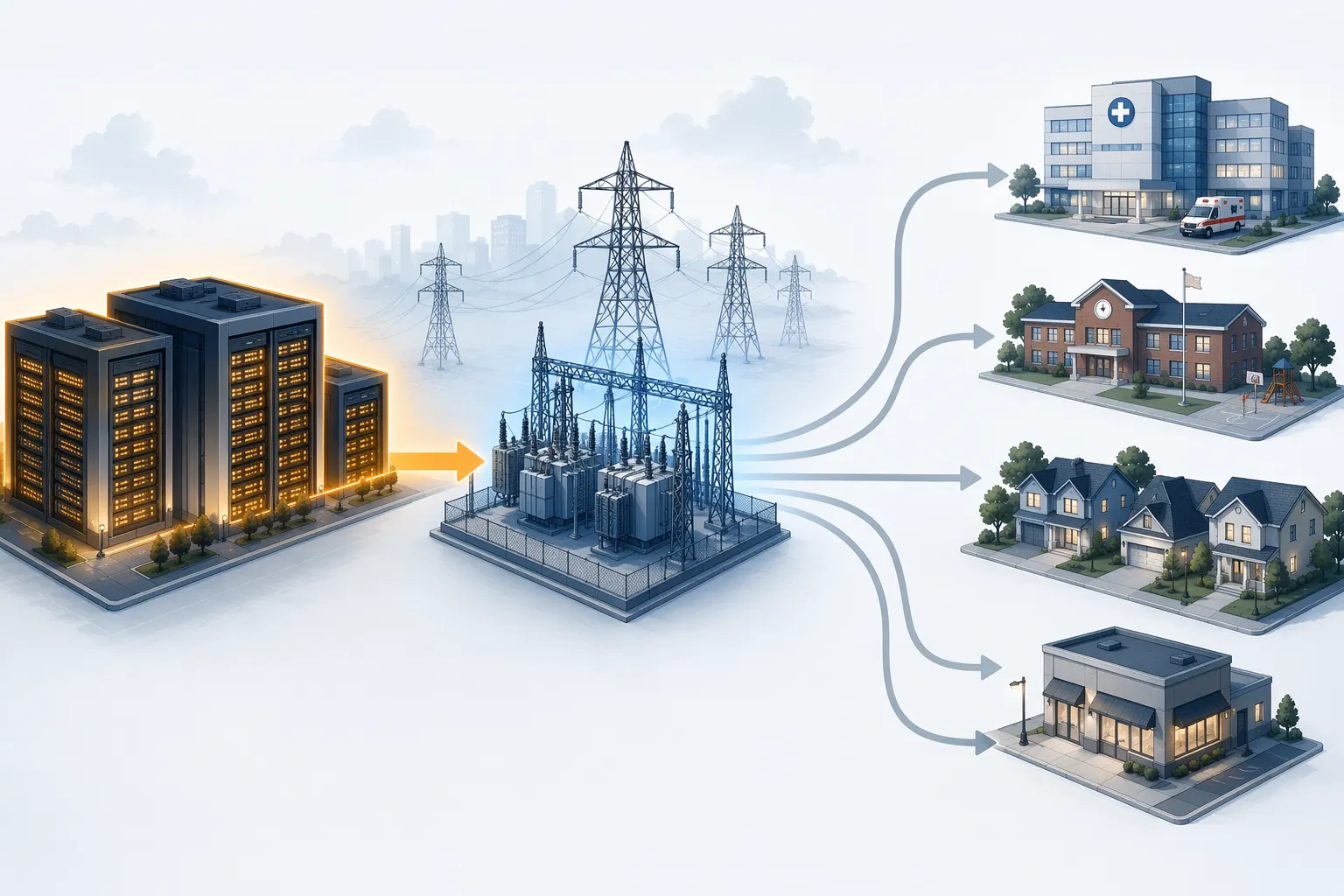
This is why a hospital AI governance committee should be cautious about business cases that stop at license fees, implementation labor, interfaces, storage, and cybersecurity review. Those are necessary line items. They are not the whole exposure if the facility sits in a data-center-dense utility region and already has a sensitive energy line.
Regional concentration is where the abstract risk becomes operational
National averages can make this issue look smoother than it is. Brookings, citing Bloomberg, reports that data centers consume about 40% of Virginia’s electricity. The same Brookings analysis cites Carnegie Mellon projections of an 8% average U.S. electricity-bill increase by 2030 linked to data centers, with impacts exceeding 25% in central and northern Virginia.[5] For a hospital in one of those territories, the relevant question is not whether the national average looks manageable. It is whether the local utility system is building for an unusually concentrated load class and how much of that cost will pass through to other customers.
PJM adds another layer because capacity-market costs can move before a hospital sees a simple energy-rate story. Pew reported that a data center-driven $9.3 billion increase in PJM’s capacity market was expected to raise residential bills by $18 per month in western Maryland and $16 per month in Ohio.[3] Those are residential estimates, not hospital estimates. Still, they are a concrete signal that data center load can affect shared electricity costs through market mechanisms that are not visible in a clinical-AI invoice.
Grid constraints make the forward-looking exposure harder to dismiss. The International Energy Agency reports that 20% of planned data center projects face significant delays because of grid bottlenecks, and that 7 of 13 U.S. grid regions are projected to fall below safety margins by 2030.[6] Again, that does not calculate a hospital surcharge. It does explain why exposed regions may face a combination of infrastructure spending, capacity pressure, interconnection delays, and political fights over who pays.
The counter-evidence is real, and it changes the wording
A simple claim that data centers always raise electricity prices does not survive the evidence. A July 2026 EPRI/Fortune working paper found that, historically, from 2015 through 2024, each doubling of data center capacity correlated with a 3.5% decrease in retail electricity prices. The authors also warned that the relationship may reverse as AI-driven demand accelerates and grid constraints intensify.[7]
That finding should not be waved away because it is inconvenient. It does two useful things for hospital budgeting. First, it separates historical correlation from forward-looking risk. A correlation between data center capacity and lower retail prices in the prior decade does not prove that data centers reduced prices, and it does not prove that the same relationship will hold when new loads arrive faster than transmission, generation, or local capacity can absorb them. Second, it keeps the appraisal regional. A hospital in a lightly constrained territory should not borrow northern Virginia’s risk profile without checking its own utility filings, capacity market, and tariff structure.
The right conclusion is narrower and more useful: AI data center growth is a plausible and material electricity-cost pressure for healthcare facilities in exposed regions, especially where utility costs are already high and data center load is shaping grid investment. It is not yet a measured, hospital-specific causal effect.
What should change in clinical-AI total cost assessments
The adjustment is not to reject clinical AI because data centers use electricity. That would be a lazy conclusion. The adjustment is to stop treating the facility energy environment as somebody else’s spreadsheet. Clinical-AI procurement already asks whether a tool will add integration work, require data movement, create monitoring obligations, or shift labor from one department to another. In data-center-dense regions, it should also ask whether the hospital’s electricity exposure is likely to change during the contract period.
| Procurement question | Why it belongs in the review |
|---|---|
| What utility territory and capacity market serves the facility? | Regional exposure matters more than the national average. |
| How large and volatile is the hospital’s current electricity spend? | A hospital with a high energy baseline is more sensitive to shared rate increases. |
| Are data center loads driving local grid upgrades, capacity costs, or rate cases? | The cost may appear through utility filings or market charges rather than through a vendor invoice. |
| Does the AI business case include a facilities or finance sensitivity scenario? | A tool can meet clinical goals while still underestimating indirect operating exposure. |
| Who owns the risk after approval? | Facilities, finance, and nursing operations may absorb consequences that were not visible during the demo. |
This appraisal did not review individual vendor ROI models, so it should not be read as a finding that a named vendor omitted a specific energy-cost line. The more defensible statement is that hospital AI total-cost assessments often have a category gap: they count the direct cost of adopting the tool, but may not test whether the regional electricity environment is changing during the same period.
The health literature also supports taking electricity costs seriously, although not as a source of quantified hospital-budget estimates. A 2026 Frontiers in Climate paper identified rising electricity costs from data centers as a health determinant, but the assessment is conceptual rather than quantitative; it does not measure effect sizes or disease burdens.[8] For hospital finance, its value is not that it supplies a dollar figure. Its value is that it recognizes electricity affordability as part of the operating environment in which care is delivered.
The evidence verdict
The evidence supports adding regional electricity exposure to clinical-AI total cost of ownership assessments, especially for hospitals in data-center-concentrated regions such as Virginia and parts of PJM territory. The basis is convergent proxy evidence: rising hospital energy costs, high electricity share of hospital energy spend, utility cost socialization, concentrated data center load, capacity-market pressure, and grid bottlenecks.
The evidence does not support a cleaner claim that AI data centers have already caused a measured increase in a particular hospital’s utility bill. Procurement teams can act on the risk without overstating the proof: mark it as regional rate exposure, run sensitivity cases against the facility energy line, and make the approving committee see the cost before it becomes a facilities or finance surprise.
References
- Hospital Energy Consumption 2026: Industry Data, BSA Design, 2026.
- Why Hospitals Need to Think About Energy, Duke/EDGE, January 5, 2026.
- What we know about energy use at U.S. data centers amid the AI boom, Pew Research Center, October 24, 2025.
- How data centers may lead to higher electricity bills, Harvard Law Today, 2025.
- Confronting and addressing rising energy bills linked to data centers, Brookings.
- Energy demand from AI, International Energy Agency.
- Data centers electricity costs cheaper 7billion buildout AI demand, Fortune, July 26, 2026.
- Frontiers in Climate data center health assessment, Frontiers in Climate, February 2026.