
A hospital AI committee can usually name the evidence question in front of it. Has the radiology triage model been externally validated? Did the sepsis alert change clinician action, or only produce more notifications? Does the ambient documentation system reduce pajama-time documentation without creating new review burdens? These are familiar questions because the clinical side of the ledger has become more disciplined: study design, population, endpoint, validation setting, clearance status, workflow dependence, and post-deployment monitoring.
The infrastructure side is less disciplined. It is increasingly measurable, but it is still often treated as background. That is the practical problem behind the debate over data center moratoria, AI impacts, and regulation: not whether clinical AI is categorically good or bad, and not whether a moratorium should become health policy by default, but whether benefit-risk appraisals can keep ignoring harms that are now being translated into asthma symptoms, premature deaths, water withdrawals, fossil-fuel demand, and chemical exposure.

The threshold fact is awkward: no published study has yet incorporated data center infrastructure costs into a formal net-benefit calculation for any clinical AI tool. That absence does not prove that a given tool should be rejected. It does mean that a committee approving a cloud-dependent software as a medical device, an ambient documentation platform, or a continuously updated prediction model is not actually looking at a complete net-benefit record if infrastructure externalities are left unnamed.
The issue has become operational because policymakers have started acting on data center impacts outside the hospital walls. Senators Bernie Sanders and Alexandria Ocasio-Cortez announced the AI Data Center Moratorium Act, S.4214, as a proposal to pause new AI data center construction while environmental and community impacts are assessed.[1] At the same time, a MultiState tracker reported that 27 states were advancing data center legislation as of April 2026.[2] Health systems do not need to convert those bills into procurement policy wholesale. They do need to recognize that the infrastructure supporting AI is no longer an invisible utility.
The Missing Term in the Net-Benefit Calculation
Clinical AI evidence is usually tool-specific and institution-facing. A radiology model may report sensitivity, specificity, turnaround time, or downstream imaging changes. A sepsis model may report alert burden, antibiotics timing, ICU transfer, or mortality, depending on the study. Ambient documentation tools may report note completion time, clinician satisfaction, or editing workload. Each appraisal asks whether this product, in this setting, improves a clinical or operational outcome enough to justify cost, risk, and implementation burden.
The infrastructure evidence is organized differently. It is not asking whether one hospital should deploy one model. It estimates public-health and resource consequences of the data center economy that increasingly supports AI. That mismatch is the center of the evidence gap. The harm estimates are not yet traceable to a particular clinical AI tool, but they are too concrete to dismiss as generic sustainability rhetoric.
The most arresting example is Han et al., a Caltech and UC Riverside preprint cited in a 2025 Lancet Regional Health–Western Pacific commentary by Tao and Gao. The model estimated that U.S. data centers could be associated with 600,000 asthma symptom cases and 1,300 premature deaths annually by 2028, with a public-health burden exceeding $20 billion.[3] The preprint status matters. A committee should not treat that estimate as settled in the same way it would treat a mature, peer-reviewed epidemiologic finding. But the estimate changes the governance conversation because it converts energy demand into patient-relevant outcomes.
That conversion is the part many clinical appraisals still lack. If a vendor claims that an AI product saves clinician time, reduces missed findings, or shortens time to treatment, the committee usually asks for the denominator, comparator, endpoint, and uncertainty interval. When the same tool depends on compute infrastructure whose aggregate public-health burden is being modeled in deaths and asthma symptoms, the harm side should not be allowed to remain a blank field labeled “cloud.”
Quantifiable Does Not Yet Mean Tool-Attributable
There is a tempting but incorrect shortcut: take a national data center harm estimate, divide it across AI uses, and assign a share to a clinical product. That would create the appearance of precision without the underlying evidence. Most hospital committees do not know which physical facilities support a vendor’s model training, inference, monitoring, analytics, backup, and retraining pipelines. Cloud-dependent SaMD products often disclose cybersecurity architecture, hosting regions, or compliance attestations, but not a clean public map from each clinical function to specific data centers, power contracts, cooling systems, or chemical supply chains.
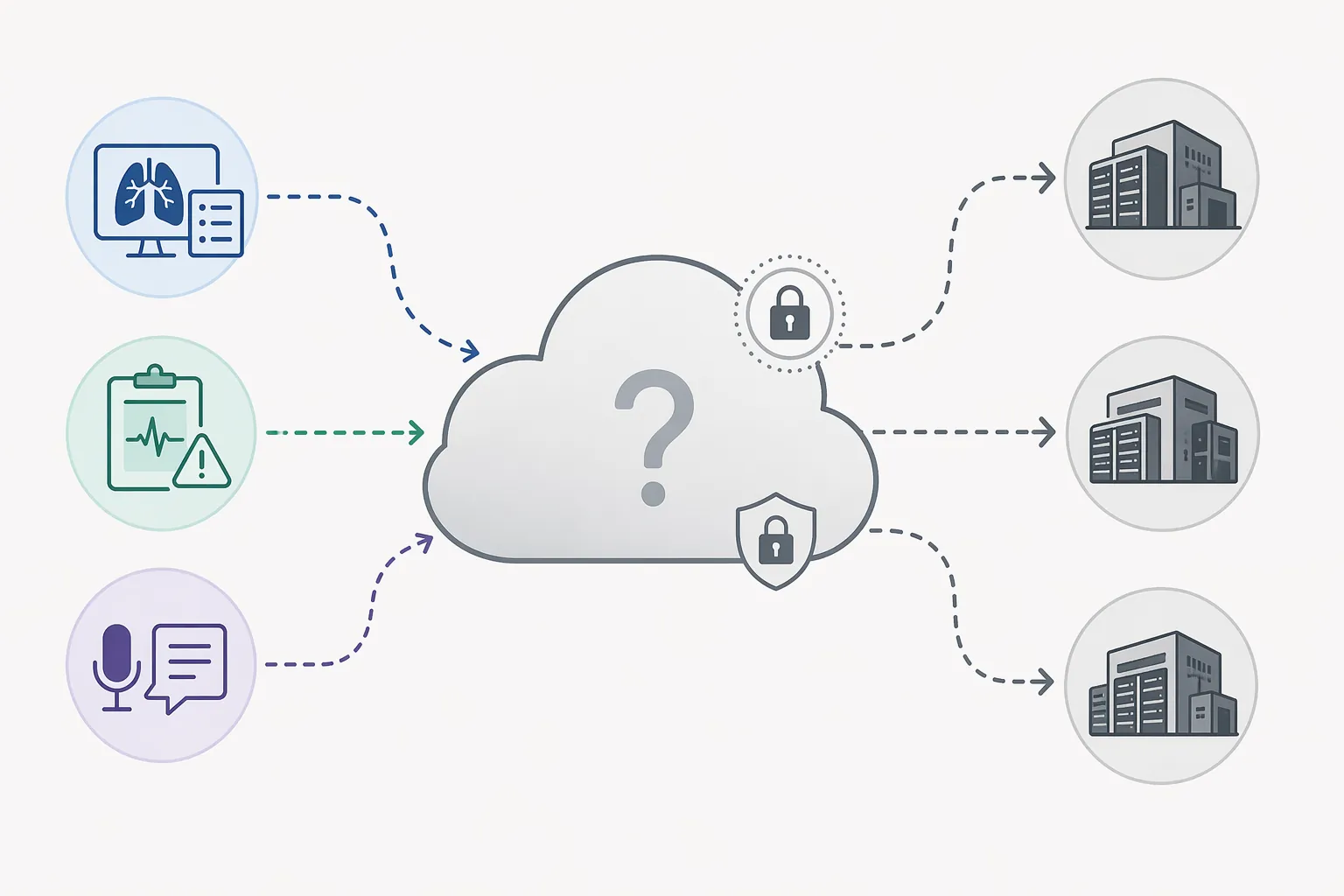
The attribution problem has several layers. One data center serves many customers. One clinical AI vendor may use multiple cloud services. A product may have separate compute demands for initial training, local configuration, real-time inference, quality monitoring, and model updates. A hospital may deploy the product at one scale during pilot testing and at a very different scale after enterprise rollout. Even when a vendor reports carbon-related information at the corporate level, that disclosure may not isolate the marginal burden created by one medical product in one health system.
That limitation should be written plainly in governance records. It is not honest to say that a committee has calculated the infrastructure-adjusted net benefit of a clinical AI tool when the facility mapping, marginal energy source, water use, and chemical inputs are unknown. It is also not necessary to pretend the evidence is unusable until every link in the chain is proven. Committees routinely make decisions under uncertainty; the difference here is that the uncertainty has usually been excluded from the vote.
Why the Blank Field Is Getting Harder to Defend
Electricity demand is the first reason. Lawrence Berkeley National Laboratory reported that U.S. data centers consumed 176 TWh in 2023 and projected consumption of 325 to 580 TWh by 2028.[4] An MIT estimate cited in the same policy discussion found that 60% of incremental demand would be met by fossil fuels.[5] Those figures do not identify the footprint of a specific sepsis model or radiology workflow. They do show that the denominator is expanding fast enough that hospitals should stop treating compute as a neutral input.
Water is the second reason. Ceres reported that Phoenix-area data centers used about 385 million gallons per year for cooling, with projected use reaching 3.7 billion gallons per year, an 870% increase.[6] A hyperscale facility can require 3 million to 7 million gallons of water per day for cooling, according to LBNL data cited in current policy discussions.[4] These numbers matter because health systems are accustomed to asking who benefits from a tool. The parallel question is who bears the resource burden when compute demand grows in water-stressed regions.
Chemical exposure is the third reason, and it is easy to miss if the discussion stops at electricity. The Environmental and Energy Study Institute summary links PFAS production for data center cooling systems to Chemours’ planned production expansion and a $450 million EPA settlement.[7] That does not mean a hospital’s AI procurement causes a specific PFAS exposure event. It does mean that the material supply chain for AI infrastructure can carry public-health consequences that are not captured by a product’s clinical validation study.
Taken together, these are not a complete causal chain from one hospital deployment to one community harm. They are a warning against false completeness. A clinical AI appraisal that includes model performance, cybersecurity, bias monitoring, cost, training burden, and clinician acceptance, but contains no line for infrastructure externalities, is not more rigorous because it avoids uncertain variables. It is simply rigorous on the variables it has chosen to see.
What Committees Can Know Now
A governance committee cannot yet calculate a definitive infrastructure-adjusted net benefit for a clinical AI product. It can, however, separate what is known, what is inferential, and what remains undisclosed. That distinction is more useful than a binary fight over whether AI infrastructure evidence is “proven enough” to matter.
| Question for the record | Current evidence status | Governance implication |
|---|---|---|
| Has this clinical AI tool shown patient, clinician, or workflow benefit in the intended setting? | Tool-specific evidence may exist, but strength varies by product, endpoint, study design, and validation setting. | Do not let infrastructure concerns substitute for ordinary clinical evidence appraisal. |
| Are data center harms quantifiable in public-health or resource terms? | Yes at aggregate levels, including modeled asthma symptoms, premature deaths, electricity demand, water use, and PFAS-linked concerns. | Do not leave infrastructure harms out of the benefit-risk record merely because they are upstream. |
| Can this committee assign a precise share of those harms to this product today? | Usually no; vendor, cloud, facility, and marginal-use mappings are often unavailable. | Document attribution limits rather than manufacturing a precise offset. |
| Has any published study integrated these infrastructure costs into this tool’s net-benefit calculation? | No published study has done so for any clinical AI tool identified in the evidence base. | State that the net-benefit calculation is incomplete, not merely pending local implementation data. |
This approach should feel familiar to committees that already review clinical AI under uncertainty. An external validation study may be missing. A subgroup analysis may be underpowered. A workflow outcome may be measured in one institution and assumed in another. The appropriate response is not to pretend the evidence is complete; it is to record the uncertainty and decide whether approval should be denied, delayed, narrowed, monitored, or conditioned.
The same logic applies here. If a cloud-dependent radiology triage tool has strong evidence of faster critical-result review, a committee may still approve it. But the approval record should not imply that the tool’s net benefit has been fully calculated if its infrastructure burden is unknown. If an ambient documentation tool shows modest time savings but requires large-scale continuous processing, the committee may reasonably ask for more disclosure before systemwide rollout. If a sepsis prediction product has weak prospective evidence and opaque compute requirements, the infrastructure uncertainty adds weight to concerns already present on the clinical side.
What to Ask Vendors and Regulators For
The immediate task is not to build a fake calculator. It is to make the missing variables visible enough that vendors, regulators, and health systems can be held to a better standard. A committee can ask for disclosure without claiming it can already convert every answer into a mortality-adjusted harm estimate.
- Separate training, inference, monitoring, and retraining compute demands, because a one-time model-development footprint is not the same as continuous clinical use.
- Identify cloud providers, hosting regions, and whether the vendor can map material product functions to facility classes or energy markets, even if exact facility names remain restricted.
- Request marginal energy, water, and cooling information for expected deployment scale, not only corporate sustainability statements.
- Ask whether the vendor has assessed PFAS-related cooling or supply-chain dependencies when relevant to its infrastructure.
- Require post-deployment reporting when utilization increases substantially, because pilot-scale compute assumptions can become obsolete after enterprise adoption.
- Record whether any formal net-benefit study has integrated clinical outcomes with infrastructure harms; for now, the expected answer will generally be no.
Regulators have a related problem. FDA clearance and clinical performance review were not designed to allocate air pollution, water demand, or chemical-production burdens across cloud infrastructure. State data center legislation and federal moratorium proposals are emerging from a different policy lane.[1][2] Clinical AI governance sits between those lanes. It cannot regulate the grid, but it can stop certifying its own ignorance as neutrality.
How the Moratorium Debate Should Change Clinical AI Appraisal
A data center moratorium proposal is a blunt instrument for a clinical AI committee. It does not tell a hospital whether to approve a specific stroke triage tool, renegotiate an ambient documentation contract, or pause an early-warning model. Its value for clinical governance is different: it signals that the infrastructure layer has become a public-policy object, not merely a vendor operations detail.
That shift should change the wording of approvals. A committee that approves a clinical AI deployment despite missing infrastructure data should say so directly. The decision record might state that clinical benefit evidence was judged sufficient for limited deployment, that no integrated infrastructure-adjusted net-benefit study exists, that aggregate data center harms have been quantified but cannot yet be attributed to this product, and that continued approval depends on vendor disclosure and local utilization monitoring.
A committee that delays or conditions deployment should be equally specific. The reason should not be a generalized objection to AI. It may be that the clinical evidence is marginal, the product is compute-intensive, the vendor cannot disclose enough about infrastructure dependencies, and the institution is unwilling to approve a tool whose benefit side is modest while the harm side remains unmeasured. That is a defensible governance judgment, not a symbolic moratorium.
The most important discipline is to keep the columns honest. Clinical gains should be evaluated with the same care committees already expect: validation, measured outcomes, workflow consequences, and post-market surveillance. Infrastructure harms should be documented according to their actual evidentiary status: aggregate estimates, preprint uncertainty where applicable, resource projections, legislative signals, vendor disclosures, and attribution limits. Until integrated studies exist, the record should not say that net benefit has been fully established. It should say what was counted, what was not counted, and who is being asked to live with the remainder.
References
- News: Sanders, Ocasio-Cortez Announce AI Data Center Moratorium Act. Office of Senator Bernie Sanders.
- Federal AI Data Center Policy Meets Resistance from State Lawmakers. MultiState. April 14, 2026.
- Environmental and public health implications of artificial intelligence data centers. Tao and Gao. 2025.
- Lawrence Berkeley National Laboratory data center electricity and water-use projections.
- MIT estimate on fossil-fuel share of incremental data center electricity demand.
- Ceres data on Phoenix-area data center cooling water use.
- Chemours 2026 PFAS production expansion and EPA settlement summary. Environmental and Energy Study Institute.