
Before appraising evidence about AI nationalization and healthcare data risk, the phrase has to be taken apart. In current debates, “AI nationalization” can mean government ownership of an AI company, a mandated national platform for health data and analytics, a public agency’s dependence on a private vendor, or a data-residency rule that says where servers must sit. Those are not interchangeable risks. A government equity stake does not create the same exposure as a cloud contract subject to foreign legal process. A national health-data platform does not raise the same governance question as a hospital’s local AI pilot.
The evidence is strongest when it can be tied to a jurisdictional hook, an access permission, a contract term, a withheld technical method, or a documented organizational decision. On that standard, the case for data-sovereignty concern is real but narrower than the rhetoric. The record is concentrated in three settings: Canada’s cloud-jurisdiction problem, the UK’s NHS-Palantir Federated Data Platform controversy, and New York City Health + Hospitals’ decision to drop Palantir. None of these is a clean test of a fully government-owned national healthcare AI model.

| Case | Mechanism actually documented | What it supports | What it does not prove |
|---|---|---|---|
| Canada | Health data stored in-country by US-owned cloud providers may remain reachable through US legal process | Data residency alone is not the same as sovereignty | That a government-owned AI model is inherently less secure |
| UK NHS-Palantir | Centralized national platform run through a private vendor, with contested access and transparency terms | Centralization can make data-use rights, pseudonymization, and aggregation risk harder to verify | That all national healthcare AI systems create the same risk |
| NYC Health + Hospitals | Public health system ended a vendor contract after concerns over de-identification and secondary use | Sophisticated public systems may retreat when permissions become hard to defend | That contract exit equals evidence of a breach or of nationalization failure |
Data Residency Is Not the Same as Data Sovereignty
Canada is the cleanest example because it does not require much speculation. A 2025 CMAJ analysis warned that health data stored by US-owned cloud providers such as AWS, Azure, and Google Cloud can remain subject to US jurisdiction under the CLOUD Act even when the servers are physically located in Canada.[1] For a hospital committee, that is not a theoretical worry about “foreign influence.” It is a question about whether the storage location promised in a procurement document actually controls who can compel access.
That distinction matters because healthcare procurement often treats in-country hosting as a closing argument. It is not. Data residency answers one question: where is the data stored? Data sovereignty asks a wider set of questions: which legal authorities can reach it, which organization controls the keys, which personnel can administer the environment, which contractual clauses survive a government demand, and which data subjects or communities have governance rights over reuse.
The Canadian legislative context makes the gap more visible. Bill C-27, which would have addressed parts of Canada’s privacy and AI governance framework, died when Parliament dissolved in 2025.[2] That does not mean Canada has no health privacy law, and it does not mean US cloud providers are mishandling Canadian health data. It means the legal architecture around AI, privacy, and data governance remained unsettled at the very moment health systems were being asked to rely on large cloud and AI infrastructures.
Indigenous data sovereignty adds a second layer that is easy to flatten if sovereignty is treated only as border control. Policy Options’ 2025 discussion of health data sovereignty emphasized Indigenous governance principles, including OCAP, in the context of AI legislation and health data reuse.[2] That concern is not solved by moving a database from one region to another. If communities have claims over how data are collected, interpreted, linked, and reused, then “Canadian-hosted” is an incomplete assurance.
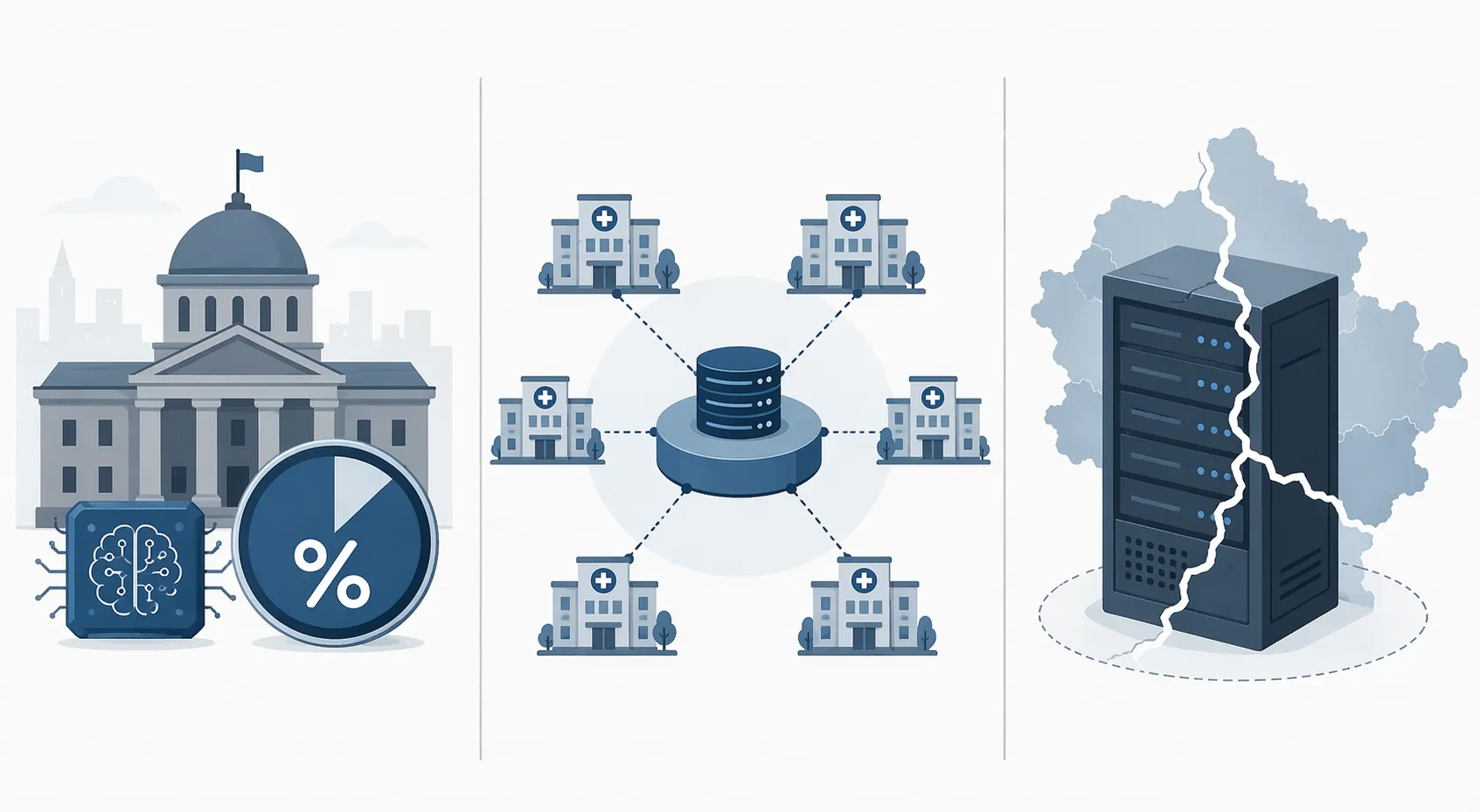
This is where the nationalization label starts to obscure the operational question. The Canadian risk is not that a national government owns an AI model. The documented risk is that a health system can satisfy a domestic storage requirement while still using infrastructure whose corporate ownership creates a foreign legal exposure. For an AI governance committee, that points to due diligence on subpoena resistance, encryption control, support access, key management, contractual notice obligations, and whether the vendor can segregate operations in a way that has more than marketing value.
The NHS-Palantir Case Is About Centralized Platform Power, Not a Public AI Model
The UK case is more disturbing at the access-control level, but less clean as evidence about “nationalization.” NHS England’s Federated Data Platform is a national health-system data platform delivered through Palantir under a £330 million contract, according to reporting and professional commentary on the arrangement.[3][4] That is centralization through a private platform, not a fully public AI infrastructure.
The contested details are the kind that make data protection assurances difficult to verify. BMA commentary and Al Jazeera reporting in May 2026 described concerns following reporting on a leaked NHS England briefing note that Palantir employees had “unlimited” access to patient data under the Federated Data Platform arrangement.[3][4] The same body of reporting and commentary also noted that approximately 100 pages of the FDP contract remained withheld, including material on pseudonymization methodology.[3][4]
Those points should be read carefully. A leaked briefing note is not the same as a publicly inspectable technical control document. Withheld contract pages are evidence of opacity, not evidence that a specific misuse occurred. But opacity is itself a governance problem when the withheld material concerns the method by which identifiable patient data are supposedly rendered safer for platform use. A committee cannot meaningfully sign off on aggregation and pseudonymization risk if the method is unavailable for scrutiny.
The NHS-Palantir controversy also shows why access language deserves more attention than slogans about public or private ownership. “Unlimited” access, if accurately characterized, is not merely a large permission; it changes the assurance model. The question shifts from whether a vendor can see a narrow dataset for a defined operational task to whether the platform operator can traverse a much broader patient-data environment, under what approvals, with what logging, and with what practical ability for the health system to detect misuse.
Aggregation risk is the other serious issue. Medact and other critics have argued that the FDP arrangement creates re-identification concerns when data are combined across sources.[4] Al Jazeera also reported warnings from two senior Ministry of Defence engineers that Palantir could generate top-secret information from unclassified data through cross-department aggregation.[4] That warning comes from a defense context, not directly from hospital operations, so it should not be imported wholesale into clinical data governance. Still, the underlying mechanism is familiar: datasets that are low-risk in isolation can become much more revealing when linked.
The UK evidence therefore supports a bounded conclusion. A national health system that centralizes operational data through a private platform can create hard-to-audit access and linkage risks, especially when contract terms and pseudonymization methods are not fully public. It does not prove that a government-built, government-operated healthcare AI platform would have the same failure mode. The mechanism documented here is vendor-controlled centralization under national mandate.
New York Shows a Contract Reversal, Not a General Law
The US case is useful because it records an institutional retreat rather than just external criticism. The Guardian reported in March 2026 that NYC Health + Hospitals dropped its Palantir contract after paying nearly $4 million since November 2023.[5] The article cited concerns from law professors Sharona Hoffman of Case Western Reserve University and Ari Waldman of UC Irvine about modern AI re-identification risk and contract provisions allowing data use for “purposes other than research” that were inadequately constrained.[5]
This is not a national AI program. It is not evidence that a government-owned healthcare AI system was breached. It is still relevant because NYC Health + Hospitals is a large public health system, and its decision shows that even sophisticated public institutions may decide a vendor data arrangement has become too difficult to defend. The operative risk was not the word “AI” by itself. It was the combination of de-identification uncertainty, broad secondary-use language, and a vendor relationship involving sensitive health data.
The re-identification concern is particularly important because many health-data contracts still lean heavily on de-identification as if it were a static control. In an AI setting, the concern is not only whether names and dates of birth were removed. It is whether longitudinal records, rare diagnoses, location patterns, appointment histories, device traces, and external datasets can be combined in ways that make a person or group inferable. The stronger the platform’s linkage capability, the less reassuring a generic de-identification clause becomes.
Which Mechanism Is Being Judged?
Most arguments about nationalized healthcare AI become less useful when they skip the mechanism. A policy can centralize data without nationalizing an AI company. A government can buy an equity stake without changing hospital data flows. A data-residency rule can keep servers inside a country while leaving operational control and legal exposure elsewhere. These are different audit problems.
| Mechanism | Primary governance question | Evidence in the current record |
|---|---|---|
| Government equity stake or ownership | Does public ownership change accountability, access, or procurement incentives? | Weak for healthcare data sovereignty; the reviewed cases do not test a fully government-owned model |
| Mandated centralized health-data platform | Who can access linked data, under what permissions, and with what transparency? | Moderate; the NHS-Palantir controversy directly concerns national-platform access and opacity |
| Cloud jurisdiction and data residency | Does in-country storage prevent foreign legal access or vendor operational access? | Strongest in Canada; the CLOUD Act issue shows why physical location is not enough |
| Broad secondary-use rights | Can vendor or government actors reuse data beyond the clinical or operational purpose patients expect? | Moderate; NYC Health + Hospitals illustrates contract-exit concern, not proven misuse |
That separation also changes the evidence standard. If the claim is that centralized platforms increase blast radius, the baseline healthcare cybersecurity record is relevant. If the claim is that government ownership uniquely causes sovereignty loss, the current evidence is thin. If the claim is that vendor-run national platforms can make data-use rights opaque, the NHS case is much more probative. If the claim is that domestic hosting solves sovereignty, the Canadian CLOUD Act analysis cuts directly against it.
The strongest practical review questions are therefore plain ones. Who holds the encryption keys? Which staff can administer the platform? Can the vendor use data for model development, product improvement, security analytics, or other non-care purposes? Are pseudonymization methods available to the controller and its independent reviewers? What happens if a foreign court, parent company, or government agency demands access? Can the health system leave without leaving behind derived data, embeddings, model weights, logs, or analytics outputs that still encode patient information?
Breach Statistics Raise the Stakes, but They Do Not Prove the Nationalization Claim
Healthcare’s cyber baseline is already poor enough that centralization deserves scrutiny. HIPAA Journal reported 772 large healthcare data breaches in 2025, a record high, and identified the Change Healthcare breach as affecting 192.7 million individuals.[6] The same source reported that more than 80% of large healthcare breaches were due to hacking and that ransomware attacks had increased 278% since 2018.[6]
Hospital-specific cybersecurity reviews point in the same direction. One 2025 review reported that cyber-attacks against hospitals doubled from 304 in 2022 to 624 in 2023.[7] These figures justify caution about concentrating operational data, identity services, analytics environments, or AI infrastructure in ways that could enlarge the consequences of compromise.
They do not, however, answer the comparative question. There is no published study in the reviewed materials that measures breach rates in government-controlled healthcare AI infrastructure against vendor-diversified healthcare AI infrastructure. The breach numbers are not an experiment in nationalization. They describe the dangerous water in which every architecture is now swimming.
The Düsseldorf case should be handled with the same restraint. The 2020 ransomware incident at a public university hospital is often discussed because it is the only documented cyber-fatality linked to hospital ransomware in the reviewed materials.[8] It is a serious reminder that hospital cyber disruption can have clinical consequences. It is weak evidence for AI-specific risk, and weaker still for nationalized AI risk, because the incident involved hospital IT disruption broadly rather than an AI platform.
A Bounded Verdict
The evidence supports concern about centralized healthcare AI data sovereignty when three conditions converge: a public mandate or public health-system dependency, a private or foreign-controlled technical platform, and opaque rights over access, linkage, pseudonymization, or secondary use. Canada shows why domestic hosting is not enough. The UK shows how a national platform can become difficult to audit when access and technical methods are contested. New York shows that a public health system may exit a vendor arrangement when de-identification and reuse permissions cannot be made convincing.
That is a meaningful evidence base, but it is not the same as proof that AI nationalization is a uniquely established healthcare data-risk category. The documented risks arise from jurisdiction, contracts, platform centralization, aggregation, and governance opacity. Some could appear in a government-led model. Some already appear in ordinary vendor procurement. The evidence is strongest when the claim stays attached to those mechanisms and weakest when “nationalized AI” is used as a single label for all of them.
References
- Data sovereignty analysis, CMAJ, 2025.
- Health data sovereignty, Policy Options, Oct. 2025.
- AI, private platforms and the risk to NHS data sovereignty, BMA.
- Palantir, Al Jazeera, May 12, 2026.
- New York hospitals Palantir AI, The Guardian, Mar. 26, 2026.
- Healthcare data breach statistics, HIPAA Journal, updated Jun. 2026.
- Risks narrative review, Interactive Journal of Medical Research, 2025.
- Cybersecurity review, Risk Management and Healthcare Policy.