
The practical question behind an enzyme aging reversal study evidence review is not whether the phrase “aging reversal” is exciting. It is what changed, in what setting, and how far that change sits from a clinical outcome a patient, clinician, or value-analysis committee would recognize as restored function. On that standard, CMLase and ER-100 belong in the same conversation only because headlines have put them there. Biologically, they are different bets.
| Appraisal dimension | CMLase | ER-100 |
|---|---|---|
| Mechanistic claim | Engineered enzyme removes Nε-carboxymethyllysine, a glycation-derived chemical modification on proteins. | AAV-delivered OSK reprogramming aims to restore youthful epigenetic information without c-Myc. |
| Main published evidence | Large CML reductions in aged human arterial tissue, skin, and lens sections treated ex vivo. | Mouse ocular and in vitro neuron evidence from Lu et al.; 2026 human trial establishes exposure, not efficacy. |
| Human status | Human tissue used, but not living humans or living tissue. | First human dosing reported in 2026 for eye disease trial. |
| Functional endpoint | No demonstrated tissue elasticity, organ function, or clinical restoration endpoint. | Foundational mouse study reported vision restoration in an ocular injury/disease context; no human efficacy result yet. |
| Major translational gap | Formalin-fixed thin sections, single-donor samples, no living organism, no effect on glucosepane. | Safety-first, small early human trial; doxycycline control system and long-term in vivo reprogramming safety remain unsettled. |
| Commercial proximity | Revel CEO is corresponding author; patent filed. | Life Biosciences is company sponsor; David Sinclair is co-founder and prominent advocate. |
| Current bottom line | Chemically specific marker removal, not demonstrated age reversal. | Further into human dosing, but not shown to reverse aging in humans. |
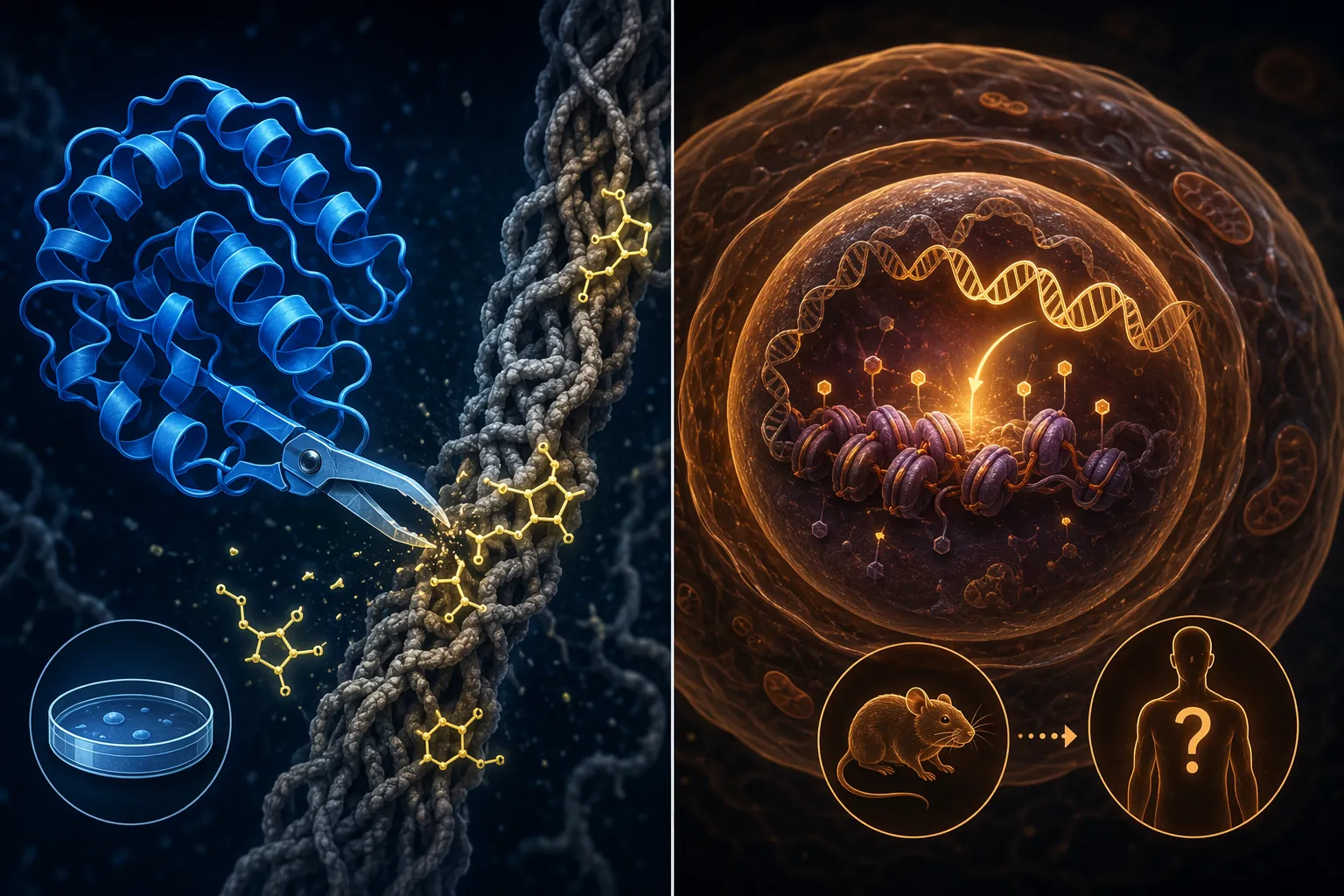
The shared label hides two different biological claims
CMLase is a subtraction strategy. It starts with a named chemical lesion, Nε-carboxymethyllysine, or CML, then asks whether an engineered enzyme can remove that lesion from aged proteins. The appeal is obvious: identify accumulated damage, build a catalytic tool, subtract the damage, and see whether tissue chemistry looks younger.
ER-100 is an information-reset strategy. It is based on partial cellular reprogramming using OSK factors, excluding c-Myc, delivered by an adeno-associated viral vector. The claim is not that one named chemical scar has been clipped away. The claim is that cells may retain recoverable youthful information, and that controlled reprogramming may restore a more functional state.
Those are not competing versions of the same product category. They have different target biology, different failure modes, different safety concerns, and different evidence ladders. Treating them as two entries in a validated “age reversal” market is already a category error.
CMLase: vivid marker reductions in a narrow experimental setting
The CMLase paper is the cleaner biochemical story. In Nature Communications, the investigators reported enzymatic deglycation of aged human tissues, including more than 70% CML reduction in aged human arterial tissue, more than 55% reduction in skin, and 45% to 78% reduction in lens tissue. In the skin sample, CML after treatment fell below the level measured in a 31-year-old donor sample.[1]
Those numbers are exactly why this study travels badly once it leaves the paper. A large percentage reduction in aged human arterial tissue sounds close to clinical rejuvenation. It is not. The treated materials were ex vivo formalin-fixed thin sections. No living human was treated. No living organism was treated. No artery became more elastic, no lens regained optical function, and no skin measurement showed restored barrier function or wound repair.
The distinction matters because a fixed section is an excellent place to ask whether an enzyme can reach and modify a chemical target under controlled conditions. It is a poor place to infer pharmacology, distribution, immune response, repair durability, or functional recovery. In procurement language, this is target-engagement evidence in treated specimens, not clinical utility evidence.
The study also narrows itself in ways that should not be blurred. CMLase addresses CML, one advanced glycation end product among many. Glucosepane is widely considered more directly relevant to tissue stiffening, and CMLase did not affect it. That is not a small footnote. If the clinical story being implied is softer vessels, less stiff tissue, or restored mechanical performance, untouched glucosepane keeps the most relevant bridge unbuilt.
There are additional translation penalties. The enzyme is bacterial, so immunogenicity in humans is unknown. Its catalytic efficiency was reported as 10 to 50 times below natural enzymes. The human tissue samples were single-donor samples. A patent was filed, and Revel’s CEO is a corresponding author, which does not invalidate the data but does raise the evidentiary burden for any downstream claim made in commercial language.[1]
The fair appraisal is therefore neither dismissal nor endorsement. CMLase shows that a specific chemical aging marker can be substantially reduced in aged human tissue sections under laboratory treatment. It does not show that enzymatic deglycation reverses tissue aging in a living system.
ER-100: a stronger in vivo lineage, but not human age reversal evidence
ER-100 has a different evidence shape. Its foundational scientific support comes from Lu et al. in Nature, where OSK-mediated reprogramming was studied in an ocular context. The paper reported vision restoration in a mouse glaucoma model and reversal of DNA methylation age in human neurons in vitro. That is more biologically dynamic than fixed tissue chemistry, but it is still not systemic human rejuvenation.[2]
The mouse result is important because function was measured in a living organism. That gives ER-100 a kind of evidence CMLase does not yet have. But the setting was the eye, the intervention was tested in preclinical disease and injury models, and the human neuronal evidence was in vitro. The evidence supports plausibility for partial reprogramming in ocular repair. It does not establish that aging biology across human tissues can be safely reset.
The 2026 development headline adds another layer of potential confusion. Life Biosciences reported first human dosing of ER-100 in June 2026, described as the first human test of this type of rejuvenation approach. The trial is described as an early Phase I study in roughly 20 patients with glaucoma and non-arteritic anterior ischemic optic neuropathy, or NAION.[3][4]
“In humans” is doing too much work in many discussions of ER-100. A first-in-human trial can establish that a product has entered human exposure. It does not, by itself, establish that the product reverses aging in humans. The trial described in the research materials is safety-only and has no placebo-controlled efficacy arm. For a hospital committee, that distinction is not pedantry. It determines whether the evidence belongs in a therapeutic-effect discussion or an early translational-monitoring file.
The control system deserves particular attention. ER-100 uses AAV delivery of OSK without c-Myc and a doxycycline-dependent on/off switch. Excluding c-Myc is meant to reduce oncogenic concern, but it does not make long-term partial reprogramming automatically safe. The doxycycline switch has not been tested in humans in this context, and AAV-delivered biological programs are not equivalent to a small molecule that can simply be stopped and cleared.
The commercial context is also material. David Sinclair is a co-founder of Life Biosciences, and his previous longevity claims around resveratrol and NMN have attracted criticism for overstatement. That history is not a scientific rebuttal to ER-100. It is a reason to separate peer-reviewed endpoints from the promotional halo around first-in-category rejuvenation language.

Where each intervention sits on the evidence ladder
For internal review, it is useful to stop asking whether either intervention is “more real” and instead place each claim on an evidence ladder. CMLase has impressive marker movement in human tissue specimens. ER-100 has preclinical functional evidence in a living mouse eye and has entered human dosing. Neither has demonstrated functional age reversal in living humans.
| Evidence question | CMLase answer | ER-100 answer |
|---|---|---|
| Did a molecular marker change? | Yes. CML was reduced in treated aged human tissue sections. | Yes. DNA methylation age shifted in human neurons in vitro in the foundational work. |
| Was there living-animal functional evidence? | No living organism was tested in the cited CMLase study. | Yes, in mouse ocular models in the Lu et al. study. |
| Was human tissue or human exposure involved? | Human tissue sections were used ex vivo. | Human dosing began in a Phase I eye-disease trial in 2026. |
| Was human efficacy demonstrated? | No. | No. |
| Was broad aging reversal demonstrated? | No. | No. |
This ladder also prevents the common mistake of rewarding the wrong kind of maturity. CMLase can look less mature because it has not entered living systems, yet its target is chemically specific. ER-100 can look more mature because it has reached human dosing, yet its human trial is not designed to prove rejuvenation efficacy. Those are different uncertainties, not a simple ranking.
A hypothetical value-analysis packet should therefore avoid a single “aging reversal enzyme” line item. CMLase would be reviewed as an engineered deglycation platform with target-selectivity, immunogenicity, delivery, and functional-tissue questions. ER-100 would be reviewed as a gene-therapy reprogramming platform with vector, inducibility, ocular safety, durability, and tumor-risk questions.
The most important missing endpoint is function
Aging reversal is not a single accepted regulatory or clinical endpoint. In practice, the phrase becomes more defensible as the evidence moves from molecular markers to tissue behavior, organ function, symptoms, morbidity, and durability. Neither CMLase nor ER-100 currently clears that full path in humans.
For CMLase, a clinically recognizable next proof point would not be another large CML percentage reduction in fixed tissue. It would be evidence that treating living tissue changes a relevant mechanical or physiological property without unacceptable immune or off-target consequences. Arterial tissue would need to behave differently, not merely stain differently.
For ER-100, the next proof point is not the mere fact of a dosed patient. A human ocular trial would need safety data first, then credible evidence that visual or structural outcomes improve beyond what disease variability, measurement noise, or uncontrolled comparison can explain. Because the current trial is described as safety-only and not placebo-controlled for efficacy, it should not be treated as an efficacy test in advance.
That leaves a narrow but useful current conclusion. CMLase supports enzyme-mediated reversal of a particular protein chemical modification in ex vivo human specimens. ER-100 supports the plausibility of partial reprogramming for ocular repair from preclinical and in vitro work and has crossed into early human safety testing. Neither supports the broader claim that enzyme-centered interventions have reversed aging in living humans.
Bias concerns change the burden of proof
Commercial proximity is expected in translational biotechnology. It is also not neutral. When a CEO, founder, patent position, or sponsor sits close to the core evidence, review committees should not discard the work; they should demand sharper separation between data, inference, and market language.
For CMLase, the direct commercial interest makes the single-donor and ex vivo limitations more consequential. Independent replication in living systems would carry more weight than additional promotional discussion of percentage CML removal. For ER-100, the founder halo and the “first human” narrative make endpoint discipline more important. Safety exposure is not efficacy, and ocular repair is not whole-body age reversal.
This is where procurement language is healthier than longevity-market language. A board member may ask whether the institution should “watch this space.” The answer is yes, but with two separate watch files. One file tracks whether engineered deglycation can move from fixed human sections to living tissue function. The other tracks whether partial reprogramming can show controlled, durable, safe repair in humans.
How to phrase the current evidence without overstating it
The defensible wording is narrower than the headline wording. CMLase has shown enzymatic reduction of CML, a protein chemical aging marker, in ex vivo aged human tissue sections. ER-100 is an investigational AAV-OSK partial-reprogramming therapy supported by mouse ocular and in vitro evidence, with early human safety testing underway. Those statements preserve what is interesting without borrowing clinical certainty the studies do not provide.
The indefensible shortcut is to say that either intervention has reversed human aging. CMLase has not been tested in living humans. ER-100 has entered humans, but the trial status described in 2026 does not establish efficacy. One is closer to a visible biochemical target; the other is closer to human exposure. Neither has crossed into demonstrated functional restoration in living humans.
Both programs deserve monitoring for different reasons. CMLase is a chemically precise attempt to subtract a defined form of accumulated molecular damage. ER-100 is a more systems-level attempt to recover youthful cellular information and has moved into early human dosing. The current evidence supports molecular or preclinical rejuvenation signals, not validated human age reversal, and any clinical or procurement conversation should treat them as distinct translational bets rather than rival products in one proven category.
References
- Reversal of protein chemical aging by enzymatic deglycation, Nature Communications, July 2026.
- Reprogramming to recover youthful epigenetic information and restore vision, Nature, 2020.
- First-ever reverse-aging treatment injected into a human, Business Insider, 2026.
- The first human test of a rejuvenation method will begin shortly, MIT Technology Review, January 27, 2026.