
ClinicalMind logoClinicalMind

The Evidence Gap in Medical AI: Why 1,451 FDA-Cleared Devices Don't Mean 1,451 Proven Tools

A critical analysis for clinicians, researchers, and policy makers examining the disconnect between the rapid growth of FDA-authorized AI/ML medical devices and the thin evidence base supporting their clinical impact, drawing on the JAMA evidence audit, the Nature Medicine proportional evidence call, and the AMIA evaluation framework.

Tool
The Evidence Gap in Medical AI: Why 1,451 FDA-Cleared Devices Don't Mean 1,451 Proven Tools
Published
Updated

Reviewer

Not reported

Not reported

FDA clearance status

Not reported

A regulatory fact, reported separately from the evidence verdict.

Risk-of-bias verdict

Not yet rated

The Adoption Surge and the Device Count

The numbers are striking. By the end of 2025, the U.S. Food and Drug Administration had authorized a cumulative total of 1,451 artificial intelligence and machine learning (AI/ML) enabled medical devices. In 2025 alone, 295 new devices received clearance — the highest annual total on record. Meanwhile, a February 2026 survey of 120 U.S. health systems by Eliciting Insights found that 75% have deployed at least one AI solution, up from 59% in 2025. Multi-solution adoption — three or more AI tools — grew 67% year-over-year, reaching 59% of surveyed systems.

These figures paint a picture of rapid, widespread integration. But they also raise a question that clinicians, researchers, and procurement teams cannot afford to ignore: does regulatory clearance equal clinical proof?
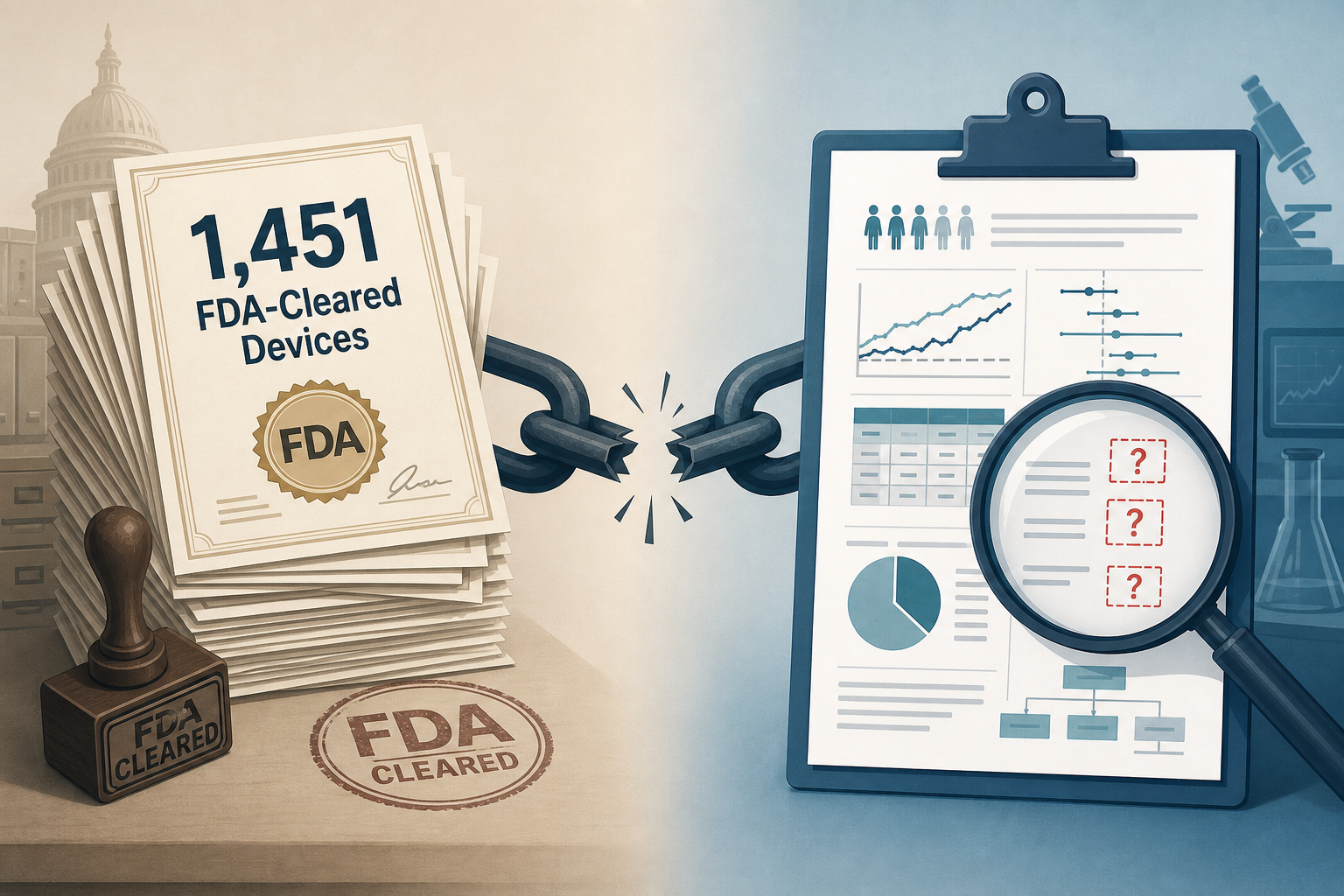
Illustration showing a stack of FDA clearance certificates on the left and a single clipboard with clinical trial documents on the right, with a broken-link gap symbol between them.
The visual contrast between regulatory clearance volume and clinical evidence depth.

Risk-of-bias scorecard

Study design
Not reported in the cited evidence
External / prospective validation
Not reported in the cited evidence
Key performance metric
Not reported in the cited evidence
Overall rating
Not yet rated

Informational only — read the full disclaimer. This content supports procurement and research judgment, not clinical care decisions.

Submit a correction or sourcing issue

Blogarama - Blog Directory