
The most defensible version of the filter coffee lower blood sugar study evidence is narrower than the claim usually sounds: in Cao et al.’s Mendelian randomization analysis, the statistically significant HbA1c association appeared for unsweetened filtered coffee only. It did not extend to filtered coffee with milk, instant coffee with milk, sweetened coffee, artificially sweetened coffee, or decaffeinated coffee patterns in that analysis.[1]
That distinction matters before any discussion of gut bacteria, coffee preparation, or clinical advice. The primary result was an odds ratio of 0.97 per unit increase in genetically predicted filtered coffee intake, with a 95% confidence interval of 0.94 to 0.99 and P=0.04.[1] It is a small signal, not a patient-level lever. It is also the strongest causal-level evidence currently available for this specific claim, which is precisely why it deserves careful handling rather than dismissal.
The Appraisal Verdict
| Question | Best Supported Answer |
|---|---|
| What exposure showed the significant HbA1c association? | Unsweetened filtered coffee, not coffee broadly. |
| What was the main effect estimate? | OR 0.97; 95% CI 0.94–0.99; P=0.04 per unit increase in genetically predicted filtered coffee intake.[1] |
| What kind of evidence is this? | Mendelian randomization using genetic instrumental variables, stronger than ordinary observational association but not equivalent to a randomized trial.[1] |
| Who does the evidence most directly apply to? | European-ancestry source populations, including UK Biobank and MiBioGen sources.[1] |
| What mechanism was proposed? | A propionic acid-producing gut microbiota pathway, with Veillonella estimated to mediate 43.33% of the filtered coffee-HbA1c association.[1] |
| Is this ready for clinical guidance? | No. It is worth tracking, but it does not justify recommending filtered coffee as a clinically meaningful individual intervention. |
The study was published in npj Science of Food in 2025 and had a correction notice in May 2026.[1] The journal context is not the argument; specialty food-science publication does not make the result weak. But for clinical, procurement, or wellness-policy use, the evidentiary threshold is not “interesting and peer reviewed.” It is whether the finding can survive translation into a decision.
Why This Finding Was Plausible Before Cao et al.
Cao et al. did not appear in an empty field. A prior Swedish nested case-control analysis from the Västerbotten Intervention Programme used plasma metabolite biomarkers to distinguish boiled and filtered coffee intake and reported a lower type 2 diabetes risk among people with the highest filtered coffee intake. The reported estimate was OR 0.42, with a 95% confidence interval of 0.23 to 0.75, in 421 matched case-control pairs.[2]
That older study is useful for plausibility because it moved beyond self-reported cups per day. Metabolomics-based exposure classification is a serious attempt to improve diet research, where recall and habit reporting often do too much work. But the Shi et al. study remains observational and modest in size.[2] It can support the idea that filtered coffee deserves further study; it cannot establish that changing a person’s coffee preparation will lower glycemic risk.
This is also where communication begins to drift. The Chalmers University release on the VIP cohort used the phrase “helps prevent type 2 diabetes,” which is understandable as public-facing shorthand but stronger than the underlying design can bear.[3] Later coverage of the Cao study described a “causal link to healthier HbA1c levels,” again capturing the Mendelian randomization ambition while risking a reader-level inference that is more intervention-like than the study itself.[4]
What Mendelian Randomization Adds, and What It Does Not
Mendelian randomization is valuable here because it uses genetic variants as instruments for an exposure. In principle, genetic allocation occurs before adult coffee habits and before later glycemic outcomes, reducing some confounding that burdens conventional nutrition epidemiology. That is a real upgrade over simply observing that coffee drinkers differ from non-coffee drinkers.
But “genetically predicted filtered coffee intake” is not the same as assigning people to drink unsweetened filtered coffee and then measuring HbA1c over time. Cao et al.’s analysis is cross-sectional in the relevant instrumental-variable sense and cannot directly establish the temporal sequence that a clinical intervention study would require.[1] It also cannot give the kind of dose-response curve a committee would want before turning a food habit into guidance.
The effect estimate should also be read at the scale at which it lives. An OR of 0.97 with a 95% CI of 0.94 to 0.99 and P=0.04 is compatible with a small population-level association.[1] It is not compatible with a confident promise that one person can meaningfully lower HbA1c by switching brewing methods. The confidence interval excludes 1.00, but barely; the P value clears the conventional threshold, but not by much. That does not make the result unimportant. It makes the result unsuitable for oversized clinical language.
The population boundary is just as important. The MR sources cited for the primary evidence are European-ancestry resources, including UK Biobank and MiBioGen.[1] The prior VIP cohort evidence is Swedish.[2] Generalizability to non-European populations is therefore unknown, not assumed. For a governance review, that is not a footnote; it affects whether a claim can be applied across a diverse patient population.
The Six Coffee Patterns Are Not Interchangeable
The easiest mistake is to compress the finding into “coffee lowers blood sugar.” Cao et al. tested multiple coffee consumption patterns, and the significant HbA1c result was specific to unsweetened filtered coffee.[1] That specificity should travel with the claim wherever the claim travels.
- Supported in the MR analysis: unsweetened filtered coffee showed a statistically significant association with lower HbA1c.[1]
- Not supported as significant HbA1c patterns in the same analysis: instant coffee with milk, filtered coffee with milk, sweetened coffee, artificially sweetened coffee, and decaffeinated coffee.[1]
- Not established by these materials: conclusions about espresso, French press, pod-based coffee, or other preparation methods not directly resolved by the analyzed patterns.
The sugar result deserves special attention because it resembles real-world coffee use more than an idealized exposure does. In the same MR study, adding sugar to coffee showed a borderline significant negative association with Veillonella, with OR 0.65, 95% CI 0.42 to 0.99, and P=0.05.[1] That does not prove sugar cancels a glycemic benefit. It does mean that the microbiome-mediated version of the claim becomes less persuasive when the coffee is sweetened.
Milk and artificial sweeteners should not be overinterpreted either. Their null findings in this analysis are not proof of harm or neutrality in every setting. They simply failed to show the same significant HbA1c association in the Cao et al. framework.[1] For evidence translation, that is enough to block a broad “filtered coffee” recommendation from being treated as if all common versions of the drink were included.
The Veillonella Mechanism Is Interesting, Not Settled
The proposed pathway is attractive because it gives the result a biological shape. Cao et al. linked filtered coffee, propionic acid-producing gut microbiota, and HbA1c, estimating that Veillonella mediated 43.33% of the filtered coffee-HbA1c association.[1] A mechanism like that is more satisfying than another loose dietary association, especially in a field that needs better anchors than self-report.
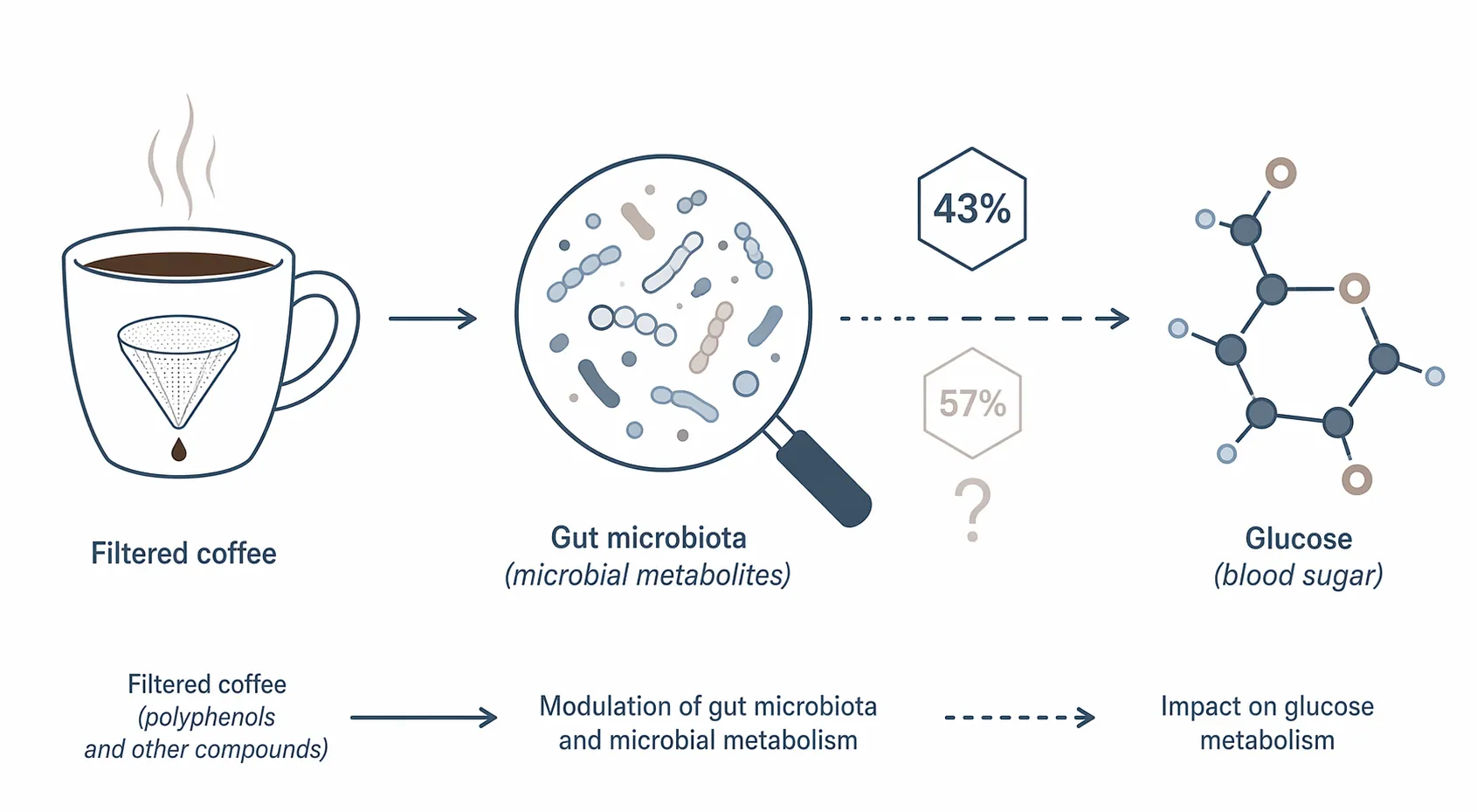
But the mediation estimate is still a statistical estimate from genetic instruments. It is not an experiment showing that filtered coffee increases Veillonella, that Veillonella then changes propionic acid exposure, and that this sequence lowers HbA1c in a measured time course. The 43.33% figure should be read as a modeled proportion of the association, not as a demonstrated biological route in patients.[1]
The remaining portion matters. If Veillonella accounts for 43.33%, then more than half of the modeled association remains outside that pathway.[1] That unexplained share could include other microbiome taxa, direct effects of coffee compounds, residual bias, instrument behavior, or pathways not measured in the analysis. A separate 2024 Nature Microbiology finding linking Lawsonibacter asaccharolyticus to coffee consumption generally also argues against turning this into a single-taxon coffee story.
The familiar filtered-versus-unfiltered coffee story also should not be smuggled in too quickly. Filtration changes coffee chemistry, and diterpenes often appear in discussions of boiled and filtered coffee. Yet the materials here do not support a simple statement that removing diterpenes is the glycemic explanation. Complicating this further, cafestol has shown insulin-secretion effects in vitro, which makes the net interpretation of diterpene retention less clean than a harmful-versus-beneficial split.
Causal-Level Evidence Is Not the Same as Clinical Actionability
For a clinician, reviewer, or value-analysis committee, the relevant question is not whether the Cao study is better than the average coffee-health association. It is. The question is whether it supports an action: advise patients to switch to unsweetened filtered coffee in order to lower HbA1c, build a wellness intervention around that instruction, or let a product claim imply glycemic benefit.
On that standard, the evidence stops short. There is no randomized trial directly testing filtered versus unfiltered coffee on glycemic outcomes in the materials reviewed. There is no direct intervention evidence showing that changing preparation method lowers HbA1c. There is no settled dose-response relationship, and the generalizability outside European-ancestry populations is unknown.[1][2]
That does not make the Cao study merely academic. A small genetically predicted association can matter at population scale if it is reproducible, biologically coherent, and eventually linked to practical exposure changes. But individual guidance needs more than a statistically significant MR estimate. It needs a reasonable expectation that the recommended behavior produces a measurable benefit for the person being advised.
The safest wording is therefore deliberately narrow: unsweetened filtered coffee showed a small genetically predicted association with lower HbA1c in European-ancestry Mendelian randomization data, with Veillonella estimated to mediate part of the association.[1] That is materially different from saying filtered coffee lowers blood sugar.
A Practical Evidence Verdict
Cao et al. is the strongest causal-level evidence available for the filtered coffee and lower HbA1c claim. It is stronger than ordinary observational epidemiology, more specific than broad coffee-health summaries, and mechanistically more interesting than a simple preparation-method comparison.[1] Shi et al. adds supportive prior evidence from biomarker-informed observational work, but it does not close the intervention gap.[2]
The claim should not be discarded. It should be narrowed until it matches the evidence. Without a randomized trial, broader population evidence, clearer temporality, and a more complete mechanism, filtered coffee should not be presented as a clinically meaningful individual intervention for lowering blood sugar.
References
- Different coffee consumption patterns affect HbA1c via propionic acid-producing gut microbiota. npj Science of Food. 2025; corrected May 2026. https://www.nature.com/articles/s41538-025-00655-w
- Plasma metabolite biomarkers of boiled and filtered coffee intake and their association with type 2 diabetes risk. Journal of Internal Medicine. 2020. https://doi.org/10.1111/joim.13009
- Filtered coffee helps prevent type 2 diabetes, show biomarkers in blood samples. Chalmers University of Technology. https://www.chalmers.se/en/current/news/life-filtered-coffee-helps-prevent-type-2-diabetes-show-biomarkers-in-blood-samples/
- Filtered coffee shows a causal link to healthier HbA1c levels. News-Medical.net. Dec 2025. https://www.news-medical.net/news/20251210/Filtered-coffee-shows-a-causal-link-to-healthier-HbA1c-levels.aspx