
The cleanest version of the claim is also the easiest one to overstate: in the Fauchier 2026 European Heart Journal analysis, influenza vaccination was associated with a 20% lower relative hazard of incident atrial fibrillation. The less headline-friendly version is the one a prevention committee actually has to work with: annualized AF incidence was 0.89% in vaccinated patients versus 1.12% in unvaccinated patients, an absolute difference of 0.23 percentage points per year and an approximate number needed to treat of 435 per year.
Both statements describe the same result. They just answer different questions. The hazard ratio answers whether the vaccinated group had lower time-to-event risk after statistical adjustment. The absolute incidence difference answers how many AF events might separate two otherwise similar groups over a year. For a low-cost, familiar intervention with other cardiovascular reasons to use it, a small absolute difference can still matter. But it is not the same as saying the flu shot has been proven to cut AF risk by one-fifth in a causal sense.

What Fauchier 2026 Actually Adds
Fauchier et al. is the main reason the question deserves a fresh look. The study used the TriNetX research network and compared adults who received influenza vaccination with those who did not, after propensity matching on 65 variables. The matched population included roughly 277,000 patients, with a mean follow-up of 2.7 years. Incident AF was lower in the vaccinated group, with a reported hazard ratio of 0.80 and p<0.0001.[1][2]
That is not a casual database comparison. Matching on dozens of variables is a serious attempt to make the vaccinated and unvaccinated groups more comparable, and the sample size gives the analysis enough precision to detect modest differences. The secondary outcomes also moved in a favorable direction: all-cause mortality HR 0.85, myocardial infarction HR 0.91, and heart failure HR 0.92.[2] That pattern makes the AF result harder to dismiss as a statistical oddity.
| Fauchier 2026 measure | Reported result | Why it matters |
|---|---|---|
| Incident AF hazard | HR 0.80; p<0.0001 | The main relative-risk signal behind the 20% claim |
| Annualized AF incidence | 0.89% vaccinated vs 1.12% unvaccinated | Shows the absolute difference is 0.23 percentage points per year |
| Approximate NNT | 435 per year | Reframes the effect size for prevention planning |
| Matching strategy | 65 propensity-matching variables | Reduces measured confounding but cannot eliminate unmeasured confounding |
| Mean follow-up | 2.7 years | Long enough to observe incident AF, but still dependent on database capture |
The NNT is not a rebuttal. It is a scale adjustment. If a flu vaccination program already exists, if the population is older or cardiovascularly vulnerable, and if vaccination also reduces other serious outcomes, preventing a small number of AF cases may be a useful additional benefit. But if the sentence being drafted is “flu vaccination cuts AF risk by 20%,” the NNT asks for a more disciplined version: in this observational analysis, vaccination was associated with a lower relative hazard, while the annual absolute difference in AF incidence was small.
The Matching Helps, but It Does Not Randomize
Propensity matching tries to answer a practical question: among people who look similar on recorded characteristics, do vaccinated patients have different outcomes than unvaccinated patients? In Fauchier 2026, the answer was yes. The problem is the phrase “recorded characteristics.” Vaccination is not randomly assigned in this analysis. It is a behavior, a clinical encounter, a marker of access, and often a proxy for being connected to preventive care.
A patient who receives an annual flu shot may also be more likely to attend primary-care visits, refill medications, manage blood pressure, accept other preventive services, or receive earlier treatment for intercurrent illness. Some of those differences can be measured and matched. Others are poorly captured in routine data. That is the healthy-user problem, and it is not a theoretical quibble when the absolute annual AF difference is 0.23 percentage points.
There is also an exposure-classification issue. The Fauchier analysis classified vaccination status based on a single influenza season; prior or cumulative vaccination history was not captured in the ACC summary available at this writing.[2] That matters because AF risk is shaped over years by age, cardiometabolic disease, inflammation, structural heart disease, and care patterns. A single-season exposure may be biologically meaningful, but it may also be an incomplete marker of longer-term prevention behavior.
One important caveat: some Fauchier details used here come from the ACC Journal Scan summary and related coverage while the European Heart Journal full text should be checked directly for exact confidence intervals, complete matching covariates, subgroup definitions, and sensitivity analyses before using the study in a formal formulary, quality-measure, or governance decision.[1][2]
Why the Signal Is Biologically Plausible
The proposed mechanism does not require much stretching. Influenza can produce systemic inflammation, sympathetic activation, endothelial dysfunction, and acute physiologic stress. In a susceptible atrium, that inflammatory load could lower the threshold for AF onset. A vaccine that prevents influenza infection, attenuates illness severity, or reduces inflammatory burden could plausibly reduce arrhythmia triggering in some patients.
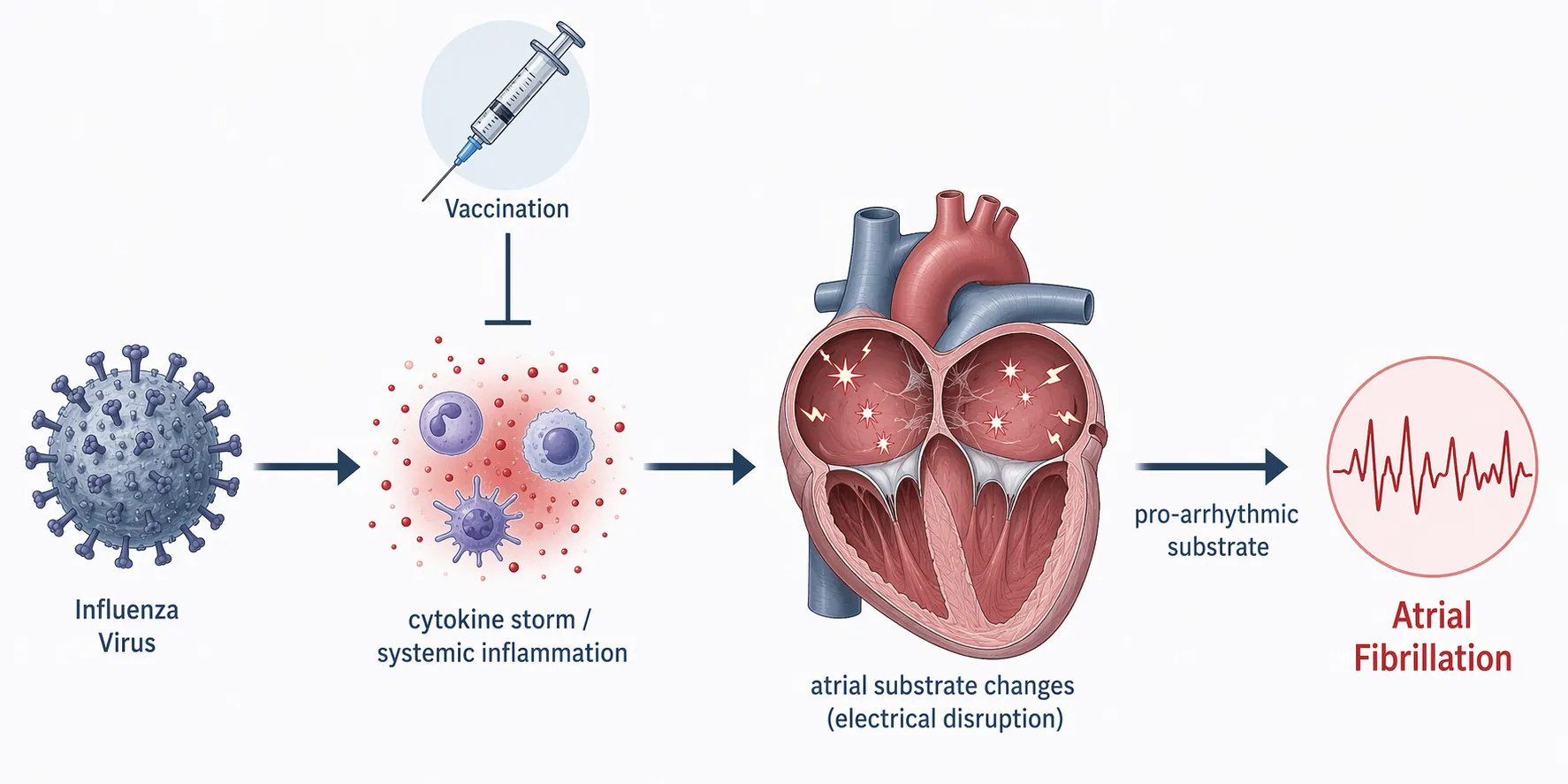
Plausibility is not proof, but it changes how the observational signal should be weighed. A database association that aligns with a credible inflammatory pathway is more persuasive than one with no clinical mechanism. The question is still whether the observed 20% relative difference is mostly a vaccine effect, partly a vaccine effect, or mostly a residual-confounding effect.
The Older Literature Points in the Same Direction, With Smaller Claims
Fauchier is not an isolated finding. Chang et al. reported a bidirectional association in 2016: influenza infection was associated with higher AF risk, while influenza vaccination was associated with lower AF risk. The reported estimates were OR 1.18 for influenza infection and OR 0.88 for vaccination.[3] That is a useful clue because it fits the inflammatory-trigger hypothesis from both sides of the exposure.
The pooled AF-specific observational signal is more modest. Liu et al. found an odds ratio of 0.94 for AF with influenza vaccination, with a 95% CI of 0.90–0.99 and I²=0% in the AF-specific subgroup.[4] Low heterogeneity is reassuring, but the estimate is not a dramatic one. It supports “associated with lower AF risk” more comfortably than it supports a strong causal claim.
Population-specific cohorts add texture rather than finality. In a gout cohort, Chen et al. reported a dose-response pattern: 1 vaccination dose had an aHR of 0.85 that was not statistically significant, 2–3 doses had an aHR of 0.72, and 4 or more doses had an aHR of 0.40.[5] That gradient may reflect cumulative biologic protection, but it may also reflect healthier, more prevention-engaged patients who repeatedly vaccinate.
Modin et al. reported a smaller association in patients with heart failure, with influenza vaccination associated with HR 0.94 for incident AF.[6] That kind of estimate is clinically plausible in a high-risk population, but it also reinforces the same general lesson: the direction is fairly consistent, while the magnitude varies by design, population, and residual-confounding risk.
Randomized Cardiovascular Evidence Supports Vaccination, Not AF Prevention Specifically
The randomized evidence is stronger for broad cardiovascular protection than for incident AF. Behrouzi et al. analyzed randomized trials and found that influenza vaccination was associated with fewer major adverse cardiovascular events, with RR 0.66 and 95% CI 0.53–0.83 across 9 trials.[7] That matters because it moves the vaccination conversation beyond observational cardiovascular epidemiology.
But none of those trials established AF prevention as a powered primary endpoint. A reduction in MACE is not interchangeable with a reduction in incident AF. The pathophysiology overlaps, the patients overlap, and the prevention logic overlaps, but the endpoint does not.
The IAMI trial is the closest randomized arrhythmia-adjacent data point. In patients with myocardial infarction, arrhythmia hospitalization was lower numerically with influenza vaccination, HR 0.43, but the confidence interval was wide at 0.11–1.64 and the result was not statistically significant.[8] That is compatible with benefit, compatible with no clear effect, and plainly underpowered for the AF question.
Guidelines already recognize influenza vaccination as part of cardiovascular prevention in patients with cardiovascular disease; the 2019 ESC guidelines assign it a Class I, Level B recommendation in that context.[9] That recommendation can stand on cardiovascular prevention grounds without needing to convert the Fauchier AF association into a definitive causal estimate.
How Strong Is the Evidence for the Exact AF Claim?
| Question | Best-supported answer |
|---|---|
| Is influenza vaccination associated with lower incident AF risk? | Yes. Fauchier 2026 is large, directionally consistent with prior observational studies, and statistically strong. |
| Is the reported effect clinically large? | Relatively, it sounds substantial; absolutely, the annualized difference was 0.23 percentage points. |
| Does the evidence prove a 20% causal reduction in AF? | No. The main AF-specific evidence remains observational. |
| Is there randomized evidence for cardiovascular benefit? | Yes, for MACE reduction in randomized trials, but not for AF prevention as a powered primary endpoint. |
| Can the finding be cited in an AF prevention memo? | Yes, if phrased as an association and paired with the absolute-risk context and limitations. |
The most defensible wording is narrow: influenza vaccination is associated with lower incident AF risk in a large propensity-matched analysis, with a reported HR of 0.80 and a small annual absolute risk difference. That is evidence worth citing. It is not evidence that should be presented to patients, executives, or quality committees as proof that the flu shot causally reduces AF incidence by 20%.
The distinction is not pedantic. Relative effects travel easily through headlines and slide decks. Absolute effects determine how many events a program might plausibly prevent. Study design determines whether the number is a causal estimate or an adjusted association. Fauchier improves the AF evidence base substantially, but it does not close the randomized-trial gap.
Evidence Verdict
- Large observational signal: Fauchier 2026 reports HR 0.80 for incident AF after propensity matching in roughly 277,000 patients.
- Modest absolute effect: annualized AF incidence differed by 0.23 percentage points, about 0.89% versus 1.12%.
- Biologically plausible: influenza-related inflammation could plausibly contribute to AF triggering in susceptible patients.
- Directionally consistent: prior observational studies and cardiovascular trial evidence point generally toward benefit.
- Not definitive: no randomized trial has tested influenza vaccination with incident AF as a powered primary endpoint.
So the flu shot can reasonably be cited as associated with lower incident atrial fibrillation risk and as cardioprotective in broader cardiovascular prevention. It should not be described as proven to cut AF incidence by 20% unless and until a dedicated AF-primary randomized trial shows that.
References
- Fauchier et al. 2026, European Heart Journal
- Influenza Vaccination, ACC Journal Scan, July 22, 2026
- Chang et al. 2016, Heart Rhythm
- Liu et al. 2022, Frontiers in Cardiovascular Medicine
- Chen et al. 2022, Frontiers in Pharmacology
- Modin et al. 2019, Circulation
- Behrouzi et al. 2022, JAMA Network Open
- IAMI Trial (Fröbert et al. 2021), Circulation
- 2019 ESC Guidelines