
Read the AI chip startup market as a healthcare diligence table and the first thing that appears is not clinical momentum. It is a valuation split. Cerebras is reported at a $66 billion market cap after raising $8.8 billion; SambaNova is estimated at $10.5 billion to $11.5 billion; Etched at $4.8 billion to $5.2 billion; and Groq was valued in the high single-digit billions before Nvidia effectively acquired it for $20 billion. Below that sit the companies with more obvious proximity to medical devices: Hailo at $600 million to $850 million, SiMa.ai at roughly $1.4 billion, and BrainChip at about $220 million in market capitalization.[1]
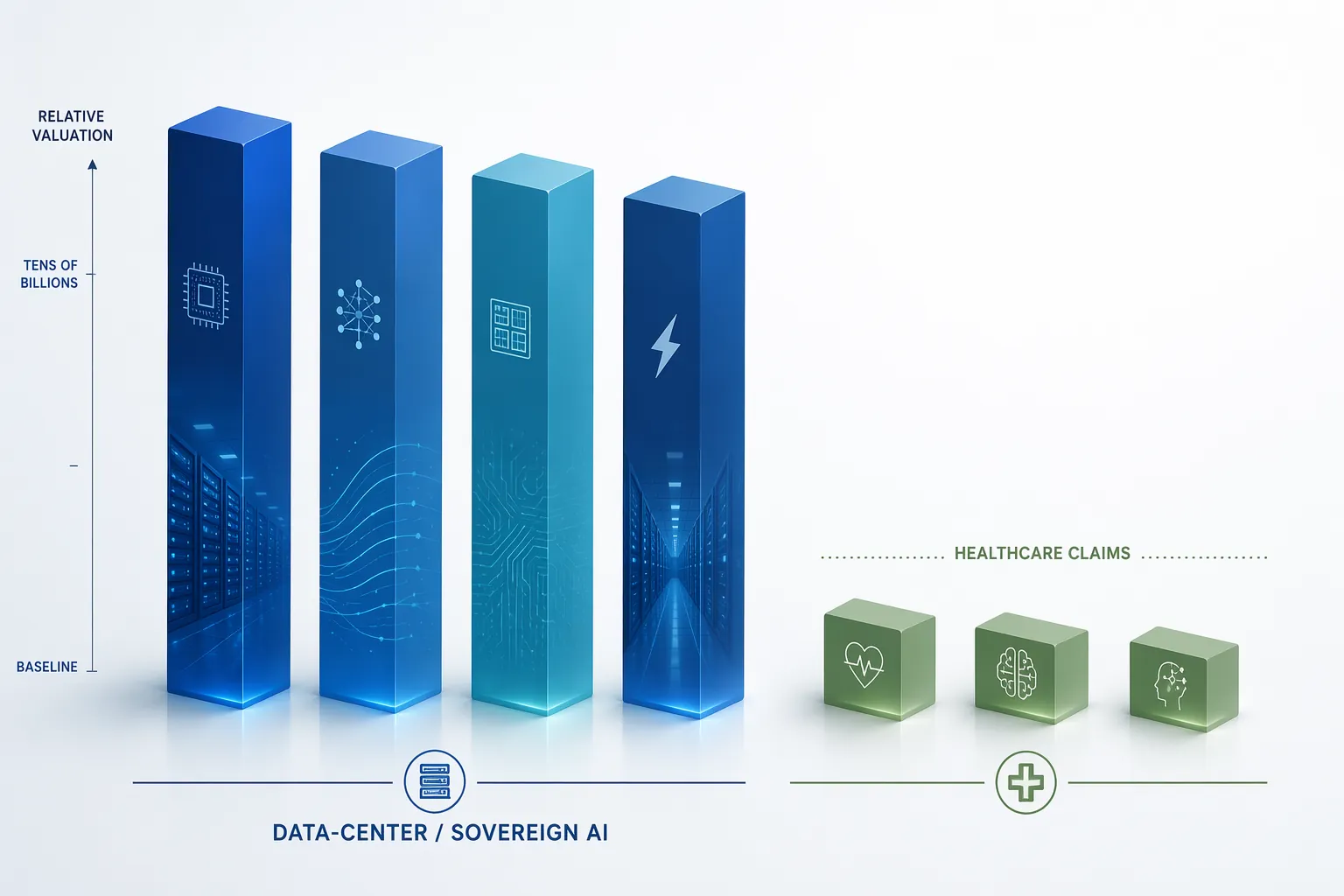
That hierarchy would be easier to reconcile if the highest-valued companies also carried the strongest healthcare evidence: prospective clinical trials, FDA-cleared intended uses, named health-system deployments, disclosed healthcare revenue, or medical-device integrations with published performance data. Publicly available evidence as of July 2026 points in the other direction. The largest valuations are attached to data-center inference, hyperscale compute contracts, sovereign-AI positioning, and customer concentration. The more healthcare-adjacent chip companies have the medical-device language, but not the clinical artifacts that would normally make the healthcare claim diligence-ready.
That distinction matters because the market is making two very different claims. One claim is that specialized AI hardware may matter in healthcare. That is plausible. Latency, power draw, privacy-preserving local inference, device size, and uptime can all matter in clinical environments. The second claim is stronger: that healthcare evidence is helping validate billion-dollar chip startup valuations. The public record does not support that stronger claim.
The Biggest Valuations Are Compute Stories First
The data-center group is not obscure about what investors are underwriting. New Market Pitch estimated about $34 billion in total AI chip funding across 89 startups, with the top 10 companies representing 61% of capital and 28 AI chip unicorns in the market.[1] That is a capital structure built around the belief that inference demand, accelerator scarcity, model-serving economics, and geopolitical compute requirements can support large independent chip platforms.
Cerebras is the cleanest example because its disclosed materials give the valuation argument a factual spine. The company is associated with a $66 billion market cap, $8.8 billion raised, heavy revenue dependence on G42, and a $20 billion compute deal with OpenAI.[1] EE Times reported that G42 represented 87% of Cerebras revenue in 2024, a concentration that matters more for valuation diligence than any generic vertical-market page.[2]
A hospital AI committee would not ignore that kind of concentration; it would ask whether the buyer base is durable, whether the economics survive outside a small number of major compute relationships, and whether the company has evidence in the intended clinical environment. For Cerebras, the visible answer is that the valuation narrative runs through large-scale compute demand, G42, OpenAI, and alternatives to Nvidia-style accelerator dependency. It does not run through a disclosed health-system revenue segment, FDA-cleared medical use, or a named clinical deployment.
That does not mean Cerebras has no healthcare-related work anywhere inside the company or among customers. It means the public evidence that explains the valuation is not healthcare evidence. In a real procurement packet, that distinction would be treated as basic hygiene: a compute platform that can theoretically support biomedical models is not the same thing as a clinically validated medical AI system.
SambaNova and Etched sit in the same valuation band of argument, though with less healthcare-specific public material to test. SambaNova’s reported $10.5 billion to $11.5 billion valuation and Etched’s $4.8 billion to $5.2 billion valuation appear in the same market map as inference and model-serving infrastructure bets, not as companies whose value is publicly anchored in clinical validation.[1] The absence of healthcare positioning in public materials is not a defect by itself. It may simply be honest category placement. The problem arises only when generalized AI infrastructure is later translated into a healthcare valuation story without the intermediate evidence.
Groq reinforces the point because the Nvidia transaction was not subtle in its framing. EE Times described the Nvidia-Groq deal as validating the AI chip startup landscape and tied the logic to inference-latency concerns and sovereign-AI commercial factors, while explicitly not presenting a healthcare-specific rationale.[3] Fortune likewise framed the post-deal landscape around which AI chip startups might be in play after Nvidia’s Groq move, not around clinical adoption or health-system demand.[4]
That is not a minor omission. If healthcare were a major value driver for these chip companies, there should be some visible trail: hospital names, medical-device manufacturers, regulated intended uses, clinical study endpoints, or at least healthcare revenue called out separately. Instead, the visible trail points to data centers, inference speed, strategic supply, and sovereign compute.
Healthcare-Adjacent Edge Chips Have Better Proximity, Not Better Clinical Evidence
The edge AI group is more interesting for healthcare diligence because the product-market logic is easier to imagine. A low-power accelerator in an imaging device, monitor, lab instrument, or wearable could reduce latency, keep data local, or make AI feasible where a server round trip is impractical. That is a real technical premise. It is just not the same as a demonstrated clinical benefit.
Hailo illustrates the gap. The company is valued at $600 million to $850 million and has raised $340 million, with healthcare listed as a vertical for its edge AI accelerator technology.[1] Public descriptions also point to use in autonomous vehicles and industrial automation, but the materials identified for this appraisal did not show named clinical deployments, FDA clearances, or clinical validation studies tied to diagnostic or care-delivery use.[1]
That may be perfectly acceptable for a chip company selling into OEMs rather than directly into hospitals. A component supplier may sit several layers below the regulated medical-device labeler. But that commercial structure does not create healthcare evidence; it obscures it. If an accelerator is embedded inside a cleared medical device, the diligence question becomes specific: which device, which intended use, which performance claim, which comparator, and which party is responsible when the model fails?
SiMa.ai is more explicit in its healthcare messaging. Its healthcare page lists application areas including imaging, monitoring, lab automation, vision-based care, and diagnostics.[5] Those are clinically consequential categories, which is exactly why the missing details matter. As of July 2026, the reviewed public materials did not identify named health-system customers, peer-reviewed citations, or FDA-clearance references supporting those healthcare claims.[5]
For a CMIO, a list of possible applications is not yet an application. “Diagnostics” is not an intended use. “Monitoring” is not a clinical workflow. “Imaging” is not a validated claim unless it is attached to modality, patient population, endpoint, performance standard, and operational setting. SiMa.ai may have credible infrastructure technology, but the public healthcare evidence trail remains thin relative to the clinical weight of the words on the page.
BrainChip is the most direct healthcare hardware case in this group because its AKD1500 neuromorphic chip has been designed into medical sensing devices.[6] It is also a useful valuation check. BrainChip announced $25 million in funding in December 2025, and CompaniesMarketCap placed its market capitalization around $220 million, down 25% year over year.[6][7] That market cap is roughly 0.3% of Cerebras’s reported $66 billion figure.[1][7]
If direct medical-device proximity were the primary driver of AI chip valuation, BrainChip should not sit this far below the data-center names. The more likely explanation is simpler: the market is paying far more for large-scale inference infrastructure and strategic compute scarcity than for healthcare-specific edge deployment. BrainChip’s medical sensing relevance makes it worth watching, but the reviewed materials did not include published clinical accuracy benchmarks for diagnostic use.[6][7]
EdgeCortix belongs in the picture only briefly. It raised a $21 million Japan government grant for edge AI, which is relevant to sovereign and edge infrastructure themes, but the reviewed materials did not show healthcare-specific evidence sufficient to change the appraisal.[1] It may become part of a medical-device stack later. That future possibility is not current clinical validation.
What Would Count As Healthcare Evidence?
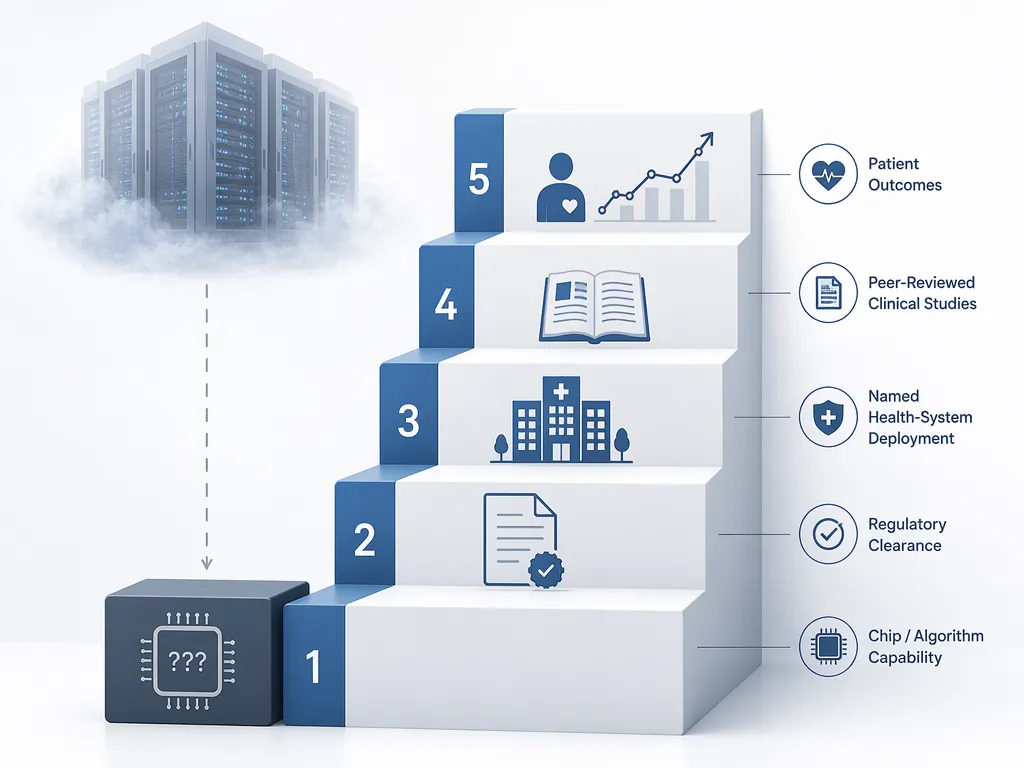
The evidentiary bar for hardware does not have to be identical to the bar for clinical software, but it cannot be waived because the component is upstream. For healthcare valuation purposes, the useful documents would look familiar:
- A named medical-device integration with the chip identified as part of the deployed architecture.
- FDA clearance or intended-use language where the device’s AI function depends on the hardware configuration.
- Peer-reviewed clinical or technical evidence showing that the edge-chip implementation preserves or improves clinically relevant performance.
- Named health-system deployment, with enough workflow detail to know where the system is used and who acts on its output.
- Disclosed healthcare revenue, even if reported as a component of a broader embedded or edge segment.
None of this requires a chip company to pretend it is a medical AI software vendor. It does require precision. If the claim is lower power at the edge, show the device context. If the claim is lower latency, show whether latency changed a clinical workflow rather than a benchmark demo. If the claim is privacy-preserving on-device inference, show what data no longer moves, what model runs locally, and whether the resulting performance remains acceptable for the intended clinical use.
The strongest version of the hardware argument would not be “AI chips will transform healthcare.” It would be narrower and more useful: a named device used in a named clinical setting achieved a documented operational or clinical result because inference moved onto specialized hardware. Public materials reviewed for the major AI chip startups do not yet provide that kind of record.
The Software Comparison Shows What Anchored Healthcare Valuation Looks Like
The point of comparing chip companies with healthcare AI software companies is not to pretend their economics are the same. They are not. Chip companies face different gross margins, capital needs, design cycles, customer concentration, and manufacturing dependencies. The comparison is useful for one narrower purpose: showing what a healthcare-specific valuation story looks like when public adoption evidence is present.
Abridge, OpenEvidence, and Hippocratic AI all carry large valuations, but their healthcare evidence trails are visibly different from those of the chip companies. Bessemer’s State of Health AI 2026 and related healthcare AI valuation trackers place Abridge at $5.3 billion with 150-plus health systems and a KLAS #1 ranking, OpenEvidence at $12 billion with 760,000 physicians, and Hippocratic AI at $3.5 billion with 50-plus health systems.[8][9]
Those numbers do not prove clinical effectiveness by themselves. Physician reach is not an outcome measure. Health-system count is not a safety study. But they are healthcare-specific adoption signals. They name the market, identify the buyer class, and create a trail that governance committees can interrogate: contract scope, workflow, deployment rate, quality monitoring, liability, and published evidence.
That is the calibration gap. Healthcare AI software companies can still be overvalued, under-evidenced, or commercially fragile, but their valuation arguments at least point toward healthcare customers and clinical workflows. The AI chip companies with the largest valuations point toward inference infrastructure. The AI chip companies with the most explicit healthcare language point toward possible device use, but generally do not show named healthcare adoption or clinical validation in public materials.
The Broader Healthcare Market Makes The Missing Attribution More Notable
A weak healthcare evidence trail might be easier to dismiss if the healthcare AI device market itself were dormant. It is not. Fortune Business Insights projected the global AI-enabled medical devices market at $10.78 billion in 2026, growing at a 32.3% compound annual growth rate.[10] Fierce Healthcare, citing SVB reporting, noted that AI captured 55% of health tech funding in 2025.[11] The FDA has also cleared more than 950 AI-enabled medical devices.[11]
Those facts do not automatically create demand for specialized edge AI chips. They do the opposite: they make the lack of disclosed chip attribution more striking. If hundreds of AI-enabled devices are reaching FDA clearance and a large AI medical-device market is forming, one would expect at least some public examples where a named startup accelerator is material to the cleared product, the workflow, or the revenue story. The reviewed public evidence provides very little of that.
There are reasonable explanations. Medical-device manufacturers may avoid naming component suppliers. FDA summaries may not foreground silicon unless it affects intended use or performance. Chip vendors may be under nondisclosure agreements. Revenue may be buried inside embedded or industrial segments. Those are all plausible. They also leave the diligence question unresolved rather than answered.
A Bounded Appraisal For July 2026
The cleanest conclusion is deliberately narrow. Public evidence as of July 2026 does not support the idea that billion-dollar AI chip startup valuations are being validated by healthcare-specific clinical outcomes, FDA clearances, disclosed healthcare revenue, or named health-system deployments. The valuations are much better explained by data-center inference demand, strategic compute scarcity, large customer relationships, sovereign-AI positioning, and the search for alternatives or complements to Nvidia.
That conclusion has caveats. Private-company valuations are estimates, and New Market Pitch assigns varying confidence levels to its entries.[1] The sample of explicitly healthcare-positioned chip companies is narrow: BrainChip, SiMa.ai, and Hailo are the main examples among the leading AI chip startups reviewed. No chip startup discloses healthcare revenue as a separate public line item, so the assessment rests partly on absence of public evidence rather than proof that no healthcare work exists.
The caveats matter, but they do not change the procurement implication. A hospital evaluating an AI chip vendor’s healthcare claim should not treat a large valuation as evidence of clinical relevance. The diligence packet still needs the ordinary healthcare artifacts: intended use, device integration, deployment site, workflow owner, performance evidence, regulatory posture, monitoring plan, and accountability when the output affects care.
Specialized AI hardware may eventually matter a great deal in medical devices and hospital edge infrastructure. It may make some models faster, cheaper, more private, or more deployable in constrained settings. Until the vendors can show clinical evidence or documented deployment, healthcare should read their valuation stories as data-center infrastructure narratives with healthcare claims attached, not as healthcare evidence.
References
- Top AI Chip Startups by Valuation (2026); Top AI Chip Startups by Fundraising (2026), New Market Pitch, July 2026.
- Cerebras IPO Revives AI Chip Startup Fever, EE Times.
- Fallout From Nvidia-Groq Deal Validates AI Chip Startup Landscape; What Is Groq-Nvidia Deal Really About?, EE Times, January 2026.
- After Nvidia's Groq Deal, These AI Chip Startups Are in Play, Fortune, January 2026.
- Healthcare, SiMa.ai.
- BrainChip Announces $25M Funding, HPC Wire, December 2025.
- BrainChip market capitalization, CompaniesMarketCap.
- State of Health AI 2026, Bessemer Venture Partners.
- Justifying Healthcare AI Valuations; Healthcare AI Startup Funding 2025-2026; Top Healthcare AI Startups by Valuation (2026); Top 20 AI Healthcare Startups by Valuation & Funding (2026), Flare Capital Partners / Digital Health Wire, New Market Pitch, AI Funding Tracker.
- AI-Enabled Medical Devices Market Size, Fortune Business Insights.
- How AI Is Reshaping Digital Health Funding in 2026; AI Investments Dominate Healthcare: SVB Report, Fierce Healthcare.