
The standard clinical-AI procurement packet still asks the familiar questions: regulatory status, cybersecurity posture, uptime, EHR integration, implementation cost, support model. Those questions matter. They also leave a gap when the vendor’s ownership has changed, because evidence is not only a scientific artifact; it is also a product of contracts, budgets, data access, and commercial claims.
For a private-equity-owned clinical-AI vendor, the procurement question is not whether ownership makes the product unusable. It is whether the evidence being used to justify purchase is still current, product-specific, and monitorable. Three issues deserve special attention before a health system treats a sales claim as validated: whether data-use rights survive change of control, whether the published study matches the commercial product being sold, and whether post-market monitoring is funded as a product function rather than left as a reassuring sentence in the deck.

Serious health systems are already moving in this direction. As of July 2026, Mass General Brigham requires every AI vendor to complete a standard assessment questionnaire covering model validation, bias testing, and real-world performance data before procurement conversations advance. Valleywise Health CIO Stephanie Hines put the expectation plainly: “I want to see the evidence. I want to see what the results have been. I want to see how you've trained your model. I want to see behind the curtain.” [1]
That “behind the curtain” demand is exactly where private-equity due diligence needs to meet clinical-AI due diligence. A questionnaire that stops at FDA status, SOC 2, and integration readiness may clear a vendor whose evidence story has become fragile after ownership changed.
The five questions procurement should add
A health system does not need to turn every vendor review into a forensic investigation. It does need a few questions that force traceability. These five should sit next to the ordinary regulatory, security, and integration checklist whenever a clinical-AI vendor is owned by private equity or has recently changed control.
- Has the vendor’s clinical evidence been published since the private-equity acquisition, or only before it?
- Do data-use, data-access, and licensing agreements survive a change of control?
- Is post-market performance monitoring funded as a product function with dedicated budget, staffing, and review cadence?
- What is the private-equity owner’s average hold period and exit history with healthcare assets?
- Does the marketed claim match the validated claim, including indication, population, inclusion criteria, comparator, and outcome measure?
The second and fifth questions usually need the most time. They are also the ones most likely to be missed by a procurement form that was designed for software operations rather than clinical evidence.
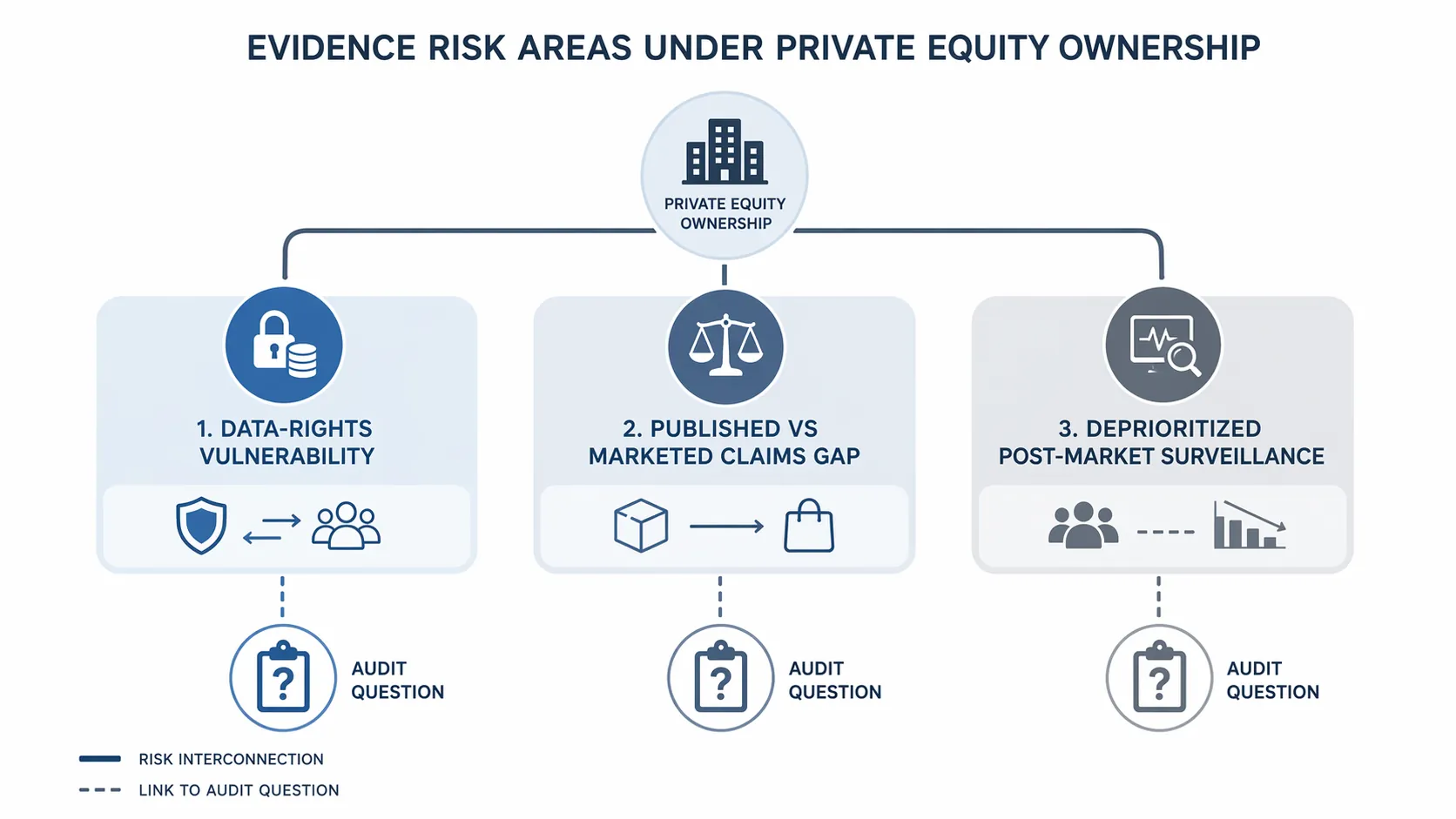
Start with the data rights, not the demo
A polished model-performance slide can hide a basic operational question: does the vendor still have the right to use the data that made the evidence possible?
WorkWise Solutions’ 2026 healthcare AI due-diligence framework flags data-rights agreements that terminate at change of control as a concrete risk. That is not an abstract legal nuisance. If a founder-era hospital partnership, academic collaboration, or data-license agreement does not survive acquisition, the new owner may inherit a product but not the same evidence environment that produced the validation results. [2]
Procurement should therefore ask for a schedule of data-use agreements supporting the vendor’s published and unpublished validation work. Legal review should confirm whether those agreements remain effective after acquisition, merger, recapitalization, asset sale, or sublicense. If the vendor cannot connect each major evidence claim to a surviving data right, the claim may still be interesting, but it is not yet dependable for contracting.
This is especially important for tools that require continued model evaluation across sites, populations, or workflow settings. A static paper may remain published, but ongoing access to representative data is what lets the vendor detect drift, recalibrate thresholds, test subgroup performance, and answer the health system’s next question after go-live.
| Procurement artifact | What to check | Why it matters |
|---|---|---|
| Data-use agreement | Survival after change of control | The new owner may not retain the rights needed for validation or monitoring |
| Validation dataset description | Source, time period, site count, and access status | A study based on inaccessible historical data may not support future monitoring |
| Contract exhibits | Named obligations for performance reporting | Monitoring is easier to enforce when it is a deliverable, not a meeting promise |
| Subprocessor or partner list | Dependencies on academic, cloud, labeling, or analytics partners | Evidence generation may depend on third parties outside the vendor’s direct control |
Then compare the paper to the product being sold
The most common evidence problem in clinical-AI procurement is not that a vendor has no evidence. It is that the evidence supports something narrower than the sales claim.
Hardian Health’s due-diligence guidance for SaMD and AIaMD acquisitions makes the problem explicit: early-stage companies “often publish on prototype models rather than the commercial product.” The same guide advises reviewers to ask what analysis has been “omitted or relegated to the footnotes and supplementaries.” [3]
For procurement, that observation should change how the sales deck is read. The evidence review should not begin with the abstract of the published study. It should begin with the claim the vendor is asking the health system to buy.
Take a hypothetical example. A vendor tells a health system that its model reduces avoidable escalation events in general medical wards. The cited paper, however, may have evaluated an earlier prototype in a single academic center, excluded patients with incomplete vitals, measured discrimination rather than clinical outcomes, and used silent-mode retrospective review rather than workflow-integrated deployment. None of those details automatically invalidates the product. Together, they narrow what the evidence can honestly support.
A useful comparison is deliberately plain. Put the sales claim in one column and the study details in another. Then require the vendor to reconcile each mismatch.
| Evidence element | Sales deck says | Published study shows | Procurement follow-up |
|---|---|---|---|
| Product version | Current commercial release | Prototype, earlier algorithm, or unclear version | Ask for version mapping and release notes tied to the study |
| Indication | Broad clinical use case | Narrower task or decision-support role | Limit contractual claims to the validated use |
| Population | Health system’s intended patient group | Different geography, acuity, age mix, or care setting | Request subgroup performance or local validation |
| Study design | Outcome improvement implied | Retrospective accuracy or silent-mode evaluation | Separate predictive performance from clinical effectiveness |
| Outcome measure | Reduced adverse events, workload, or cost | A proxy metric such as sensitivity, specificity, alert rate, or documentation time | Require evidence for the outcome being purchased |
This comparison matters more after acquisition because commercial incentives often change faster than the evidence base. A buyer may push the vendor to expand use cases, move into new specialties, package the tool for different customer segments, or shorten implementation timelines. Those moves may be reasonable business decisions. They still require a clean answer to one question: which version, in which population, under which workflow, produced the evidence being cited?
WorkWise’s evidence-sorting tool is helpful here because it separates internal benchmarks from peer-reviewed publications, retrospective designs from prospective ones, and single-site validation from multi-site validation. That hierarchy is not a perfect substitute for a formal evidence grading process, but it prevents a vendor from letting a retrospective internal benchmark carry the persuasive weight of prospective, multi-site, independently monitored performance. [2]
A practical evidence hierarchy for procurement runs from internal benchmark, to peer-reviewed retrospective study, to prospective single-site validation, to multi-site prospective validation, to independently validated post-market surveillance. The further the marketed claim moves from the validated setting, the higher up that hierarchy the health system should ask the vendor to climb.
Ask what changed after acquisition
The timing of the evidence matters. If all clinical validation predates the private-equity transaction, procurement should treat it as pre-acquisition evidence unless the vendor can show continuity in product version, data rights, implementation model, and monitoring responsibilities.
Zahlan and colleagues reported in 2026 that among 3,807 AI health startups founded from 2010 through 2024, 4% had been acquired and 8% had ceased operations. The acquisition share is not large, but it is enough to matter in a procurement market where some tools reach health systems carrying evidence generated before commercial scaling. [4]
The right follow-up is not a vague question about whether the acquisition affected quality. It is a document request: list all clinical evidence generated before acquisition, all evidence generated after acquisition, all product releases since the key validation study, and all marketed claims that changed during that period.
A vendor with a serious evidence program should be able to answer without drama. In some cases, new ownership may have improved discipline: more formal quality systems, stronger documentation, better resourcing, clearer release controls. Procurement should leave room for that. But the burden is on the vendor to show the chain of evidence, not on the health system to assume continuity.
Post-market monitoring is where promises become budget lines
Clinical-AI tools do not stop changing risk after contract signature. Case mix shifts. Documentation patterns change. EHR fields are modified. Alert-routing rules are adjusted. Clinicians learn to ignore, override, or over-trust the tool. A model that looked acceptable during validation can become less useful, less fair, or simply less visible once it enters the real workflow.
That is why post-market surveillance should not be treated as an optional analytics add-on. Procurement should ask whether monitoring has a dedicated budget, named owners, scheduled reporting, subgroup review, incident escalation, and contractual remedies when performance falls outside agreed thresholds.
Private-equity ownership sharpens this question because the owner’s investment horizon may not match the health system’s patient-safety horizon. PE firms commonly target 3–7 year hold periods with exit-value maximization rather than long-term clinical outcome monitoring. That does not prove a specific vendor will underfund surveillance. It does mean monitoring should be visible in the contract and operating model, not inferred from goodwill.
The answer should be concrete enough for an implementation team to use after the sales team leaves. Who reviews drift reports? How often are subgroup analyses refreshed? What happens if the model’s performance changes in a high-risk population? Does the vendor provide site-specific dashboards, aggregate network benchmarks, or both? Can the health system pause use, narrow the indication, or require remediation without reopening the entire commercial agreement?
Use adjacent private-equity evidence carefully
The broader healthcare literature gives procurement teams a reason to be alert, but not a license to overclaim. A 2023 JAMA study by Kannan, Bruch, and Song found that private-equity acquisition of hospitals was associated with a 25.4% increase in hospital-acquired conditions, including falls and bloodstream infections. That study examined hospitals, not clinical-AI-device companies. Its value here is cautionary: ownership incentives can be associated with measurable quality changes even in regulated healthcare settings. [5]
A 2023 BMJ systematic review looked across 55 studies in 16 healthcare settings and found private-equity ownership consistently associated with higher costs to patients or payers and mixed-to-harmful quality impacts, with no consistently beneficial impacts identified. The same limitation applies: the review explicitly excluded medical-device and technology companies, so it is adjacent evidence rather than direct evidence about AI vendors. [6]
That distinction matters. There is no published study in the supplied research that directly compares the quality of clinical-AI evidence for private-equity-backed vendors against non-private-equity-backed vendors. Procurement teams should not pretend such a study exists. They should instead treat ownership as a risk signal that changes the questions asked about traceability, data rights, claims alignment, and monitoring.
A defensible standard for the procurement file
By the time a clinical-AI product reaches value analysis, the file should make one thing clear: the health system is not buying a generalized belief in AI, a founder’s early study, or an investor’s growth plan. It is buying a specific product version for a specific clinical use in a specific workflow, with a defined plan for watching what happens after deployment.
For a private-equity-owned vendor, the procurement record should therefore include the acquisition date, evidence generated before and after that date, change-of-control review for relevant data rights, version mapping between studies and the commercial release, comparison of validated and marketed claims, post-market surveillance obligations, and the owner’s healthcare hold-period and exit history.
Private equity ownership does not disqualify a clinical-AI vendor. It does make ownership too relevant to leave in the corporate-background section of the file. Before outcome claims are accepted as current, product-specific, and monitorable, procurement should be able to trace the evidence all the way from the data agreement to the deployed model.
References
- How Health Systems Hold AI Vendors Accountable, DistilInfo, July 21, 2026, link
- A Healthcare AI Due Diligence Framework: The Criteria That Separate Products From Demos, WorkWise Solutions, 2026, link
- How To Conduct Due Diligence On SaMD And AIaMD Acquisitions, Hardian Health, January 2024, link
- AI health startups founded 2010–2024, npj Digital Medicine, 2026, link
- Changes in Hospital Adverse Events and Patient Outcomes Associated with Private Equity Acquisition, JAMA, 2023, link
- Evaluating trends in private equity ownership and impacts on health outcomes, costs, and quality: systematic review, BMJ, 2023, link