
For a community health outreach program that includes prostate cancer screening, algorithmic fairness cannot be assumed from FDA clearance, aggregate accuracy, or performance at academic centers. The strongest published fairness evidence in the current prostate cancer AI literature belongs to ArteraAI’s multimodal artificial intelligence model: a dedicated analysis of 5,708 patients from five NRG Oncology phase III trials, including 948 African American men, reported overlapping risk-score hazard-ratio distributions and found no statistical evidence of algorithmic bias between African American and non-African American patients [1]. Paige Prostate has a different evidence profile: FDA de novo clearance and strong retrospective pathology performance, but CADTH reported training data that were 82.2% White, limited race/ethnicity subgroup evidence, no patient-outcome studies, and no cost-effectiveness data [2]. For other named tools, the practical finding is simpler and less reassuring: published race-stratified subgroup evidence is not available in the materials reviewed.

That distinction matters because outreach deployment is not a neutral setting. A tool used after patients have already reached an academic urology or pathology workflow inherits one set of population assumptions. A tool introduced into prostate cancer screening community health outreach inherits another: who was invited, who trusted the program enough to participate, who had prior PSA testing, who had access to follow-up biopsy, and who is most harmed if a reassuring result performs less well in the group the program was built to reach.
The outreach setting raises the evidentiary bar
The disparity context is not incidental. AUA News reported that 33% of Black men are screened for prostate cancer compared with 41% of White men, while Black men have approximately twice the prostate cancer mortality rate [3]. That combination—lower screening and higher mortality—makes subgroup performance evidence more than a technical appendix. It is part of the safety case.
The populations in community programs also look different from the populations that often dominate AI development and validation. In a Jefferson Sidney Kimmel Comprehensive Cancer Center community-based prostate cancer screening program, 289 men were evaluated; 84.9% were Black, and 40.9% had not been screened in at least three years [4]. In the Man Van mobile screening clinic reported by ASCO, 3,379 men were screened, 36% were non-White, 94 cancers were detected, and 81 of those were clinically significant [5]. These are the kinds of settings where a health system might want AI support—but they are not the same as retrospective academic pathology datasets.
No cited study directly evaluates an FDA-cleared prostate cancer AI tool deployed inside one of these community outreach screening models. That gap does not make every tool unsafe. It does mean a governance committee should not treat aggregate validation as evidence of equitable outreach performance.
What the published evidence supports by tool
| Tool or model | What the evidence supports | Fairness evidence relevant to outreach |
|---|---|---|
| ArteraAI multimodal AI model | Dedicated peer-reviewed fairness analysis using 5,708 patients from five NRG Oncology phase III trials, including 948 African American men [1]. | Strongest available published subgroup evidence; study reported overlapping DM-MMAI and PCSM-MMAI hazard-ratio distributions and no statistical evidence of algorithmic bias, but it was developer-funded and included company employee co-authors [1]. |
| Paige Prostate | FDA de novo clearance in 2021; CADTH summarized five retrospective academic pathology studies with sensitivity of 96% to 99.2% and specificity of 93% to 98% [2]. | Training data reported as 82.2% White; CADTH flagged limited evidence for race/ethnicity subgroup performance, no patient-outcome evidence, and no cost-effectiveness data [2]. |
| Ibex | Included here as a named prostate cancer AI tool relevant to the procurement landscape. | No published race-stratified subgroup analysis was identified in the materials reviewed. |
| DeepDx-Prostate | Included here as a named prostate cancer AI tool relevant to the procurement landscape. | No published race-stratified subgroup analysis was identified in the materials reviewed. |
| ProstatID | Included here as a named prostate cancer AI tool relevant to the procurement landscape. | No published race-stratified subgroup analysis was identified in the materials reviewed. |
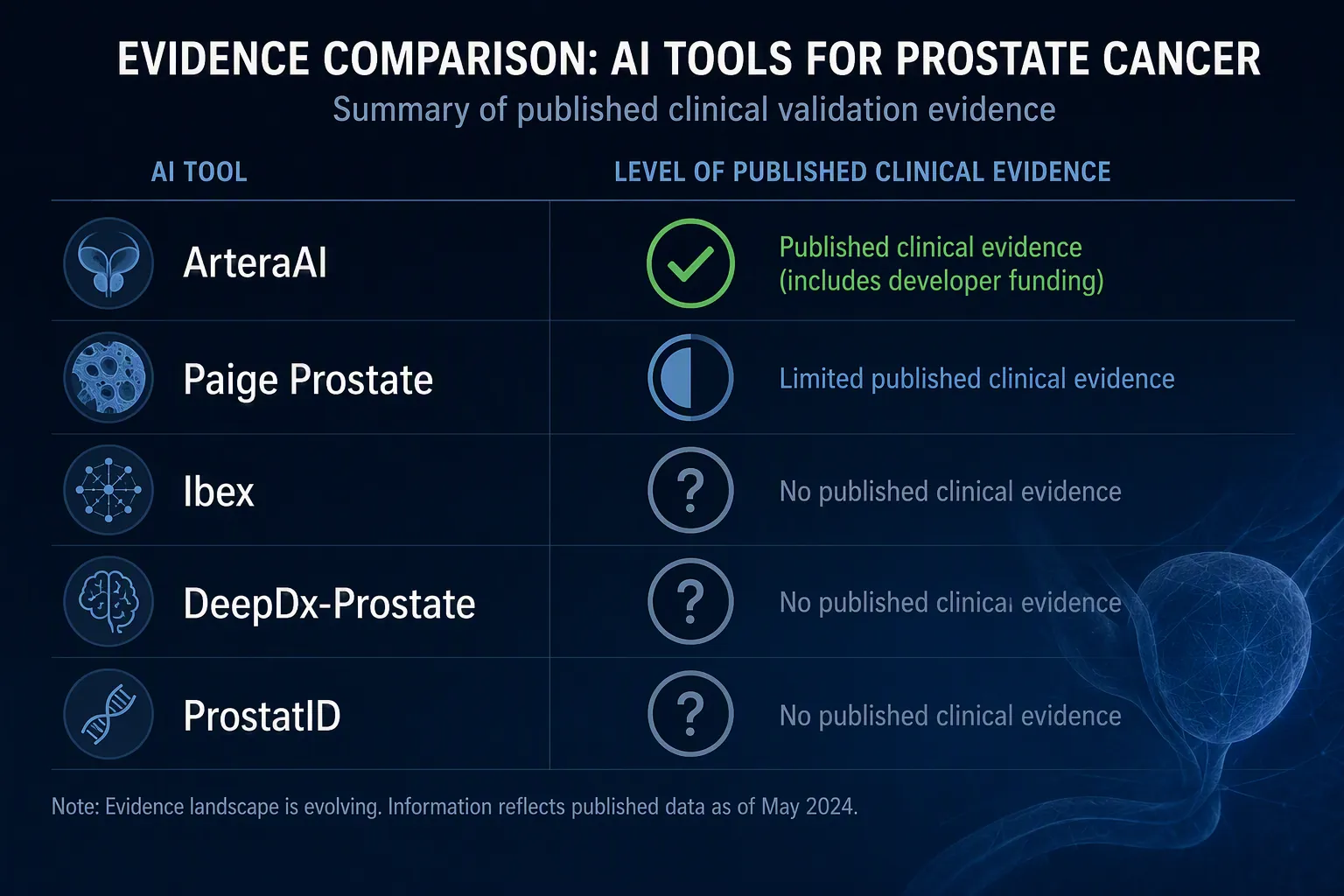
The table should not be read as a ranking of commercial quality. It is an evidence appraisal. A product with strong workflow value may still have weak published subgroup evidence. A model with promising fairness data may still need independent replication before use in a population that differs from the trial cohorts used in its analysis.
ArteraAI has the most serious fairness evidence—and the most important caveat
The ArteraAI fairness study is the outlier in a useful way. It asks the question governance teams usually have to infer indirectly: whether the model’s prognostic signal behaves differently for African American and non-African American men. The study analyzed men from five NRG Oncology prostate cancer phase III trials and included enough African American patients—948 out of 5,708 overall—to support a race-stratified analysis rather than a symbolic subgroup table [1].
The reported estimates were directionally reassuring. For distant metastasis, the DM-MMAI subgroup hazard ratio was 1.2 with a 1.0–1.3 interval in African American men and 1.4 with a 1.3–1.5 interval in non-African American men. For prostate cancer–specific mortality, the PCSM-MMAI subgroup hazard ratio was 1.3 with a 1.1–1.5 interval in African American men and 1.5 with a 1.4–1.6 interval in non-African American men. The distributions overlapped, and the authors concluded that they found no statistical evidence of algorithmic bias [1].
That is better than an aggregate AUROC followed by a fairness claim in the discussion section. It is also not the same as independent confirmation in community screening outreach. The study was funded by Artera, and multiple co-authors were Artera employees [1]. A governance committee does not have to dismiss the findings because of that conflict, but it should not file the conflict away as a formality. Developer-funded subgroup evidence can be valuable and still require replication, especially when the deployment population may include men who were unscreened for years, recruited through mobile clinics, or connected to follow-up through community health workers.
The other limitation is contextual. Trial cohorts can provide cleaner endpoint ascertainment and stronger analytic structure than routine outreach programs. They do not automatically answer whether the same model will remain well calibrated when the surrounding workflow changes—when PSA testing, biopsy referral, transportation, insurance status, follow-up completion, and trust in the health system all influence who reaches the point where AI is applied.
Paige Prostate shows why clearance and overall performance are not enough
Paige Prostate has evidence that a procurement committee would reasonably notice. CADTH describes the Paige Prostate Suite as assistive AI for prostate cancer diagnosis and notes FDA de novo clearance in 2021. Across five retrospective studies in academic pathology settings, CADTH reported sensitivity ranging from 96% to 99.2% and specificity ranging from 93% to 98% [2]. Those are not trivial results.
But the same CADTH scan identifies the equity problem a committee cannot outsource to the clearance decision. The algorithm development data were reported as 82.2% White, and CADTH cautioned that equity-deserving groups may be underrepresented. It also found limited evidence on race and ethnicity subgroup performance, no included studies assessing patient outcomes, and no cost-effectiveness evidence [2].
For a pathology department using the tool as an assistive reader in a controlled academic workflow, those gaps may be handled through local validation, pathologist oversight, and quality monitoring. For a health system proposing the tool as part of a larger outreach strategy for Black and Hispanic men, the same gaps carry a different weight. The outreach program lead is not only asking whether the AI can detect cancer on whole-slide images. They are asking whether the entire program can defend its use of AI when the published record does not adequately show race-stratified performance in the population being served.
This is also where language matters. “FDA-cleared,” “validated,” and “equitable” are not interchangeable terms. Clearance addresses a regulatory question. Retrospective academic pathology studies address a performance question in a particular evidence environment. Race-stratified validation and monitored local deployment address a fairness question. A committee packet that collapses those into one green checkmark is not doing the clinical program any favors.
For Ibex, DeepDx-Prostate, and ProstatID, the absence is the finding
Ibex, DeepDx-Prostate, and ProstatID do not need an extended product-by-product review to answer the fairness question posed here. In the materials available for this appraisal, published race-stratified subgroup analyses were not identified. That does not prove unequal performance. It also does not permit an assumption of equal performance.
The broader review literature supports caution rather than inference. A 2025 comprehensive review in Frontiers in Immunology described persistent gaps in AI performance across marginalized populations as an unresolved problem in prostate cancer AI [6]. AUA News’ 2026 review of AI and the future of prostate cancer screening similarly described algorithmic bias and the need for prospective real-world studies as major implementation challenges [7].
Readers comparing these tools with AI in other cancer screening workflows may find the same pattern familiar: performance evidence often arrives before implementation evidence. For broader context, see AI in Cancer Screening: What the Evidence Shows and AI in Pathology: Whole Slide Imaging and the Evidence Gap.
Do not confuse statistical risk models with deep-learning pathology tools
Stockholm3 and 4Kscore sometimes appear in the same screening conversation, but they should not be grouped casually with deep-learning pathology systems. AUA News’ 2026 review distinguishes these as multivariable statistical models rather than AI or deep-learning tools [7]. They may be relevant to screening pathway design, but they do not answer whether an image-based AI system or multimodal model performs equitably across racial subgroups.
What community-embedded evidence would look like
The missing study is not hard to describe. It would prospectively evaluate the AI tool inside the actual outreach workflow, enroll the populations the program intends to serve, predefine subgroup analyses, track follow-up completion, and measure clinically meaningful downstream outcomes rather than only slide-level or case-level performance. It would also report enough detail for a health system to know whether underperformance is coming from the model, the specimen pathway, referral completion, or access barriers after a positive result.
The NYU Langone community health worker trial is useful here as a design contrast, not as evidence for any prostate cancer AI product. The trial used community health worker–led decision coaching for prostate cancer screening engagement and represents the kind of prospective, community-embedded evaluation that AI tools have generally not yet received in outreach settings [8].
That matters operationally. If an outreach program serving Black and Hispanic men deploys an AI tool without subgroup evidence, the first real fairness test may happen after procurement—on the patients least able to absorb another failure of access, follow-up, or risk communication. Post-market monitoring is necessary, but it should not become a substitute for asking the subgroup question before the contract is signed.
Governance conclusion
A defensible governance position is narrower than a vendor slide and more useful than a blanket rejection. ArteraAI’s published fairness study is promising and materially stronger than the subgroup evidence available for other tools in this appraisal, but its developer funding and employee co-authorship mean it should not be treated as independently settled. Paige Prostate has meaningful retrospective performance evidence and FDA de novo clearance, but the published record summarized by CADTH does not resolve race/ethnicity subgroup performance, patient outcomes, or cost-effectiveness. For Ibex, DeepDx-Prostate, and ProstatID, committees should not infer fairness where published race-stratified analyses are absent.
Before deploying prostate cancer AI in community outreach programs serving Black and Hispanic men, committees should require one of two things: independent validation in a population close to the intended deployment setting, or a monitored local evaluation with predefined subgroup metrics, escalation rules, and accountability for follow-up. The procurement question is not whether AI can help prostate cancer care. It is whether this specific tool has evidence strong enough for the specific population that will live with the consequences.
References
- Assessing Algorithmic Fairness With a Multimodal Artificial Intelligence Model in Men of African and Non-African Origin on NRG Oncology Prostate Cancer Phase III Trials, JCO Clinical Cancer Informatics, 2025.
- The Paige Prostate Suite: Assistive Artificial Intelligence for Prostate Cancer Diagnosis, CADTH.
- Community-Based Interventions: A Powerful Tool Against Disparities and Inequities in Prostate Cancer, AUA News, April 2024.
- Evaluating the impact of a community-based prostate cancer screening program.
- Mobile Prostate Cancer Screening Clinic Can Help Address Barriers, Serving High-Risk Communities, ASCO.
- Utilization of artificial intelligence in prostate cancer detection: a comprehensive review of innovations in screening and diagnosis, Frontiers in Immunology, 2025.
- Artificial Intelligence and the Future of Prostate Cancer Screening, AUA News, March 2026.
- Prostate Cancer Screening: Can a Community-Based Intervention Improve Engagement?, Physician Focus.