
The current evidence from sleep monitoring is stronger than most earlier sleep epidemiology, and still weaker than many vendor claims imply. The best available studies support population-level associations between objectively measured sleep patterns and chronic disease. They do not prospectively validate consumer wearables as individual disease-risk prediction tools.
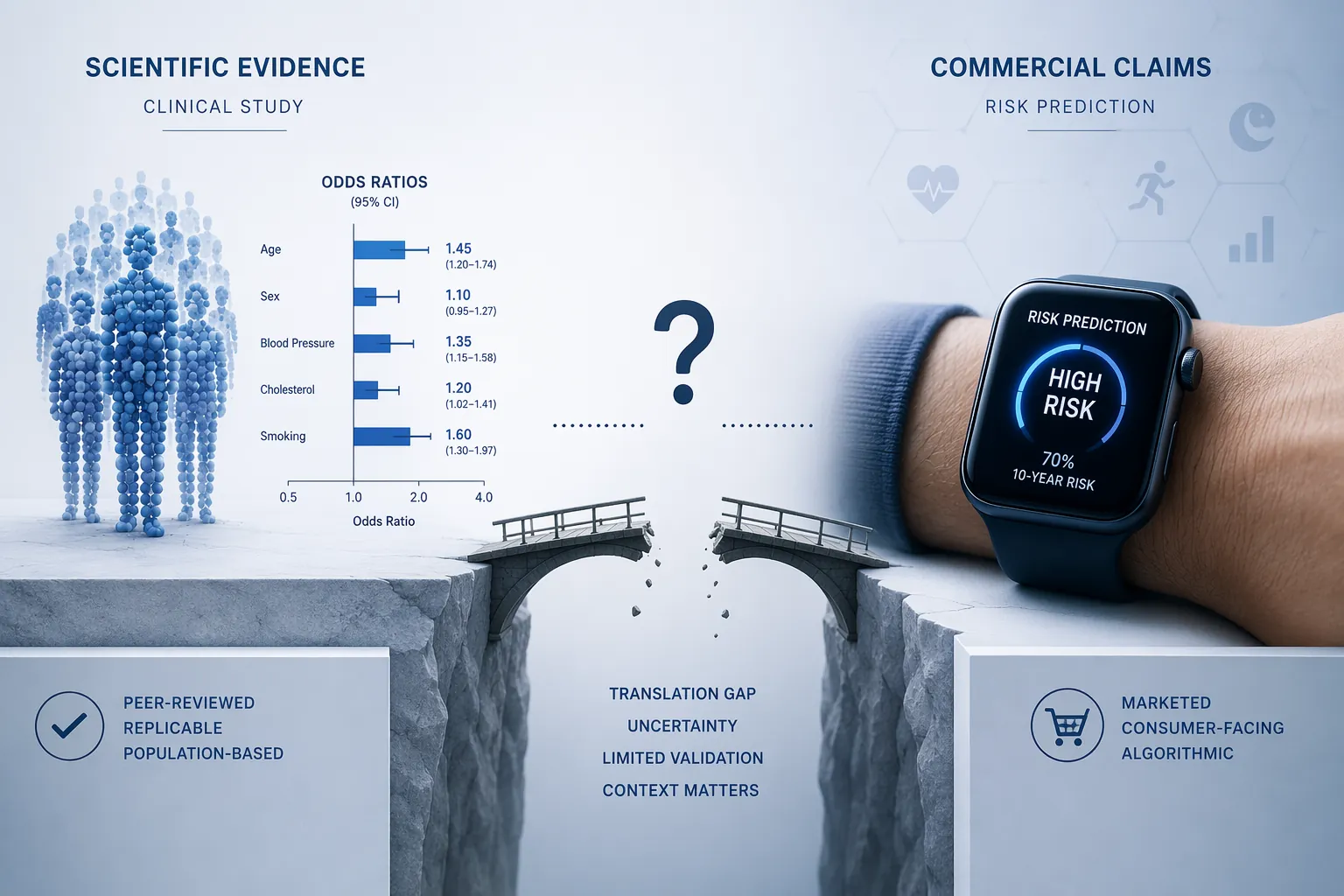
That distinction is not a semantic nuisance. It is the difference between a cohort study that finds higher odds of later diagnosis among people with irregular sleep, and a clinical product that tells one person, on one wrist, that their future disease risk has been measured accurately enough to act on.
| Study | What was measured | Population and exposure | Main signal | What it does not establish |
|---|---|---|---|---|
| Zheng et al., All of Us/Fitbit, 2024 | Commercial Fitbit-derived sleep patterns | 6,785 participants, 6.5 million person-nights, median 4.5 years of follow-up | Sleep irregularity and duration extremes were associated with incident chronic disease risks | Prospectively validated individual risk prediction by consumer wearables [1] |
| Thapa et al., Stanford SleepFM, 2026 | Laboratory polysomnography interpreted with an AI foundation model | 65,000 participants and 585,000 hours of PSG data from a sleep medicine center | Reported C-indices above 0.8 for more than 130 conditions, with cross-modal brain–cardiac contrasts carrying signal | Evidence that Apple Watch, Oura, Whoop, Fitbit-style sensors, or other consumer devices can reproduce those individual-risk predictions [2] |
The table is the appraisal. One study is closest to real-world consumer wearable monitoring. The other is a high-capacity laboratory PSG model. They are both important. They are not interchangeable.
The Fitbit cohort is the study vendors will want to cite first
The All of Us/Fitbit study deserves attention because it sits uncomfortably close to the claim being sold. It used commercial wearable data, not a one-night lab recording. It followed participants over a median 4.5 years. It included 6.5 million person-nights of sleep data from 6,785 participants. In a field where many sleep studies still lean on short windows and self-report, that is a meaningful improvement [1].
The most procurement-relevant finding was sleep irregularity. After adjustment for sleep duration and sleep apnea, irregular sleep was independently associated with higher odds of hypertension, major depressive disorder, and obesity. The reported odds ratios were 1.56 for hypertension, 1.75 for major depressive disorder, and 1.49 for obesity [1].
An odds ratio of 1.56 is not a personal forecast. It means the odds of hypertension were higher in the irregular-sleep group within the study model, after specified adjustments. It does not mean a Fitbit has been validated to tell an individual patient that they are 56% more likely to develop hypertension, nor that acting on the device output has been shown to prevent that outcome.
The duration findings are also easy to oversell if the verbs are allowed to drift. The study reported J-shaped associations: by Fitbit measurement, 5 hours of sleep was associated with a 29% increased hypertension risk, 10 hours with a 61% increased hypertension risk, and the estimated optimum was 6.8 hours [1]. That is stronger than a generic “short sleep is bad” message, because it uses long-duration objective monitoring and distinguishes duration from irregularity. It still remains a modeled association in a cohort.
| Wording | What the evidence supports |
|---|---|
| Measured | Fitbit-derived sleep patterns were collected over long periods in the cohort. |
| Associated | Irregularity and duration extremes were statistically associated with later chronic disease outcomes. |
| Predicted | The study supports risk modeling at a population level, not a validated claim that a device predicts an individual’s disease future. |
| Validated for deployment | That would require prospective validation of the intended device, algorithm, threshold, workflow, and target population. |
The cohort caveat belongs in the same paragraph as the scale, not in a footnote. The study population was 71% female, 84% White, and 71% college-educated [1]. That composition does not invalidate the signal, but it limits how far a screening claim should travel into populations that differ by race, sex, education, access to care, work schedule, comorbidity burden, or wearable-use patterns.
There is also a device problem hiding inside the apparently simple phrase “objective sleep.” The All of Us study used Fitbit-derived sleep data, and Fitbit underestimated REM sleep by 11.4 minutes compared with polysomnography [1]. A systematic REM underestimate does not erase the study’s associations, but it matters if a vendor wants to convert sleep-stage outputs into clinical risk scores. Measurement error can move thresholds, distort subgroup performance, and change calibration when the product is used outside the original study setting.
Device specificity also cuts against broad wearable claims. A Fitbit signal is not automatically an Apple Watch signal, an Oura signal, or a Whoop signal. Different sensors, firmware, sleep-stage classifiers, wear locations, missing-data behavior, and update cycles can change what is actually being measured. A vendor cannot borrow the All of Us exposure time while quietly substituting a different device architecture.
SleepFM is a serious PSG result, not a shortcut to smartwatch prediction
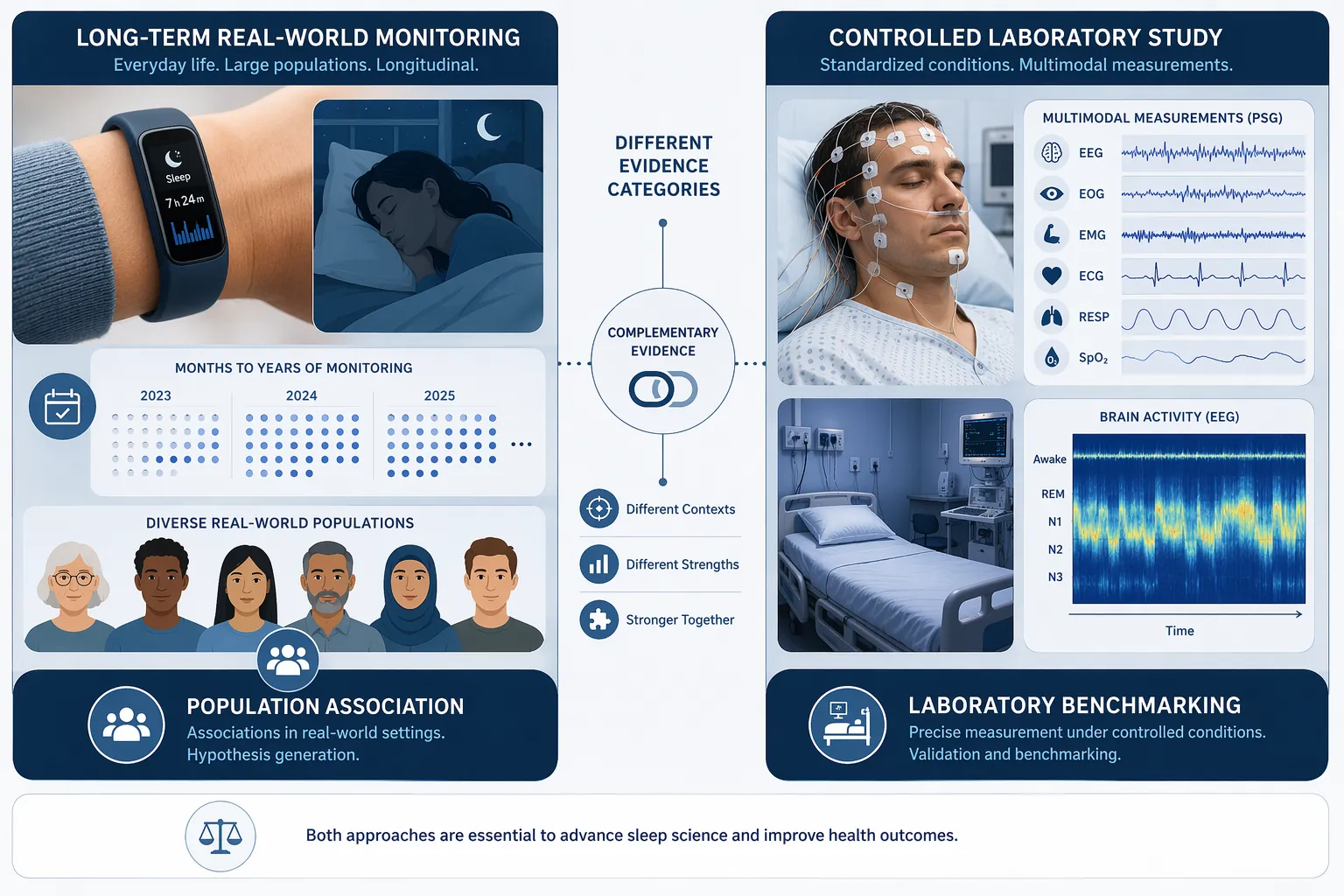
Stanford’s SleepFM work is attention-grabbing for different reasons. It used laboratory polysomnography, not a consumer wearable stream, and reported results from 65,000 participants and 585,000 hours of PSG data. The model reportedly achieved C-indices above 0.8 for more than 130 conditions, including Parkinson’s disease at 0.89, dementia at 0.85, heart attack at 0.81, and hypertensive heart disease at 0.84 [2].
A C-index above 0.8 is not noise. It suggests the model often ranked people with the condition as higher risk than people without it. But discrimination is not the same as calibration, and neither is the same as prospective clinical utility. A model can separate groups impressively and still be poorly calibrated for an individual patient in a different care setting.
The most interesting SleepFM finding may be the cross-modal signal. The Stanford description cites contrasts such as “a brain that looks asleep but a heart that looks awake” as especially predictive [2]. That is biologically plausible enough to take seriously and methodologically specific enough to treat carefully. It depends on multimodal PSG physiology: brain activity, cardiac signals, respiratory patterns, and other laboratory-grade channels interpreted together.
That is exactly why it should not be used as proof that a wrist or ring device can perform the same job. Consumer wearables infer sleep from narrower signals. They do not collect full PSG. They do not observe brain sleep state directly. If the SleepFM signal depends on mismatches between neural and cardiac sleep states, then a device without neural measurement is not merely a cheaper implementation. It is measuring a different substrate.
The source population also matters. SleepFM used data from the Stanford Sleep Medicine Center from 1999 to 2024, which brings inherent referral bias: people sent for sleep evaluation are not a random community screening population [2]. That setting can be scientifically valuable and clinically rich, but it is not the same as passive monitoring in asymptomatic employees, health-plan members, or primary-care patients.
As of July 2026, the SleepFM work is also young. It was published in January 2026 and had not yet been independently replicated according to the supplied research brief [2]. For discovery and benchmarking, that is not a fatal flaw. For procurement of a clinical risk product, it is a stopping point.
Population association is not individual prediction
The practical failure mode is predictable. A vendor cites All of Us for long-term wearable associations, cites SleepFM for high disease discrimination, then lets the audience assume the two findings combine into validated wearable risk prediction. They do not.
To support an individual-risk claim, the evaluation would need to test the intended product as it will actually be used. The same device class matters. The same sensor inputs matter. The same preprocessing and sleep-stage algorithm matter. The same risk model matters. The same alert threshold matters. The same population matters. So does the follow-up design: incident outcomes collected prospectively are not equivalent to retrospective labels in a referred clinical sample.
Calibration is the usual missing piece. A procurement team does not only need to know whether higher-risk patients tend to rank above lower-risk patients. It needs to know whether a stated risk estimate means what it says for women and men, for racial and ethnic groups underrepresented in development data, for shift workers, for patients with diagnosed sleep apnea, for people with intermittent device wear, and for those whose devices update algorithms midstream.
The consequence of skipping that work lands on clinical governance, not on the sales deck. If the tool over-flags, clinicians inherit avoidable follow-up, anxiety, and false-positive workups. If it under-flags, the organization has to explain why a marketed “predictive” product missed patients. If performance shifts outside the development cohort, the equity review arrives after deployment rather than before it.
- Was the proposed deployment device the same measurement device used in the validation evidence?
- Were outcomes incident disease events, not only prevalent diagnoses or retrospective labels?
- Was the model prospectively validated outside the development site or cohort?
- Were calibration and subgroup performance reported for the population that will actually be screened?
- Were device updates, missing wear time, sleep-stage error, and comorbid sleep apnea handled in the analysis?
- Does the clinical workflow specify who reviews the risk output, what action follows, and how false positives and false negatives are monitored?
What can be responsibly said in 2026
A careful claim is available: long-duration objective sleep monitoring has produced important population-level evidence that sleep irregularity and duration extremes are associated with chronic disease risk. The All of Us/Fitbit study is the strongest consumer-wearable example in that category. SleepFM adds evidence that rich PSG physiology contains disease-relevant signal that modern AI can extract.
A stronger commercial claim is not yet supported: that a consumer wearable can predict an individual’s chronic disease risk while they sleep. Neither the All of Us/Fitbit study nor the Stanford SleepFM work establishes prospective, independently replicated, calibrated individual-risk prediction in a diverse real-world population using the exact consumer devices that would be deployed [1][2].
The evidence scorecard is therefore mixed in a very specific way: strong signal, limited transferability, no prospective individual-risk validation, and high risk of overstatement if marketed as predictive clinical screening. That is not a dismissal of sleep monitoring. It is the line between useful epidemiology and a product claim a health system would have to defend.
References
- Sleep patterns and risk of chronic disease as measured by long-term monitoring with commercial wearable devices in the All of Us Research Program — Nature Medicine, 2024.
- AI sleep disease — Stanford Medicine, Jan. 2026.