
The strongest fact in Sleeptracker-AI’s heat and humidity claim is not subtle: 201,619 users, 24.2 million nights, bedroom temperature and humidity linked to REM sleep, deep sleep, and a proprietary estimated apnea-hypopnea index. In the reported analysis, a 3°C increase above a user’s usual bedroom temperature combined with a 10 percentage-point increase in relative humidity was associated with about 1.94% less REM sleep, 1.15% less deep sleep, and a 5.7% increase in estimated AHI.[1]
That is not the scale of a vendor anecdote. It is exactly the kind of home-based longitudinal dataset that sleep laboratories cannot easily produce, especially when the question is what happens in ordinary bedrooms rather than under supervised laboratory conditions. The procurement problem is different: size can make a signal worth investigating, but it does not by itself make the exposure well measured, the outcome independently validated, or the resulting claim ready for institutional reliance.

What the 24.2-million-night study actually supports
The Wanchaitanawong et al. study is best read as a very large observational association between user-level bedroom conditions and Sleeptracker-AI-derived sleep metrics. Its practical appeal is obvious. Instead of asking whether heat affects sleep in general, it asks whether a contactless under-mattress system can detect sleep changes across many nights as bedroom temperature and humidity vary within real homes.[1]
For teams evaluating AI sleep tracking evidence on weather and heat effects, that distinction matters. A study can show that an algorithm’s outputs move with temperature and humidity. It does not automatically show that the algorithm has measured true REM loss, true deep-sleep loss, or true respiratory instability under those environmental conditions. The evidence chain has several links: exposure measurement, device signal acquisition, sleep-stage classification, respiratory-event estimation, statistical modeling, and then clinical or procurement interpretation.
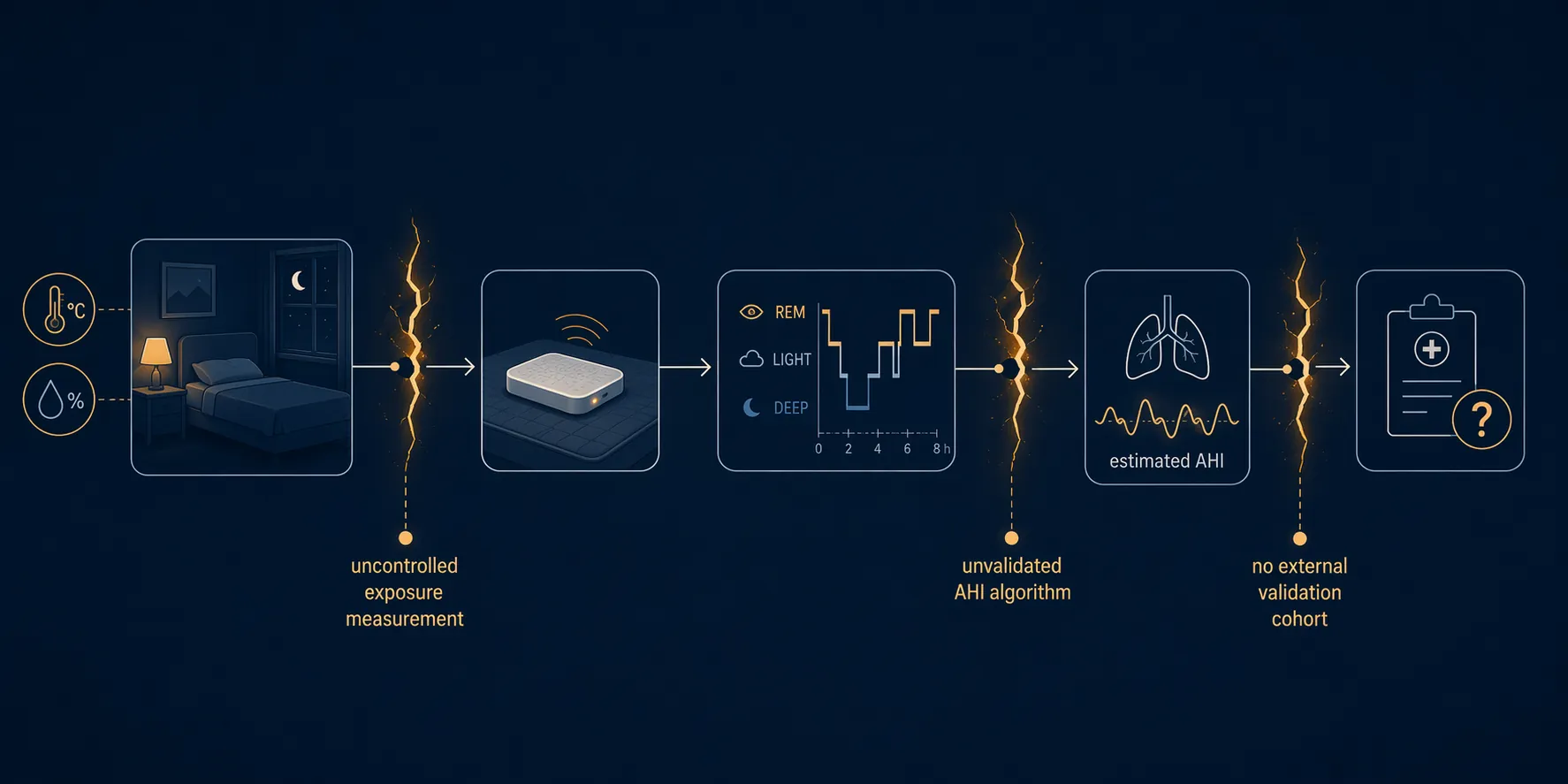
The study’s strongest contribution is the first serious scale argument: a manufacturer-linked device ecosystem can generate a large, longitudinal bedroom microenvironment dataset. Its weaker contribution is validation. The reported associations are generated inside a single device and algorithmic pipeline, without an external validation cohort that would show whether the same heat- and humidity-linked changes appear when measured by independent instruments or a different sleep-measurement system.[1]
The exposure problem starts in the bedroom
Temperature and humidity sound like straightforward variables until they become inputs to a clinical-adjacent claim. In this study, the environmental measures came from each user’s own bedroom context, not from a controlled exposure protocol or centrally calibrated research instruments. That is acceptable for exploratory real-world signal detection, but it is a limitation when the result is used to argue that a device can reliably detect heat- and humidity-driven sleep disruption.
Exposure error is not a small housekeeping issue here. Bedroom temperature can vary by sensor placement, mattress microclimate, airflow, open windows, heating and cooling cycles, bedding, and whether the measured location reflects the air actually surrounding the sleeper. Humidity has the same problem. If those measurements are noisy, the resulting effect estimates may be biased toward or away from the apparent association, depending on the pattern of error and its relation to users, rooms, seasons, and device use.
A procurement team does not need every bedroom converted into a climate chamber. It does need to know whether the environmental input is accurate enough for the intended decision. A wellness insight that says “your room seems warmer on worse sleep nights” can tolerate more uncertainty than a procurement claim that an AI sleep system measures environmental disruption with clinical reliability.
Sleep staging has validation evidence, but not the whole claim
The best reason not to dismiss Sleeptracker-AI outright is that the device is not resting only on marketing language. Ding et al. evaluated Sleeptracker-AI against polysomnography in 82 adults and reported high agreement for sleep staging compared with PSG.[2] That matters. PSG comparison is the kind of anchor a reviewer wants to see before taking sleep-stage outputs seriously.
But the validation boundary is important. Ding et al. supports the device’s sleep-staging measurement basis in that validation setting; it does not automatically validate every downstream use of those outputs, every environmental subgroup analysis, or the proprietary estimated-AHI outcome used in the heat and humidity study.[2] A PSG validation study with 82 adults is useful evidence for staging, not a blanket certificate for all algorithmic endpoints generated by the platform.
This is where large observational datasets often become over-persuasive. Once a device has some validation evidence, and then a much larger real-world study reports plausible associations, the two pieces can blur together. The stricter reading keeps them separate: one study supports sleep-stage agreement versus PSG; the other shows that device-generated outcomes vary with measured bedroom conditions in a very large user base.
Estimated AHI is the most procurement-sensitive endpoint
The respiratory finding deserves the most caution. The heat and humidity analysis reports an increase in estimated AHI, not PSG-scored AHI.[1] In sleep medicine, AHI is not just another app metric. It can shape screening pathways, referrals, diagnosis discussions, and treatment decisions when used carelessly. Even when a vendor avoids making a diagnostic claim, institutional users may still interpret respiratory-instability outputs through a clinical lens.
The research materials do not establish that Sleeptracker-AI’s proprietary estimated-AHI algorithm has been independently validated against PSG-scored AHI under heat and humidity variation. That does not mean the signal is false. It means the respiratory component of the claim is less mature than the sleep-staging component. For procurement, that difference should be visible in the evidence memo rather than buried under the total night count.
A defensible institutional interpretation would say: Sleeptracker-AI reported a large association between bedroom heat/humidity and its proprietary breathing anomaly estimate. It would not say: Sleeptracker-AI has independently proven that heat and humidity increase PSG-confirmed AHI by the reported amount. The second sentence requires validation evidence that is not supplied by the current materials.
Why broader consumer-tracker evidence helps, but only a little
The broader device-accuracy literature supports a cautious middle position. A 2024 scoping review of 62 wearable setups found average sleep/wake accuracy of 87.2% versus PSG, while average four-stage classification accuracy was 65.2%.[3] That pattern is familiar: consumer and near-consumer devices may perform relatively well at distinguishing sleep from wake, while multi-stage sleep classification is harder.
A comparison of 11 consumer sleep trackers similarly frames Sleeptracker-AI within a competitive landscape where devices vary by metric, population, and validation method.[4] These studies are useful context for governance committees because they reduce both extremes: they make it harder to dismiss all home sleep tracking as useless, and harder to assume that one validated metric implies reliability across all sleep stages, respiratory estimates, and environmental claims.
The broader AI-in-sleep-medicine literature also shows why these tools are attractive. AI systems can help extract sleep-relevant patterns from signals that would be impractical to score manually at population scale.[5] The unresolved question is not whether AI belongs anywhere in sleep medicine. It is whether this specific AI claim has enough validation for the use a buyer has in mind.
Population scale does not remove selection bias
The Wanchaitanawong et al. dataset is impressive precisely because 24.2 million nights can reveal within-person patterns that smaller studies may miss.[1] Still, the user base is not a random sample of the sleeping population. It consists of people using a specific commercial sleep-monitoring system in homes where the device is installed and used over time.
That matters for generalizability. Users able and willing to buy and maintain a contactless sleep monitor may differ from patients seen in safety-net sleep clinics, shift workers, people in unstable housing, patients with untreated severe sleep-disordered breathing, or older adults with complex comorbidities. A large self-selected dataset can be highly informative about its own ecosystem and still require caution before being generalized to clinical populations.
The cleanest use of the study is therefore not “this proves the device performs clinically across all populations.” It is “this device ecosystem produced a very large longitudinal association that should guide further validation.” That is a meaningful contribution, but it is a different procurement conclusion.
Manufacturer involvement is a risk signal, not a disqualification
The heat and humidity study involved Stanford and Fullpower-AI authors, with manufacturer involvement in the evidence base.[1] That should not be treated as automatic invalidation. Device manufacturers often hold the data, understand the signal pipeline, and are positioned to perform early large-scale analyses.
It should, however, change the review posture. Proprietary algorithms, undisclosed feature engineering, and manufacturer-controlled data access make independent replication more important, not less. The key governance question is whether an outside team can reproduce the heat/humidity findings using independent exposure measurement, an independent sleep outcome, or at least a prespecified external validation cohort.
Without that step, a buyer is being asked to rely on an internally generated chain: the same ecosystem measures the bedroom condition, generates the sleep-stage outcomes, estimates the respiratory endpoint, and reports the association. Each link may be reasonable. The concern is cumulative dependence.
Evidence Scorecard for Procurement Review
| Dimension | Current evidence | Procurement interpretation |
|---|---|---|
| Study design quality | Large observational analysis of 201,619 users and 24.2 million nights; no randomization or controlled exposure.[1] | Strong for signal generation; limited for causal inference. |
| Environmental exposure | Bedroom temperature and humidity varied in users’ own environments rather than a controlled exposure protocol. | Useful real-world context, but exposure measurement uncertainty remains material. |
| Sleep-stage outcomes | Sleeptracker-AI has PSG validation evidence for sleep staging in 82 adults.[2] | Supports cautious use of staging outputs, within the limits of the validation study. |
| Respiratory outcome | Heat/humidity study used proprietary estimated AHI rather than PSG-scored AHI.[1] | Not enough to treat the respiratory finding as independently validated clinical measurement. |
| External validation | No external validation cohort is established in the reviewed materials. | High concern for institutional reliance. |
| Generalizability | Very large user base, but drawn from a single commercial device ecosystem. | Scale is impressive; representativeness remains uncertain. |
| Conflict of interest | Manufacturer involvement is present in the evidence base.[1] | Requires independent replication or stronger transparency before high-stakes reliance. |
| Regulatory status | The reviewed evidence does not establish FDA clearance for heat- or humidity-effect detection. | Separate clearance status from the evidence verdict; do not treat publication as clearance. |
The scorecard points to a split verdict. As a population-scale observational study, the evidence is unusually interesting. As procurement-grade proof that Sleeptracker-AI reliably measures heat- and humidity-driven sleep disruption, it remains incomplete.
What a governance committee should ask before relying on the claim
The most useful next questions are not broad philosophical objections to consumer sleep tracking. They are practical requests that map directly to the weak links in the evidence chain.
- Has the estimated-AHI algorithm been independently validated against PSG-scored AHI, including across different bedroom temperatures and humidity levels?
- Were the environmental sensors calibrated, where were they placed, and how closely do they reflect the sleeper’s actual microenvironment?
- Can an external research team reproduce the reported heat/humidity associations using independent data access or a prespecified validation cohort?
- How does the model handle seasonality, geography, air conditioning, bedding, comorbidities, alcohol use, medications, and other plausible confounders?
- What decision will the institution make from these outputs: wellness coaching, environmental quality improvement, triage, referral, diagnosis support, or treatment monitoring?
That last question often decides the evidence threshold. If the intended use is low-risk environmental feedback to interested users, the current evidence may be enough to justify continued evaluation. If the intended use is clinical workflow integration, respiratory-risk stratification, or capital purchasing justified by medical measurement reliability, the validation gap becomes much harder to accept.
Procurement verdict
Sleeptracker-AI’s heat and humidity study deserves attention. A 24.2-million-night dataset tied to bedroom environmental conditions and longitudinal sleep outputs is rare, and the device has separate PSG validation evidence for sleep staging.[1][2] The study is a credible signal-generation effort.
It is not yet procurement-grade proof that Sleeptracker-AI independently and clinically reliably measures heat- and humidity-driven sleep disruption. The single-device design, uncontrolled environmental exposure, lack of external validation cohort, proprietary estimated-AHI endpoint, and manufacturer involvement all limit how far the claim can travel. For institutional review, the safest evidence appraisal is narrow: promising, unusually large, and worth tracking, but not sufficient to treat the reported heat and humidity effects as independently validated proof of clinical measurement reliability.
References
- Sleeptracker accuracy-validation page, Sleeptracker
- Evaluating the performance of a contactless sleep tracker compared to polysomnography, Sleep Medicine, 2022
- The performance of commercial sleep technologies against polysomnography: a systematic scoping review, npj Digital Medicine, 2024
- The accuracy of 11 commercially available consumer sleep trackers in measuring sleep parameters, PubMed Central
- Artificial intelligence in sleep medicine, PubMed Central