
For a procurement committee, the question is not whether ambient AI scribes sound useful. It is whether the evidence is strong enough to let a smartphone listen during care, generate a note, and reduce documentation burden without quietly moving risk into the physician’s review step. That distinction matters for teams searching for smartphone call-context features in healthcare applications: the current peer-reviewed evidence is stronger for phone-based ambient capture during in-person visits than for telephone or virtual encounters conducted by smartphone.
The evidence verdict is bounded benefit with unresolved safety and generalizability gaps. Ambient scribes can reduce documentation time and mental demand in studied settings, but the accuracy spread is too wide for category-level confidence. Most ambient AI scribes are not FDA-cleared medical devices when used only for documentation support; if a product moves into diagnosis, triage, or other medical-device functionality, that regulatory analysis changes. In either case, every AI-generated note still requires physician review because no study establishes a safe threshold for unreviewed delegation.
| Appraisal item | What the evidence supports |
|---|---|
| Study base | Systematic reviews identify small, mostly single-site and controlled studies, with limited follow-up and narrow clinical settings [1][2]. |
| Time savings | A primary-care pilot found per-appointment note time decreased from 6.2 to 5.3 minutes; a large non-peer-reviewed Cleveland Clinic report described about 2 minutes saved per appointment [3][4]. |
| Cognitive load | NASA-TLX mental demand dropped from 12.2 to 6.3 in the Stults et al. pilot [3]. |
| Accuracy | Ng et al. reported word-error rates ranging from 0.087% to more than 50%, with F1 scores from 0.416 to 0.856 [1]. |
| Safety signal | Alboksmaty et al. found effectiveness gains across 9 studies, while 3 of 6 studies assessing safety raised concerns [2]. |
| Phone-specific evidence | Telephone and virtual encounters were explicitly excluded from Alboksmaty et al.; current evidence should not be read as validation for smartphone-call scribing [2]. |
| Operational control | Physician review remains mandatory; the literature does not define a safe level of review or a safe-delegation threshold. |
The Useful Signal Is Real, but Small Enough to Inspect
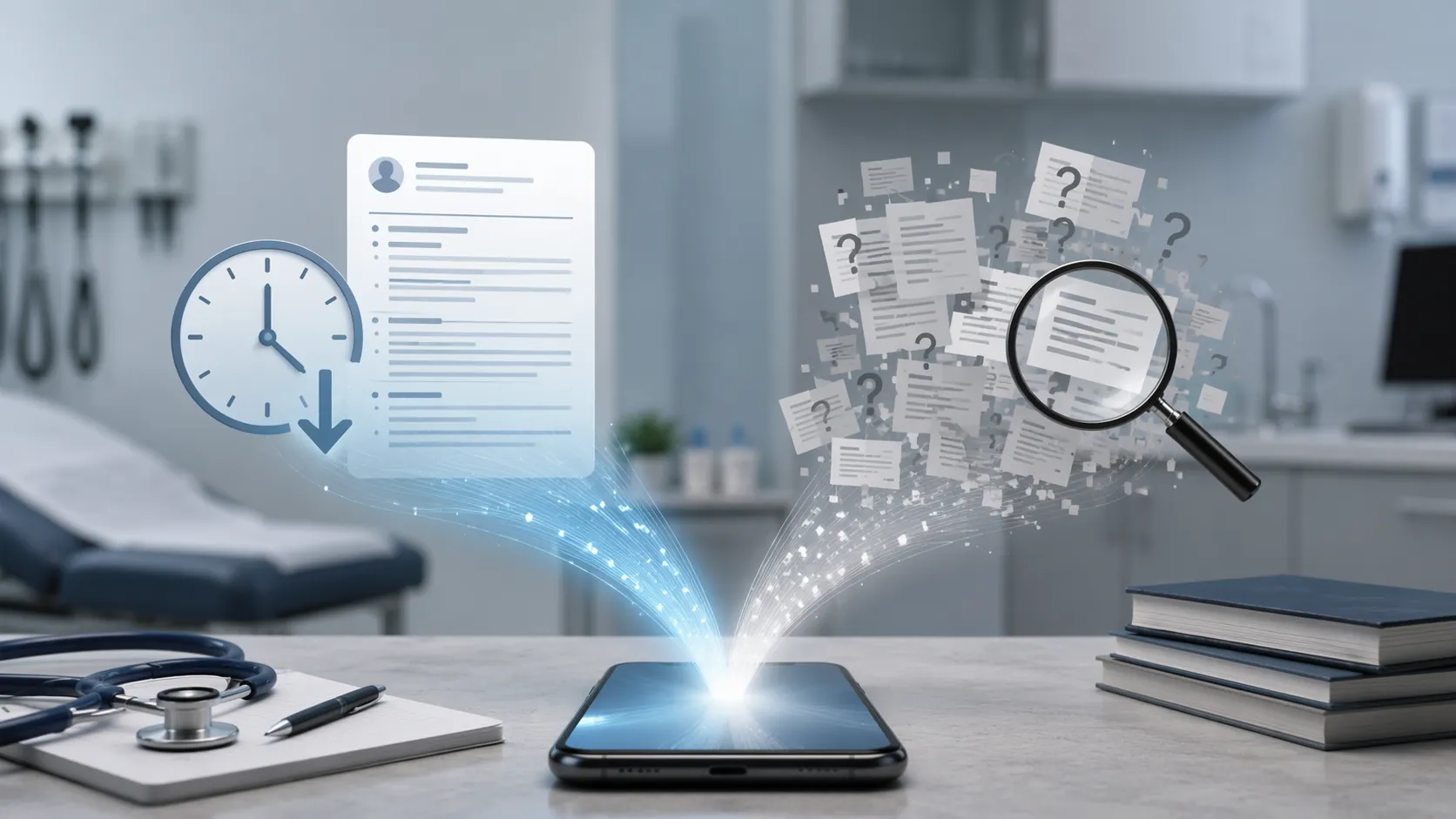
The most credible reason to consider these tools is not a vague burnout story. It is the measured decrease in documentation burden under clinical conditions. In the Stults et al. pilot, the mean per-appointment note time fell from 6.2 to 5.3 minutes, and NASA-TLX mental demand fell from 12.2 to 6.3, with a reported p value below .001 for the mental-demand change [3]. That is a meaningful workflow signal, especially for clinicians whose day is shaped by accumulated minutes and the attention cost of finishing notes after visits.
It is also not the kind of signal that should be inflated into universal productivity. A reduction of about a minute per appointment in a controlled primary-care pilot can matter, but it does not answer what happens in a subspecialty visit with multiple active problems, a family member supplying part of the history, an interpreter, or a patient who corrects the clinician’s summary halfway through the encounter. The workflow benefit is best treated as a local hypothesis to test, not a systemwide constant to paste into an ROI model.
Alboksmaty et al. strengthen the case that the category can improve measured effectiveness: all 9 studies in their systematic review showed effectiveness gains [2]. The same review makes the safety question harder to dismiss, because 3 of the 6 studies that examined safety raised concerns [2]. That pattern is exactly what procurement teams should expect from a documentation assistant that works upstream in the encounter but still depends on a clinician downstream to detect what is missing, distorted, or overconfidently summarized.
Accuracy Is Not One Number
Ng et al. provide the broadest map of the evidence base, and the central finding is not simply that ambient scribes are getting better. It is that performance varies enormously. Across 29 studies, reported word-error rates ranged from 0.087% to more than 50%, and F1 scores ranged from 0.416 to 0.856 [1]. A category with that spread cannot be appraised by its best demonstration.
The lower end of the error range can make the technology look routine. The higher end should make a committee ask what exactly was being measured: dictated-style speech or conversational clinical speech, a standardized encounter or an ordinary visit, native English or multilingual communication, primary care or complex specialty care, audio capture or downstream note generation. A scribe that performs well in one version of the problem may still fail in another.
The pre-LLM baseline helps explain why the residual risk is not surprising. Kodish-Wachs and colleagues reported word-error rates of 35% to 65% for conversational clinical speech recognition in work summarized by Ng et al. [1]. Newer ambient systems do more than transcribe; they structure, summarize, and draft clinical documentation. That can improve usefulness, but it can also make errors less visible because the final note may read fluently even when a clinically relevant fact never made it into the output.
Omissions Deserve More Weight Than Generic Error Rates
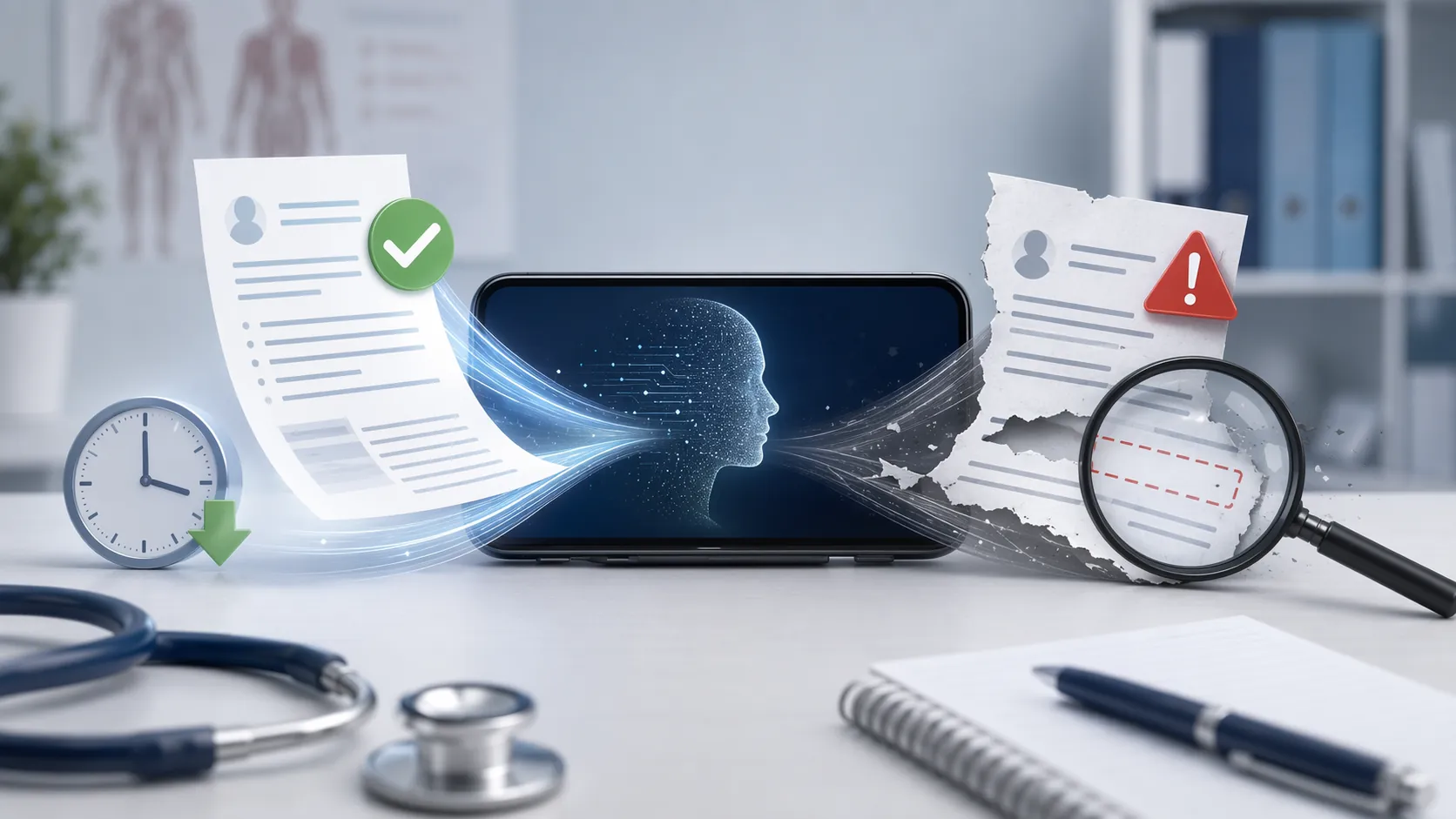
A generic error rate is too blunt for clinical documentation. A misspelled medication name, a harmless formatting error, a fabricated normal exam element, and a missing anticoagulant history do not carry the same risk. The Biro et al. instrument-validation work summarized in the evidence base identified omission errors as both the most common error type and the one with the highest clinical risk [1]. That finding should sit near the center of any deployment decision.
Omissions are operationally awkward because they are harder to catch than obvious nonsense. The reviewing clinician is not merely proofreading. She is comparing the AI-generated note against her memory of the encounter, the chart, the patient’s stated concern, and the plan she believes she communicated. If the tool saves typing time but increases the need for verification, the net benefit depends on how much review work returns through a different door.
This is why “physician in the loop” is not a sufficient safety description. The phrase does not specify whether the physician reviews every section, listens to audio, checks only abnormal findings, reconciles medication changes, verifies patient instructions, or audits a sample after signing. The available studies do not define which level of review is safe. Until they do, review has to be treated as a clinical responsibility, not a decorative governance control.
The Smartphone Evidence Is Narrower Than the Product Story
Many products that procurement teams evaluate, including tools from Abridge, DAX Copilot, Ambience Healthcare, and Nabla, can be presented as low-friction ambient documentation systems. Some workflows use a phone or mobile app in the room. That does not mean the evidence validates every smartphone scenario a health system may want to deploy.
The distinction is simple and important. The literature supports some use of phone-based ambient capture during in-person clinical encounters. It does not establish safety or effectiveness for ambient scribing during telephone or virtual encounters. Alboksmaty et al. explicitly excluded telephone and virtual encounters from their systematic review [2]. A committee evaluating smartphone-call documentation should therefore treat that use case as an evidence gap, not as a minor extension of in-room capture.
The gap matters because a phone-only encounter changes the clinical signal. There is no physical exam in the same sense, fewer visual cues, more dependence on speech quality, and often a different documentation style. Patients may be driving, using speakerphone, switching languages, or relying on a caregiver to relay information. Those are not edge cases in access-oriented care; they are common enough that local validation should include them before any deployment rule assumes equivalence.

Generalizability Is a Safety Issue, Not an Academic Footnote
The peer-reviewed evidence leans toward controlled, native-English, predominantly primary-care settings. That is a reasonable place to begin studying documentation tools, but it is not a representative map of clinical communication. A health system that serves multilingual patients, patients with heavy accents, patients with speech impairments, or patients moving between primary care and subspecialty care cannot assume the average study result applies evenly.
The speech-recognition equity literature should make committees cautious here. Koenecke et al. found higher error rates for Black speakers than white speakers across major automated speech-recognition systems [5]. That study was not an ambient-scribe clinical trial, so it should not be used to quantify the error rate of a specific healthcare product. It does, however, turn “accuracy” from a technical average into a governance question: which patients are more likely to be misheard, and who notices before the note becomes part of the record?
Local validation should therefore be subgroup-aware from the beginning. If an implementation pilot only measures mean documentation time, mean note completion time, and overall clinician satisfaction, it can miss the patients for whom the tool performs worst. At minimum, a deployment evaluation should look separately at language, interpreter use, accent-related concerns where measurable, specialty, visit complexity, and encounter modality. The point is not to demand perfect performance before use; it is to avoid certifying safety from a sample that never tested the population at risk.
Large Implementation Reports Are Context, Not Proof
The Cleveland Clinic report is useful because it shows what scaled adoption can look like in a large institution. It described more than 4,000 providers, more than 1 million encounters, and about 2 minutes saved per appointment [4]. Those are important implementation signals: the tool was not confined to a tiny pilot, and the organization reported a measurable operational effect.
They are not, by themselves, peer-reviewed evidence of safety or generalizable effectiveness. An institution-specific report can be shaped by local training, specialty mix, documentation templates, clinician selection, technical support, and how time savings are measured. It belongs in a procurement packet as context. It should not be blended with systematic reviews and pilots as if it carried the same evidentiary weight.
The same separation applies to vendor-reported claims about lower call volume, higher appointment-fill rates, or improved access metrics. Those claims may be worth investigating during contracting. They should not be presented as established clinical evidence unless they have been independently evaluated with methods and denominators a committee can inspect.
Consent and Regulatory Status Still Need a Workflow
The regulatory point is narrower than many sales and risk conversations imply. Documentation-only ambient scribes are often outside FDA medical-device clearance because they support note creation rather than directly diagnosing, treating, or driving clinical decisions. That status should not be mistaken for clinical validation. Lack of FDA clearance can mean the product is not regulated as a device for that intended use, not that its outputs have been proven safe across clinical contexts.
Consent is also more than a sign on the wall or a sentence at rooming. The AMA Journal of Ethics case commentary emphasizes the gap between legal permission and ethically adequate informed consent for ambient listening tools [6]. A defensible workflow should specify who explains the tool, when patients can decline, how refusal is documented, whether the visit continues without penalty, what happens to audio, and how patients can ask later whether AI contributed to the note.
Those details are not peripheral once omission and generalizability risks are visible. Patients are being asked to allow an additional listener into the encounter, and clinicians are being asked to sign the result. If the governance workflow cannot explain review responsibility, consent, storage, escalation, and audit, the implementation is not ready for broad deployment even if the average documentation-time result looks favorable.
A Defensible Procurement Position
The evidence does not support a blanket rejection of smartphone ambient AI scribes. It supports cautious deployment in bounded settings where the organization can verify performance. The safest starting point is not “turn it on for everyone,” but “define the encounters where the evidence is closest to our use case, measure locally, and require review before signing.”
- Require physician review of every AI-generated note before it enters the signed record.
- Validate locally by specialty, language context, interpreter use, visit complexity, and modality.
- Measure omissions separately from generic transcription or formatting errors.
- Keep peer-reviewed evidence, institutional reports, and vendor claims in separate appraisal categories.
- Do not infer evidence for smartphone-call or virtual-visit scribing from in-person phone-based capture studies.
- Build consent, refusal, audio-retention, escalation, and audit processes before broad rollout.
The unresolved question is not whether ambient scribes can help clinicians. They can. The unresolved question is where the review burden, accuracy risk, and equity risk land after the note is generated. Current studies do not establish a safe-delegation threshold for unreviewed notes, and they do not validate ambient scribing for smartphone-call encounters. That is the boundary procurement teams should keep intact.
References
- Ng et al. 2025 systematic review of ambient artificial intelligence scribes, PMC, 2025, https://pmc.ncbi.nlm.nih.gov/articles/PMC12220090/
- Alboksmaty et al. 2025 systematic review of ambient artificial intelligence in clinical documentation, PMC, 2025, https://pmc.ncbi.nlm.nih.gov/articles/PMC12301838/
- Stults et al. 2025 JAMA Network Open pilot study of ambient artificial intelligence scribes, PMC, 2025, https://pmc.ncbi.nlm.nih.gov/articles/PMC12048851/
- Cleveland Clinic ambient documentation implementation report, Consult QD, consultqd.clevelandclinic.org
- Racial disparities in automated speech recognition, PNAS, 2020, https://pmc.ncbi.nlm.nih.gov/articles/PMC7149386/
- AMA Journal of Ethics case commentary on ambient listening tools, AMA Journal of Ethics, November 2025, journalofethics.ama-assn.org