
For anyone deciding whether to buy, fund, or approve storytelling techniques for addressing vaccine skepticism in public health, the short answer is cautious: the experimental evidence supports narrative as a potentially useful communication component, not as a generally superior replacement for clear factual correction. The better studies show modest, audience-dependent effects. They also show that a story can lose its advantage, or even create the wrong emotional conditions, when the audience and framing are mismatched.
That distinction matters because storytelling is often discussed as if it solves the central weakness of factual communication: facts tell, stories move. Sometimes they do. But the relevant question for vaccine communication is narrower and harder: compared with a clear informational message, did the narrative change vaccine attitudes, beliefs, intentions, or behavior in the intended audience? On that question, the evidence is useful but not sweeping.
| Evidence question | Current answer |
|---|---|
| Is there peer-reviewed experimental evidence? | Yes, including randomized and experimental studies with samples of several hundred to 2,000 participants. |
| Are effects large? | No. The reported effects are generally modest or conditional. |
| Do narratives consistently beat factual communication? | No. Some narrative types outperform other narratives, while factual or expository correction performs better in some skeptical audiences. |
| Has actual vaccination behavior been shown to change? | Not in the cited experimental evidence. Outcomes are mainly intentions, attitudes, beliefs, perceived change, or debunking efficacy. |
| Can stories backfire? | The evidence supports more precise concern: some combinations increase negative emotion, reduce debunking efficacy, or trigger critical thinking that weakens persuasion. |

The strongest signal comes from how the story is built
The most informative result is not simply that a vaccine story worked. In Huang and Green’s 2022 randomized study of 394 unvaccinated African American adults, self-persuasion narratives outperformed standard pro-vaccine narratives, with partial eta-squared values reported in the 0.05–0.07 range for key outcomes.[1] That is a meaningful experimental signal, but it is not a license to conclude that any personal story is better than a direct health message.
The difference was structural. A standard pro-vaccine narrative presents a character who supports vaccination and conveys that position to the reader. A self-persuasion narrative gives the reader a character who begins with hesitation and then changes their mind. That second format may be less likely to feel like an argument being imposed from outside. It gives the audience a psychologically available route: someone like me had doubts, processed them, and reconsidered.
The mediation findings make the result more interesting. Huang and Green reported that effects were mediated by self-referencing, affective empathy, and perceived similarity; for vaccination intention, the indirect effect through similarity was B = 0.39 with a 95% confidence interval of 0.106 to 0.711.[1] In plain terms, the persuasive mechanism was not just emotional intensity. It involved whether readers connected the character to themselves.
That finding should push campaign teams away from the vague instruction to “use stories” and toward a more disciplined question: whose story, showing what kind of change, for which audience? A polished testimonial from an authority-approved source may be narratively tidy and still fail to create similarity. A hesitancy-to-acceptance story may do more work because it treats uncertainty as part of the reader’s experience rather than as a defect to be corrected.
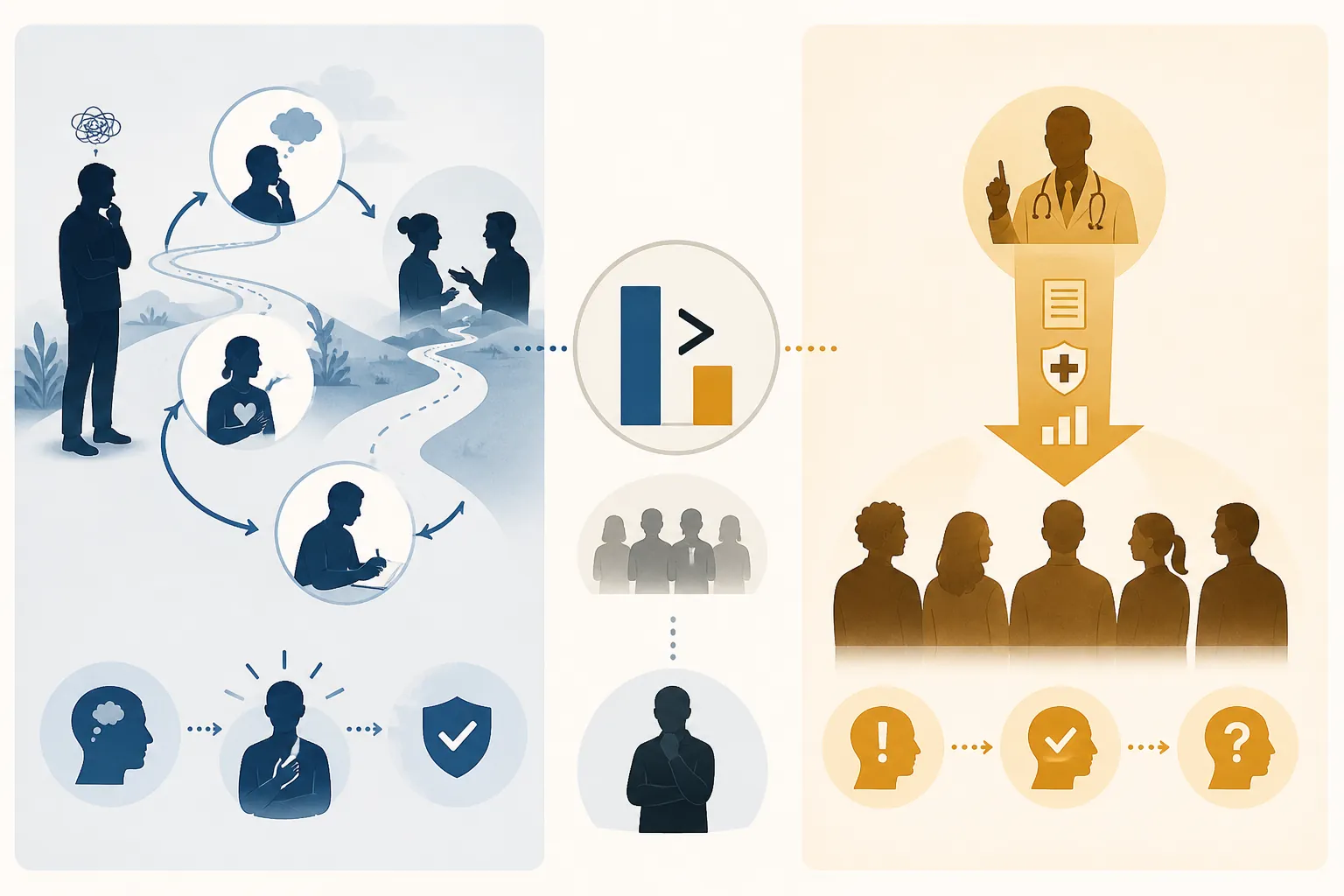
The wrong audience can turn a narrative into weaker correction
Jheng and colleagues’ 2025 study is a useful brake on enthusiasm because it tests narrative correction under conditions where public-health teams often reach for emotional content: misinformation, harm, and fear. In a sample of 432 pregnant women in Taiwan, narratives combined with harm-stressing messages reduced debunking efficacy for non-skeptics; the moderated mediation index for social media engagement was b = −0.59, with a 95% confidence interval of −0.92 to −0.30.[2]
For skeptics, the result was also uncomfortable. Narratives elicited more negative emotion regardless of whether harm content was included, while expository corrective messages produced better debunking efficacy.[2] That is not a generic “backlash” claim. It is a more specific warning: in this context, among these participants, narrative framing and fear-related content could interfere with the corrective task, especially when the endpoint was debunking efficacy rather than emotional engagement.
This matters operationally. If the communication problem is rumor correction, a story that increases emotional salience may not be the right tool. The audience may remember the harm frame, feel more threatened, or engage with the content in a way that does not strengthen the correction. A factual corrective message can look less compelling in a creative review meeting and still be the better comparator for the job.

Emotion can move attitudes, but the measured movement is modest
Dube and colleagues’ 2024 study gives storytelling a fairer case in a larger sample. In 2,000 Canadian parents, narrative videos had a modest positive effect on vaccine attitudes, and the most emotionally evocative narrative—a mother recounting a child’s meningococcal disease—was rated as the most opinion-changing.[3] The study is important because it does not reduce narrative to decoration; it tests emotionally concrete material against measurable attitude outcomes.
The limitations are just as important as the result. The effect was concentrated among the already-hesitant subgroup, while the broader sample was predominantly vaccine-acceptant at baseline.[3] That makes the finding encouraging for a specific use case—reaching some parents with hesitation—but weaker as evidence for persuading entrenched skeptics or shifting behavior across a population.
The most striking response also came from a perceived-change measure rather than a behavioral endpoint.[3] A participant saying a video changed their opinion is not the same as a delayed vaccination appointment being completed. It is still a relevant outcome, especially for early-stage communication testing, but it should not be treated as proof of vaccine uptake.
One-sided stories may persuade under uncertainty, with a cost
Another study complicates a common best practice in health communication: acknowledge the other side. In Huang’s 2024 study of 600 participants, one-sided narratives outperformed two-sided narratives under high psychological uncertainty, while acknowledging counterarguments triggered critical thinking that undermined persuasion.[4]
This is not a simple recommendation to suppress counterarguments. It is evidence that timing and audience state matter. When people are uncertain, a two-sided narrative may invite closer scrutiny at the exact moment the communicator hopes to reduce uncertainty. That scrutiny may be valuable for informed decision-making, but it can weaken persuasion as an outcome.
Public-health institutions have to live with both halves of that sentence. They are not commercial advertisers optimizing only for conversion. A message that persuades by avoiding counterarguments may perform well in a study and still raise accountability questions if it leaves legitimate concerns unaddressed. The evidence supports attention to uncertainty; it does not remove the obligation to be transparent.
What narrative seems to do best
Across these studies, narrative appears most defensible when it is matched to a specific communication mechanism. A self-persuasion story may help when the barrier is identity-protective hesitation and the reader can recognize themselves in the character. An emotionally evocative disease story may shift attitudes among some hesitant parents. A one-sided narrative may persuade under psychological uncertainty. Those are not interchangeable uses.
| Narrative approach | Evidence-supported interpretation | Practical caution |
|---|---|---|
| Self-persuasion narrative | May outperform a standard pro-vaccine narrative when readers identify with a hesitant character who changes their mind. | Requires audience similarity; a generic protagonist may not create the same mechanism. |
| Emotionally evocative disease narrative | May modestly improve attitudes, especially among some already-hesitant parents. | Perceived opinion change is not vaccination behavior. |
| Narrative plus harm-stressing correction | Can reduce debunking efficacy or increase negative emotion in some groups. | Fear and story are not automatically additive. |
| One-sided narrative under uncertainty | May outperform two-sided narrative when uncertainty is high. | Persuasion gains must be weighed against transparency and trust obligations. |
| Expository factual correction | May outperform narrative correction for skeptics in some misinformation contexts. | Should remain a serious comparator, not a control condition treated as obsolete. |
The pattern is not anti-story. It is anti-generic. “Storytelling” describes too many different interventions to be a useful procurement category on its own. A hesitancy-to-acceptance narrative, a bereavement testimony, a community theatre performance, and a myth-correction anecdote may all be stories, but they do not ask the audience to do the same cognitive or emotional work.
Why anti-vaccine stories travel so easily is not proof that pro-vaccine stories will
One reason storytelling remains tempting is that vaccine-skeptic movements often use it well. Shwetz’s 2026 medical-humanities analysis argues that vaccine-skeptic groups have a structural narrative advantage: they can offer simpler, emotionally compelling stories without being constrained by scientific fidelity in the same way public-health institutions are.[5]
That observation explains the communication environment, but it does not settle the intervention question. The fact that inaccurate stories spread does not mean accurate stories will produce symmetric corrective effects. Scientific communication carries burdens that misinformation does not: uncertainty, qualification, changing evidence, and responsibility for consequences. Those burdens make public-health storytelling harder, not impossible.
Community credibility is a separate condition, not a creative style
For some communities, the main question is not whether the message is narrative or factual. It is whether the messenger and process are credible. Martell and colleagues’ 2025 scoping review of 45 sources on narrative approaches for Indigenous populations emphasized community co-creation, culturally safe messengers, and acknowledgment of historical mistrust.[6] The review also identified “truth-teller” rhetoric as a potent anti-vaccine narrative strategy.[6]
That is a boundary condition for importing evidence from controlled message experiments into real public-health work. A narrative created outside a community and delivered into it may have the surface form of storytelling while lacking the relational basis that makes a story legitimate. In those settings, the intervention is not just the script. It is who shaped it, who carries it, and whether it acknowledges why distrust exists.
The Sabin Vaccine Institute’s Nigeria case study illustrates the operational appeal of this approach. Its Community Theatre for Immunisation program reported a 26% increase in fully immunized children through community-driven storytelling.[7] That is promising implementation evidence, especially because it links storytelling to an uptake-related outcome rather than only attitudes. But it is still a case study, not the same kind of evidence as a randomized message experiment, and it should not be used to generalize across settings without attention to context.
The evidence does not yet answer the behavior question
The largest unresolved issue is endpoint discipline. The experimental studies cited here primarily measure intention, attitudes, beliefs, perceived opinion change, emotion, engagement, or debunking efficacy. Those are legitimate communication outcomes, but they are not the same as actual vaccination. A parent may report greater openness and still postpone. A patient may endorse the message and still fail to schedule. A social media user may engage with a correction and still not update a durable belief.
This does not make the studies irrelevant. Early communication research often has to measure intermediate outcomes before running costly field trials. But public-health decision-makers should not let an intention endpoint become a behavior claim. If the funded objective is vaccine uptake, the evaluation plan has to follow people beyond immediate message response.
Generalizability is also constrained. Several key experiments were conducted in COVID-19 vaccination contexts during or after the pandemic, including Huang and Green, Jheng and colleagues, and Huang’s uncertainty study.[1][2][4] COVID-19 vaccine decisions carried unusual political, institutional, and temporal pressures. Evidence from that context may not transfer cleanly to routine childhood immunization, seasonal vaccination, or travel vaccines.
Baseline sample composition adds another constraint. When a sample is predominantly vaccine-acceptant, a positive average effect may say more about reinforcing or nudging the movable middle than about persuading people with durable opposition. That distinction is not academic. A campaign designed for mildly hesitant parents may fail, or create more resistance, if deployed as if it were built for committed skeptics.
A practical evidence standard for using stories
A responsible public-health review should treat a proposed storytelling campaign as a testable intervention, not a creative upgrade. The minimum standard is comparator clarity: what is the story expected to beat? A factual correction? A clinician recommendation? A reminder system? A peer messenger without narrative content? Without that comparison, “storytelling worked” can mean little more than “people liked the material.”
- Define the audience before choosing the story format: mildly hesitant, uncertain, misinformed, distrustful, accepting but under-informed, or strongly opposed.
- Specify the mechanism: similarity, self-referencing, empathy, fear reduction, risk salience, correction of false belief, or trust repair.
- Use a real comparator, especially a clear factual message when the task is correction.
- Measure the endpoint that matters: not only liking, sharing, or perceived change, but intention durability and, when feasible, vaccination behavior.
- Pretest for negative emotion, reduced correction efficacy, and credibility loss in the audience most likely to receive the campaign.
Those standards are not hostile to narrative. They protect the people asked to carry the message and the people expected to receive it. A community messenger risks credibility when a campaign misreads local experience. A hesitant parent or patient deserves more than a persuasive technique aimed at bypassing concern. A public-health agency needs to know whether it is buying attitude movement, rumor correction, trust repair, or actual uptake.
The narrow verdict
Storytelling has evidence behind it, but the evidence is conditional. Self-persuasion narratives can outperform standard pro-vaccine narratives when similarity and self-referencing are activated. Emotional disease narratives can modestly shift attitudes in some parent audiences. One-sided narratives may persuade under high uncertainty. Community-driven narrative work may be promising when credibility is built through local participation.
The same evidence also limits the claim. Narratives do not consistently outperform factual messages. In some skeptical audiences, expository correction performs better. Harm-stressing stories can reduce debunking efficacy or intensify negative emotion. Most experimental outcomes stop short of actual vaccination behavior. The defensible conclusion is not that public health should tell more stories. It is that storytelling should be tailored, compared, pretested, and evaluated as one communication component among others.
References
- Self-persuasion as a narrative means to encourage COVID-19 vaccination among unvaccinated African American adults, Journal of Behavioral Medicine, 2022.
- The effects of narrative and harm-stressing corrective messages on debunking efficacy among pregnant women, Scientific Reports, 2025.
- Use of narratives to promote vaccine acceptance among Canadian parents, Human Vaccines & Immunotherapeutics, 2024.
- Effects of one-sided and two-sided narratives under psychological uncertainty, Science Communication, 2024.
- How vaccine skeptics use storytelling effectively to create powerful but medically inaccurate messaging, The Conversation, 2026.
- Narrative approaches to vaccination communication with Indigenous populations, International Journal for Equity in Health, 2025.
- Leveraging the power of storytelling to increase vaccine demand, Sabin Vaccine Institute.