
The Rutgers time-restricted eating study offers narrower evidence than the dementia-risk headline suggests. The pilot presented at NUTRITION 2026 reported one between-group cognitive signal after six months: women assigned to time-restricted eating improved more than controls on a spatial planning/problem-solving task, the CANTAB Stockings of Cambridge test, with p<0.05.[1] It did not measure dementia incidence, diagnose cognitive decline, or show broad improvement across cognitive domains.
That distinction matters because the public framing moved faster than the evidence. The ASN/EurekAlert release itself says the findings should be regarded as preliminary until peer-reviewed publication, while the news hook around the study leaned into the idea that time-restricted eating may reduce dementia risk in older women.[2] A preliminary cognitive-test result can be worth tracking without being ready for that kind of risk-reduction language.
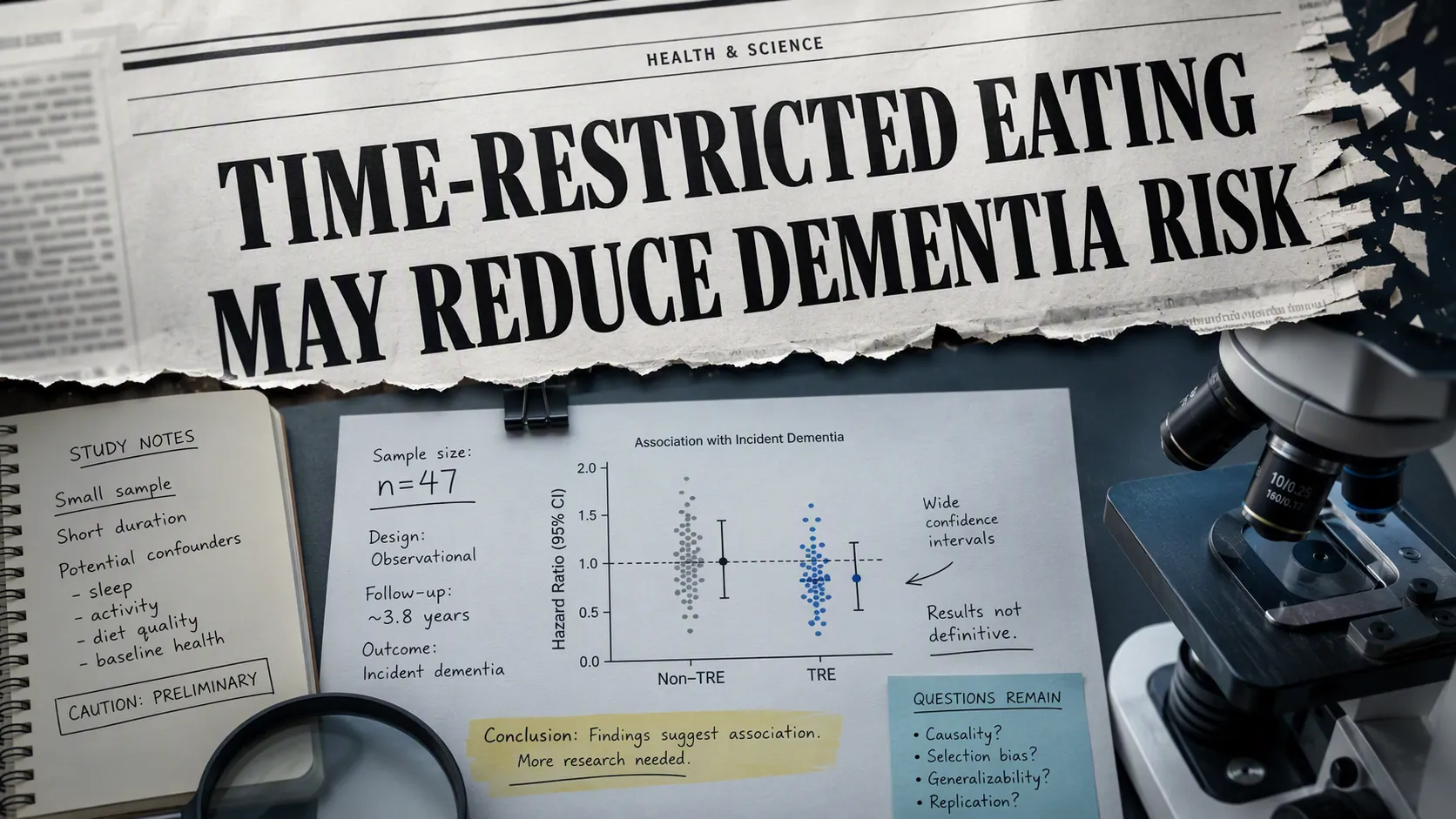
What Rutgers Actually Tested
The study was small, specific, and intervention-focused. It included 47 women aged 50 to 79 with overweight or obesity at a single Rutgers site.[1] Participants followed either a time-restricted eating intervention or a control condition that also produced weight loss. That second detail is one of the cleaner features of the design: the TRE group lost about 7.5 kg, while the control group lost about 6.1 kg, making weight loss broadly similar rather than leaving the timing question hopelessly tangled with a large weight-loss difference.[1]
In practical appraisal terms, the comparison asks a useful question: if two groups lose a similar amount of weight, does the timing of eating add a cognitive advantage? Many diet studies struggle because the intervention arm changes several things at once. This pilot at least gives the timing hypothesis a clearer lane than a study in which one group simply loses much more weight.
But the outcome was not dementia. The outcome was performance on computerized cognitive tests over six months. That makes the study relevant to cognition, not sufficient for claims about dementia prevention. A six-month change in a task score is not the same object as reduced dementia incidence, slower clinical decline, or protection against neurodegenerative disease.
The Cognitive Signal Was Domain-Specific
The most defensible positive statement is also the most limited one: spatial planning improved more in the TRE group than in the control group. The reported between-group difference came from the CANTAB Stockings of Cambridge test, a task used to assess planning and problem-solving, and reached p<0.05.[1] If the abstract is later supported by the full peer-reviewed paper, this result would justify saying that TRE showed an early signal in one executive-function-related domain in this study population.
It does not justify saying that cognition broadly improved. The same abstract reports no between-group differences for multitasking or reaction time.[1] Those null findings are not incidental. They define the shape of the result. The effect, as presented, was not a general cognitive lift across the test battery.
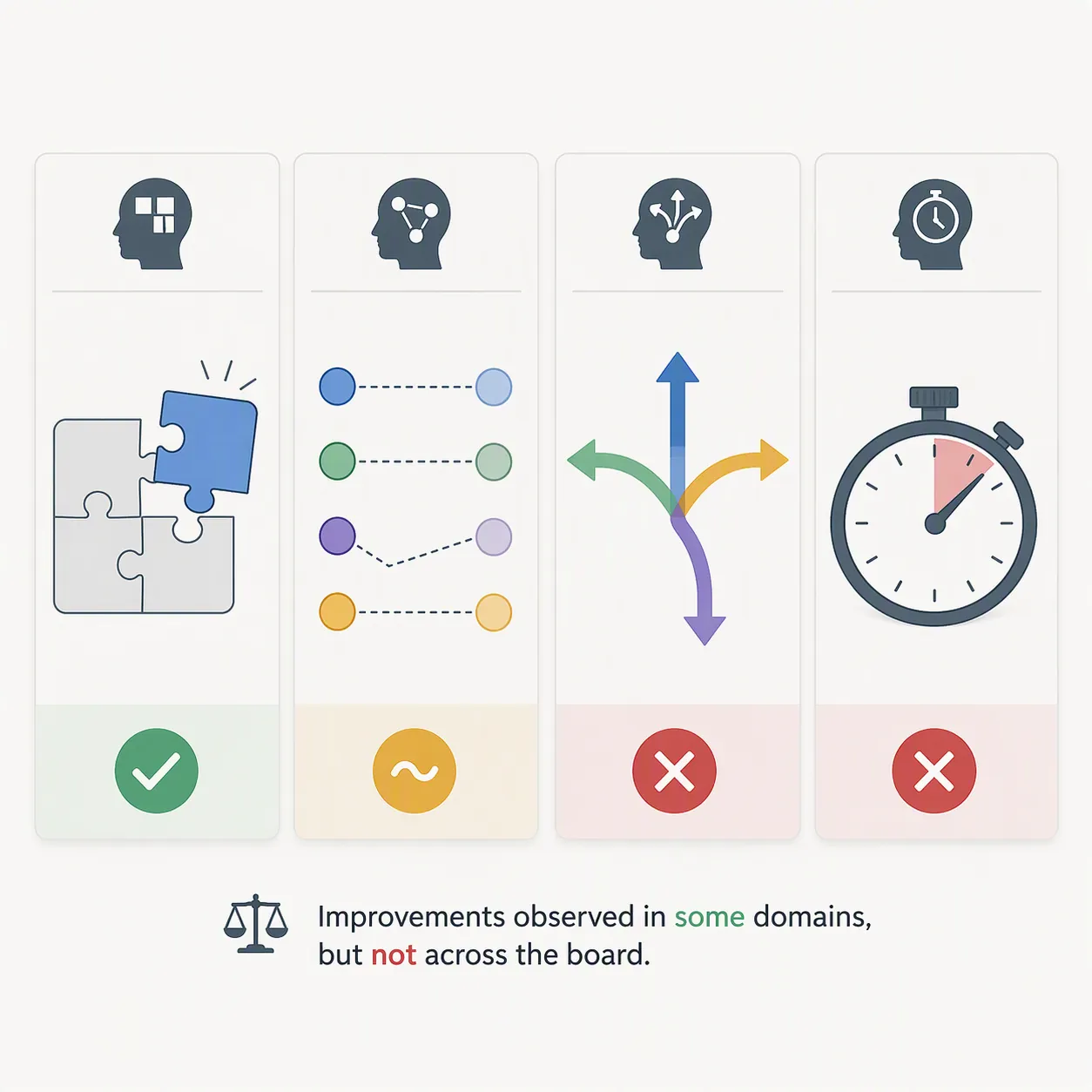
The paired associates learning result needs the most careful handling. PAL errors decreased within the TRE group, with p<0.01, but the between-group comparison was not significant.[1] That means participants in the TRE group improved from their own baseline on this memory-related task, while the evidence does not show that TRE outperformed the control condition on PAL.
That distinction is not statistical pedantry. Within-group improvement can reflect many things: practice effects, regression toward the mean, changes shared by both groups, or a real intervention effect that the study was too small to separate from control. The abstract does not allow a reviewer to choose among those explanations. It allows a narrower note: PAL moved in a favorable direction inside the TRE arm, but the trial did not demonstrate a TRE advantage over control on PAL.
| Cognitive domain or test | Reported result | What it can support | What it cannot support |
|---|---|---|---|
| Spatial planning / CANTAB Stockings of Cambridge | Between-group improvement favoring TRE, p<0.05 | A preliminary domain-specific signal | A broad cognition or dementia-prevention claim |
| Paired associates learning | Errors decreased within TRE group, p<0.01; between-group comparison not significant | A within-arm improvement worth watching | Evidence that TRE outperformed control on this memory task |
| Multitasking | No between-group difference | No demonstrated TRE advantage in this domain | A generalized executive-function benefit |
| Reaction time | No between-group difference | No demonstrated TRE advantage in this domain | A general processing-speed benefit |
The Design Label Is Not a Footnote
One of the more awkward features of the record is the design label. The NUTRITION 2026 abstract title describes the study as a randomized controlled trial.[1] A Consensus evidence review discussing the same work describes it as a non-randomized controlled trial.[3] From the abstract alone, that conflict cannot be resolved confidently.
This is not a cosmetic disagreement. Readers use the phrase randomized controlled trial as a shortcut for internal validity. If allocation was truly randomized, the study has a stronger starting position against selection bias, although it would still remain small and preliminary. If it was non-randomized, baseline differences and self-selection become more serious concerns. Until the full paper clarifies allocation, concealment, baseline balance, adherence, attrition, and analysis decisions, the safer description is design-ambiguous rather than simply RCT.
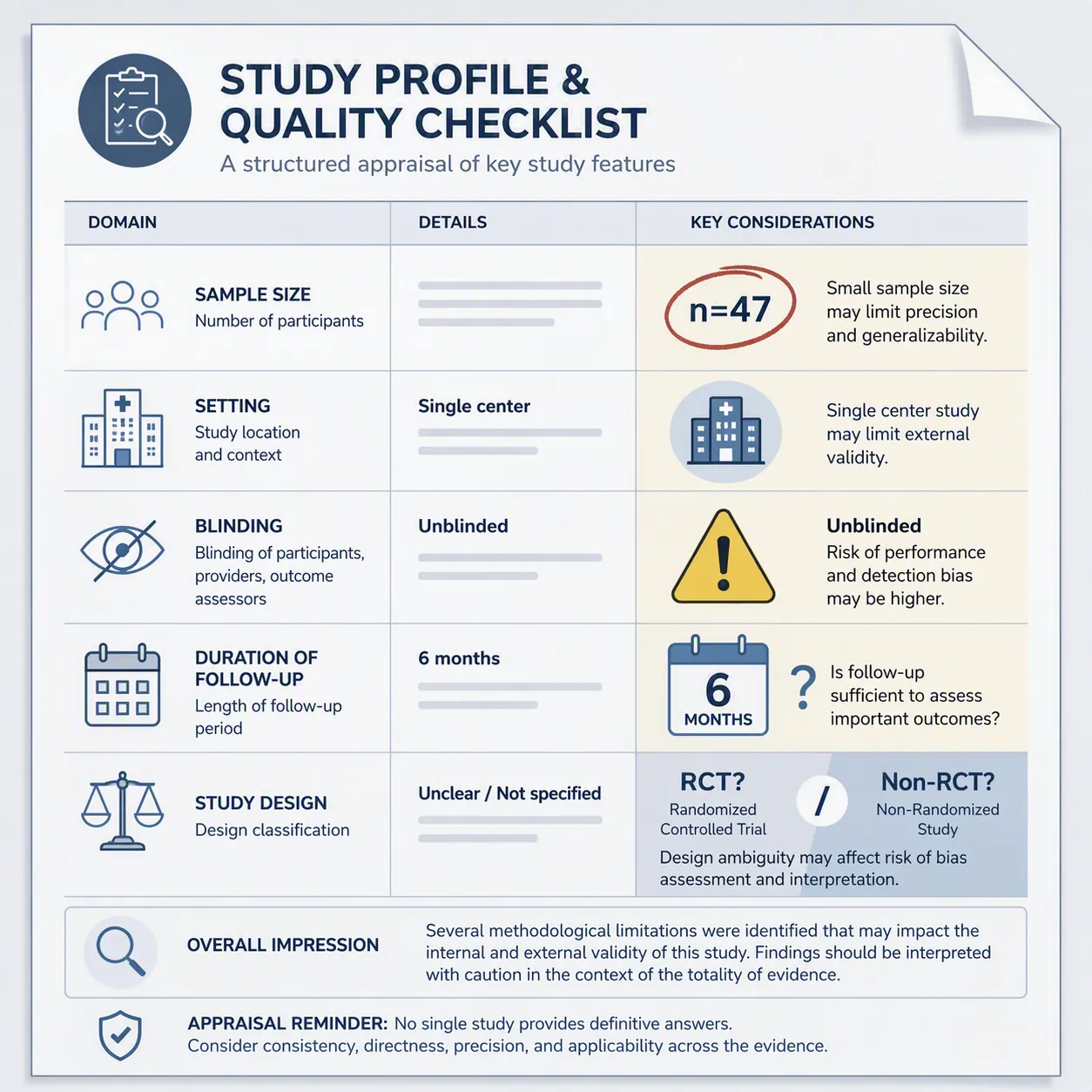
The abstract also does not describe blinding.[1] In lifestyle interventions, participant blinding is usually difficult or impossible, but outcome assessment and analysis procedures still matter. Cognitive testing can be affected by expectation, engagement, test familiarity, and differential encouragement. A conference abstract rarely has room to settle those issues, which is exactly why it should not be treated as a finished evidence package.
Why the Dementia-Risk Leap Is Too Large
Dementia risk is a long-horizon clinical outcome. The Rutgers pilot followed 47 participants for six months and reported computerized cognitive-test changes.[1] No dementia diagnoses, conversion rates, neuroimaging endpoints, or biomarker trajectories are reported in the abstract. No mechanistic biomarkers such as inflammatory markers, insulin measures, brain-derived neurotrophic factor, or circadian markers are described in the materials provided.
That absence does not make the result meaningless. It means the causal pathway remains untested in this study. A plausible lifestyle mechanism is not interchangeable with measured evidence that the mechanism occurred. For professional use, this is the difference between saying “a pilot study found a planning-task signal” and saying “TRE may reduce dementia risk.” The first sentence fits the data. The second borrows authority from an outcome the study did not measure.
The population also narrows the inference. The participants were women aged 50 to 79 with overweight or obesity at one center.[1] The finding should not be generalized to men, adults outside that age range, people without overweight or obesity, people with diagnosed cognitive impairment, or clinical dementia-prevention programs. Even within the studied group, the sample size leaves wide uncertainty around effect stability.
Prior Evidence Does Not Rescue the Headline
The broader literature is not empty, but it is not settled enough to turn this abstract into a recommendation. A 2024 systematic review by Sharifi and colleagues examined intermittent fasting and cognitive function, and its role here is mainly contextual: it shows scientific interest in the question, not a completed answer for older women using TRE to prevent cognitive decline.[4]
The direction of prior findings is also mixed. Li and colleagues reported in 2023 that time-restricted eating was associated with worse performance in orientation and attention among older Chinese adults.[5] That kind of observational association cannot prove TRE caused worse cognition, but it does complicate a simple beneficial narrative. A positive headline built around one small pilot should not ignore a literature in which signals do not all point the same way.
There are favorable signals as well. Currenti and colleagues reported an odds ratio of 0.28 for cognitive impairment associated with 10-hour TRE in a 2021 study.[6] That result supports continued interest in meal timing and cognition, but it does not validate the Rutgers dementia-risk framing. Different populations, designs, outcomes, and exposure definitions cannot be merged into a confident clinical claim by proximity.
How This Evidence Can Be Used
For an evidence memo, the Rutgers finding belongs in a preliminary-signal category. A fair entry would say that a small single-center pilot of 47 women aged 50 to 79 with overweight or obesity found similar weight loss in TRE and control groups, with a between-group improvement favoring TRE on spatial planning but not on multitasking or reaction time, and with PAL improvement only within the TRE group.[1] It should also state that the work has been presented as a conference abstract, that ASN described the findings as preliminary pending peer review, and that the study record contains an unresolved randomized-versus-non-randomized ambiguity.[2][3]
For a clinician answering a patient question, the cleanest correction is similarly modest: the study does not show that time-restricted eating prevents dementia. It suggests that, in one small group of older women with overweight or obesity, TRE may have improved performance on one planning task more than a weight-loss control condition over six months. That is a research lead, not a dementia-prevention result.
For procurement, governance, or protocol decisions, the evidence is not strong enough to support adoption language. It is suitable for a “watch after peer review” note, especially because the equivalent weight loss makes the timing question worth following. It is not suitable as reliable evidence that TRE reduces dementia risk, broadly improves cognition in older women, or justifies a cognitive-health recommendation, purchasing rationale, clinical protocol, or confident dementia-prevention statement.
References
- Time-Restricted Eating and Caloric Restriction Influences Cognition in Older Women: A Randomized Controlled Trial. NUTRITION 2026 abstract.
- Time-restricted eating may reduce dementia risk in older women. EurekAlert!/ASN. July 26, 2026.
- Research shows time-restricted eating improves cognitive performance in women with obesity: evidence review. Consensus.
- Intermittent fasting and cognitive function: A systematic review. Preventive Medicine Reports. 2024.
- Time-restricted eating is associated with poor performance in specific cognitive domains of older adults in China. Scientific Reports. 2023.
- Time restricted feeding and mental health: A review of possible mechanisms on affective and cognitive disorders. 2021.