
regulatory
How the 2026 PCAC Vote Changed BPC-157 Compounding Status
Short answer: no, the July 2026 PCAC vote did not make BPC-157 FDA-approved, and it did not make BPC-157 broadly compoundable for institutional stocking. As of July 2026, BPC-157 has no FDA finished-drug approval, no active investigational new drug application, and no registered U.S. human randomized controlled trials identified in the available record. The July 23, 2026 Pharmacy Compounding Advisory Committee vote was an 8-6-1 non-binding recommendation to add BPC-157 to the 503A Bulks List for ulcerative colitis only.[1]
That distinction matters for anyone evaluating a vendor claim about “BPC-157 compounding FDA status 2025” after the 2026 vote. A PCAC recommendation is part of an FDA rulemaking process. It is not FDA approval. It is not an efficacy finding. It is not a coverage decision. It is not permission for a 503B outsourcing facility to manufacture and stock BPC-157 for office use. It also does not settle the evidence question, which remains thin on the human side.

What changed in July 2026?
The change was procedural, not clinical. On July 23, 2026, PCAC voted 8-6-1 to recommend that FDA place BPC-157 in Category 1 for 503A compounding when used for ulcerative colitis.[1] Category 1 status, if adopted through FDA’s process, would mean the substance may be eligible for traditional pharmacy compounding under section 503A while FDA evaluates whether to include it on the final Bulks List. It would not mean FDA has approved BPC-157 as a drug.
The vote is also narrower than many promotional summaries make it sound. It concerned 503A pharmacy compounding tied to individual prescriptions and a proposed ulcerative colitis use. It did not create a 503B outsourcing facility pathway, did not authorize hospitals or clinics to stock the compound for office use, and did not endorse musculoskeletal, anti-aging, athletic recovery, wound-healing, or “regenerative” claims.
| Claim being made | What the July 2026 vote supports |
|---|---|
| “BPC-157 is FDA-approved.” | No. The vote was a non-binding advisory recommendation, not a finished-drug approval. |
| “FDA found BPC-157 effective.” | No. Category 1 compounding status is not an efficacy endorsement. |
| “A hospital can stock BPC-157 for office use.” | No. The vote concerned 503A compounding, not 503B outsourcing facility stocking. |
| “BPC-157 is broadly compoundable now.” | No. The recommendation was limited to 503A and framed around ulcerative colitis. |
| “The regulatory issue is settled.” | No. FDA would still need to proceed through notice-and-comment rulemaking before a final agency position. |
How did the status move from the 2025 picture to the 2026 vote?
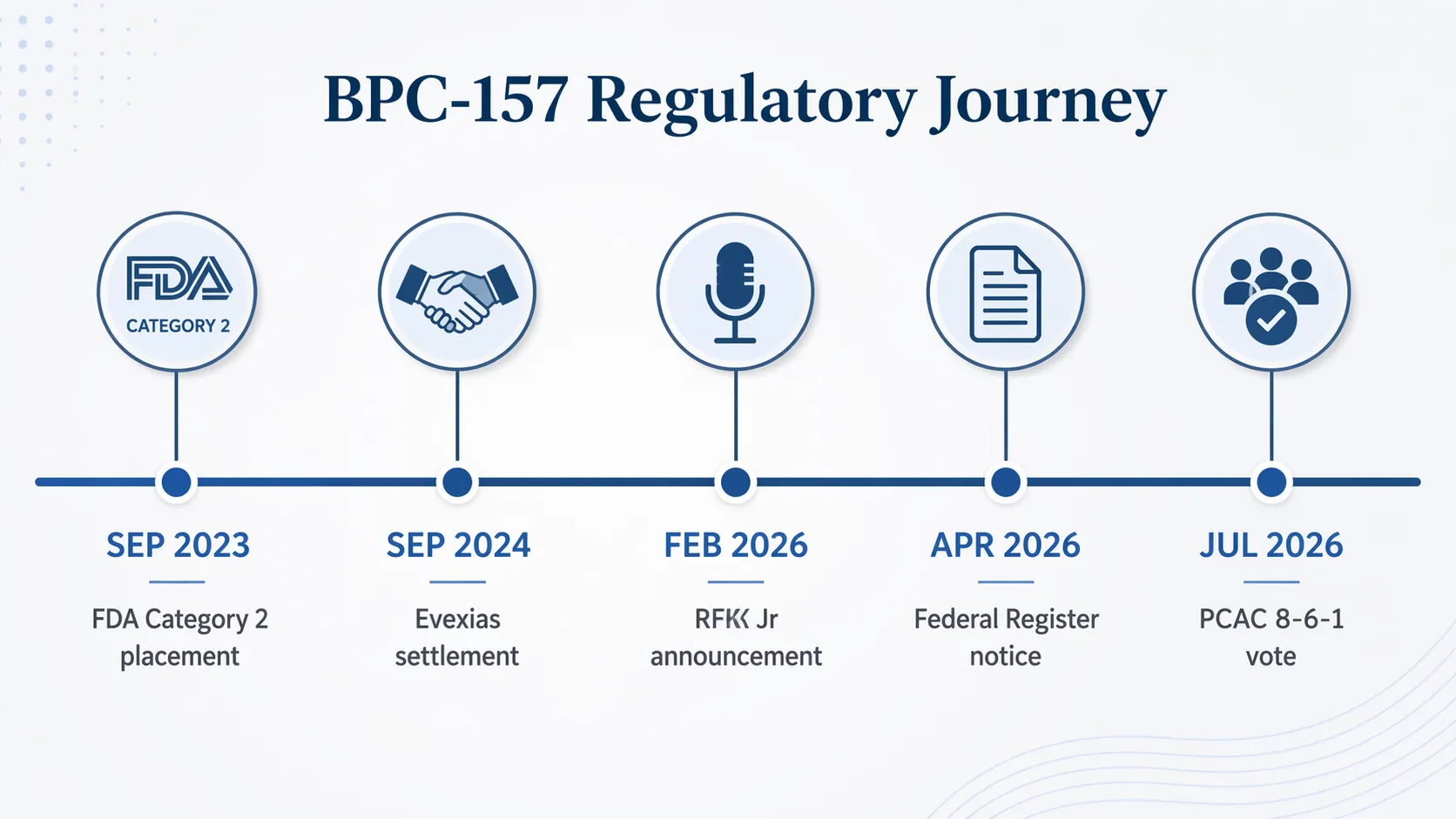
The 2025 question cannot be answered cleanly without the 2026 events, because the public regulatory posture shifted after litigation and renewed review. In September 2023, FDA placed BPC-157 in Category 2, a category used for bulk drug substances that FDA has identified as presenting significant safety risks.[2] In September 2024, Evexias reached a settlement with FDA related to peptide compounding, a development that helped reopen the process for several nominated peptides.[3] In February 2026, HHS Secretary Robert F. Kennedy Jr. announced movement on peptide access, followed by an April 2026 Federal Register notice and the July 2026 PCAC meeting.[1][3]
There is one unresolved administrative wrinkle worth documenting rather than smoothing over. BPC-157 appears in FDA materials as a bulk drug substance nominated but withdrawn on the Category 2 page, rather than simply as an active Category 2 substance. That makes the interim enforcement posture harder to reduce to a single sentence. The safer institutional phrasing is that FDA’s final Bulks List treatment has not been settled and the July 2026 PCAC vote is a non-binding recommendation rather than a final rule.
What does Category 1 mean for a 503A pharmacy?
For 503A, Category 1 is a compounding-process category. It signals that a nominated bulk drug substance may be used by state-licensed pharmacies or physicians for patient-specific compounding while FDA evaluates the substance for possible inclusion on the 503A Bulks List. The operative words are patient-specific and evaluates. The category does not convert the substance into an approved drug and does not allow a pharmacy to bypass the ordinary limits of section 503A.
A 503A pathway is not the same thing as a 503B pathway. Traditional 503A compounding is built around individual prescriptions. 503B outsourcing facilities can produce compounded drugs without patient-specific prescriptions for office use when the applicable statutory and regulatory conditions are met. The July 2026 BPC-157 vote did not create that 503B stocking pathway.[1][2]
For a procurement file, the distinction can be written plainly: “The July 2026 PCAC vote, if adopted, may affect whether BPC-157 can be compounded by 503A pharmacies for individual prescriptions in the nominated context; it does not establish FDA approval, clinical efficacy, reimbursement status, or 503B office-use stocking authorization.”
Did FDA staff support the change?
No. Reporting on the June 2026 PCAC briefing indicates that FDA career staff recommended against reclassification. The concerns described in that coverage included lack of effectiveness evidence, poor substance characterization, immunogenicity questions, impurities, and unresolved safety issues.[1][4][5] Those are not the same as a finding that BPC-157 is unsafe in every circumstance. They are enough, however, to undercut any claim that the agency’s scientific staff had endorsed BPC-157 as clinically established.
The close vote should be treated as governance-relevant but not evidence-generating. It shows that a federal advisory committee was divided on whether BPC-157 should move into a 503A compounding category for a defined use. It does not add patients to the clinical evidence base, randomize anyone, blind an outcome assessor, or replicate a trial.
What human evidence exists for BPC-157?
The human clinical record remains small. The available human studies are three Lee et al. reports published in Alternative Therapies in Health and Medicine: a 2021 retrospective uncontrolled study in 16 patients with knee osteoarthritis, a 2024 small-n report in 12 patients with interstitial cystitis, and a 2025 intravenous safety pilot involving 2 patients.[6][7] Combined, that is approximately 30 human participants across three uncontrolled studies from the same investigative team.
| Study | Population and size | Design features that limit interpretation |
|---|---|---|
| Lee et al., 2021 | 16 patients with knee osteoarthritis | Retrospective and uncontrolled; no placebo control or blinding |
| Lee et al., 2024 | 12 patients with interstitial cystitis | Very small sample; no controlled comparative arm identified |
| Lee et al., 2025 | 2-patient intravenous safety pilot | Too small to establish efficacy or a reliable safety profile |
Those studies may justify further investigation. They do not establish treatment effect. Without a placebo group, blinding, prespecified comparative outcomes, independent replication, or a population large enough to characterize uncommon harms, the findings cannot support formulary-level claims that BPC-157 works for ulcerative colitis, musculoskeletal repair, pain, athletic recovery, or systemic “healing.”
A 2025 systematic review in Current Reviews in Musculoskeletal Medicine concluded that BPC-157 “should be considered investigational” and flagged possible publication bias.[8] That is a restrained conclusion, and it is the appropriate one: the compound has a long preclinical trail, but the clinical evidence has not crossed the threshold needed for routine therapeutic claims.

How should animal data be weighed?
BPC-157 is not a compound with no biologic rationale. Reviews and critical summaries describe more than 500 animal studies, many associated with the Sikiric group at the University of Zagreb, involving rodent models and tissue-repair pathways such as VEGFR2/Akt-eNOS/ERK signaling.[6][7] That preclinical volume helps explain why the peptide continues to attract attention.
The governance problem is the scale mismatch. Hundreds of animal experiments do not substitute for controlled human trials, particularly when the promoted uses span gastrointestinal disease, soft-tissue injury, orthopedic pain, and general wellness. For procurement review, the relevant comparison is not “mechanism versus no mechanism.” It is extensive animal plausibility versus roughly 30 human participants in uncontrolled reports.
Does the lack of a large trial prove suppression?
No. The absence of large randomized trials can have structural explanations without proving a suppression narrative. BPC-157 reportedly lacks a composition-of-matter patent, which can reduce the commercial incentive to fund Phase II and Phase III studies. That may help explain why the evidence base is underdeveloped. It does not turn uncontrolled reports into controlled evidence, and it does not make FDA’s evidentiary standards inapplicable.
A value-analysis committee does not need to adjudicate motives to make a defensible decision. It only needs to separate the explanation for the evidence gap from the evidentiary consequence of the gap. The consequence is straightforward: therapeutic claims remain unsubstantiated until controlled, adequately powered, independently replicated human data are available.
What about the PCAC membership concerns?
The July 2026 vote also arrived with process concerns. STAT reported that the committee had only 3 voting members against 12 authorized before 8 new members were added in June 2026, and raised questions about whether some new advisers could benefit from rulings involving peptides.[9] That context does not invalidate the vote on its own. It does reinforce why the vote should be documented as an advisory regulatory event rather than used as a proxy for scientific consensus.
Are there patient-safety issues procurement teams should flag?
The strongest procurement issue is not a proven, quantified rate of harm; the available materials do not support that level of precision. The issue is uncertainty. FDA staff concerns reported in 2026 included characterization, immunogenicity, impurities, and unresolved safety questions.[1][4][5] The Partnership for Safe Medicines has separately warned about risks associated with untested peptides, including impurities, lack of consistent quality standards, and unknown long-term effects.[10]
For athletic and military populations, there is an additional compliance issue: BPC-157 is prohibited by the World Anti-Doping Agency.[6] That does not answer the clinical-efficacy question, but it is relevant if a health system serves patients whose employment, competition status, or command requirements make prohibited substances consequential.
What should an internal memo say?
A concise institutional position can avoid both overstatement and false reassurance:
- BPC-157 is not FDA-approved as a finished drug.
- The July 23, 2026 PCAC vote was an 8-6-1 non-binding recommendation for Category 1 503A status limited to ulcerative colitis.
- Category 1 503A status, if adopted, would not establish efficacy, insurance coverage, or 503B stocking permission.
- The human evidence base consists of three small uncontrolled studies from one investigative team, with approximately 30 combined participants.
- Therapeutic claims should be treated as unsubstantiated pending controlled, independently replicated human studies and final FDA rulemaking.
That wording leaves room for future FDA action without letting a vendor convert an advisory vote into a clinical endorsement. It also keeps the procurement decision focused on what the institution can verify: legal pathway, evidence quality, operational use case, and claims being made at the point of sale.
What happens next?
FDA may accept, modify, or decline the PCAC recommendation. Formal notice-and-comment rulemaking still lies ahead and could take a year or more.[1][2] Until that process is complete, the July 2026 vote should be tracked as a regulatory development, not treated as final agency action.
The broader peptide-compounding environment is also moving. FDA has been considering additional peptides, including GHK-Cu, Melanotan II, LL-37, Dihexa acetate, and PEG-MGF, for PCAC review before the end of February 2027.[11] That makes it more important, not less, to keep the categories clean. A future committee vote for another peptide would still need the same parsing: advisory recommendation, compounding pathway, evidence base, and final FDA action are separate questions.
For now, the defensible procurement posture is narrow: document the July 2026 PCAC vote as non-binding; do not present Category 1 503A status as FDA approval, coverage, 503B stocking authorization, or clinical validation; and treat BPC-157 therapeutic claims as unsubstantiated until the human evidence changes.
References
- FDA advisory committee backs two controversial peptides, RAPS, July 2026.
- FDA’s Pep(tide) Rally! Post 1 of 2, FDA Law Blog, July 2026.
- Regulatory Status of Peptide Compounding in 2025, Frier Levitt, 2025.
- What’s behind the push to make peptide therapies more readily available, NPR, July 2026.
- FDA’s Review Of Peptides Signals A Growing Public Health Challenge, Forbes, July 2026.
- BPC-157 and the Difference Between an Evidence Gap and a Cover-Up, WellFounded Health.
- BPC-157 – No Proof Required!, McGill Office for Science and Society.
- Body Protective Compound 157: A Systematic Review of the Current Evidence, Current Reviews in Musculoskeletal Medicine, 2025.
- New FDA peptide advisers could benefit from their own rulings, STAT, July 2026.
- The five risks of taking untested peptides, Partnership for Safe Medicines, 2025.
- FDA considers adding a dozen peptides to its bulk drug compounding list, RAPS, July 2026.