
general
Can Humans Get Cancer from Catfish? What the Evidence Shows
No: based on the evidence available in July 2026, humans cannot realistically get cancer from catfish transmissible melanoma. The newly reported cancer is a real and important finding in brown bullhead catfish, but the word “transmissible” here means that living cancer cells can spread between compatible catfish hosts, not that the disease becomes a foodborne or handling-related cancer risk for people. The evidence chain is unusually direct: a peer-reviewed Nature paper identified a clonal, host-adapted melanoma in brown bullhead catfish; the research team stated that “the cancer cells cannot infect or survive in another species”; independent experts described the human risk as effectively nil; and Quebec’s environment ministry said there is no known risk to humans.[1][2][3][4]
That is the practical answer for the anxious reader who handled a fish, cleaned one, served one, or saw photographs of tumor-covered catfish online. The evidence does not support the idea that catfish cancer cells can infect a human body. It also does not show that eating or touching an affected catfish can give a person cancer. The sharper question is not whether cancer can ever be associated with infectious agents; it is whether these particular catfish cancer cells can live, evade rejection, and grow inside a human. The available answer is no.
What Was Found in Catfish
The concern began with a Nature paper published on July 22, 2026, reporting the first known transmissible cancer in fish: a clonal melanoma in brown bullhead catfish, Ameiurus nebulosus, in Lake Memphremagog.[1] “Clonal” matters because it means the tumor cells share a common cellular origin. In ordinary cancers, each animal’s tumor arises from that animal’s own cells. In a transmissible cancer, the cancer cell itself becomes the spreading unit, moving as living tissue from one host to another within a suitable host population.
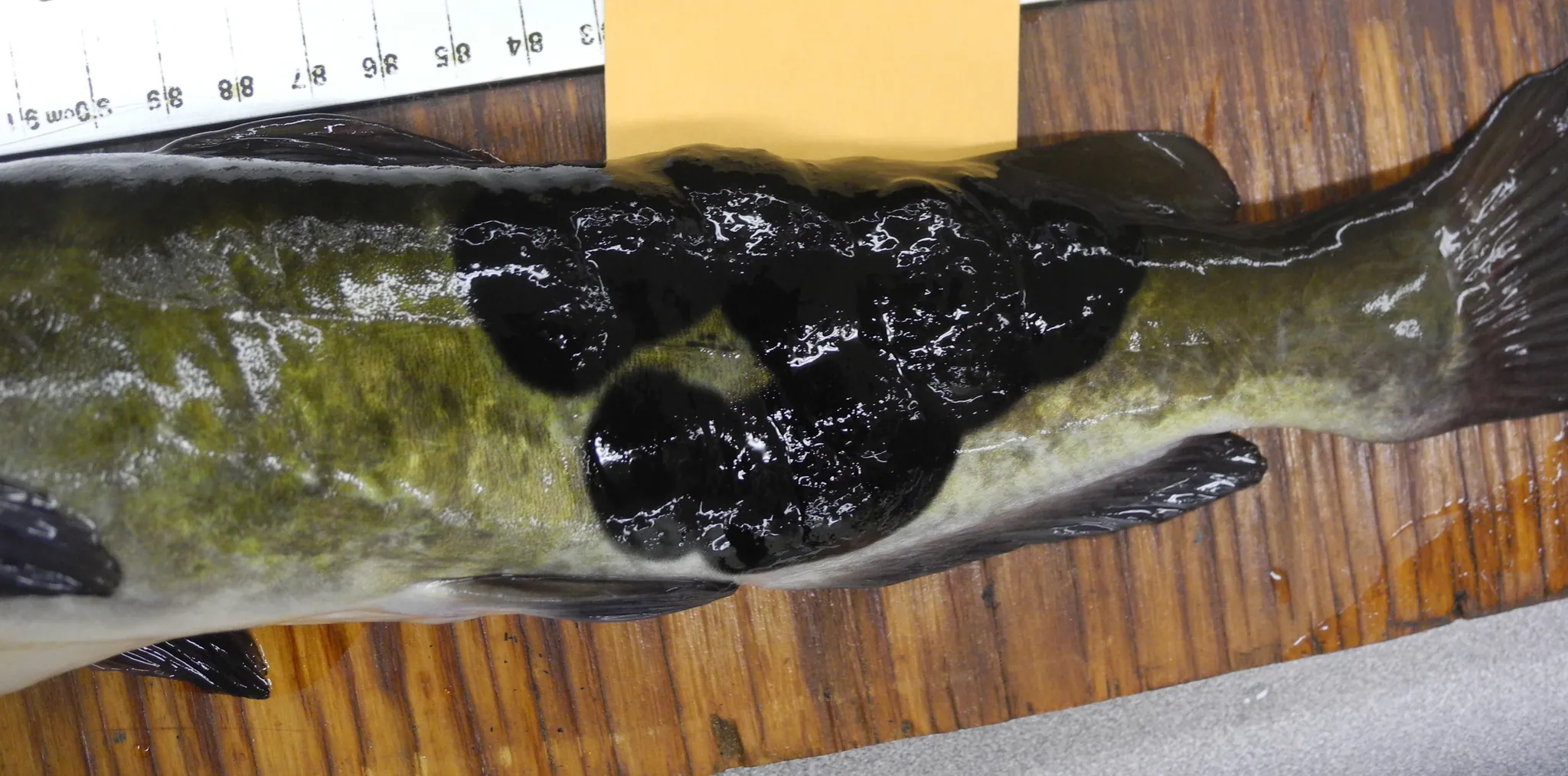
That is biologically striking. It is not the same as a contagious infection in the everyday sense. A virus or bacterium can often survive outside a host long enough to reach a new one, enter cells, replicate, and spread. A transmissible cancer requires living cancer cells from one animal to persist as cells in another animal. Those cells must survive transfer, avoid immediate immune destruction, and keep functioning in the new host’s tissue environment.
The catfish melanoma described in the Nature paper is adapted to catfish biology.[1] The University of Vermont account of the work states the boundary plainly: the researchers say the cancer cells “cannot infect or survive in another species.”[2] That sentence is doing a great deal of work. It does not merely say that human infection has not been observed. It says the cells are not expected to remain viable as a cancer in a different species.
Why “Transmissible” Does Not Mean Human-Infectious
For a catfish tumor cell to become a human cancer, several unlikely barriers would have to fall at once. The cell would need to enter the body alive. It would need to tolerate human temperature, chemistry, tissue structure, and immune surveillance. It would need to escape recognition as foreign tissue. Then it would need to divide and obtain the support that a growing tumor requires.
The immune barrier is not a minor technicality. Prof. Beata Ujvari of Deakin University explained in expert commentary that allogeneic cells — cells from another individual — are generally rejected by the immune system, and a cross-species transfer creates an even larger mismatch.[3] In plain terms, a human immune system does not see catfish tumor cells as “almost self.” It sees foreign animal cells. That is not a hospitable starting point for cancer transmission.
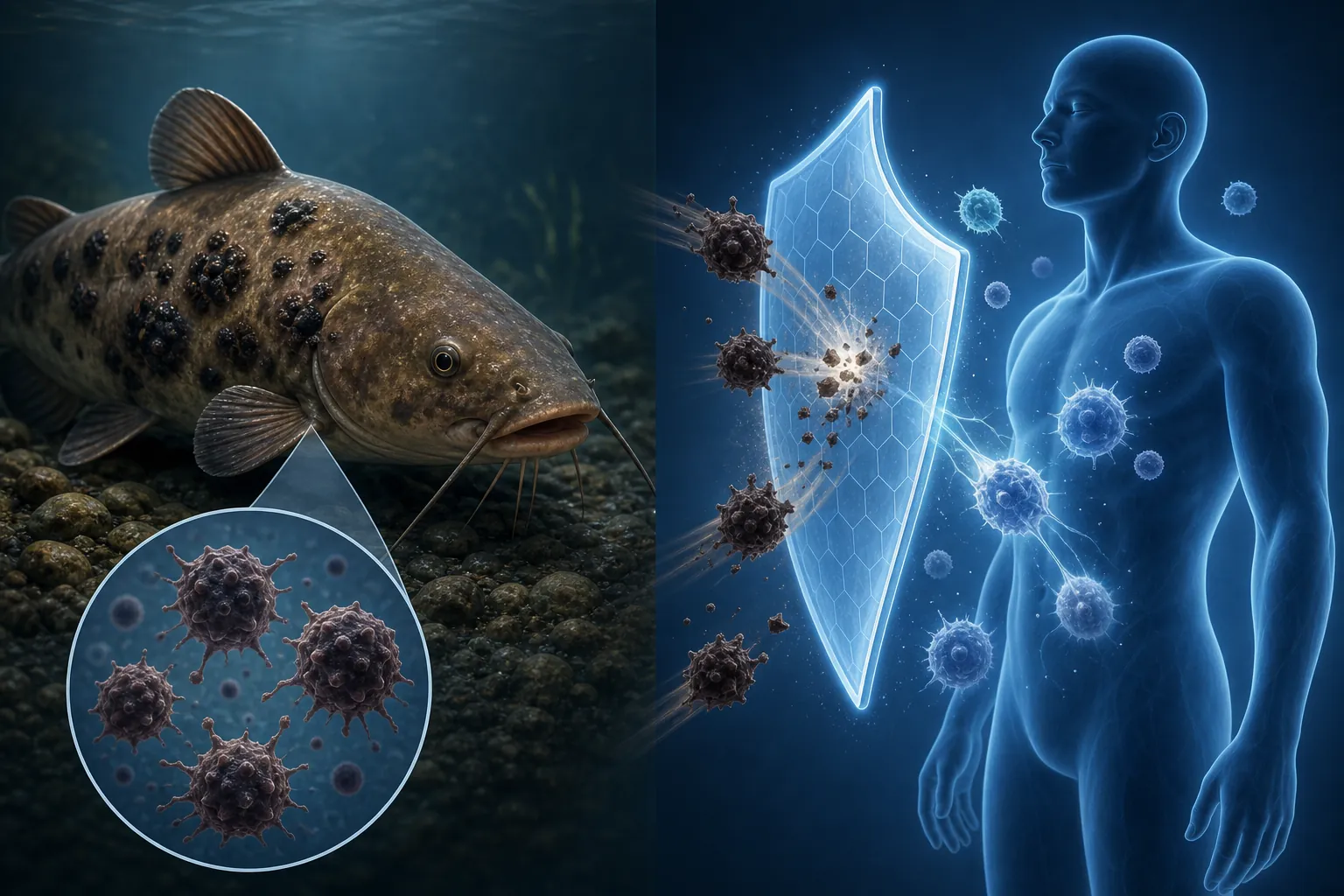
Dr. Elizabeth Murchison of the University of Cambridge, whose work has shaped much of the modern understanding of transmissible cancers, put the human-risk judgment in unusually firm terms: the risk is “as close to zero as it gets.”[3] That assessment is consistent with the research team’s own statement about species survival, not a separate reassurance pasted onto the science after the fact.
Dr. Alberto Báez-Ortega, also quoted in the expert roundup, placed the finding in the small comparative category of known transmissible cancers in animals.[3] That context is useful because it keeps the catfish discovery from sounding either unprecedented in all of biology or broadly threatening to humans. Transmissible cancers do exist in nature. They remain rare, host-bound phenomena, and this fish case does not change the human record.
Has Any Animal Cancer Ever Been Passed to People?
No documented animal-to-human transmissible cancer is known. The Wellcome Sanger Institute stated in 2019 that “cancer has never been passed from animals to people.”[5] That statement predates the 2026 catfish paper, so it was not written in response to this discovery. Still, the catfish paper and the expert commentary do not overturn it; they add another animal transmissible cancer to the comparative oncology record, while preserving the same human boundary.
This distinction is where public language can go wrong. “Zoonotic” usually refers to diseases or agents that move from animals to humans. Calling the catfish finding a “zoonotic cancer risk” would imply a bridge that the evidence does not show. The cancer is transmissible within its own biological setting. It is not documented as transmissible to humans, and the cited experts explain why that leap is biologically implausible.
There is also a separate topic: viruses or other infectious agents that may contribute to cancer. That is not what the catfish paper reports. A cancer-causing virus, when proven, is an infectious agent that can increase cancer risk through infection and later cellular changes. A transmissible cancer is different: the cancer cell itself is the transmissible unit. Blending those two questions creates more alarm than clarity.
What This Means for Handling or Eating Catfish
For cancer risk, the practical implication is straightforward: the available evidence does not support fear that touching, cleaning, or eating catfish with this melanoma can give a person cancer. Quebec’s Ministry of the Environment, as reported by CBC, said the disease poses no known risk to humans.[4] That public-agency statement lines up with the narrower cellular biology: catfish melanoma cells are not equipped to become human cancer cells.
That does not mean every visibly diseased fish should be treated as appetizing or risk-free in every possible sense. People commonly avoid eating fish with abnormal growths, off odor, or signs of poor condition, and ordinary food-handling precautions still matter. But those are general quality and food-safety judgments. They are not evidence that catfish transmissible melanoma is a human cancer hazard.
A careful answer also avoids promising more than the sources can support. The Nature paper is new, and as of July 2026 it has not had years of independent replication or long-term surveillance built around it.[1] That freshness matters for scientific confidence about the fish disease itself. It does not, however, create a positive human-risk signal. The current evidence points in one direction: the cells are catfish-specific, and no animal-to-human transmissible cancer has been documented.
The Evidence Grade in Plain Terms
| Question | What the evidence supports |
|---|---|
| Was a transmissible cancer found in catfish? | Yes. The 2026 Nature paper reports a clonal melanoma in brown bullhead catfish in Lake Memphremagog. |
| Does transmissible mean it can infect humans? | No. In this case it means cancer cells can spread between suitable catfish hosts. |
| Can the catfish cancer cells survive in humans? | The research team says the cells cannot infect or survive in another species. |
| Has animal cancer ever been documented as passing to people? | No documented animal-to-human transmissible cancer is known. |
| What is the practical human cancer risk? | Effectively zero, based on the current paper, expert commentary, and public-agency statements. |
The most defensible conclusion is calm and narrow: the catfish discovery is important for biology, but it is not evidence that people can get cancer from catfish. For humans, the risk from this transmissible melanoma is effectively zero based on current evidence. The appropriate caveat is scientific, not alarming: the paper is only days old, so the fish-disease finding will need the usual follow-up work, but the sources now available do not support a zoonotic cancer threat.
References
- Transmissible melanoma in brown bullhead catfish, Nature, July 22, 2026
- More Than Parasites & Tumors: Vermont Scientists Discover Transmissible Cancer in Catfish, University of Vermont
- Transmissible melanoma: a type of cancer has been discovered in fish, the fourth known contagious tumor among animals, Science Media Centre Spain
- Fish transmissible cancer, CBC
- Six shocking animal cancer facts, Wellcome Sanger Institute, April 12, 2019