
The hard part of interpreting baby food recall plastic contamination health risks is that the FDA recall class sounds like a clinical grade, but it is not one. In the 2026 plastic-related baby-food recalls, the product with the highest FDA class was not the one with the widest distribution or the clearest report of plastic strands in food. It was the one with the most dangerous immediate mechanism: choking.
| Recall | FDA class | Reported problem | Reported injuries | What the notice does and does not show |
|---|---|---|---|---|
| Gerber Soothe N Chew teething sticks, Jan. 31, 2026 | Class I | Choking hazard from a teething-stick fragment; product line discontinued | One emergency-room visit; no serious injury reported | Shows a plausible airway-risk mechanism. Does not show that serious injury occurred in the reported case. [1] |
| Gerber Arrowroot Biscuits, Jan. 28, 2026 | Class II | Soft plastic/paper pieces traced to supplier-contaminated arrowroot flour; nationwide recall | No injuries reported | Shows foreign material in a food product. Does not show documented clinical harm at the time of the notice. [2] |
| Pumpkin Tree Peter Rabbit Organics Banana Strawberry fruit puree pouches, July 21, 2026 | Class II | Packaging defect released food-grade plastic strands; distributed through Kroger, Meijer, and Target; roughly 380,000 pouches recalled | No injuries reported | Shows a large exposure window and a defined packaging mechanism. Does not show reported injury in consumers at the time of recall. [3][4] |
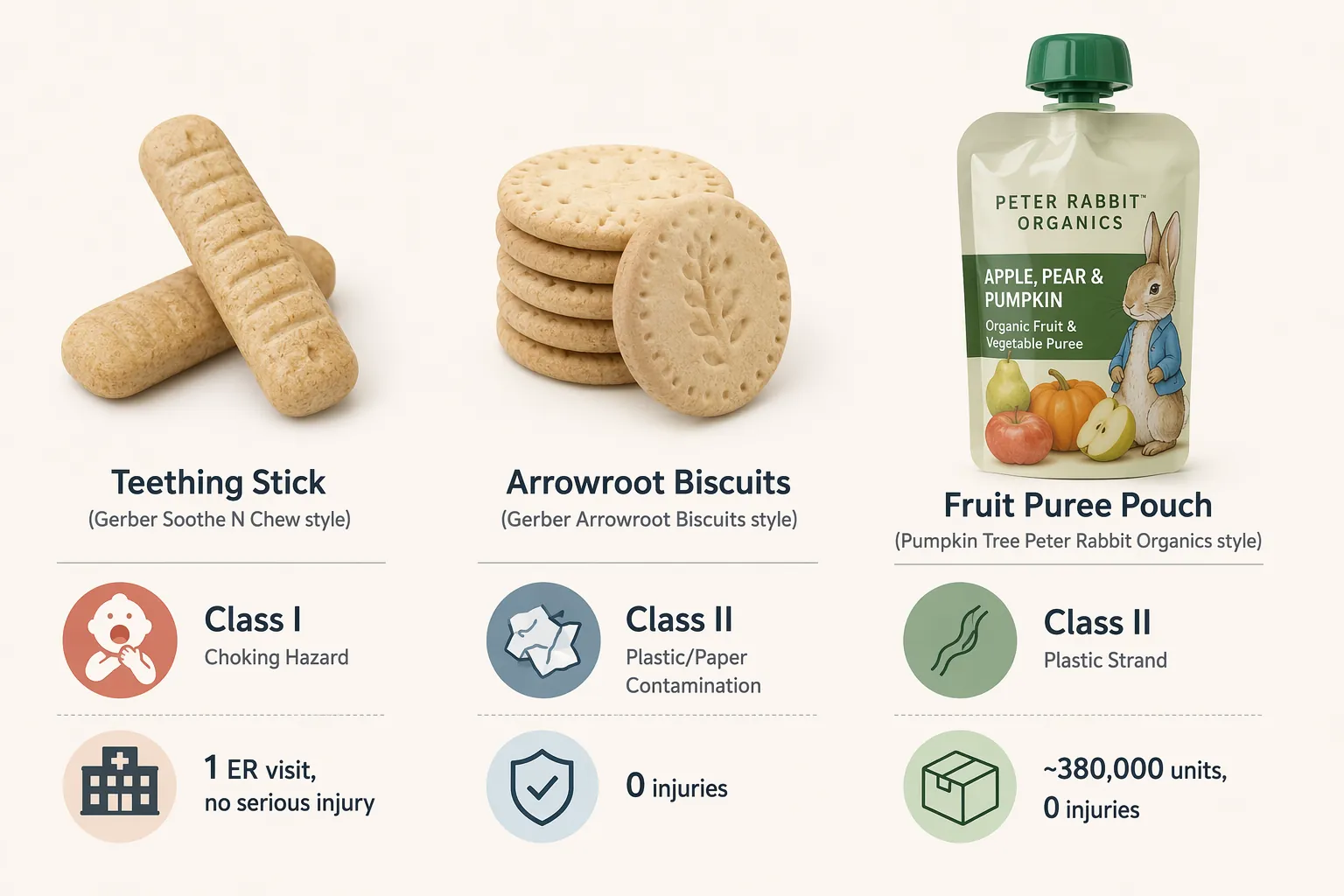
That pattern is counterintuitive only if the class is being read as a bedside severity score. It is more coherent when read as a regulatory signal about possible consequences under foreseeable use. A fragment that can obstruct an airway can justify a higher classification even if the reported clinical outcome was not serious. A wider recall involving soft food-grade plastic strands can remain Class II if the expected consequences are temporary or medically reversible and no injuries have been reported.
For a parent holding a recalled pouch, “zero injuries reported” is not the same as “irrelevant.” For a procurement lead or risk manager, “Class I” is not the same as “children were seriously harmed.” Both shortcuts distort the decision.
What the FDA class is actually measuring
FDA recall classes are built around the probability and seriousness of possible health consequences. Class I means there is a reasonable probability that use of or exposure to the product will cause serious adverse health consequences or death. Class II means use of or exposure to the product may cause temporary or medically reversible adverse health consequences, or that the probability of serious consequences is remote. Class III means use of or exposure is not likely to cause adverse health consequences. [5]
Those definitions do not count injuries. They do not rank public outrage. They do not say how frightened a parent should be after a child has already swallowed a bite. They describe the regulator’s judgment about the hazard scenario: what could happen, how serious it could be, and how likely that pathway appears from the information available.
That is why the Gerber Soothe N Chew recall can sit above the two plastic-contamination recalls in class even though the public facts include one emergency-room visit and no serious injury. The class follows the choking mechanism. The Arrowroot Biscuit and Pumpkin Tree pouch recalls involve foreign material in food, but the reported injury picture in both notices was quieter.
A choking hazard and a swallowed contaminant are not the same clinical pathway
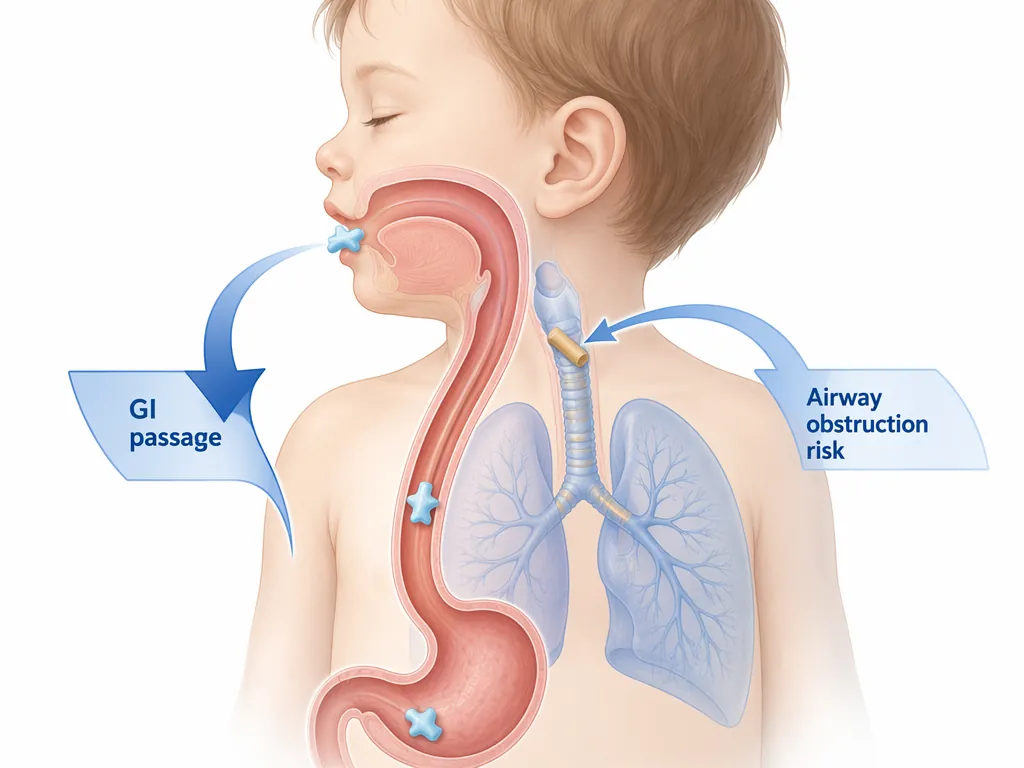
The relevant first question is not simply “Was there plastic?” It is where the material can go and what it can do there. A fragment lodged at the airway is an immediate emergency. A small object that reaches the gastrointestinal tract usually raises a different set of questions: size, shape, sharpness, symptoms, location, and whether it is likely to pass.
General pediatric foreign-body ingestion literature gives useful guardrails, although it does not perfectly match soft food-grade plastic in baby food. StatPearls summarizes that most ingested foreign objects pass spontaneously, while esophageal obstruction is the most common complication and occurs in a minority of cases. The same clinical frame explains why intervention is not automatic after every ingestion report. [6]
That evidence supports a narrower conclusion than many headlines imply. It does not prove that every plastic-contaminated pouch is harmless. It does explain why a choking-hazard recall can be classified more severely than a broader contamination recall with no reported injuries. Airway obstruction is a different risk pathway from gastrointestinal passage.
The fit is still imperfect. Coins, button batteries, magnets, sharp objects, and hard plastic pieces dominate much of the foreign-body literature. Soft plastic or paper fragments mixed into baby food are not the same exposure. The clinical comparator helps calibrate the alarm; it does not eliminate uncertainty.
The larger recall is not automatically the more dangerous recall
The Pumpkin Tree Peter Rabbit Organics recall is the clearest example of why scale and class need to be separated. Roughly 380,000 pouches is not a small operational event. Distribution through major retailers means many homes could plausibly have had the affected product. But the FDA notice described food-grade plastic strands from a packaging defect and zero reported injuries, which points to a different risk profile than a hard fragment that can lodge at the airway. [3][4]
The Gerber Arrowroot Biscuit recall sits between the two intuitively. It involved soft plastic/paper pieces in a dry baby-food product, with nationwide distribution and no reported injuries. The source was supplier-contaminated arrowroot flour, not a consumer misuse problem. That matters for removal and traceability, but the clinical question still turns on exposure: what was the child likely to swallow, and what harm pathway follows from that material? [2]
In a risk memo, those differences would not be cosmetic. A choking-hazard product may require urgent household-level removal even if the injury count is low. A contamination recall with no injuries may require broad inventory controls, lot checks, retailer notification, and parent communication without implying that serious harm has already been observed.
Where microplastic uncertainty belongs
Plastic in baby food also raises a chemical-exposure question, especially for infants and young children. That question should not be dismissed, but it should not be substituted for the documented recall facts either. The current evidence base does not provide an established safety threshold for infant microplastic ingestion, and much of the concern depends on mechanistic reasoning, animal data, exposure modeling, or extrapolation rather than direct pediatric outcome data from recalled products. [7]
That distinction matters because the 2026 recalls discussed here were not all microplastic studies. They were recall notices involving fragments, pieces, strands, or product breakage. A parent may reasonably want to remove the affected food from the home immediately. A clinical reader should still avoid turning the absence of infant thresholds into a claim that these specific recalled products caused chemical injury.
The evidence gap cuts both ways. It prevents overclaiming harm from a recalled pouch with no injury reports. It also prevents the cleaner-sounding reassurance that food-grade plastic exposure is automatically trivial for infants. The correct statement is narrower: the documented recalls identify contamination or choking mechanisms, while infant-specific chemical-risk thresholds remain unsettled.
How to read the next plastic-related baby-food recall
A recall class is a starting signal. It tells the reader to look for the mechanism of harm, not to stop reading. The practical sequence is simple enough to use in a kitchen, a procurement office, or a safety huddle.
- Confirm the product, lot, size, flavor, date code, and retailer channel before assuming exposure.
- Identify the mechanism: choking, gastrointestinal foreign-body passage, obstruction, laceration, contamination, or chemical exposure.
- Separate reported injuries from possible consequences; both matter, but they answer different questions.
- Treat “no injuries reported” as a surveillance fact, not as proof that exposure cannot matter.
- Treat “Class I” as a regulatory warning about serious possible consequences, not as evidence that serious injury has already occurred.
For the 2026 cases, that approach produces a less dramatic but more useful reading. Gerber Soothe N Chew received the highest class because choking can become serious quickly, despite only one reported emergency-room visit and no serious injury. Gerber Arrowroot Biscuits and Pumpkin Tree pouches were Class II recalls even though they involved actual foreign material in food, because the reported harm record and expected clinical course were different.
Recall class is therefore not noise, but it is not the whole signal. It is an instruction to investigate exposure and mechanism before translating a regulatory category into a clinical judgment.
References
- Baby Food Recall Gets FDA's Highest Risk Level, Newsweek.
- Gerber Products Company Announces Voluntary Recall of Limited Batches of Arrowroot Biscuits Out of an Abundance of Caution, U.S. Food and Drug Administration, Jan. 28, 2026.
- PT Organics Limited Recalls Select Pumpkin Tree Peter Rabbit Organics Banana Strawberry Fruit Puree, U.S. Food and Drug Administration, July 21, 2026.
- Baby Food Recall: Pumpkin Tree Peter Rabbit Organics, Consumer Reports.
- Recalls Background and Definitions, U.S. Food and Drug Administration.
- Pediatric Foreign Body Ingestion, StatPearls, NCBI Bookshelf.
- Infant microplastic exposure overview, PMC.