
As of July 24, 2026, the Midwest Poultry Services egg recall is the kind of FDA update that looks incomplete for a reason: the recall is public, the pathogen is serious, the distribution footprint is defined, and the classification field has not yet caught up with the instinct to label it.
The FDA notice says Midwest Poultry Services L.P. voluntarily recalled shell eggs because of possible Salmonella Enteritidis contamination. The affected eggs were distributed in Texas, Louisiana, Oklahoma, Arkansas, New Mexico, and Mississippi, with identifiers including plant code P-1950, code 0840962, and Julian dates 157 through 184. The notice also says no illnesses had been reported at the time of the announcement.[1]
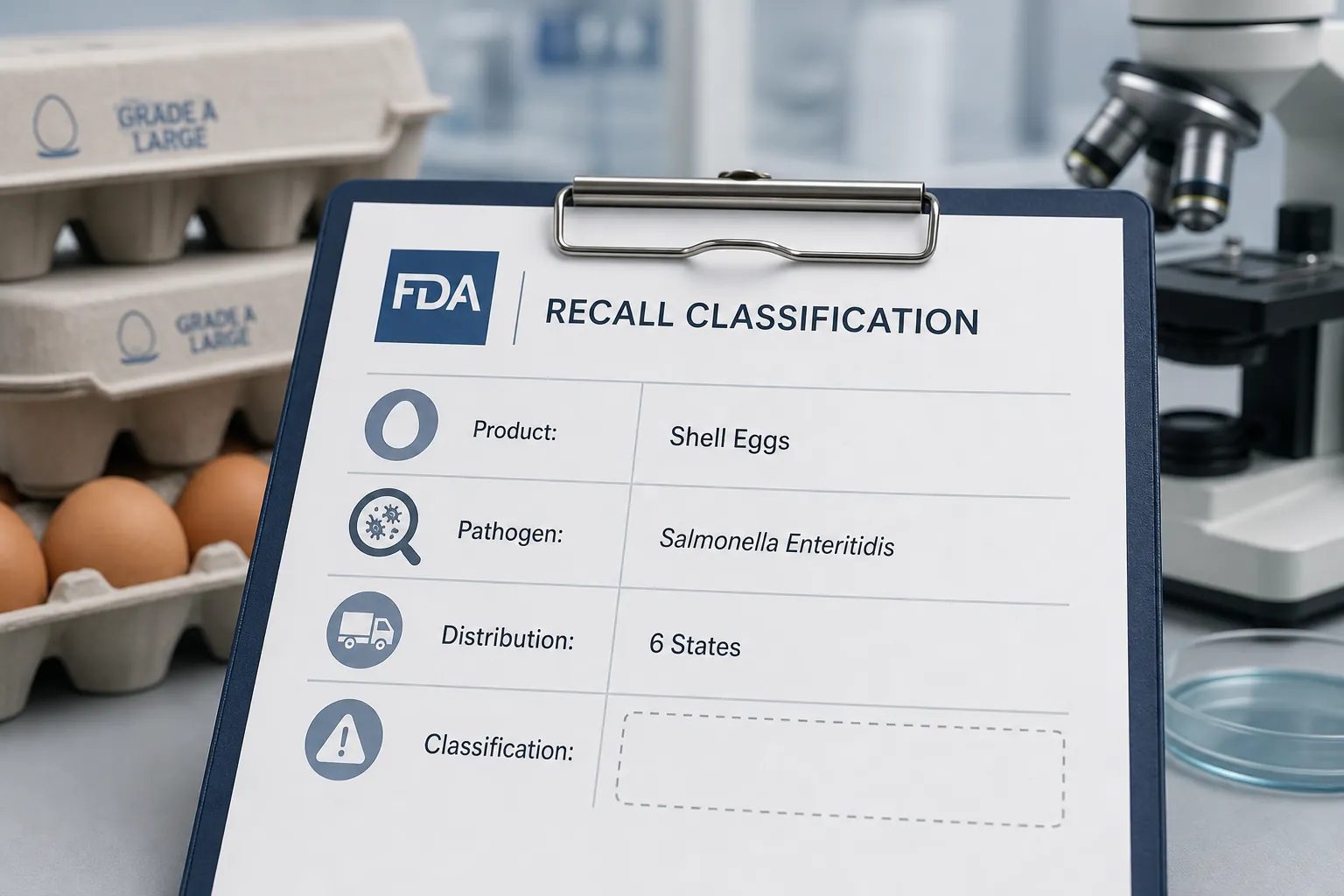
That last fact does not make the recall trivial. It makes the classification question harder. A pathogen with known severe consequences can be present before epidemiologists have linked illnesses to a product, before consumer exposure is fully understood, and before FDA has finished the hazard assessment that turns a recall entry into Class I, Class II, or Class III.
For readers who need the affected cartons, UPCs, and lot details rather than the classification issue, the companion Midwest Poultry Services egg recall list is the better working document. The question here is narrower: why does an FDA egg recall involving possible Salmonella remain unclassified when the hazard itself can be severe?
What the FDA Has Actually Said So Far
The primary FDA recall notice does three important things. It identifies the product and distribution states. It states the reason for the recall as possible Salmonella Enteritidis contamination. And it reports that the company initiated the recall after environmental testing indicated possible contamination, with no illnesses reported at announcement.[1]
The FDA recalls page, however, did not show a Class I, Class II, or Class III classification for the Midwest Poultry entry as of the July 24 status check.[2] That absence should be read literally. It means the public recall entry exists without a completed or published FDA classification. It does not mean FDA has declared the product low-risk, and it does not mean FDA has already decided the recall is Class I.
This distinction matters for procurement teams and safety committees because operational decisions often happen before the classification is posted. Product may already be held, supplier records may already be reviewed, retail notifications may already be flowing, and legal teams may already be preserving documentation. The public label is an important governance signal, but it is not the first moment the risk becomes operationally real.
The Three Classes Are Hazard Assessments, Not Alarm Levels
FDA’s recall classes are defined around the probability and severity of harm. A Class I recall is a situation in which there is a reasonable probability that use of, or exposure to, a violative product will cause serious adverse health consequences or death. Class II covers situations where use of, or exposure to, a violative product may cause temporary or medically reversible adverse health consequences, or where the probability of serious adverse health consequences is remote. Class III covers situations where use of, or exposure to, a violative product is not likely to cause adverse health consequences.[3]
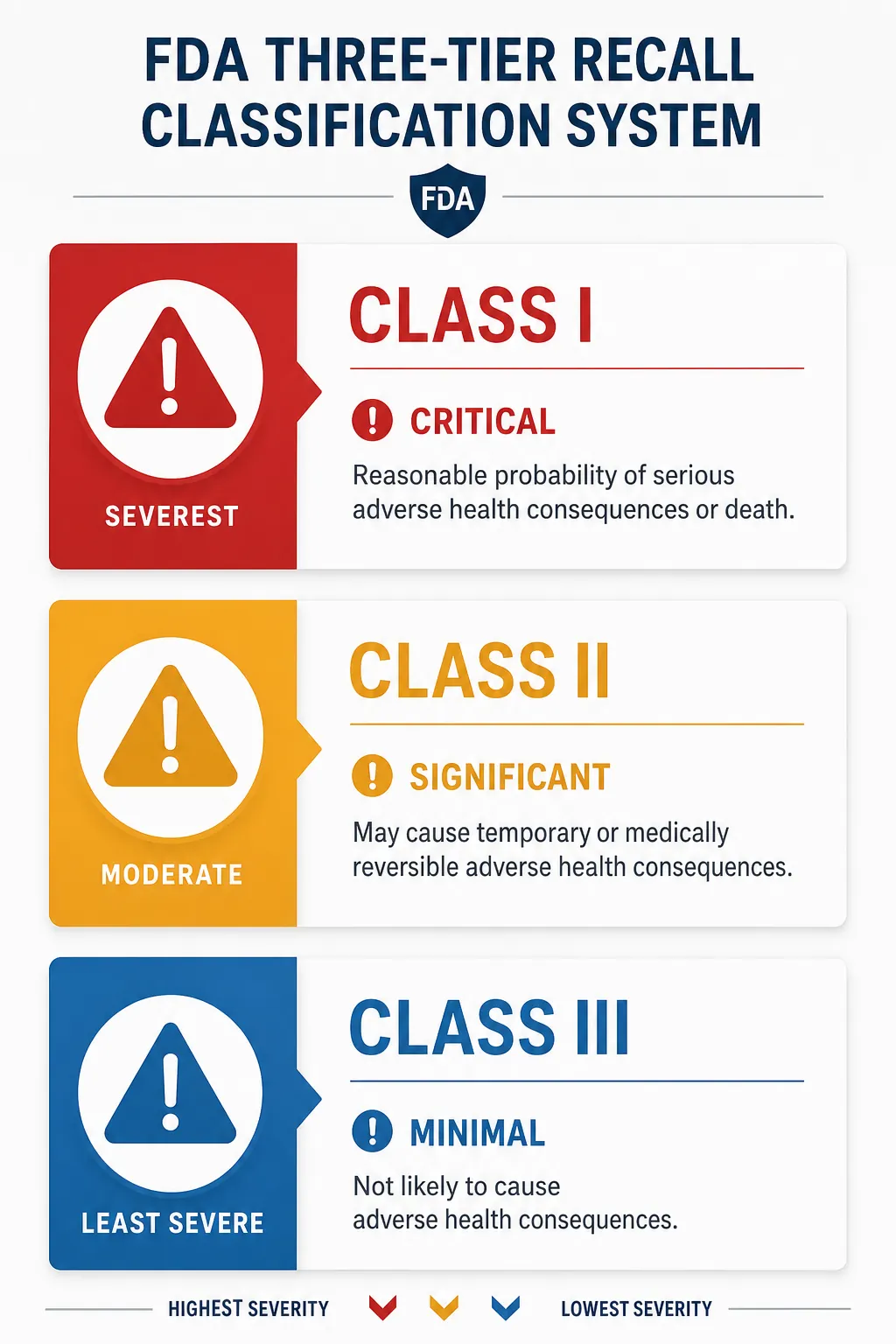
| FDA recall class | What the label means in practice |
|---|---|
| Class I | The agency sees a reasonable probability of serious adverse health consequences or death. |
| Class II | Harm may be temporary or reversible, or the chance of serious harm is remote. |
| Class III | Adverse health consequences are not likely. |
| Unclassified | The recall is public, but FDA has not yet assigned or published a class. |
Those labels do not translate cleanly into everyday shorthand. Class I is not simply the recall that sounds worst in a headline; it requires a judgment about reasonable probability as well as severity. Class II is not a safe product; it still involves potential adverse health consequences. Class III is not irrelevant; it means the expected health consequence is low, not that the event lacks regulatory importance. And unclassified is not a quiet synonym for Class III.
The same framework applies across FDA-regulated products. Clinical teams may meet it in food recalls, device corrections, drug withdrawals, or clinical-AI incident tracking. That is why a food recall can still be relevant to readers who usually follow medical-device and AI governance issues; the interpretive problem is the same. A label that arrives late, changes later, or remains absent for a time has to be handled without either false reassurance or premature escalation. The same classification logic appears in FDA device recall discussions such as why AI medical devices are recalled sooner and more often.
Why Salmonella Pushes the Case Toward Seriousness
On severity alone, Salmonella Enteritidis cannot be treated casually. CDC outbreak materials on eggs and Salmonella emphasize that infection can be especially dangerous for young children, older adults, and people with weakened immune systems.[4] That is the part of the case that makes a Class I outcome plausible in the abstract: the contaminant is capable of causing serious illness, and vulnerable populations may face worse outcomes.
The stronger wording should stop there. The Midwest Poultry notice does not say illnesses have been confirmed. It does not identify a CDC outbreak linked to the recalled eggs. It does not say hospitalizations or deaths have occurred. Turning “possible contamination” into confirmed illness would overstate the public record.
This is the central tension in the Midwest Poultry egg recall: the hazard profile is severe enough to deserve immediate attention, but the evidence of actual harm was still absent at announcement. FDA’s classification system has to account for both sides of that sentence.
Why Zero Reported Illnesses Can Delay a Classification
A recall can begin because a company or regulator detects contamination risk before people are known to be sick. That appears to be the posture here. Reuters, citing the FDA notice, reported that the recall covered nearly 1.59 million dozen eggs and that the issue was detected through proactive environmental monitoring rather than through a confirmed illness cluster.[5]
That detection route is important. It suggests the company and regulators are acting on contamination evidence, not waiting for a case count to build. It also means the public record does not yet contain the type of epidemiological evidence that can make a Class I determination straightforward: confirmed illnesses, traceback linkage, genetic matching, hospitalization data, or evidence that contaminated product reached a population at high risk.
The August Egg Company outbreak shows the difference. FDA’s 2025 outbreak investigation recorded 134 illnesses, 38 hospitalizations, and 1 death in a Salmonella outbreak linked to eggs.[6] Those numbers do not prove anything about Midwest Poultry. They show what a more concrete evidentiary record looks like when an egg-associated Salmonella event moves from contamination concern to confirmed outbreak.
A prior Black Sheep Egg Company entry also illustrates why unclassified status should not be treated as final. FDA recall tracking showed an initial unclassified posture before later Class I elevation after illness evidence emerged.[2] The lesson is administrative rather than predictive: an unclassified recall is a status at a point in time, not a permanent risk judgment.
Retailer Context Helps With Exposure, Not Classification by Itself
Retail distribution makes the recall visible to consumers and procurement teams, but it does not by itself decide the FDA class. CBS News reported Kroger among the retailers connected to the Midwest Poultry recall.[7] That matters for locating product and understanding potential exposure channels. It does not convert possible contamination into confirmed illness.
The state list also needs discipline. The FDA egg recall notice identifies six distribution states: Texas, Louisiana, Oklahoma, Arkansas, New Mexico, and Mississippi.[1] Other state lists circulating around adjacent poultry or prepared-food alerts should not be copied into this recall unless they are tied to the FDA Midwest Poultry egg notice itself.
For operations teams, the practical response is still concrete: isolate potentially affected inventory, check supplier and distributor records, preserve purchase documentation, and route consumer or patient-facing questions through the latest FDA notice. None of those steps requires guessing the final class.
How to Read the Midwest Poultry Status Today
The cleanest reading is also the least dramatic: Midwest Poultry Services has a public voluntary shell egg recall involving possible Salmonella Enteritidis contamination; the affected distribution states and identifying codes are known; no illnesses were reported at announcement; and FDA had not published a Class I, II, or III designation as of July 24, 2026.[1][2]
That combination supports caution without speculation. The severity side of the record explains why the recall deserves serious handling. The confirmed-harm side explains why the classification may still be pending. The FDA class, when it appears, will be a formal hazard assessment rather than a headline translation of how frightening Salmonella sounds.
For clinical-AI and medical-device governance readers, the useful habit is portable. FDA labels often arrive after operational risk work has already begun. Teams that know how to read “unclassified” correctly can avoid two bad moves: treating the absence of a class as reassurance, or declaring a Class I outcome before FDA has assigned one. The same discipline applies in other recall categories, including Class II case studies such as AI models and antihistamine recall risk assessment, and in downstream alerting systems such as AI-powered consumer recall apps.
The analysis should change if the record changes. Confirmed illnesses, outbreak linkage, new traceback findings, or an FDA hazard-assessment update could support a later classification. Until then, the Midwest Poultry recall remains unclassified because FDA classification is not a pure measure of contaminant severity; it weighs severity, probability, exposure, and available evidence of harm.
References
- Midwest Poultry Services, L.P. Recalls Shell Eggs Due to Possible Salmonella Enteritidis Contamination, FDA, July 22, 2026
- Recalls, Market Withdrawals, & Safety Alerts, FDA
- Recalls Background and Definitions, FDA
- Salmonella Outbreak Linked to Eggs, CDC
- Poultry firm recalls nearly 1.6 mln dozen eggs over potential salmonella, US FDA says, Reuters, July 23, 2026
- Outbreak Investigation of Salmonella: Eggs (June 2025), FDA
- Egg recall for salmonella risk includes Kroger stores in 6 states, CBS News