
The FDA De Novo classification for neuropacs gives hospitals a real regulatory event to evaluate, not just another AI imaging press release. It also gives value-analysis committees a familiar trap: a cleared device, a high-profile JAMA Neurology study, and sensitivity figures strong enough to dominate the room before anyone has asked what counted as ground truth. For anyone tracking Parkinson’s diagnosis developments in 2025, neuropacs is one of the more serious entries precisely because the evidence is substantial enough to deserve a careful reading.
The regulatory fact is narrow. FDA’s De Novo database lists DEN240071 for neuropacs, an AI-based MRI diagnostic aid for parkinsonian syndromes.[1] The device is not a standalone Parkinson’s disease diagnosis system. It is intended to provide supplemental information, after other causes of parkinsonism have been clinically excluded. That distinction matters because the published evidence can support one use case while still falling short of another: a tertiary movement-disorder clinic adding structured MRI-derived information to an expert workup is not the same as a community neurology group relying on the output to resolve an early, ambiguous presentation.
What the JAMA Neurology study actually tested
The main study deserves attention. It was a prospective multicenter evaluation across 21 Parkinson Study Group sites in the United States and Canada, with 249 patients: 99 with Parkinson’s disease, 53 with multiple system atrophy-parkinsonian type, and 97 with progressive supranuclear palsy. The investigators also analyzed a retrospective cohort of 396 patients, and the work was NIH-funded.[2]
The reported diagnostic performance is the part that procurement packets will quote first. The AI approach showed 96% sensitivity for distinguishing Parkinson’s disease from atypical parkinsonism, and 98% sensitivity in pairwise comparisons of Parkinson’s disease versus multiple system atrophy and Parkinson’s disease versus progressive supranuclear palsy.[2] In the neuropathology-confirmed subset of 25 patients, the AI predicted the correct diagnosis in approximately 94% of cases, compared with 81.6% for clinical diagnosis.[2]
Those are not trivial results. Diffusion MRI is attractive here because it avoids ionizing radiation and targets a clinical problem where uncertainty is real. Parkinson’s disease, multiple system atrophy, and progressive supranuclear palsy can overlap clinically, especially early, and getting the syndrome wrong can alter counseling, trial eligibility, medication expectations, and follow-up intensity. A noninvasive MRI-based aid that performs well in expert hands is worth taking seriously.
Taking it seriously, however, means reading it as a diagnostic accuracy study rather than as a clearance celebration.
| Appraisal domain | What supports confidence | What limits confidence |
|---|---|---|
| Design | Prospective multicenter cohort across 21 Parkinson Study Group sites; 249 prospective patients plus 396 retrospective patients.[2] | The prospective setting was specialized: tertiary movement-disorder centers, not primary-care or community neurology. |
| Target condition | Clinically important distinction among Parkinson’s disease, multiple system atrophy-parkinsonian type, and progressive supranuclear palsy.[2] | The published results do not separately report performance in the early or ambiguous cases where diagnostic uncertainty is often greatest. |
| Reference standard | A neuropathology-confirmed subset was included and points in a favorable direction.[2] | For more than 97% of patients, the reference diagnosis was clinical rather than neuropathologic.[2] |
| Blinding and thresholds | The study used a structured AI imaging approach rather than an informal reader impression.[2] | The study was not blinded, and the AI algorithm was not tested prospectively against a prespecified threshold. |
| Intended-use fit | FDA classified neuropacs as a supplemental MRI-based aid, which is a more defensible claim than standalone diagnosis.[1] | Clinical utility depends on how much the supplemental result changes decisions, who interprets it, and whether the MRI protocol is reproduced reliably. |
The reference standard is the central weakness, not a technicality
A high sensitivity figure is only as reassuring as the comparator it was measured against. In most of the prospective study, neuropacs was judged against clinical diagnosis. That is a practical choice in Parkinsonian syndromes, because autopsy confirmation is rarely available during life. It is also the reason the result cannot be read as pathology-grade accuracy.
Clinical diagnosis is not a disposable endpoint. In a tertiary movement-disorder setting, it often reflects the best available synthesis of examination, history, progression, medication response, and expert judgment. But when clinical diagnosis becomes the reference standard for an AI model, errors in the comparator can become errors in the label. The model may be rewarded for matching expert clinical impressions, even when some of those impressions would later be revised.
That problem is structural in Parkinson’s disease research. A Finnish 10-year diagnostic stability study found that 13.3% of neurologist-made Parkinson’s disease diagnoses were revised within 10 years, with a median 22 months to revision, and only 3% of deceased patients received autopsy confirmation.[3] Those numbers do not invalidate the JAMA Neurology study. They explain why a clinical reference standard should be treated as a limitation with practical consequences, not as a footnote.
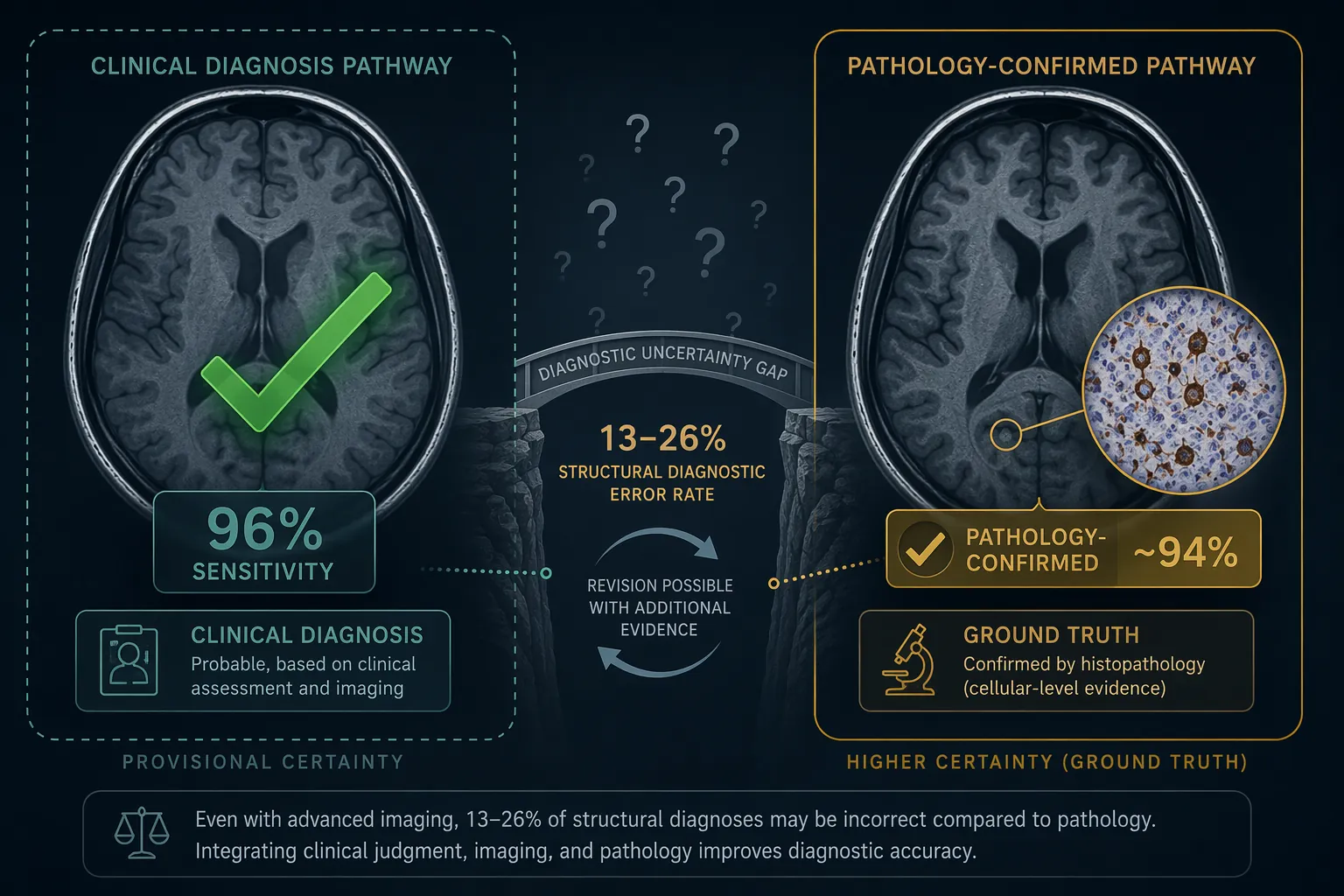
The autopsy-confirmed subset is therefore important, and it is encouraging. Approximately 94% correct prediction in neuropathology-confirmed cases is the kind of signal one wants to see before arguing that an imaging biomarker reflects disease biology rather than only local diagnostic habits.[2] The problem is size. A subset of 25 patients can reduce anxiety about face validity; it cannot carry the full evidentiary burden for broad deployment across different scanners, protocols, readers, referral pathways, and disease stages.
This is where procurement language often drifts. “Supported by autopsy-confirmed cases” is accurate. “Validated against neuropathology” would be too strong if it implies that the main performance figures came from pathology-confirmed diagnoses. The first statement helps a committee understand the evidence. The second can set up false reassurance.
Expert-center performance does not automatically travel
All prospective patients in the study came from tertiary movement-disorder centers.[2] That is a strength for internal diagnostic discipline and a weakness for transportability. These centers have clinicians who see parkinsonian syndromes frequently, know the atypical patterns, and can apply diagnostic exclusions with more consistency than a general setting. They also tend to receive patients after referral, which can change case mix.
A hospital committee has to ask a different question from the one answered by the study. The study asks whether diffusion-MRI AI can distinguish Parkinson’s disease from atypical parkinsonism in a specialized research network. The deployment question asks what happens when orders come from clinicians with different levels of movement-disorder expertise, MRI acquisition varies by site, and the patient population includes more borderline presentations.
That difference is not academic. A tool can look strongest in the place where clinicians already know how to frame the differential diagnosis, exclude mimics, and interpret discordant information. The organization may hope to use the same tool where diagnostic uncertainty is greater. Unless performance is separately reported in those early, ambiguous, or lower-expertise settings, the committee cannot assume that the published sensitivity will follow the device into routine community use.
The missing subgroup is especially consequential: early or ambiguous cases are not separately reported. If a patient has a classic presentation in a tertiary clinic, supplemental MRI information may confirm what the specialist already suspects. If a patient is early, mixed, medication-confounded, or incompletely worked up, the same output may be more tempting and less secure. That is the exact deployment condition where governance should be strictest.
Blinding and threshold choices change how the numbers should be used
The study was not blinded. Movement-disorder specialists providing the reference diagnosis may have been aware of imaging findings, and the AI algorithm was not prospectively tested against a prespecified threshold. Those features do not make the study unusable, but they move it away from the kind of locked, blinded validation that should anchor confident enterprise adoption.
Blinding matters because diagnostic labels in Parkinsonian syndromes are partly interpretive. If the reference diagnosis and imaging information are not fully separated, the evaluation can overstate agreement between the AI result and clinical diagnosis. Thresholds matter because post hoc or insufficiently locked decision rules can perform better in a study dataset than in the next population. A committee does not need to reject the evidence on this basis. It does need to avoid treating the reported sensitivity as a plug-and-play operating characteristic for every future site.
Supplemental-use labeling is a governance condition, not a disclaimer to ignore
The De Novo classification is more defensible because the device is positioned as supplemental information, not as a replacement for clinical diagnosis.[1] That should shape deployment. The output belongs inside a defined diagnostic workflow: who may order the scan, what MRI protocol is required, who checks technical adequacy, how the result appears in the report, and what clinicians should do when the AI output conflicts with the clinical impression.
“Supplemental” also limits the strength of the value argument. Diagnostic accuracy does not automatically produce clinical utility. A supplemental aid earns its place if it changes decisions that matter: fewer unresolved referrals, better selection for specialty evaluation, clearer counseling, avoided inappropriate treatment expectations, or improved trial routing. The published study supports diagnostic discrimination in expert settings; it does not by itself show that adding neuropacs changes downstream management, outcomes, cost, or patient experience in routine care.
There is also a circularity problem to manage. The device requires prior clinical exclusion of other causes of parkinsonism, so its use depends on the user’s diagnostic discipline. But one reason to buy the tool is to aid diagnostic discrimination. That can be acceptable in a specialty clinic with clear order criteria. It is less comfortable if the device becomes a shortcut for clinicians who have not completed the exclusion work the intended use assumes.
Where it fits among other Parkinson’s diagnostic tools
Neuropacs should not be evaluated as if it were the only attempt to reduce uncertainty in Parkinsonian syndromes. DAT-SPECT, alpha-synuclein seed amplification assays, and skin biopsy approaches such as Syn-One all sit in the broader diagnostic landscape. They differ in invasiveness, availability, regulatory status, workflow burden, biological target, and the exact question they answer. There are no head-to-head comparisons in the provided evidence base that would support ranking neuropacs against those alternatives.
That caveat is important for procurement. A diffusion-MRI AI aid may be attractive because MRI is already familiar to many health systems and avoids nuclear medicine logistics. But a convenient workflow is not the same as proven incremental value. The relevant comparison is not “AI MRI versus everything else” in the abstract; it is whether adding this specific AI output to the local diagnostic pathway improves decisions enough to justify protocol control, radiology workflow changes, contracting, monitoring, and clinician education.
Commercial momentum should not be confused with implementation evidence
Neuropacs Corp. announced the De Novo classification alongside a $1 million seed round, which signals an early commercialization stage rather than a mature real-world evidence base.[4] That is not a criticism; every device has to begin somewhere. It does mean the committee should expect limited implementation data, especially on local failure modes: incomplete MRI protocol adherence, unclear report language, discordant cases, clinician overreliance, and whether the tool changes management or merely adds another line to the chart.
The remedial work after overconfident adoption is predictable. Someone will have to explain why a reassuring AI result did not exclude atypical disease, revise ordering criteria after use expands beyond the intended population, or audit cases where the result was treated as determinative despite supplemental labeling. Those tasks are avoidable only if deployment is designed around the limits of the study rather than around its most impressive percentage.
A procurement-ready reading
The strongest defensible reading is favorable but bounded. Neuropacs has credible expert-center evidence, a plausible clinical role, noninvasive imaging appeal, and an FDA De Novo classification for supplemental use. In a specialized tertiary movement-disorder practice, or in a tightly governed pilot with locked MRI protocols, defined ordering criteria, clinician education, and outcome monitoring, the evidence is substantial enough to justify serious consideration.
The same evidence does not justify confident broad deployment across less specialized settings. The main reasons are not ideological objections to AI. They are diagnostic accuracy fundamentals: most reference labels were clinical rather than neuropathologic, the study was unblinded, performance in early or ambiguous cases was not separately reported, and all prospective patients came from tertiary movement-disorder centers. Those limitations are exactly the ones that matter when a CMIO asks whether the result will hold in community neurology, when neuroradiology asks who owns the protocol, and when value analysis asks whether supplemental information changes actual decisions.
A procurement memo that survives six months later should therefore avoid saying that neuropacs has solved Parkinson’s diagnosis. It can say that a serious prospective multicenter study found high sensitivity in expert-center differentiation of Parkinson’s disease from atypical parkinsonism, with encouraging but small neuropathology-confirmed support. It should also say that broader use needs local validation or a controlled pilot before the published JAMA Neurology results are treated as enterprise-wide performance expectations.