

The Promise: Rapid Adoption and Reported ROI
Healthcare administration in the United States consumes an estimated $350 billion annually in waste, with $266 billion attributed to administrative complexity alone, according to a 2019 JAMA study cited by the Peterson Health Technology Institute (PHTI). Against that backdrop, artificial intelligence has been positioned as the primary lever for cutting costs, reducing clinician burnout, and streamlining workflows. The adoption numbers through early 2026 suggest the industry is betting heavily on that promise.
A March 2026 survey by Eliciting Insights of 120 health system executives found that 75% of U.S. health systems now use at least one AI platform, up from 59% in 2025. Half of those systems run three or more AI applications simultaneously. The same survey reported that more than half of organizations able to quantify their AI return on investment saw at least a 2x ROI. The American Medical Association's 2026 Physician Survey on Augmented Intelligence (n=1,692, January–February 2026) found that 81% of physicians now use AI professionally, a dramatic leap from 38% in 2023. Seventy-six percent of physicians surveyed believe AI enhances their ability to care for patients.
The most heavily adopted use cases cluster around administrative burden reduction:
- Clinical note-taking (ambient scribes) leads at 68% adoption, with 62% year-over-year growth (Eliciting Insights, 2026).
- AI-based clinical documentation improvement and coding follows at 43% adoption, growing 59% year over year.
- Automated prior authorization processing, revenue cycle management, and patient scheduling round out the top administrative use cases.
The NVIDIA 2026 State of AI in Healthcare and Life Sciences survey adds another layer: 85% of healthcare executives report that AI is increasing revenue, and 80% say it is reducing costs. For payers and providers, the top ROI use case is administrative tasks and workflow optimization, cited by 39% of respondents.
The Paradox: PHTI Findings on System-Level Cost Inflation
If AI is delivering per-organization savings and physicians are embracing it, where is the problem? The answer, according to a January 2026 expert workshop convened by the Peterson Health Technology Institute (PHTI) under the Chatham House Rule, is that AI adoption in prior authorization and billing is unlikely to deliver system-level savings under current payment incentives. The workshop's findings, published in April 2026, identify a mechanism that runs counter to the efficiency narrative: AI tools are reducing per-transaction labor costs while simultaneously increasing the volume and complexity of transactions, leading to net cost inflation at the system level.
The PHTI report identifies three specific dynamics driving this paradox:
- AI-assisted coding tools are increasing billing intensity by capturing more billable elements per encounter than manual coding.
- Health plans are responding with across-the-board downcoding, which may disproportionately harm providers not yet using AI.
- Real-time prior authorization at the point of care remains not yet scalable, despite significant investment.
Current health plan responses are 'likely not sufficient to address AI-driven medical inflation,' the PHTI report concluded, as reported by Fierce Healthcare in April 2026.
This is the administrative AI paradox: the same tools that reduce documentation time and improve coding accuracy are also inflating total system costs by enabling higher-complexity billing and triggering defensive payer responses. The problem is not that AI fails to deliver efficiency — it is that efficiency, under fee-for-service incentives, translates into more revenue per encounter, not lower total spending.
Billing Intensity Dynamics: How AI Drives Higher-Complexity Coding
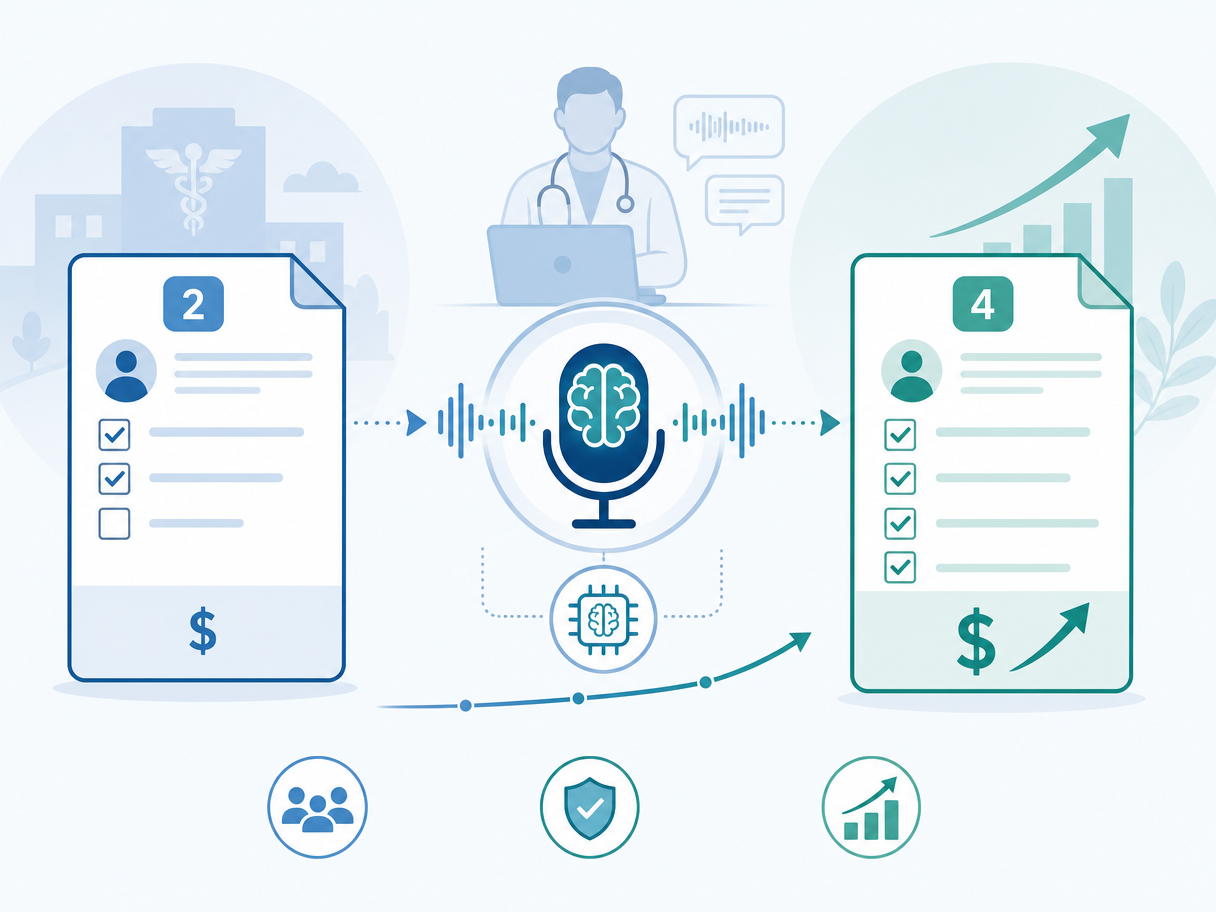
The most concrete mechanism driving system-level cost inflation is billing intensity escalation. Ambient clinical intelligence tools — AI scribes that generate clinical notes in real time — capture more detail than a physician typing or dictating manually. That additional detail translates directly into higher Evaluation and Management (E&M) coding levels and more comprehensive documentation of diagnostic-related group (DRG) complexity add-ons.
The PHTI workshop found that AI-assisted coding tools are increasing billing intensity faster than historical trends. When an ambient scribe captures every patient utterance, every review of systems question, and every minor finding, the resulting note supports a higher billing code than a manually generated note for the same clinical encounter. The effect is not fraudulent — it is technically accurate coding — but it represents a structural shift in how much revenue a given patient visit generates.
| Factor | Pre-AI Baseline | With AI Assistance | System-Level Effect |
|---|---|---|---|
| E&M coding level distribution | Manual coding, Level 3–4 typical | Shift toward Level 4–5 | Higher per-claim reimbursement |
| DRG complexity add-ons | Limited by documentation time | Comprehensive capture of comorbidities | Higher per-admission payment |
| Coding accuracy | Variable, dependent on coder skill | Consistent, guideline-driven | Fewer denied claims, more revenue |
| Payer response | Manual audit and selective downcoding | Across-the-board algorithmic downcoding | Net cost inflation for both sides |
Health plans have not been passive observers. According to the PHTI report, payers are responding with across-the-board downcoding — applying algorithmic rules to reduce billed codes regardless of clinical appropriateness. This creates a perverse dynamic: providers who invest in AI capture higher revenue, while those who do not face downcoding without the compensating benefit of higher initial billing. The net effect is an arms race in coding technology, not a reduction in administrative waste.
For a deeper look at how ambient AI systems function beyond simple note-taking, see our article on ambient clinical intelligence capabilities for health systems.
The 'Bot War' Problem: Provider AI vs. Payer AI in Prior Authorization
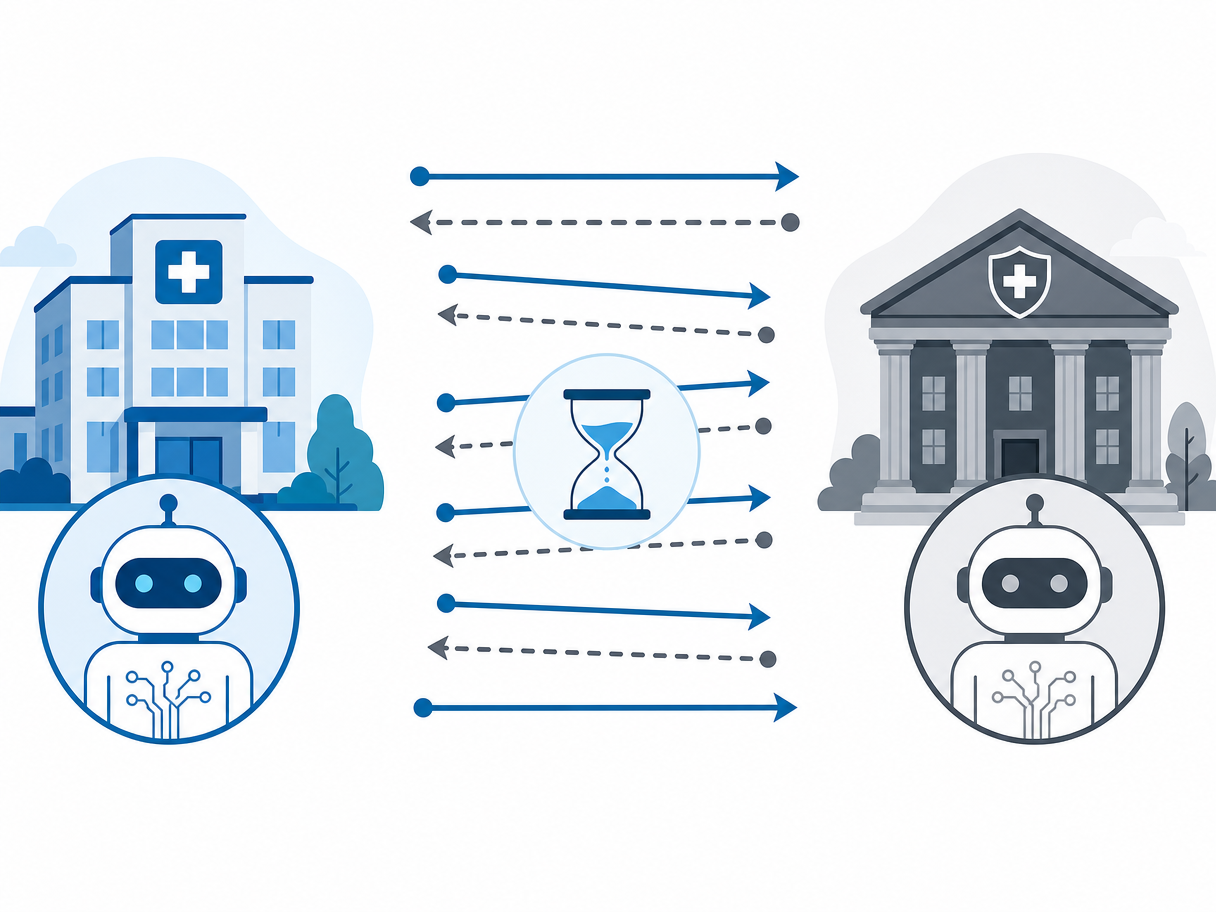
Nowhere is the paradox more visible than in prior authorization. AI tools on the provider side generate prior authorization requests faster and with more supporting documentation. AI tools on the payer side review those requests and issue denials faster. The result is not a streamlined process but a higher-volume, higher-speed back-and-forth that increases total transaction costs.
The PHTI workshop found that while AI speeds up individual prior authorization steps, there is no evidence that it reduces per-claim costs system-wide. Instead, the automation of both sides of the negotiation creates what analysts are calling a 'bot war' — provider AI generates a request, payer AI denies it, provider AI appeals, payer AI reviews the appeal. Each cycle consumes computational and human resources, and the volume of cycles increases as both sides deploy more sophisticated automation.
The Fierce Healthcare report on the PHTI findings (April 2026) notes that health plans are using across-the-board downcoding as a blunt instrument, which may disproportionately harm providers not yet using AI. This creates a two-tier administrative system: AI-equipped providers can fight denials at scale, while smaller or less-resourced practices face a growing disadvantage.
Shadow AI: The Governance Gap
A critical amplifier of the administrative AI paradox is the widespread use of AI tools outside formal IT governance structures. Wolters Kluwer's 2026 healthcare AI trends analysis reports that 78% of healthcare workers use AI without IT approval, and 63% of organizations lack formal AI governance policies. This 'shadow AI' phenomenon means that the billing intensity and bot war dynamics described above are occurring largely outside the visibility of health system leadership.
The risks of ungoverned AI deployment in administration include:
- Unmonitored billing practices: Clinicians using ambient scribes may inadvertently generate notes that support higher billing codes without understanding the downstream revenue impact or audit risk.
- Clinical deskilling: Wolters Kluwer expert Alex Tyrrell warns that generative AI tools that automate documentation may erode clinicians' ability to synthesize and document clinical information independently.
- Inconsistent vendor evaluation: Without centralized governance, different departments may adopt AI tools with varying accuracy, bias profiles, and regulatory compliance status.
- Data security and privacy gaps: AI tools used without IT approval may not meet HIPAA or institutional security requirements.
Wolters Kluwer's Holly Urban, MD, characterizes 2026 as 'the year of governance' for healthcare AI, predicting that health systems will be forced to catch up to clinician-led AI adoption. The governance gap is not merely a compliance issue — it is a direct contributor to the cost inflation paradox, because ungoverned AI deployments optimize for individual productivity without regard for system-level consequences.
Policy Levers: State Guardrails and Federal Deregulation
The regulatory response to the administrative AI paradox is unfolding along two tracks: state-level guardrails targeting AI-driven denials and downcoding, and a federal push for rapid AI adoption that may conflict with those state efforts.
According to Manatt Health's Q1 2026 Health AI Policy Tracker, 43 states have introduced more than 240 AI-focused bills in 2026, nearly matching the total for all of 2025. Only Wyoming and North Dakota have not introduced AI-focused health legislation since 2024. Several key laws have already been enacted:
| State | Bill | Effective Date | Key Provision |
|---|---|---|---|
| Indiana | HB 1271 | July 2026 | First law banning sole-AI downcoding of claims |
| Washington | SB 5395 | Enacted 2026 | Prohibits health carriers from relying solely on AI to deny or delay care |
| Utah | SB 319 | Enacted 2026 | Requires disclosure of AI use in utilization review |
| Maryland | HB 1563 | Enacted 2026 | Requires quarterly adverse-decision reporting to the insurance commissioner |
These laws share a common principle: AI may assist but not be the sole basis for denying or limiting care. They represent a direct response to the bot war dynamic and the concern that payer-side AI systems are issuing denials at scale without meaningful human review.
At the federal level, the dynamic is more complex. A December 2025 White House executive order directed the Department of Justice to establish an AI Litigation Task Force to challenge what it characterized as 'onerous' state AI laws. Over 50 Republican state lawmakers across 24 states sent a letter urging the Administration to stop blocking state AI legislation. The tension between federal deregulation and state guardrails creates an uncertain compliance environment for health systems operating across multiple states.
For a comprehensive overview of the federal regulatory framework, see our article: Artificial Intelligence and Health: The U.S. Regulatory Framework in 2026.
Recommendations for Health Systems and Policymakers
The administrative AI paradox cannot be resolved by technology alone. It requires coordinated action from health system leaders, policymakers, and standards organizations. The following recommendations are drawn from the PHTI workshop findings, emerging state regulatory frameworks, and expert commentary from organizations including Wolters Kluwer and Gartner.
For Health System Executives and CFOs
- Establish AI governance frameworks now. With 63% of organizations lacking governance policies and 78% of workers using AI without approval, the first step is visibility. Create a cross-functional AI oversight committee that includes clinical, financial, legal, and IT leadership.
- Measure system-level impact, not just per-transaction ROI. A tool that delivers 2x ROI on a single department's budget may be increasing total organizational costs through billing intensity or downstream payer responses. Build dashboards that track coding distribution, denial rates, and net revenue per encounter before and after AI deployment.
- Prioritize value over complexity. Gartner has advised health systems to evaluate AI tools based on their contribution to value-based care metrics rather than fee-for-service revenue optimization. Tools that increase coding complexity without improving patient outcomes are likely to attract regulatory scrutiny and payer pushback.
- Invest in end-to-end workflow redesign, not point solutions. Deploying an ambient scribe without addressing how notes flow into coding, billing, and prior authorization processes risks creating the bot war dynamic. Map the full administrative workflow before adopting AI at any single step.
For Policymakers and Regulators
- Adopt the principle that AI may assist but not be the sole basis for denying care, as Indiana, Washington, and Utah have done. These guardrails address the most acute risk of the bot war dynamic without blocking beneficial AI adoption.
- Require transparency in AI-assisted utilization review. Mandatory disclosure of when AI is used in prior authorization or claims processing, as Utah's SB 319 requires, enables providers and patients to understand and challenge automated decisions.
- Invest in data standardization. The PHTI workshop noted that real-time prior authorization at point of care remains not yet scalable, largely due to interoperability gaps. Federal and state action to mandate standardized data formats and APIs could unlock the system-level savings that point solutions alone cannot deliver.
- Fund independent evaluation of AI administrative tools. The PHTI workshop model — convening experts to assess evidence and identify unintended consequences — should be expanded and funded at scale. Health systems need unbiased assessments of which tools deliver genuine system-level savings versus those that merely shift costs.
The evidence from the PHTI workshop, the AMA survey, and state legislative activity through mid-2026 paints a clear picture: AI in healthcare administration is here to stay, and its benefits are real. But those benefits will not automatically translate into lower system costs. Without governance frameworks that align AI deployment with value-based incentives, without transparency requirements that prevent automated denial loops, and without data standards that enable true end-to-end automation, the paradox will persist: per-transaction efficiency gains alongside system-level cost inflation. The solution is not less AI — it is smarter, more coordinated, and more transparent AI deployment.