
The short answer is unsatisfying but useful: published evidence supports override protocols, clinician review, and human-in-the-loop safeguards in some healthcare AI deployments, but it does not yet prove that an AI agent kill switch, tested as its own intervention, independently prevents patient harm. No randomized trial has compared “kill switch available” with “kill switch unavailable” as the primary safety variable. The best evidence sits nearby: reduced potential harm in override-protocol analyses, lower alarm burden in human-in-the-loop systems, fewer false positives after sepsis alert redesign, and observational mortality associations after broader decision-support changes.[1][2][3]
That distinction matters because “kill switch” has become an easy phrase for several different controls. In clinical work, the important question is not whether a red button exists. It is whether someone sees the unsafe output, has authority to interrupt it, understands when to do so, documents the action, and whether the interrupted pathway produces safer care afterward.

What Counts As A Kill Switch In Clinical AI?
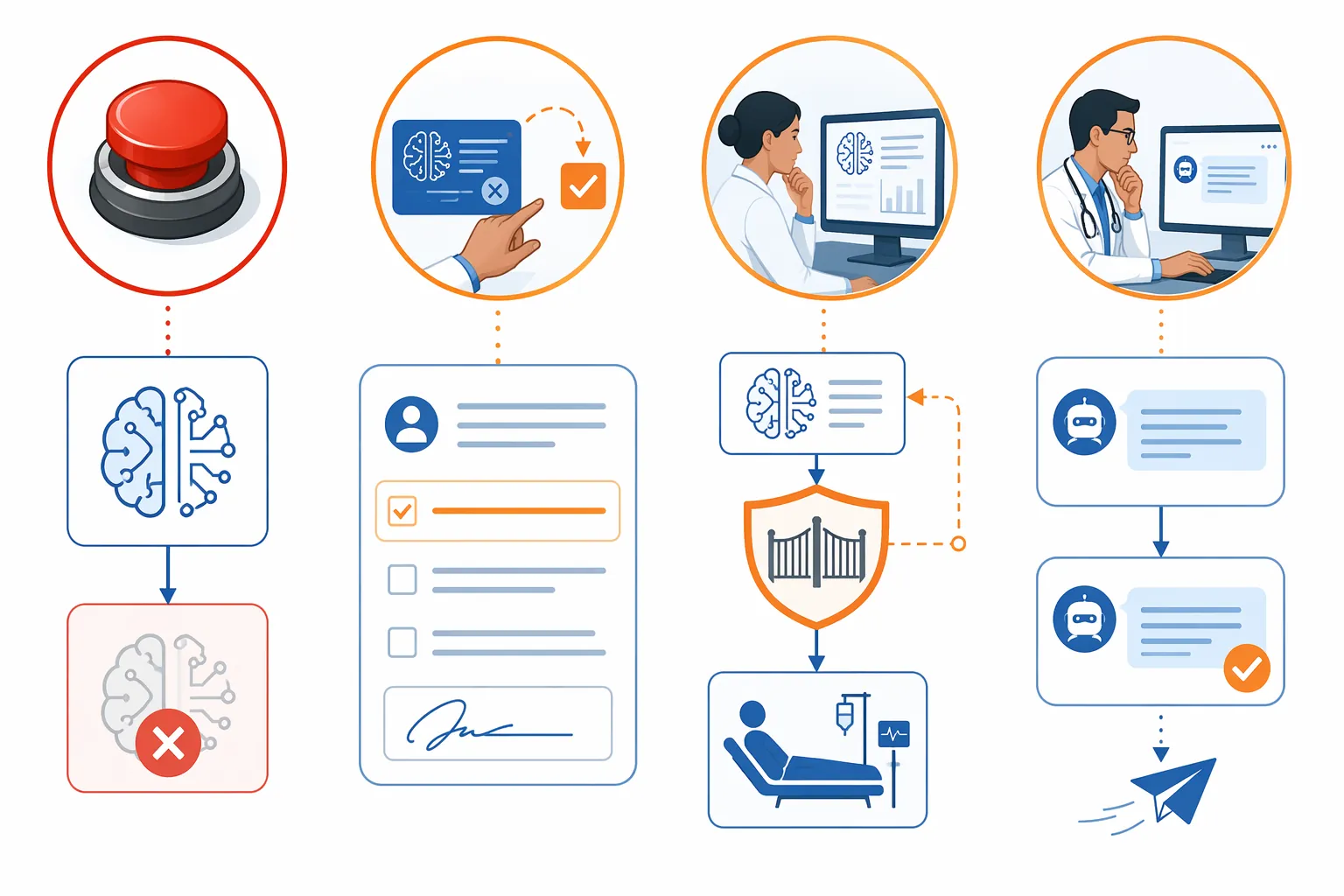
A true kill switch disables a system, model, feature, or autonomous action pathway. It is an interruption mechanism. It is not the same thing as an override protocol, which lets a clinician reject or modify a recommendation while the system continues operating. It is also different from prospective human review, where an AI output cannot reach the patient or chart until a person approves it.
| Mechanism | What It Does | What It Does Not Prove By Existing Alone |
|---|---|---|
| Kill switch | Disables an AI model, feature, agent, or output pathway | That anyone will recognize the need to use it in time |
| Clinician override | Allows a user to reject, modify, or bypass an AI recommendation | That override decisions are appropriate or consistently documented |
| Human-in-the-loop architecture | Places a human review step inside the workflow | That the review step is actually used or clinically meaningful |
| Model disabling after deployment | Removes or suspends a poorly performing tool | That the disabling action itself caused improved outcomes |
| Escalation protocol | Defines who reviews, who can stop use, and when escalation occurs | That staff have time, authority, or feedback to act safely |
The evidence becomes much easier to read once these mechanisms are kept separate. A study showing fewer false positives after alert redesign is not automatically evidence that a kill switch prevented harm. A policy requiring an override button is not the same as a measured reduction in adverse events. A human review field in the interface is not evidence of human review if nobody uses it.
The Strongest Evidence Is Adjacent, Not Direct
The most prominent claim in the available material is a roughly 40% reduction in potential harm after clinical override protocol implementation, reported by Censinet in an article discussing Neil Patel’s work on clinical override systems.[1] That figure deserves attention because it is one of the few numbers directly tied to harm reduction rather than to adoption, satisfaction, or governance maturity. It also needs careful handling: the underlying source should be verified for publication-level detail, so the number should not be treated as a settled, independently replicated effect size.
Even if the 40% figure holds up, it supports override protocol implementation more than it supports the narrower claim that a kill switch alone prevents patient harm. A protocol can include many moving parts: who may override, what must be documented, how exceptions are reviewed, how the model is monitored, and when the system is disabled or modified. If patient risk falls after all of that changes, the practical lesson is valuable. The causal claim remains broader than the button.
The human-in-the-loop evidence is more systematic but still not a clean kill-switch test. Olawade et al.’s 2026 systematic review reported that human-in-the-loop architectures reduced alarm burden by up to 80% while maintaining safety outcomes.[2] For clinical operations, that is not a small result. Alarm burden is not an aesthetic problem; it determines whether a nurse, resident, or attending can still distinguish a meaningful warning from the background noise of the shift.
But “maintaining safety outcomes” is not the same as proving fewer patients were harmed because a kill switch existed. It indicates that, in the reviewed settings, human involvement could make systems quieter without an observed safety penalty. That is a useful and clinically plausible finding. It does not isolate emergency disablement as the active ingredient.
The Sepsis Evidence Shows Why Implementation Carries The Weight
Sepsis prediction is a good place to test the seriousness of AI safety claims because the work is time-sensitive and noisy. A model can be dangerous when it misses patients, but also when it trains staff to ignore alerts. The Epic Sepsis Model experience remains the most concrete case thread in the available evidence: in practice, the model reportedly achieved only 33% sensitivity and was widely disabled by clinicians.[1]
A low-sensitivity sepsis model creates a particular kind of safety problem. If clinicians believe the system is a backstop, missed cases may carry more risk than a normal missed prediction. If clinicians do not believe the system, they disable or ignore it, and the organization may continue to carry a nominal safeguard that no longer functions as one. Neither outcome is solved by naming the disablement option a kill switch.
The stronger safety story appears after redesign. A rebuilt sepsis clinical decision support system reportedly improved specificity from about 42% to about 82% and was associated with a 31% drop in sepsis mortality.[1] Those numbers are clinically meaningful if verified in the underlying source material. Higher specificity means fewer patients are incorrectly flagged, which can reduce unnecessary workups and make true warnings more credible. An associated mortality decline is the outcome everyone wants to see.
Still, the word “associated” is doing real work. A rebuilt decision-support system usually changes more than one thing: thresholds, interface design, escalation routing, staff training, alert timing, governance review, and clinician expectations. Mortality can also move with secular practice changes, staffing differences, quality initiatives, and coding shifts. The evidence supports the claim that sepsis AI safety improved after redesign. It does not support the cleaner claim that a kill switch, by itself, produced a mortality reduction.
Mayo Clinic’s sepsis work points in the same direction. Becker’s reported that Mayo reduced the false positive rate of a sepsis tool from roughly 22% to roughly 15.8% through better override protocols.[3] That is the kind of implementation detail worth caring about. It means fewer clinicians are interrupted for patients who do not need the response the tool is prompting. It also means the next alert may have a better chance of being taken seriously.
Again, the evidence is not a simple kill-switch experiment. It is a workflow and protocol story. The system was made more tolerable and, potentially, safer by changing how human judgment interacted with the model. If the only documented intervention were “staff could turn it off,” the safety claim would be much weaker.
Override Rates Can Signal Two Opposite Failures
Override behavior is often treated as evidence that humans remain in control. It can show that. It can also show that control is mostly ceremonial. The available evidence notes override rates ranging from less than 5% to more than 96% across studies.[3] Those extremes do not mean the same thing, but both should make a safety reviewer pause.
- Very low override rates may mean the AI is usually right, or they may indicate automation bias, time pressure, fear of deviating from the machine, or a review step that is too burdensome to use.
- Very high override rates may mean clinicians are appropriately rejecting poor recommendations, or they may mean the system has lost practical utility and is adding work without improving care.
- Undocumented overrides are especially weak safety evidence because they do not show why the clinician acted or whether the action improved the patient pathway.
- A useful override system needs denominator data: how many recommendations appeared, how many were seen, how many were accepted, how many were overridden, and what happened afterward.
This is where many “human-in-the-loop” claims become thin. A human is not meaningfully in the loop just because the interface contains an approval field. The human must be positioned where action can still change the result.
The MyChart Finding Is A Warning About Available Review
The Harvard Epic MyChart finding is irritating in exactly the way a useful safety finding often is. Becker’s reported that, in a November 2025 study, fewer than 33% of AI-generated patient communications were reviewed before sending.[3] The issue is not that every AI-assisted message is necessarily unsafe. The issue is that an available review step did not reliably become actual review.
Patient messaging is not sepsis triage, but the human-factors lesson transfers. If the safeguard depends on a clinician noticing, opening, reading, judging, and acting under ordinary workload, then review rates are not a minor process metric. They are part of the safety intervention. A health system cannot count “clinician review available” as a control and then ignore whether clinicians reviewed the outputs.
What Better Evidence Would Need To Show
The evidence gap is not mysterious. To prove that an AI agent kill switch prevents patient harm, a study would need to show that the kill switch changed a decision pathway and that the change plausibly reduced downstream harm. That does not always require a randomized trial, though randomization would be stronger. It does require more than policy language.
- Trigger evidence: what signal or event caused the kill switch, override, or escalation pathway to activate.
- Authority evidence: who had permission to stop the model or reject the AI output, and whether that authority was usable during care.
- Behavior evidence: how often staff actually used the control, how quickly they used it, and how often they declined to use it.
- Outcome evidence: what changed in alert burden, false positives, false negatives, sensitivity, specificity, escalation timing, adverse events, or mortality.
- Attribution evidence: what else changed at the same time, including thresholds, staffing, training, model updates, and clinical protocols.
A hypothetical example makes the distinction clear. Suppose a hospital deploys an AI agent that drafts medication-adjustment recommendations. A pharmacist can halt all autonomous recommendations for a drug class after a safety trigger. If the hospital later shows that pharmacists used the halt function after a recurring unsafe pattern, recommendations stopped reaching prescribers, near-miss events fell, and no simultaneous medication-safety campaign explains the drop, that begins to look like evidence for the kill switch. If the hospital only shows that the halt function was present in the interface, it does not.
The current published and semi-published evidence usually gets partway there. It shows redesign, override behavior, lower false positive rates, alarm reduction, or associated outcomes. It rarely isolates the kill switch as the independent cause.
Governance Is Moving Faster Than Clinical Proof
Policy interest is real. In October 2025, Senator Markey introduced the Right to Override Act, described as a proposal to establish an AI override button in healthcare.[4] As of July 2026, it had not been enacted. Its status should be checked at publication, but its clinical meaning is already limited: a legal right to override can be important without proving that overrides reduce patient harm in practice.
That limitation should not be dismissed. Mandated override rights can shift institutional incentives. They can make it harder for vendors or health systems to design AI tools that trap clinicians inside an automated pathway. But the safety question still comes back to use: whether the person at the bedside, inbox, triage queue, or monitoring station can exercise the right quickly enough and with enough feedback to matter.
The FDA’s 2025 draft guidance, as summarized in a PMC article on the “illusion of safety,” addresses lifecycle risks such as model drift, bias, and data poisoning under a total product lifecycle framework.[5] That is the right regulatory neighborhood. Drift and data poisoning can turn a once-acceptable model into a worse one. But the guidance does not specifically mandate kill-switch architectures. It points toward continuous monitoring and lifecycle control rather than a single emergency device.
For health systems, that means the governance artifact should be more than an escalation chart. An AI governance committee charter should say who can pause a model, who receives the alert, what evidence is reviewed, when the tool can return to service, and how the post-event review is tied back to patient outcomes. The least glamorous user in the workflow should not be left carrying the entire safety burden because the institution bought a control and named it oversight.
So, Do Kill Switches Prevent Patient Harm?
They are plausible, often necessary safeguards. In some settings, related controls have been associated with better safety signals: lower potential harm, reduced alarm burden, fewer false positives, improved specificity, and mortality improvements after broader sepsis decision-support redesign.[1][2][3] Those are not trivial findings.
The evidence is thinner on the exact claim that AI agent kill switches prevent patient harm in healthcare. The strongest support is for implementation quality: monitored override behavior, workflow-integrated human control, careful alert redesign, lifecycle surveillance, and documented authority to stop unsafe automation. The kill switch is part of that safety architecture. It is not yet an independently proven patient-harm reducer.
References
- When the Model Is Wrong: Clinical Override Protocols for AI Recommendations, Censinet
- Human-in-the-loop architectures reduced alarm burden by up to 80% while maintaining safety outcomes, ScienceDirect, 2026
- Kill switches, guardrails & the raging debate over healthcare AI agents, Becker’s Hospital Review
- Senate Proposal Aims To Establish AI Override Button in Healthcare, MeriTalk, October 2025
- The illusion of safety, PMC
Comments
Join the discussion with an anonymous comment.