
AI can already forecast asthma-related visit surges from air quality, weather, allergen, and viral-circulation data better than several traditional statistical approaches. That is the useful answer. The less convenient answer is that this evidence does not yet support an asthma alert telling an individual patient that an attack is imminent.
The strongest evidence comes from a retrospective South Korean national-data study by Hwang et al., which compared 648 model configurations across long short-term memory networks, gated recurrent units, random forest, gradient boosting, generalized linear models, generalized additive models, and distributed lag nonlinear models. The LSTM approach performed best, reaching R² = 0.723 for outpatient asthma visits and R² = 0.650 for emergency room visits when using 18 environmental factors over a 5-year period.[1]
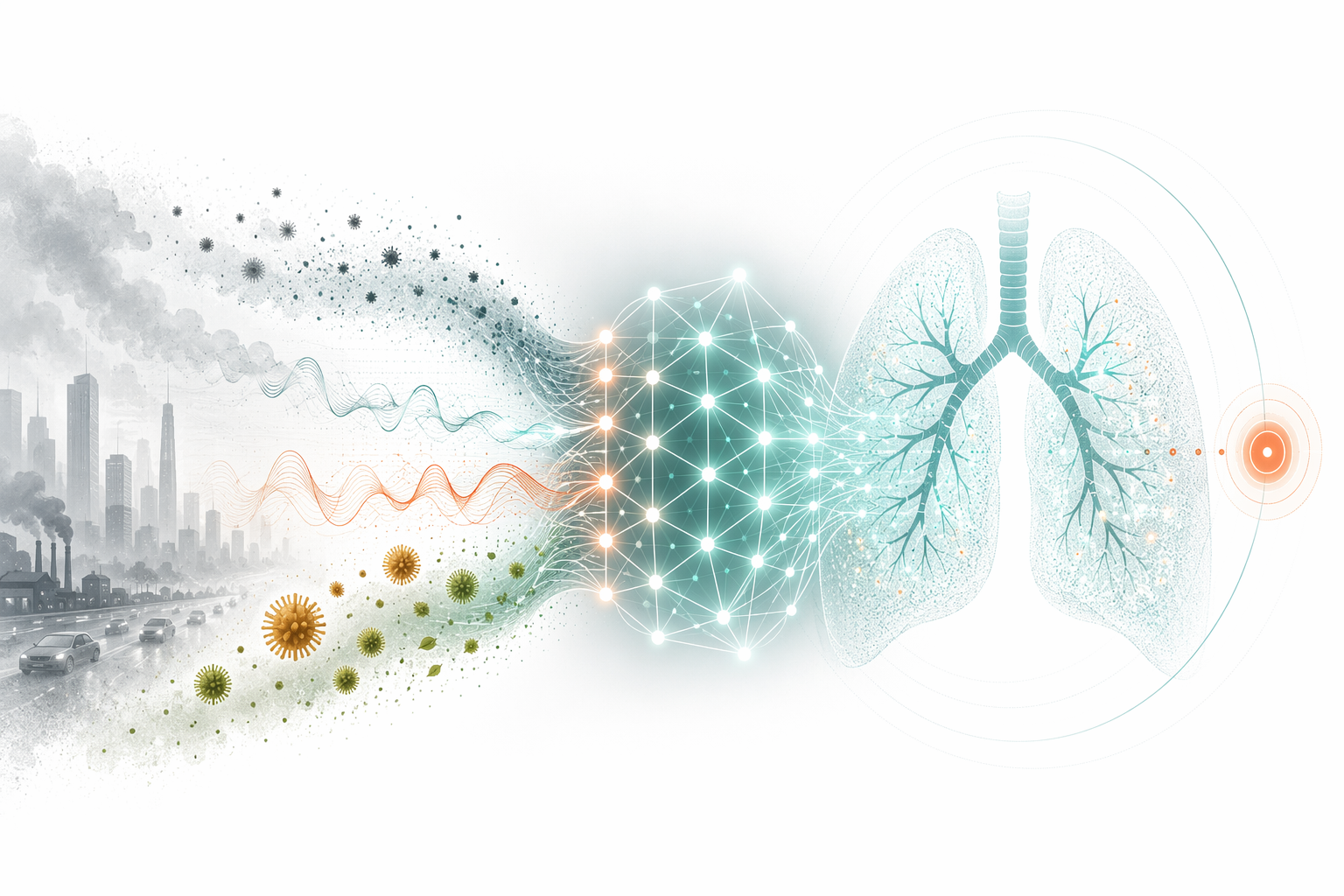
That is a meaningful modeling result for air-quality health alerting. It suggests that deep learning can read environmental time-series signals that matter for asthma care. It does not mean a clinic can safely connect such a model to the EHR today and start sending patient-level warnings.
What “predicting asthma attacks” means in this evidence base
In the Hwang study, the target was not a patient’s next wheezing episode, rescue inhaler use, nighttime symptoms, or need for oral corticosteroids. The models predicted asthma patient visit counts: outpatient visits and emergency room visits. That distinction matters clinically because a visit count is shaped by disease activity, exposure, access to care, patient behavior, local practice patterns, and the threshold for seeking urgent care.
A useful population forecast can still be valuable. A public health team might prepare for a rise in respiratory visits, a clinic network might adjust staffing, and a health system might decide when environmental messaging should become more visible. But those uses sit closer to surveillance and operations than to individual clinical decision support.
The clinical leap is easy to miss. A model that predicts more emergency visits tomorrow does not necessarily know whether a child with asthma in a specific apartment, school, neighborhood, medication-adherence pattern, and viral-exposure setting is likely to deteriorate tonight. The former is a population curve. The latter is a patient-facing warning.
Why LSTM models are plausible for this problem
Asthma exacerbations rarely follow a clean one-variable trigger. Outdoor particles may rise, temperature may shift, pollen may peak, and influenza activity may increase in the same period. The health signal also has lag: exposure today may influence visits later, and the lag may differ for pollutants, allergens, and infections.
That is the kind of temporal mixture where LSTM models are attractive. They are designed for sequential data, so they can use earlier values in a time series rather than treating each day as an isolated observation. In Hwang et al., that architecture outperformed not only GLM and GAM approaches but also tree-based machine learning models such as random forest and gradient boosting in the tested configurations.[1]
The broader environmental AI literature points in the same general direction without answering the clinical question by itself. A 2025 systematic review of 65 Q1 journal articles using PRISMA methodology reported that random forest models can achieve up to 98.2% accuracy for air pollution classification, while deep learning methods better capture spatiotemporal patterns.[2] That supports the idea that model choice matters for environmental signals. It does not prove that an asthma alert improves patient outcomes.
The important signals were not only pollutants
The most clinically interesting part of Hwang et al. is not just the R² value. It is the feature-importance work, because it shows which environmental and infectious signals carried weight in the models. Influenza activity was the single strongest predictor for both outpatient and emergency room asthma visits.[1]
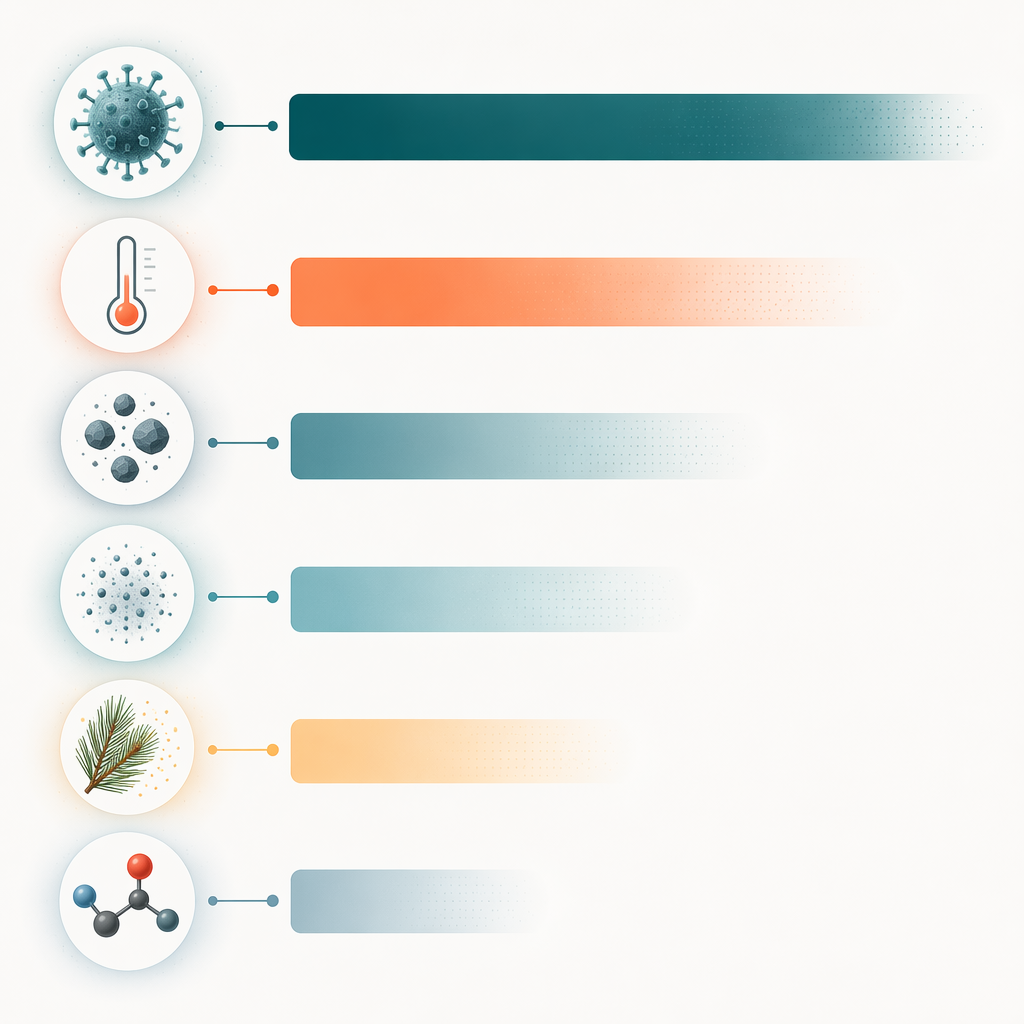
That result is a useful correction to a narrow “air quality alert” frame. For asthma, an alert system that watches particles but ignores viral circulation is likely watching only part of the clinical weather. Respiratory infections are well-recognized exacerbation drivers, and in this model comparison influenza activity contributed more predictive information than any single pollutant signal.[1]
Temperature also mattered, but not uniformly. Temperature and diurnal temperature range significantly affected outpatient visits, while they were not significant drivers for emergency room visits in the same way.[1] That split is the sort of detail that gets flattened when an AI model is described only as “predicting asthma attacks.” Outpatient utilization and emergency care are related outcomes, but they are not interchangeable clinical endpoints.
The particulate findings were similarly specific. PM10 showed a stronger association with asthma exacerbation than PM2.5, consistent with prior literature on coarse particle airway effects as summarized in the study.[1] That does not make PM2.5 irrelevant; it means that, in this modeling context, the coarser particle measure carried more predictive value for the asthma visit outcomes being studied.
The study also reported synergistic interaction effects between nitrogen dioxide and carbon monoxide, and pine pollen emerged as a significant driver of emergency room visits specifically.[1] Pine pollen’s ER-specific signal is clinically plausible because allergen exposure can help push susceptible patients into acute exacerbation patterns. The interaction finding is also a reminder that air pollution risk is not always additive in the way a simple dashboard might imply.
| Signal | What the study found | Clinical interpretation |
|---|---|---|
| Influenza activity | Strongest predictor for outpatient and ER asthma visits | An asthma forecasting system should not treat pollution as the only relevant external trigger |
| Temperature and diurnal temperature range | Significant for outpatient visits but not ER visits | Different asthma utilization endpoints may need different alert logic |
| PM10 | More strongly associated with exacerbation than PM2.5 | Coarse particle exposure may deserve more attention in asthma-specific forecasting |
| NO2 and CO | Synergistic interaction effects | Pollutants may combine in ways that simple single-threshold alerts miss |
| Pine pollen | Significant driver of ER visits | Allergen-triggered acute exacerbations may require separate handling from routine pollution messaging |
Where the evidence becomes less ready for clinical alerting
The Hwang study used national-level averaged environmental data from South Korea, not personal exposure measurements from wearable sensors, home monitors, workplace conditions, school environments, or indoor air systems.[1] For clinical alerting, that is a major boundary. Patients do not breathe a national average.
This matters most for the exact patients who often need asthma support: children moving between home and school, workers with occupational exposures, people in poorly ventilated housing, and patients whose symptoms are driven by indoor allergens or local microenvironments. A population-level environmental input can be directionally useful while still missing the exposure that actually reaches the airway.
The study was also retrospective.[1] Retrospective performance can show that a model learned meaningful historical patterns. It cannot show what happens when a prediction is delivered to a clinician, public health nurse, patient portal, or mobile app. Alert fatigue, liability, response protocols, health literacy, medication access, and false reassurance all appear only when the model enters a real workflow.
Generalizability is another practical issue. South Korea’s pollutant profiles, climate patterns, healthcare-seeking behaviors, and air quality standards are not the same as those in the United States. A model trained and evaluated on national South Korean data may still be highly informative, but a US health system would need local validation before treating its output as operational guidance.
Population forecasting is not the same as personalized asthma prediction
A 2021 systematic review on personalized asthma attack prediction models helps frame the gap. Personalized prediction requires models that use patient-level information, not only shared environmental context.[3] In asthma, that could include prior exacerbation history, medication use, symptoms, lung function, adherence patterns, comorbidities, local exposure, and possibly sensor-derived data, depending on the intended use.
The Hwang model answers a different question: given environmental and infectious-disease signals, how many asthma visits are likely to occur? That is a legitimate and useful question. It is not the same as deciding whether a specific patient should step up therapy, avoid outdoor activity, contact a clinician, or go to urgent care.
For an individual-facing asthma alert to be clinically credible, the model would need to cross several additional thresholds. It would need patient-level validation, a defined action tied to the alert, prospective testing, measurement of benefit and harm, and a clear decision about whether it functions as general wellness guidance, population health surveillance, or regulated clinical decision support.
What a responsible deployment boundary looks like in Q3 2026
The best near-term use is not an automated patient warning that implies certainty about an impending attack. The more defensible use is environmental health surveillance: forecasting expected asthma visit pressure, identifying high-risk periods, and helping public health or health-system teams decide when to intensify outreach, staffing, or broad respiratory messaging.
If a health system wanted to evaluate this class of model, the first deployment question should not be “What is the R²?” It should be “Where does the alert land, and what changes because of it?” A forecast placed in an analytics dashboard has different risk than a best-practice advisory in the EHR. A public health staffing signal has different risk than a text message telling a patient with asthma to alter behavior.
The regulatory status also remains unsettled for this specific use case. No FDA-cleared or CE-marked AI/ML medical device specifically for air-quality-based asthma health alerting was identified in the supplied research materials. That does not prevent public health analytics or general environmental notification tools from existing, but it does limit any claim that these systems are ready-made clinical decision support products.
The disciplined conclusion is favorable but narrow. LSTM-based models have shown better performance than several traditional approaches for forecasting asthma visit counts from environmental data, and the Hwang study is unusually useful because it separates outpatient and ER outcomes while examining specific drivers such as influenza, PM10, temperature variation, pollutant interactions, and pine pollen.[1] As of Q3 2026, however, these models are best understood as promising tools for environmental health surveillance and future population health workflows, not as clinically validated AI alert systems for individual asthma management.
References
- Prediction of the number of asthma patients using environmental factors based on deep learning algorithms, Respiratory Research, 2023.
- Systematic review on artificial intelligence methods for air pollution classification and forecasting, Environmental Modelling & Software, 2025.
- Personalized asthma attack prediction models: a systematic review, 2021.
Comments
Join the discussion with an anonymous comment.