
AI in air quality monitoring for public health is crossing a meaningful threshold: the strongest systems are no longer being judged only by how closely they estimate PM2.5, NO2, or ozone. They are increasingly being evaluated by whether those exposure estimates line up with hospital admissions, asthma exacerbation risk, COPD burden, and cardiovascular events. That shift matters. A cleaner forecast error curve is useful to an environmental scientist; a validated signal tied to avoidable admissions is the beginning of something a respiratory service, health department, or population health team might actually use.
The evidence is still uneven, but the direction is clear enough to take seriously. A 2024 Journal of Allergy and Clinical Immunology review describes machine learning models that have been used to predict hospital admissions associated with NO2, PM2.5, and O3 exposure, including Random Forest, artificial neural network, LSTM, and XGBoost approaches.[1] That does not make any one model a clinical decision-support tool. It does mean air quality AI has moved into the zone where public health validity has to be assessed against outcomes, not only against monitor readings.

The Clinical Relevance Starts With Exposure Resolution
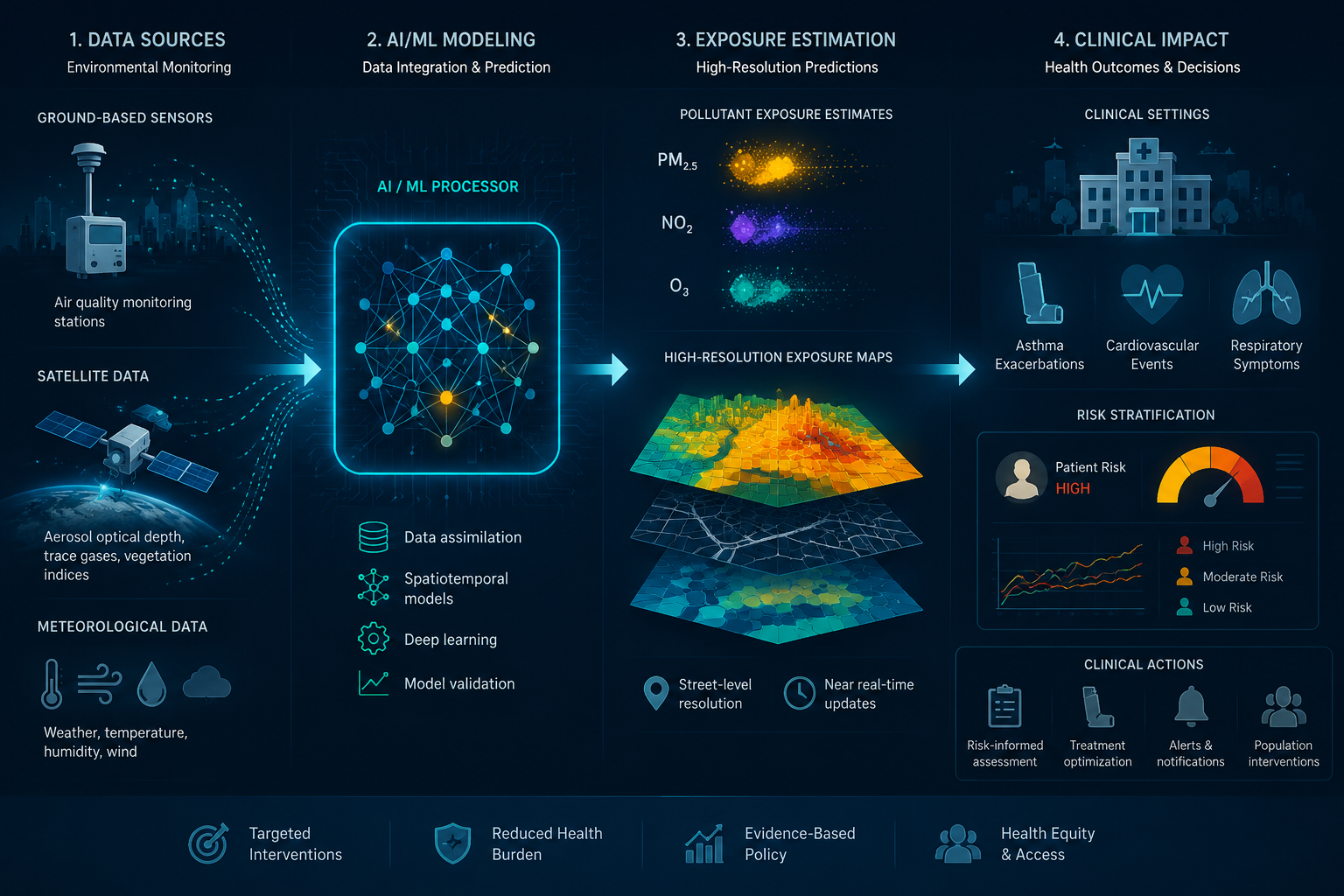
Traditional air monitoring networks are essential, but they often leave clinicians and local public health teams with a coarse picture: a citywide reading, a regional alert, or a daily index that arrives after the exposure has already occurred. Machine learning changes the practical question. Instead of asking only whether a city is polluted today, a model can estimate which neighborhoods, school routes, traffic corridors, or indoor environments are likely to carry higher exposure in the next several hours.
That is where high-resolution forecasting becomes clinically relevant. A 2025 systematic review of 65 Q1 journal articles reported that Random Forest models achieved up to 98.2% accuracy in predicting air pollutant concentrations.[2] The number is impressive, but it should not be read as a health outcome result. It says the model can perform well at estimating environmental conditions under the reviewed study conditions. The clinical implication is more modest and more useful: if pollutant estimates become more reliable at smaller spatial and temporal scales, exposure assessment for asthma, COPD, and cardiovascular risk studies can become less blunt.
Short-term forecasting is the same story with a different operational consequence. A 2025 Artificial Intelligence Review synthesis found that LSTM and hybrid deep learning models outperformed traditional ARIMA models by 5–8% in 72-hour air quality forecasts, while AirFormer reduced prediction errors by 5–8% across 1,085 monitoring stations in mainland China.[3] For a clinician, the model architecture is not the point. The useful question is whether a better 72-hour signal could help a health department time school advisories, outreach to high-risk patients, or staffing awareness during likely respiratory surges.
What the Models Actually Do Before Anyone Calls It Health Intelligence
The technical middle of air quality AI is often compressed into one phrase — “better monitoring” — but several distinct tasks sit underneath it. A 2025 Artificial Intelligence Review framework groups the field into data imputation, sensor calibration, anomaly detection, AQI estimation, and short-term forecasting.[3] Those categories matter because they do not carry the same clinical meaning.
| AI task | What it improves | Why it matters for public health |
|---|---|---|
| Data imputation | Fills gaps when sensors fail or records are incomplete | Reduces blind spots in exposure histories |
| Sensor calibration | Corrects low-cost sensor readings against more reliable references | Makes dense local networks more credible |
| Anomaly detection | Flags unusual indoor or outdoor readings | Helps separate real exposure events from noise or device failure |
| AQI estimation | Converts pollutant inputs into interpretable air quality indicators | Supports public alerts and risk communication |
| Short-term forecasting | Predicts pollutant levels hours to days ahead | Creates lead time for schools, clinics, and public health agencies |
Sensor calibration deserves special attention because many promising public health deployments depend on low-cost sensors. Dense networks are attractive precisely because they can be placed near schools, roads, and underserved neighborhoods where regulatory monitors may be sparse. But low-cost sensors drift, respond differently under changing humidity or temperature, and can produce misleading readings if they are treated as plug-and-play medical infrastructure.
Machine learning helps, but it does not remove the maintenance problem. In the 2025 Artificial Intelligence Review synthesis, Random Forest regression used for low-cost sensor calibration reduced mean absolute error by 37–94% depending on pollutant, reaching ±2.7 µg/m³ for PM2.5 and ±2.6 ppb for NO2.[3] Those gains are directly relevant to exposure science. They also create a governance obligation: a calibrated model can decay as sensors age, conditions change, or the deployment setting shifts.
Anomaly detection sits closer to operations. LSTM-autoencoder hybrid models achieved 99.5% accuracy in detecting indoor air quality anomalies across more than 247,000 CO2 readings in New Zealand schools.[3] That finding is not evidence that the system prevents asthma exacerbations. It is evidence that machine learning can help identify unusual indoor air patterns in a setting where children spend long periods and where delayed recognition can carry respiratory consequences.
The Harder Step Is Linking Pollutants to People
Air quality estimates become public health intelligence when they are connected to people who differ in vulnerability. A neighborhood with elevated PM2.5 is not just a colored tile on a map if the same area has older residents, high asthma prevalence, limited access to primary care, or schools near major roads. The more clinically useful model is not the one that merely says “air is worse here.” It is the one that helps identify who is likely to bear the burden.
A 2025 Scientific Reports framework describes AI-generated health risk maps that integrate pollutant levels with demographic vulnerability variables, including age and asthma prevalence, and can update every 5 minutes to support population-specific alerts.[4] The refresh rate is important, but the vulnerability layer is the more clinically meaningful feature. It moves the output from environmental description toward risk stratification.
The same study also shows why caution is necessary. The framework used a synthetic dataset and had not yet been validated with real-world sensor deployment and health outcome records; the authors described that validation as a next phase.[4] That distinction should not be softened. A synthetic demonstration can show that a workflow is plausible. It cannot prove that alerts will identify real patients at real risk, reduce exacerbations, or improve hospital preparedness.
Explainability is another part of the bridge from map to action. SHAP analysis in AI-driven AQI prediction has identified wind speed, traffic density, and industrial zone proximity as influential variables.[3] For a public health team, that kind of explanation can make a forecast more actionable: traffic-related exposure suggests different interventions than a regional weather-driven pollution episode. For a clinician, it also helps prevent overinterpretation. A model that can point to plausible exposure drivers is easier to discuss than one that produces a risk score without a traceable reason.
Hospital Admissions Are the Evidence Line to Watch
The most consequential evidence is not that an algorithm predicts NO2 well on Tuesday afternoon. It is that predicted or measured exposure can be related to health events that clinicians and hospitals already track. The Journal of Allergy and Clinical Immunology review’s discussion of machine learning models for hospital admissions tied to NO2, PM2.5, and O3 is therefore central to the field’s clinical relevance.[1]
Admissions are imperfect endpoints. They reflect exposure, baseline disease, access to care, medication adherence, coding practices, weather, viral circulation, and local thresholds for seeking emergency help. But they are not abstract. If a model’s exposure estimates improve the prediction of asthma, COPD, or cardiovascular admissions, the output begins to resemble something a public health agency could use for planning, surveillance, and targeted communication.
That still falls short of bedside decision-making. A pediatric asthma clinician should not be expected to change a controller medication because an environmental model produces a neighborhood-level risk score. A hospital operations team might reasonably monitor forecasted pollution spikes alongside syndromic surveillance, weather, and prior admission patterns. The same signal can be useful at population level and inappropriate as individual medical advice.
Deployment Evidence Is Real, but Concentrated
The most compelling deployments are not the most medically polished ones. They are the ones that show whether dense, AI-supported sensing can survive outside a paper. UNICEF’s Office of Innovation and Arm deployed 148 AI-based open-source sensors in schools in Lao PDR to track PM2.5 exposure.[5] The clinical relevance is straightforward: children with asthma or other respiratory vulnerabilities spend much of the day in school buildings, and school-based monitoring can reveal exposures that city-level averages miss.
AirQo provides another kind of evidence: geographic and operational reach in settings where traditional monitoring has often been sparse. The initiative operates across 16 African cities, showing how AI-supported air quality infrastructure can expand local visibility where data gaps have historically limited both environmental policy and health research.[6] That is not the same as proving reduced morbidity. It is, however, a prerequisite for studying morbidity with any local precision.
China’s AI-Air system is a higher-scale example. World Economic Forum reporting describes the system as reaching 92% forecast accuracy within 18 months.[7] The scale and reported performance are notable, particularly when read alongside the AirFormer station-level results from mainland China.[3] They also illustrate a recurring limitation: much of the strongest real-world evidence comes from a relatively small set of large initiatives, which may not generalize cleanly to smaller health departments, fragmented sensor networks, or low-resource settings with limited maintenance capacity.
Why This Is Not Yet Clinical Infrastructure
The temptation is to treat high model accuracy, street-level maps, and hospital-admission validation as enough to declare clinical translation. They are not enough. The current evidence supports clinical relevance, not clinical equivalence to regulated decision support.
The regulatory path is one reason. AI-driven air quality monitoring systems used for public health sit outside the familiar boundaries of many FDA-cleared medical AI tools. They may influence health messaging, surveillance, school advisories, environmental justice work, or hospital situational awareness, but they are not necessarily diagnosing, treating, or directly recommending care for an individual patient. That gray zone makes oversight less clear precisely where the health consequences are becoming more visible.
The evidence base also leans heavily on simulation and retrospective modeling. Synthetic risk maps can demonstrate feasibility; retrospective admissions models can show association; controlled sensor calibration studies can quantify error reduction. None of these alone proves that a deployed system will remain calibrated, trusted, interpretable, and useful when a health department has to decide whether to issue alerts or when a hospital wants to anticipate respiratory demand.
The operational weaknesses are familiar to anyone who has maintained a quality dashboard. Sensors drift. Data feeds fail. Neighborhood conditions change. Models trained in one city may behave differently in another. Deep learning forecasts may be accurate yet difficult to explain. Even SHAP-supported interpretation does not fully solve the problem of black-box spatiotemporal models, especially when the output could shape public guidance for vulnerable populations.
A Careful Readiness Judgment
AI air quality monitoring has reached clinical relevance because it can estimate exposure at higher resolution, improve short-term pollutant forecasts, calibrate dense sensor networks, detect anomalies, and connect air pollution signals to population health outcomes. The strongest evidence now points beyond environmental sensing alone and toward public health risk intelligence.
It has not yet reached clinical translation in the way FDA-cleared decision-support tools have. The next evidence step is not another architecture leaderboard. It is validation in real-world sensor networks linked to health outcome records, with documented calibration durability, transparent governance, and clear rules for who acts on an alert.
Until then, the best role for these systems is public health intelligence and risk stratification support. They can help show where exposure is rising, which populations may be more vulnerable, and when agencies or institutions may need to prepare. They should not be treated as standalone clinical decision-making systems, especially when the person expected to act on the signal is a clinician, school official, or public health worker who needs more than a prediction score.
References
- Opportunities for using artificial intelligence in air pollution and health research — Journal of Allergy and Clinical Immunology, 2024
- Application of artificial intelligence in air pollution monitoring and forecasting: A systematic review — ScienceDirect, 2024/2025
- Artificial intelligence in air quality monitoring and forecasting — Artificial Intelligence Review, 2025
- Machine learning-driven framework for realtime air quality assessment and predictive environmental health risk mapping — Scientific Reports / PMC, 2025
- AI-based open-source sensors in Lao schools — UNICEF Office of Innovation
- AirQo air quality monitoring network — AirQo
- AI-Air system reporting — World Economic Forum
Comments
Join the discussion with an anonymous comment.