
A large event rarely has one air quality problem. It has a toilet queue with poor air exchange, a corridor that fills during an interval, a field-level sideline exposed to smoke, a dancefloor where people are breathing hard, and public concourses that may look acceptable if they are averaged into the rest of the venue. That is the practical starting point for AI in air quality monitoring for public health at large events: not whether a model sounds advanced, but whether it can show where people are actually breathing worse air soon enough for staff to act.
The strongest evidence for that problem comes from the UK Events Research Programme, which monitored indoor air quality across 90 live events, 10 venues, 385 sensors, and 179 spaces. Most monitored spaces performed well: 90% maintained carbon dioxide below 800 ppm. The uncomfortable finding is the tail of the distribution. At peak occupancy, 10% of spaces exceeded 1500 ppm, with toilets, corridors, and nightclub dancefloors among the higher-risk zones.[1]
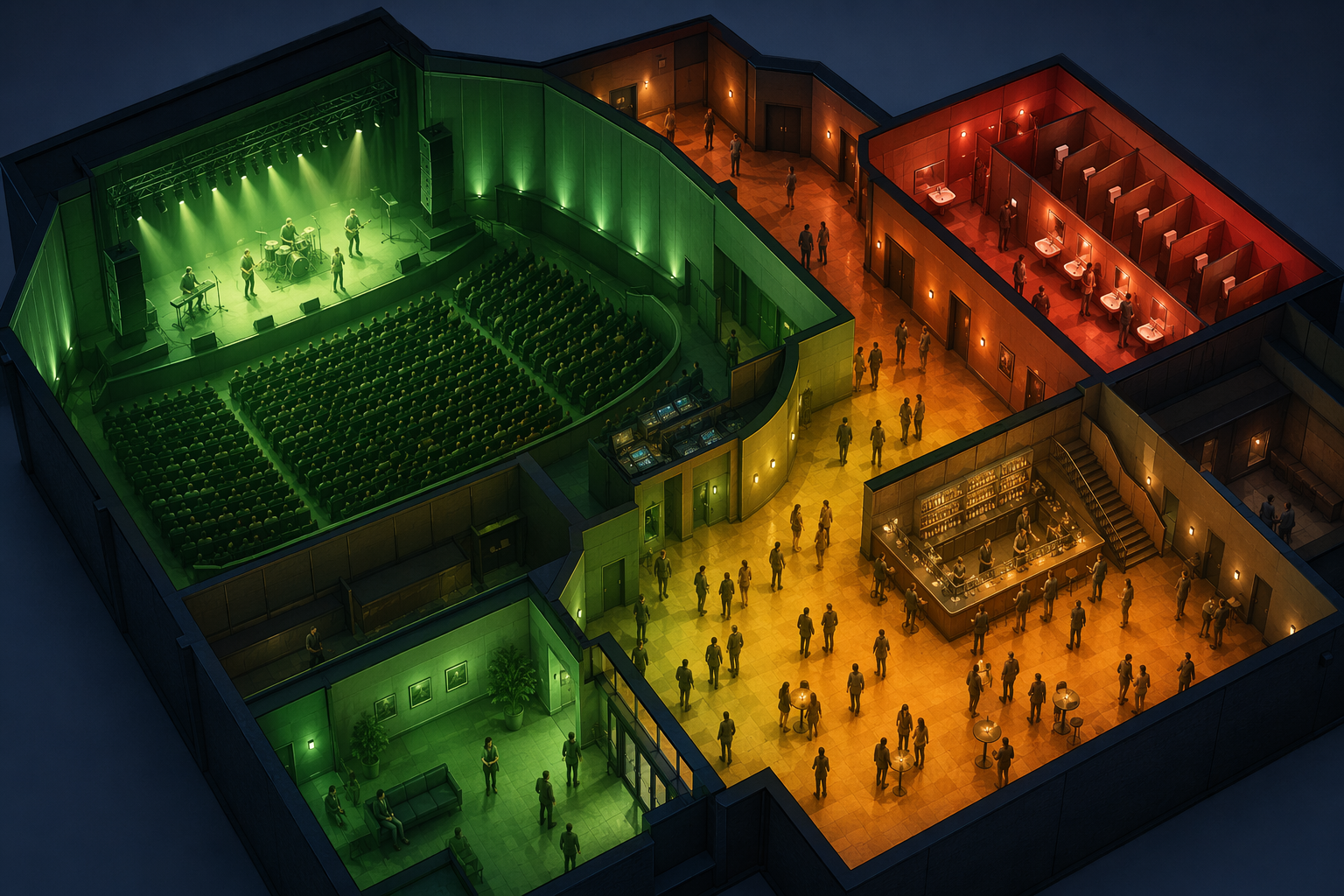
Those figures matter because they describe a venue as a set of microenvironments, not a single exposure box. Within one theatre, carbon dioxide differed by up to 400 ppm from front to back. In a nightclub, the difference between the dancefloor and bar exceeded 1600 ppm.[1] A single sensor near an entrance, a control room, or a relatively open concourse would not reliably identify those pockets. It might even reassure the team while the worst-breathing space in the building is elsewhere.
What Dense Monitoring Adds
Carbon dioxide is not particulate matter, nitrogen dioxide, sulfur dioxide, or ozone. In the UK programme, it functioned mainly as a proxy for exhaled breath, ventilation, and infection-risk conditions, not as a direct measure of outdoor pollutant exposure.[1] That distinction is important. A system that finds stale air in a corridor is not automatically proving protection against wildfire smoke or traffic-related particulates. It is proving something narrower and still valuable: the venue has spatial ventilation variation large enough to change operational decisions.
For an event health team, the operational value is obvious. If a toilet block repeatedly spikes during the same part of the program, the response may be crowd-flow management, temporary ventilation changes, cleaning schedule adjustments, or queue redistribution. If a corridor becomes a sustained high-CO2 area during ingress or egress, the safety issue is not only respiratory infection risk; it is also the fact that people and staff are spending time in a poorly ventilated bottleneck. If a nightclub dancefloor separates sharply from a nearby bar, the decision is not whether the venue is generally safe, but whether the high-exertion zone needs intervention.
This is where AI systems become interesting, provided they are kept in their proper lane. Dense sensor networks generate streams that are too granular for a person to interpret manually throughout an event. Models can help clean, calibrate, classify, forecast, and prioritize those streams. They can turn many local readings into a short list of places where someone should look, intervene, or prepare. That is a different claim from saying the system has been clinically proven to prevent emergency presentations.
| Evidence Question | What Current Studies Can Support | What They Do Not Yet Prove |
|---|---|---|
| Is air quality spatially uneven inside large event venues? | Yes, the UK Events Research Programme found large within-venue variation across monitored spaces. | It does not show that every venue has the same pattern or that CO2 represents all pollutants. |
| Can AI models forecast operational air quality measures quickly enough to be useful? | Yes, selected studies report high forecast or classification performance with inference times compatible with real-time use. | Performance in one city, stadium, or dataset does not guarantee generalizability. |
| Are AI air quality systems clinically validated health-protection interventions? | Not yet. The evidence is strongest for surveillance, forecasting, and targeted mitigation planning. | Prospective evidence showing fewer symptoms, exposures, or emergency presentations remains limited. |
Forecasts Matter When Decisions Cannot Wait
The Mosaic Stadium project in Saskatchewan is useful because it begins with a safety demand, not a technology demonstration. After the Air Quality Health Index rose above 7 during the 2023 Labour Day Classic, the Canadian Football League Players' Association called for stronger player safety measures. A University of Regina engineering capstone team then built an AI model using PurpleAir low-cost PM2.5 sensors placed at field level and in public areas, producing 3-, 6-, 12-, and 24-hour forecasts with reported 98% prediction accuracy.[2]
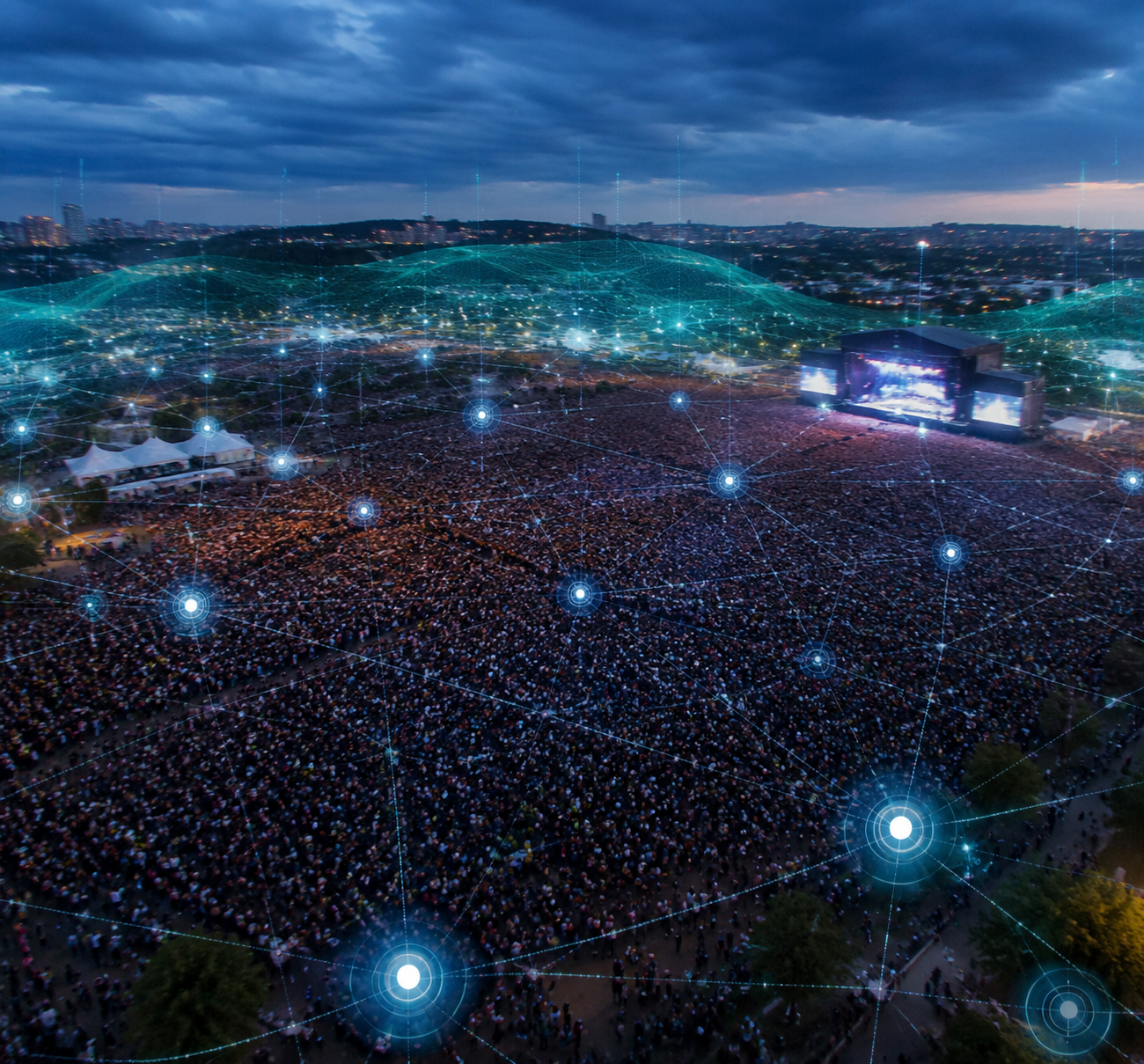
The time horizons are not a technical detail. A 3-hour PM2.5 forecast can affect staffing, sideline preparation, gate communications, and whether vulnerable workers need reassignment. A 6- or 12-hour forecast can support conversations with league officials, broadcast teams, transport managers, and public health agencies. A 24-hour forecast can inform whether additional monitoring, mitigation, or contingency planning is needed before crews and spectators arrive.
That is a meaningful form of operational readiness. It also has limits. The Mosaic Stadium model is reported as a single-location project, even though it was adopted by the Saskatchewan Roughriders, Alberta and British Columbia ministries, and the US Environmental Protection Agency.[2] Adoption by teams or agencies says the tool was considered useful enough to deploy. It does not, by itself, establish that players had fewer symptoms, medical visits fell, or spectators experienced lower cumulative PM2.5 exposure.
That caveat should not be treated as a dismissal. Event medicine often operates before perfect evidence arrives. Heat policies, smoke delays, ventilation changes, and crowd-flow interventions frequently depend on the best available surveillance and forecast information. The appropriate question is whether the system is accurate enough, fast enough, calibrated enough, and embedded enough in decision-making to justify operational use. The clinical question is separate: whether using the system measurably improves health outcomes.
Model Performance Is Only Part of Deployment
Broader forecasting studies help show why real-time AI deployment is plausible, while also showing why procurement teams should look beyond the headline metric. In one 2025 study using Kabul and Istanbul data, a Random Forest model achieved 99.96% AQI classification accuracy with 0.028 seconds inference time per sample. The same study reported that TSMixer achieved an R² of 0.9861 for pollutant concentration forecasting, but required 1.25 seconds per inference.[3]
Those numbers point to a practical tradeoff. A fast Random Forest model may be suitable for CPU-based, near-real-time deployment on modest infrastructure. A slower deep learning model with stronger concentration-forecasting performance may belong in cloud or hardware-accelerated workflows, especially if it is processing many sensors across a venue. At a large event, latency is not abstract. If a dashboard refreshes too slowly, a safety officer may already have moved staff, opened gates, or lost the window to prevent crowding in a poorly ventilated corridor.
The same study's boundary is also clinically relevant. Kabul and Istanbul data cannot be assumed to represent stadiums, theatres, convention centers, or outdoor festival sites in other climates and urban morphologies. A model trained or benchmarked on one pollutant profile may behave differently where wildfire smoke, traffic emissions, sea breezes, temperature inversions, indoor cooking, pyrotechnics, or dust are the main drivers. Before a venue depends on forecasts, local validation is not a luxury.
Interpretability work gives some reassurance that models are learning signals that make environmental sense. A 2025 Scientific Reports study found that lagged pollutant variables, including O3_lag_24, PM2.5_lag_24, and PM10_lag_24, were influential for 24-hour forecasting, while PM2.5, SO2, and NO2 dominated AQI classification decisions.[4] For event use, this matters less as an academic explanation and more as a check against black-box confidence. If a forecast changes, operators need to know whether it is being driven by recent pollutant behavior, sensor anomalies, or unrelated inputs.
Low-Cost Sensors Need Calibration, Not Blind Trust
Large events do not need only excellent models. They need enough spatial coverage to find the places that matter. Reference-grade instruments are valuable, but they are rarely dense enough to map every concourse, toilet block, tunnel, sideline, hospitality area, and temporary clinic. Low-cost sensors offer coverage; the weakness is data quality, drift, siting, maintenance, and calibration.
AirQo shows why AI calibration is more than a convenience feature. Its AI-driven calibration approach supports low-cost sensor networks across 16 African cities, addressing a monitoring gap in a region where fewer than 4% of global monitoring stations are located in Africa.[5] That does not prove clinical effectiveness at mass gatherings. It does show a credible pathway for expanding distributed monitoring in places where reference-grade infrastructure is sparse or unaffordable.
The equity point should not be softened. If only wealthy venues can afford dense air quality intelligence, the highest-risk settings may remain the least measured. Outdoor religious gatherings, political events, markets, festivals, and sports venues in under-monitored regions may face heat, dust, traffic pollution, smoke, and crowd-density risks without the sensor coverage needed for targeted mitigation. AI calibration does not solve governance, maintenance, or staffing, but it can lower the barrier to knowing where the problem is.
What Counts as Enough Evidence
For operational use, the evidence threshold can be pragmatic. A system may be reasonable to pilot if it has documented sensor placement logic, calibration procedures, forecast accuracy, inference speed, uptime expectations, alert thresholds, and a clear response protocol. It should specify who receives the alert, who confirms it, who can change ventilation or crowd flow, who can delay activity, and how the action is logged. Without that chain, the dashboard is mainly decoration.
- For CO2-based systems, buyers should ask how sensors are distributed across high-occupancy, low-airflow, and transient spaces rather than relying on a venue average.
- For PM2.5 or AQI forecasting, buyers should ask whether the model was validated locally and whether the forecast horizon matches real event decisions.
- For low-cost sensor networks, buyers should ask how calibration is performed, how drift is detected, and how faulty readings are excluded.
- For AI alerts, buyers should ask which mitigation actions are authorized before the event starts, not after the first threshold breach.
For clinical claims, the threshold is higher. A vendor, venue, or agency should not describe an AI monitoring system as clinically validated simply because it predicts PM2.5 accurately or detects a high-CO2 room. Clinical validation would require prospective study designs with defined endpoints: reduced exposure time, lower peak exposure, fewer respiratory symptoms, fewer heat or cardiopulmonary presentations, fewer staff complaints, or reduced need for medical interventions. Depending on the setting, the study may not need to be a randomized controlled trial, but it does need to connect system use to human outcomes rather than stopping at model performance.
A sensible study at future events would not merely compare predicted and observed pollutant values. It would document what the event team did with the forecast, whether the action occurred on time, whether exposure changed in the targeted zone, and whether attendee or worker outcomes moved in the expected direction. If the model warned of PM2.5 elevation and the event delayed warmups, moved vulnerable staff, changed gate timing, or opened cleaner-air areas, the evaluation should capture those steps. Otherwise the field will keep mistaking surveillance accuracy for health protection.
Where This Leaves Event Health Teams
The current evidence supports a cautious but active position. AI air quality systems are reasonable to consider for surveillance, forecasting, and targeted mitigation at large events, especially where spatial heterogeneity is likely and staff need early warning. The UK Events Research Programme shows why dense monitoring matters. The Mosaic Stadium project shows how PM2.5 forecasting can become operational when smoke or pollution threatens play. Scalable modeling studies show that real-time classification and forecasting are technically plausible, though not universally generalizable. AirQo shows that calibration can make distributed low-cost sensing more credible in under-monitored settings.
The missing evidence is not a minor footnote. These systems should not be sold or studied as proven clinical interventions until prospective outcome evidence exists. The better procurement language is narrower and more honest: AI-supported air quality monitoring can help identify unsafe microenvironments, forecast pollutant risk, and guide targeted operational responses. Whether that reliably translates into fewer symptoms, lower exposures, or fewer medical events is the next question to test.
References
- Indoor air quality monitoring in the UK Events Research Programme, PMC
- University of Regina engineering students develop AI model to predict stadium air quality, University of Regina, August 2025
- Scalable AI forecasting study, Discover Atmosphere, Springer Nature, 2025
- Machine learning framework for real-time air quality assessment, Nature Scientific Reports, 2025
- AirQo: Using AI and low-cost sensors to close Africa's air quality data gap, Clean Air Fund
Comments
Join the discussion with an anonymous comment.