
During a wildfire smoke episode, the exposure number that reaches a respiratory clinic is often an outdoor PM2.5 value. That number may come from a regulatory monitor, a nearby station, or an interpolated map. It can be useful for public messaging. It is less satisfying when the patient spent the day inside a long-term care facility, beside a leaky window, in a home with a portable purifier running, or in a room where smoke had already penetrated before the alert arrived.
That is the clinical problem behind AI air quality monitoring during smoke events: not whether machine learning can make another environmental dashboard, but whether it can estimate the air patients actually breathed closely enough to matter for respiratory care. The strongest recent evidence comes from Coker et al., who found that a 10 μg/m³ increase in machine-learning-predicted indoor PM2.5 was associated with a 10.1% increase in salbutamol dispensations, compared with 3.6–6.1% for four outdoor PM2.5 metrics.[1]
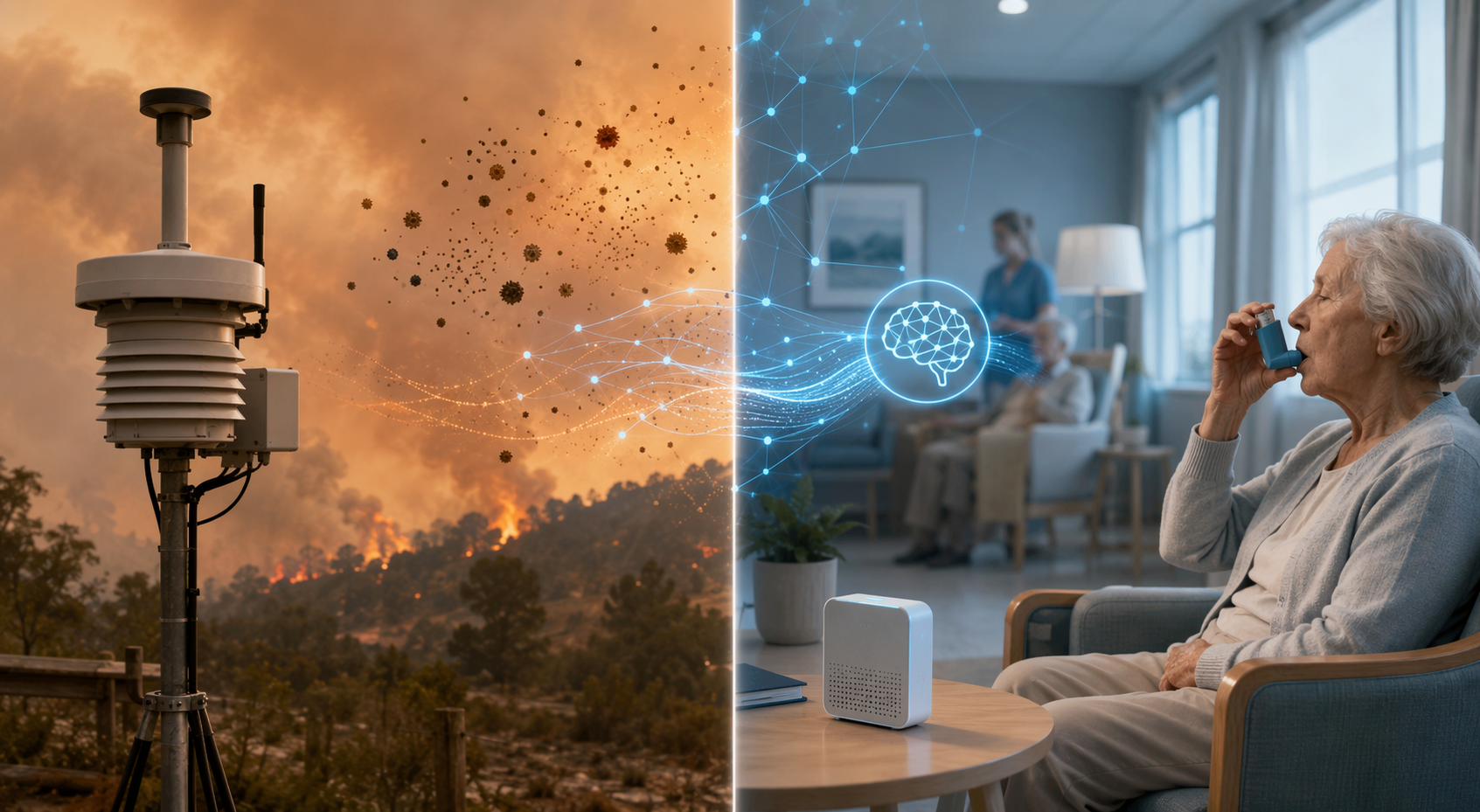
For clinicians, that difference is more interesting than the model branding. Salbutamol dispensations are not a perfect respiratory outcome, and they are not the same as an emergency department visit or hospitalization. But they are closer to clinical behavior than an algorithm’s internal performance score. If an indoor exposure estimate tracks reliever medication use more strongly than outdoor-only measures, it deserves attention as a possible bridge between smoke monitoring and respiratory risk awareness.
Why Outdoor PM2.5 Is an Uneasy Clinical Proxy
Wildfire smoke is not just another seasonal nuisance layered onto asthma and COPD care. Aguilera et al. reported that wildfire PM2.5 was up to 10 times more harmful per unit concentration for respiratory health than PM2.5 from other sources.[2] The burden is also becoming harder to treat as an occasional exception. Burke et al. found that wildfire smoke eroded 25% of U.S. Clean Air Act PM2.5 gains between 2016 and 2022.[3]
The respiratory signal is not speculative. Meta-analytic estimates cited in the wildfire smoke literature associate wildfire smoke PM2.5 with increased asthma emergency department visits, with a relative risk of 1.07 and 95% CI of 1.04–1.09, and with hospital admissions, with a relative risk of 1.06 and 95% CI of 1.02–1.09.[4] Those are population-level estimates, not bedside predictions, but they explain why clinicians are right to care about exposure measurement rather than treating the AQI as background weather.
The weak point is that outdoor PM2.5 often stands in for personal exposure because it is available, not because it is physiologically precise. Indoor concentration depends on infiltration, ventilation, filtration, room use, window behavior, building age, HVAC operation, and local smoke intensity. In a care facility, the same outdoor plume may produce different exposure conditions across buildings and even across rooms. When clinicians see an outdoor metric, they are seeing part of the exposure chain, not the whole chain.
That distinction matters during triage and counseling. A patient with severe COPD in a well-filtered indoor environment may not have the same exposure as a patient with milder disease in a smoke-infiltrated apartment, even if both are mapped under the same outdoor PM2.5 field. Outdoor data still matter; they are the warning signal. They are not automatically the dose.
What Coker et al. Actually Tested
Coker et al. trained ensemble machine-learning models using 44 colocated indoor and outdoor low-cost PM sensors at British Columbia care facilities during wildfire seasons.[1] The setup is important. Colocation means the study was not merely comparing a distant outdoor station with a health outcome. It was trying to learn the relationship between outdoor smoke conditions and indoor particle concentrations in places where vulnerable people were actually staying.
The models included random forest, XGBoost, and quantile random forest approaches. Across these ensemble methods, the reported R² ranged from 0.71 to 0.79, and RMSE was as low as 3.29 μg/m³ for predicted indoor PM2.5.[1] Those values suggest technically credible prediction, but the clinical value is not settled by R². A model can perform well on a held-out dataset and still be awkward for clinical use if it estimates the wrong exposure window, misses the highest-risk buildings, or produces uncertainty that no clinician can interpret under pressure.
| Question | What the BC study contributes | What it does not prove |
|---|---|---|
| Can ML estimate indoor PM2.5 during smoke seasons? | Ensemble models predicted indoor PM2.5 with R² 0.71–0.79 and RMSE as low as 3.29 μg/m³. | That performance will generalize to all regions, homes, or HVAC conditions. |
| Does the indoor estimate better align with a respiratory signal? | A 10 μg/m³ increase in predicted indoor PM2.5 was associated with a 10.1% increase in salbutamol dispensations. | That acting on the estimate reduces symptoms, ED visits, or admissions. |
| Is outdoor PM2.5 enough? | Four outdoor metrics showed weaker associations with salbutamol dispensations, at 3.6–6.1% per 10 μg/m³. | Outdoor monitoring is clinically irrelevant or should be discarded. |
The more practice-relevant finding is the comparison with outdoor metrics. For the same 10 μg/m³ increment, the ML-predicted indoor PM2.5 association with salbutamol dispensations was about 1.7 to 2.8 times stronger than the associations seen with four outdoor PM2.5 measures.[1] That is not a subtle modeling footnote. It suggests that some of the apparent weakness in smoke-health associations may come from measuring exposure at the wrong place.
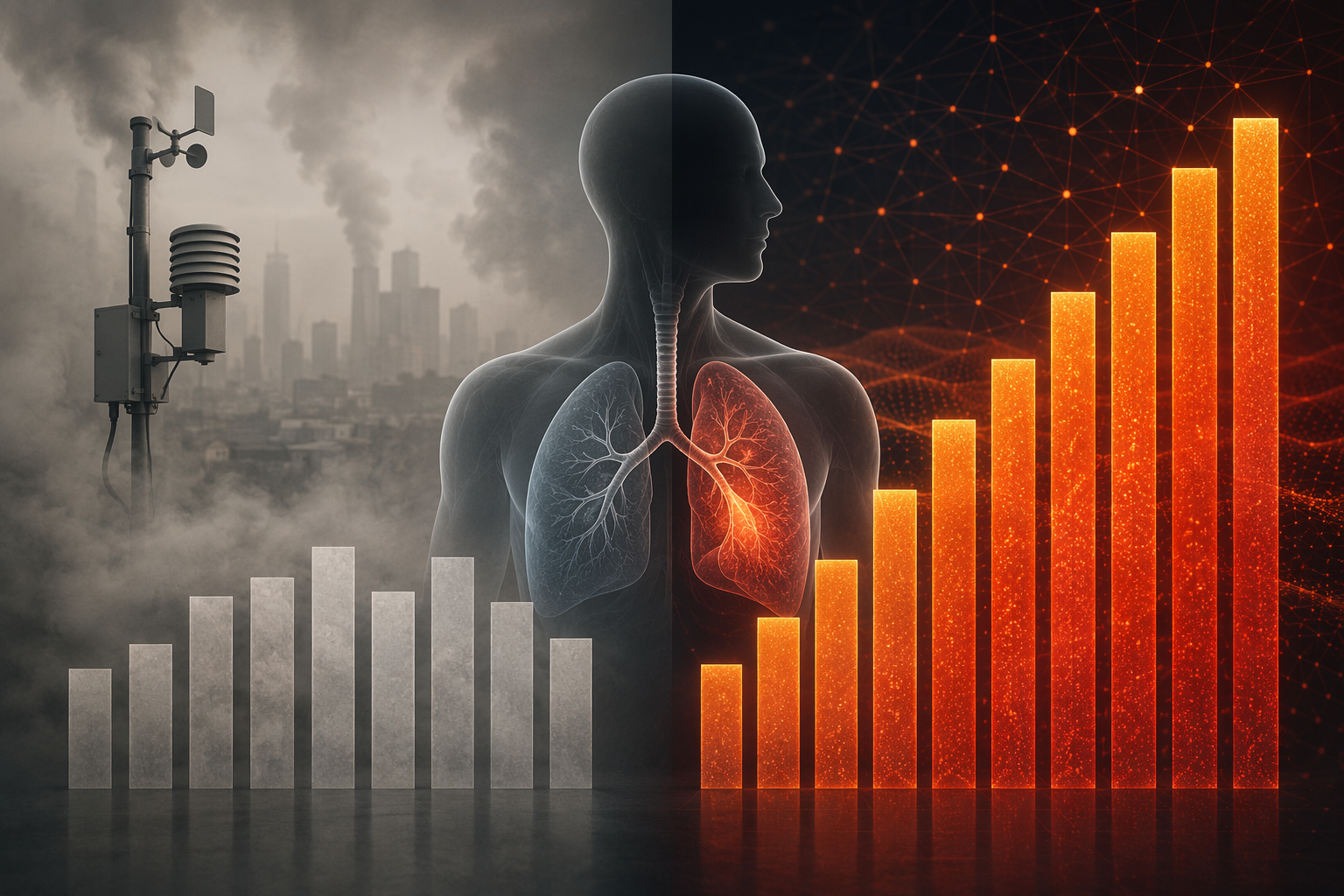
There is a practical reason that salbutamol dispensations are a useful signal here. During smoke events, clinicians may not see every exacerbation immediately. Some patients increase reliever use at home. Some contact pharmacies before emergency departments. Some receive medication adjustments without hospitalization. A pharmacy-linked outcome is imperfect, but it can detect respiratory stress that outdoor-monitor-only exposure estimates may blur.
The Clinical Translation Is Exposure Awareness, Not Automated Treatment
The BC findings support a narrower, more useful claim than many AI headlines would prefer: ML-predicted indoor PM2.5 appears to be a more clinically relevant exposure estimate than outdoor-only PM2.5 during wildfire smoke episodes in the studied setting. It does not prove that AI monitoring improves asthma control, prevents COPD exacerbations, reduces emergency department visits, or identifies which individual patient needs a medication change.
That boundary matters because the next step in care is not just measurement. A clinician would still need to know the patient’s baseline disease severity, recent exacerbation history, rescue medication use, oxygen needs, housing conditions, access to clean-air space, and ability to follow an action plan. Indoor PM2.5 can sharpen the environmental part of that assessment. It cannot replace the clinical assessment.
Where it may help first is in risk awareness. A respiratory clinic, emergency department, or care facility could use indoor exposure estimates to identify when a smoke event is penetrating indoor spaces despite reassuring outdoor-distance assumptions. That might change the urgency of counseling about staying indoors, checking inhaler supply, using filtration, relocating to cleaner indoor areas, or monitoring high-risk residents more closely. Those are plausible uses; they are not yet standardized protocols.
- Reasonable near-term use: interpret indoor PM2.5 estimates as environmental risk context during smoke events.
- Reasonable near-term use: prioritize outreach or observation for patients already known to be high risk when indoor exposure appears elevated.
- Premature use: automatically changing controller therapy based only on an AI-derived exposure estimate.
- Premature use: treating a model output as proof that an individual patient will exacerbate.
This is also where earlier work on wildfire smoke’s underestimated health burden becomes clinically relevant. If outdoor-only measurements understate health effects, then improving exposure assignment is not an academic refinement. It changes how seriously clinicians should treat “moderate” or geographically smoothed values when symptoms are rising indoors.
The AI Evidence Is Technically Encouraging, Clinically Incomplete
Machine learning is already plausible in air pollution monitoring. A systematic review reported that random forest models achieved up to 98.2% accuracy in air pollution monitoring applications, and that combined ML-MMF models exceeded 90% accuracy.[5] Those numbers show that AI methods can be technically strong in environmental estimation tasks. They should not be imported wholesale into respiratory care as evidence of clinical benefit.
Accuracy in an air pollution model can mean many things depending on the pollutant, time scale, spatial resolution, comparator, and validation design. A high-performing model in one geography may fail in another if the building stock, ventilation behavior, sensor density, smoke chemistry, or background pollution mix changes. Indoor PM2.5 modeling also depends on indoor behavior, which is often the least standardized part of the exposure pathway.
The BC study is therefore important partly because it is specific: 44 care facilities in British Columbia, colocated indoor and outdoor low-cost PM sensors, wildfire seasons, and a respiratory medication outcome.[1] That specificity makes the result more clinically interpretable. It also limits generalization. A long-term care facility in British Columbia is not automatically a single-family home in California, a school in Oregon, a dialysis center in Alberta, or an apartment tower with intermittent window air conditioning.
There is another limitation that matters more than algorithm choice: no randomized trials have shown that AI-driven air quality monitoring during smoke events improves patient outcomes. The current evidence supports better exposure estimation and stronger epidemiological association. It does not yet show that a clinician receiving an indoor PM2.5 prediction will make a better decision, that patients will change behavior, or that exacerbations will fall.
What Clinicians Can Take From an Indoor PM2.5 Estimate
A predicted indoor PM2.5 value is most useful when it answers a concrete question: is the patient’s indoor environment likely reducing smoke exposure, or is the smoke event reaching the space where the patient is breathing? That question is different from asking whether the regional AQI is high. It is also different from asking an algorithm to decide treatment.
In practice, the estimate may be most defensible as an additional exposure layer for patients already recognized as vulnerable: severe asthma, COPD with prior exacerbations, chronic oxygen use, limited mobility, residence in congregate care, or inability to access cleaner indoor air. If the predicted indoor PM2.5 is elevated during a smoke episode, a care team might intensify nonpharmacologic protection and follow-up. If the estimate remains low despite high outdoor smoke, it may support confidence that indoor controls are working, while still watching symptoms.
The estimate should be read with its provenance attached. Was it generated from local indoor sensors, colocated outdoor sensors, regional outdoor monitors, building data, or a model transferred from another setting? Does it provide uncertainty? Does it update on a time scale that matches clinical action? Does anyone know whether the room windows were open, filters were changed, or the patient spent the day elsewhere? A polished dashboard can hide these questions, but clinical judgment cannot.
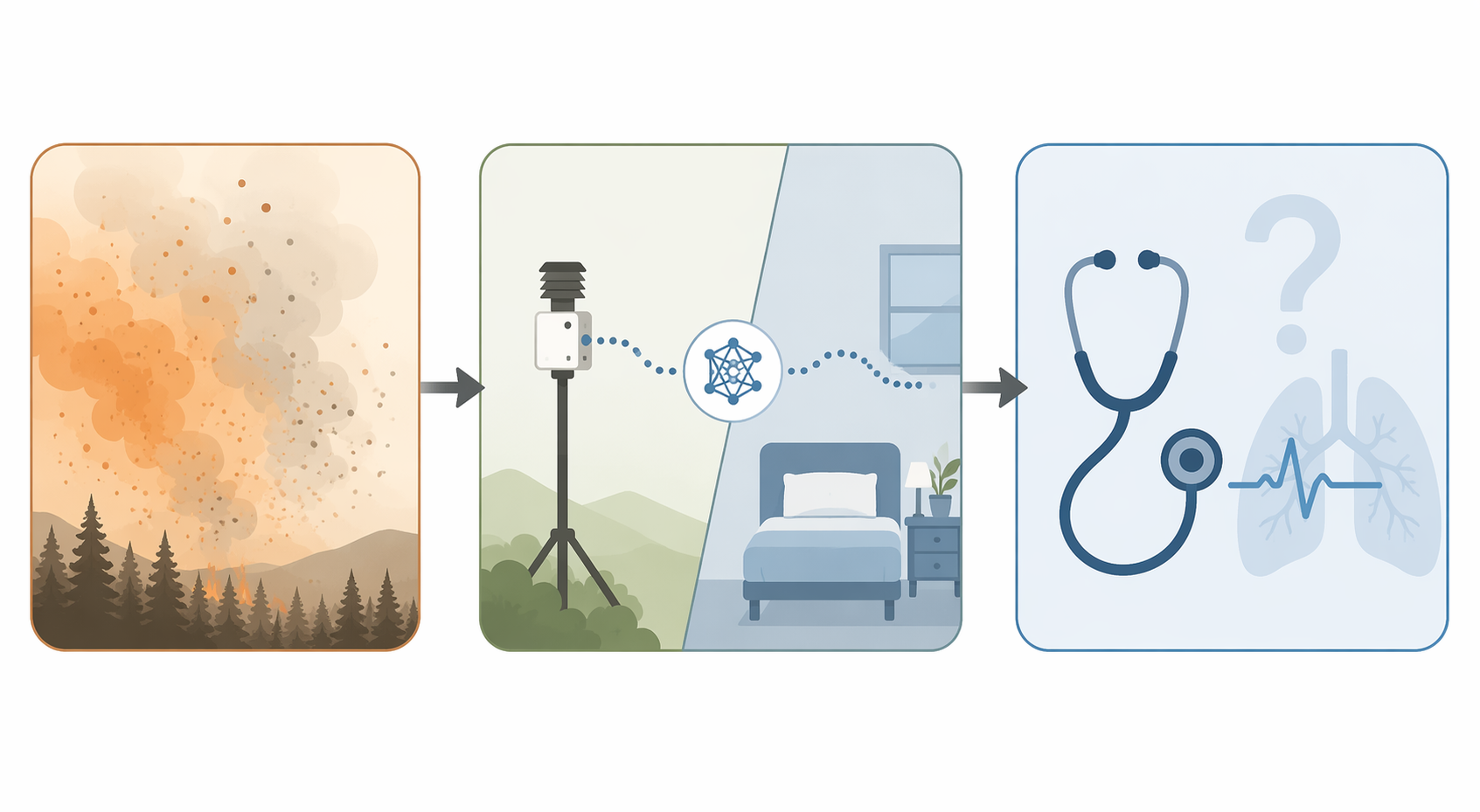
A useful clinical approach would keep the model in its lane. Environmental staff or facility teams may monitor filtration and indoor air conditions. Respiratory therapists may reinforce inhaler access and symptom action plans. Physicians and advanced practice clinicians may adjust care based on the full clinical picture. The AI estimate informs the exposure context; it should not silently become the clinical decision.
Regulation and Deployment Are Still Unsettled
No FDA-cleared AI/ML medical devices specifically for air quality monitoring during smoke events were identified in the available evidence reviewed here. That absence should not be overread as a judgment that such tools are unsafe or useless. It means clinicians should be careful about how the output is represented: general environmental awareness, facility operations support, patient-facing wellness information, or clinical decision support are not the same regulatory posture.
The line becomes especially important if a tool moves from “indoor PM2.5 is elevated” to “increase monitoring for this patient,” “change medication,” or “seek emergency care.” At that point, the model is no longer just estimating the room environment; it is participating in clinical decision-making. Teams considering that path should look closely at how FDA clinical decision support policy distinguishes transparent clinician-reviewable support from software functions that may require more formal oversight, a topic discussed in more detail in FDA CDS guidance for AI tools.
Deployment also needs mundane safeguards that rarely appear in model-performance abstracts: sensor maintenance, calibration drift, missing data, alert fatigue, accountability for reviewing alerts, documentation standards, patient privacy, and equity. A model that works in a monitored facility may not work for patients in under-resourced housing where sensors, filtration, and follow-up are least available. If indoor exposure modeling only improves care for buildings already equipped to measure and respond, it may widen the gap it is meant to close.
The Translational Judgment
ML-predicted indoor PM2.5 during wildfire smoke events is more than a technical convenience. In the BC care-facility study, it aligned more strongly with salbutamol dispensations than outdoor-only PM2.5 measures, and it did so with model performance that is credible enough to take seriously.[1] For respiratory care, that makes indoor exposure prediction a promising input for risk awareness, facility response, patient counseling, and research designs that finally measure the air patients are likely breathing.
It is not yet a patient-level management protocol. The evidence supports cautious incorporation into clinical context, especially for high-risk groups during smoke events, while outcomes trials, validation in other building types, and regulatory clarity catch up. The right standard is neither distrust of AI nor enthusiasm for every new exposure map. It is whether the estimate is closer to the patient’s actual air, and whether acting on it has been shown to help.
References
- Coker et al. (2025), ACS ES&T Air, 2025.
- Aguilera et al. (2021), Nature Communications, 2021.
- Burke et al. (2023), Nature, 2023.
- Comprehensive review of wildfire smoke PM2.5 and respiratory outcomes, PMC.
- Systematic review on AI in air pollution, ScienceDirect.
Comments
Join the discussion with an anonymous comment.